What Is Apron Front Sink? Definition & Guide
Quick Definition
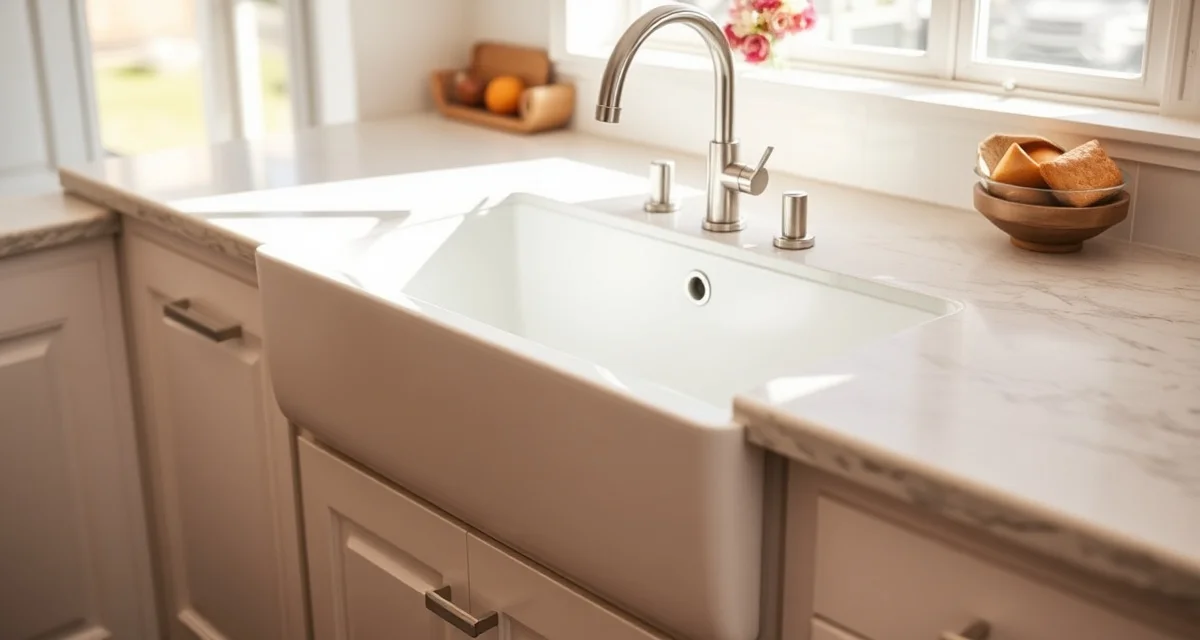
An apron front sink (also called a farmhouse sink) is a large, deep basin sink where the front face of the sink extends past the cabinet face and is visible rather than hidden behind a cabinet door. In countertop fabrication, apron front sinks require a specialized cutout that is open at the front edge - unlike standard undermount or drop-in sinks where the cutout is surrounded by stone on all four sides. This open-front cutout creates unique structural and templating challenges.
TL;DR
- An apron front sink has an exposed front face that extends past the cabinet, visible in the finished kitchen
- Requires a 3-sided cutout (open at the front) instead of the standard 4-sided cutout
- Creates structural challenges because the countertop has no stone support across the front of the sink
- Cabinet must be modified or purchased as a specialty apron-front base to accommodate the sink depth
- Templating must account for the exact sink model, as dimensions vary significantly between manufacturers
- The stone countertop sits on the sink rim (not over it), requiring precise height coordination
- One of the most common sources of templating errors and installation callbacks
How Apron Front Sinks Differ From Standard Sinks
| Feature | Standard Undermount | Apron Front |
|---|---|---|
| Cutout shape | 4-sided (enclosed) | 3-sided (open at front) |
| Front face | Hidden behind cabinet door | Exposed, visible |
| Cabinet requirement | Standard sink base | Specialty apron-front base |
| Stone at front edge | Full stone across front | No stone across front of sink |
| Structural concern | Moderate | Higher - front span unsupported |
| Templating complexity | Standard | Higher - sink must be in place |
Why Apron Front Sinks Are a Fabrication Challenge
Open Front Cutout
A standard undermount sink cutout leaves stone on all four sides, creating a strong frame. An apron front cutout removes the front side entirely, leaving two narrow stone "wings" on either side of the sink that must support the countertop across the full sink width (typically 30-36 inches).
Calculate your material waste savings
See exactly how much slab material and money you could save with optimized cutting layouts.
Try the free Waste CalculatorThese wings are structurally vulnerable. If they're too narrow (less than 3-4 inches), they can crack during installation or later under the weight of dishes, pots, and water.
Sink-First Installation
With most undermount sinks, the fabricator cuts the opening and the sink is attached later. Apron front sinks are different - the sink must be installed in the cabinet before the countertop is templated. The stone sits on top of the sink's rim, so the template must match the exact position of the sink.
This means:
- The sink must be on-site and installed before the templater visits
- If the sink position changes after templating, the countertop won't fit
- Last-minute sink swaps (even to a different model of the same brand) can invalidate the template
Height Coordination
The top of the apron front sink rim must be at exactly the right height relative to the cabinet top so the stone countertop sits level. If the sink is too high, the stone rocks on the rim. If it's too low, there's a gap between the stone and the sink edge.
Templating an Apron Front Sink
Templating for an apron front sink requires more measurements and more attention to detail than a standard sink cutout.
What the Templater Must Capture
- Sink model and exact dimensions - Verify the actual sink matches the specification, not just the brand
- Sink rim height relative to the cabinet top surface
- Sink position within the cabinet opening (centered or offset)
- Distance from the back wall to the back edge of the sink rim
- Wing widths - the stone area on each side of the sink opening
- Front edge alignment - where the stone terminates at the apron face
- Reveal specification - how much of the sink rim is visible (if any) vs. covered by stone
Critical Verification Points
- Confirm the sink is the correct model before templating
- Verify the sink is level and securely mounted
- Measure from the sink - not from the cabinet - since the sink position determines the cutout
- Document whether the stone sits on top of the sink rim or butts up against it
Common Templating Errors
- Templating before the sink is installed - forces the fabricator to work from spec sheets, which don't account for actual installation position
- Using spec sheet dimensions instead of measuring the actual sink - manufacturing tolerances mean the real sink may differ from published specs by 1/8" or more
- Not checking for level - a sink that's installed slightly tilted creates a countertop that doesn't sit flat
- Insufficient wing width - template shows very narrow stone wings that won't support the countertop long-term
Structural Considerations
Minimum Wing Width
The stone wings on either side of an apron front sink cutout should be at least 3 inches wide, preferably 4+ inches. Narrower wings are prone to cracking, especially with natural stone.
Support Beneath the Wings
The cabinet on each side of the sink opening must provide full support beneath the stone wings. If the wings overhang the cabinet framing, they're at risk of breaking under load.
Reinforcement Options
For wider sink installations (36" or larger) or thinner materials, fabricators may recommend:
- Steel rod reinforcement embedded in the stone along the back of the cutout
- Epoxy reinforcement strips on the underside of the countertop
- Additional cabinet support brackets beneath the wing areas
- Thicker material (3cm instead of 2cm) around the sink area
Cabinet Requirements for Apron Front Sinks
Standard sink base cabinets don't work with apron front sinks. The cabinet must have:
- An open or notched front that allows the sink's apron face to extend forward
- Interior reinforcement to support the sink weight (a filled fireclay sink can weigh 100+ lbs)
- Adjustable support system that allows the sink height to be set precisely
- Adequate depth to accommodate the sink basin (typically 9-10 inches deep)
Specialty apron-front base cabinets are available from most cabinet manufacturers. Custom cabinets can also be modified for apron sink installation.
Popular Apron Front Sink Materials
| Material | Weight (Empty) | Durability | Price Range |
|---|---|---|---|
| Fireclay | 80-120 lbs | Very high | $400-$1,500 |
| Cast iron (enameled) | 100-150 lbs | Very high | $300-$1,200 |
| Stainless steel | 25-40 lbs | High | $200-$800 |
| Copper | 40-70 lbs | Moderate (patinas) | $500-$2,000 |
| Composite granite | 30-50 lbs | High | $250-$700 |
The sink material affects the fabrication plan because heavier sinks require more solid cabinet support, which influences the templating reference points.
What is an apron front sink?
An apron front sink (farmhouse sink) has an exposed front face that extends past the cabinet. The visible front panel is the "apron."
Why are apron front sinks harder to fabricate for?
Because the cutout is open at the front (3 sides instead of 4), creating structural challenges. The sink must also be installed before templating, adding coordination requirements.
Does the sink need to be installed before templating?
Yes. The stone sits on the sink rim, so the exact sink position must be known. Templating from spec sheets alone introduces significant error risk.
What's the minimum stone width beside an apron front sink?
At least 3 inches on each side, preferably 4+ inches. Narrower wings are prone to cracking.
Can you install an apron front sink with a 2cm countertop?
It's possible but riskier. 3cm material provides more structural integrity around the open-front cutout. Reinforcement may be needed with 2cm installations.
Do apron front sinks need a special cabinet?
Yes. Standard sink base cabinets must be modified or replaced with a specialty apron-front base that accommodates the sink's extended front face and depth.
How heavy are apron front sinks?
Fireclay and cast iron models typically weigh 80-150 lbs empty. This weight must be supported by the cabinet and any structural reinforcement.
What happens if the sink position changes after templating?
The countertop cutout won't align with the sink. This usually requires a remake or significant modification, costing $1,500-$4,000.
How is the stone attached to the sink?
The stone typically rests on the sink rim and is secured with adhesive (silicone) along the rim contact points. The weight of the stone helps hold it in place.
Can any countertop material work with an apron front sink?
Most materials work, but thicker and stronger materials (3cm granite, quartz) are preferred over thin or brittle options (12mm porcelain) for the structural demands of the open-front cutout.
Should the stone overhang the sink apron at all?
This is a design choice. Some installations have the stone flush with the apron face; others set the stone back slightly. The template must capture whichever specification the customer approved.
How do fabricators prevent cracking around apron front cutouts?
By maintaining adequate wing width, ensuring full cabinet support beneath the wings, using reinforcement (steel rods or epoxy strips) when needed, and routing the cutout corners with a radius rather than sharp angles.
Template Apron Front Sinks With Confidence
Apron front sink installations are one of the most error-prone jobs in countertop fabrication. SlabWise's template verification system checks cutout dimensions, wing widths, and structural requirements before any stone is cut - catching the mistakes that lead to expensive remakes.
Start your 14-day free trial →
Try These Free Tools
- Photo to Template -- Snap a photo of an existing countertop and get an AI-generated DXF template.
- Template Compare -- Upload two templates and see every dimension change highlighted instantly.
- AI Template Verification -- Cross-check your template against manufacturer specs before cutting.
Sources & Further Reading
- National Kitchen & Bath Association - Kitchen Sink Selection Guide
- International Surface Fabricators Association - Sink Cutout and Installation Standards
- Natural Stone Institute - Countertop Sink Integration Best Practices
- Remodeling Magazine - Apron Front Sinks: Design and Installation Considerations