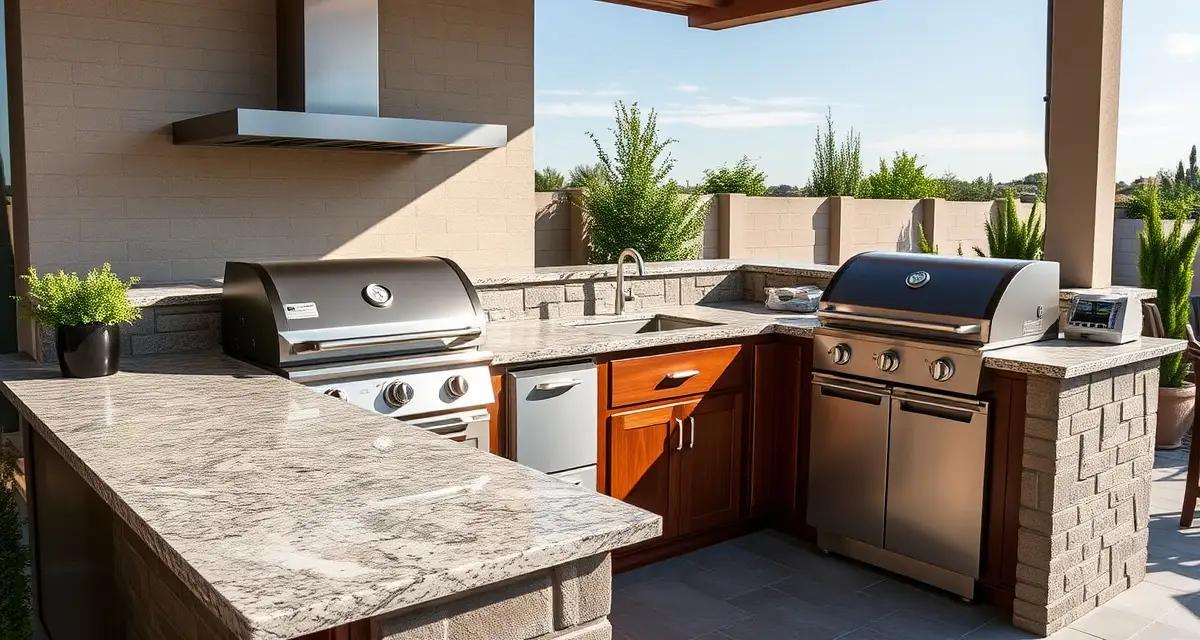
Best Outdoor Countertop Materials in 2026
Quick Definition
Outdoor countertop materials must survive UV exposure, rain, freeze-thaw cycles, extreme heat, and temperature swings that would destroy indoor-only surfaces. The best outdoor countertop materials combine weather resistance with cooking-surface durability, since most outdoor countertops sit adjacent to grills, smokers, and pizza ovens.
TL;DR
- Porcelain slabs (Dekton/Neolith) are the #1 outdoor material - UV stable, heat proof, freeze-thaw resistant
- Granite is the proven natural stone choice for outdoor use with proper sealing
- Concrete offers full customization for outdoor kitchen layouts
- Avoid quartz outdoors - UV exposure yellows the resin binders within 1-2 years
- Avoid marble outdoors - acid rain, tree sap, and pollen cause rapid deterioration
- Outdoor countertops cost 15-30% more to install than indoor due to structural and weather-proofing requirements
- Climate zone determines which materials will perform well long-term
What Outdoor Countertops Must Withstand
Outdoor surfaces face conditions that indoor materials never encounter:
Calculate your material waste savings
See exactly how much slab material and money you could save with optimized cutting layouts.
Try the free Waste Calculator| Environmental Factor | Impact on Countertops |
|---|---|
| UV radiation | Fades colors, yellows resins, degrades sealers |
| Rain and moisture | Penetrates porous surfaces, causes staining and mold |
| Freeze-thaw cycles | Water expands in pores, causing cracks and spalling |
| Direct sunlight heat | Surface temperatures reach 150°F+ in summer |
| Temperature swings | 50-80°F daily variation causes expansion/contraction |
| Wind-blown debris | Sand, grit, and particles scratch surfaces |
| Grill and smoker heat | Radiant heat from cooking appliances reaches 600°F+ |
| Food and grease | BBQ sauces, marinades, and grease splash onto surfaces |
1. Porcelain Slabs - Best Overall for Outdoors
Price: $65-$175/sq ft installed (outdoor) Weather resistance: 10/10 UV stability: Excellent - no fading over decades
Sintered porcelain surfaces like Dekton, Neolith, and SapienStone were engineered for extreme conditions. They replicate the look of marble, concrete, wood, and rust without any of the durability compromises.
Why Porcelain Dominates Outdoors
- UV immune. Colors stay consistent after 10+ years of direct sun exposure.
- Freeze-thaw proof. Near-zero water absorption means nothing penetrates to freeze and crack.
- Heat proof above 1,000°F. Place a hot grill grate or pizza stone directly on it.
- Stain proof. BBQ sauce, red wine, grease, charcoal - nothing penetrates.
- No sealing required. Install it and forget about maintenance.
- Large format slabs cover outdoor kitchen spans with fewer seams.
Outdoor-Specific Drawbacks
- Higher installed cost than granite
- Edges can chip during installation if not handled properly
- Requires fabricators experienced with porcelain - not every shop cuts it
- Dark colors get very hot in direct sun (uncomfortable to touch, though not damaged)
Best Porcelain Products for Outdoor Use
| Product | Manufacturer | Key Feature |
|---|---|---|
| Dekton | Cosentino | Widest color range, 20mm outdoor standard |
| Neolith | TheSize | Ultra-compact sintered surface |
| SapienStone | Iris Ceramica | Italian-made, competitive pricing |
| Lapitec | Breton | Full-body color (not surface printed) |
2. Granite - Best Natural Stone for Outdoors
Price: $55-$200/sq ft installed (outdoor) Weather resistance: 8/10 UV stability: Good - natural minerals resist fading
Granite has served as an outdoor building material for centuries - think monuments, bridges, and building facades. It handles outdoor conditions well when properly sealed and maintained.
Why Granite Works Outdoors
- Natural UV resistance. Mineral-based colors do not fade like synthetic materials.
- Extreme heat tolerance. Hot grill grates and smoker racks will not damage it.
- Hard surface. Wind-blown sand and grit do not scratch granite.
- Proven longevity. Outdoor granite structures have lasted centuries.
Outdoor-Specific Drawbacks
- Requires sealing every 6-12 months in outdoor conditions (more frequent than indoor)
- Porous surface absorbs moisture if sealer breaks down - risk of freeze-thaw cracking in cold climates
- Dark granite gets extremely hot in direct summer sun
- Outdoor conditions break down sealers faster than indoor environments
Best Granite Colors for Outdoor Kitchens
Choose lighter colors to minimize heat absorption:
- Light options: Kashmir White, Colonial White, Alaska White
- Mid-tones: Luna Pearl, Bianco Antico, New Caledonia
- Dark (use with caution in hot climates): Ubatuba, Steel Gray, Absolute Black
3. Concrete - Best for Custom Outdoor Kitchens
Price: $75-$150/sq ft installed (outdoor) Weather resistance: 7/10 UV stability: Moderate - pigments may shift slightly
Concrete countertops allow outdoor kitchen designers to create exactly what they envision - custom shapes, integrated features, and seamless connections to masonry structures.
Why Concrete Fits Outdoor Kitchens
- Fully custom shapes match any outdoor kitchen layout, including curved bars
- Integrated features - drainboards, grease channels, embedded trivets
- Matches masonry - complements stone, brick, and stucco outdoor structures
- Can be cast with fiber reinforcement for crack resistance
- Color pigments match any design palette
Outdoor-Specific Drawbacks
- Hairline cracks are inevitable - outdoor temperature swings accelerate cracking
- Requires sealing every 6-12 months outdoors
- Stains from BBQ sauce and grease if sealer is not maintained
- Heavy - outdoor island structures must be engineered to support the weight
- Freeze-thaw damage possible if water penetrates unsealed areas
Concrete Outdoor Countertop Best Practices
- Use GFRC (Glass Fiber Reinforced Concrete) for thinner, lighter, stronger slabs
- Specify penetrating sealers rather than topical sealers for outdoor use
- Include drip edges to prevent water from pooling against the structure
- Consider concrete overlays on existing structures rather than full-pour slabs
4. Natural Stone Tile - Best Budget Outdoor Option
Price: $25-$75/sq ft installed Weather resistance: 7/10 UV stability: Good
Natural stone tiles (slate, travertine, bluestone, or granite tiles) provide a stone look at a fraction of slab pricing. Tile is particularly practical for large outdoor bar tops and serving areas.
Why Choose Tile Outdoors
- Lower material cost than full slabs
- Easy to replace individual damaged tiles
- Wide material options - slate, travertine, limestone, granite
- DIY-friendly installation for handy homeowners
Outdoor-Specific Drawbacks
- Grout lines trap dirt, mold, and grease
- Uneven surface makes it harder to set down glasses and plates
- Less premium appearance than full slabs
- Tile edges chip more easily than slab edges
5. Stainless Steel - Best for Grill Stations
Price: $80-$200/sq ft installed Weather resistance: 9/10 (marine-grade) UV stability: Excellent
Stainless steel is the professional outdoor cooking surface. Specify marine-grade 316 stainless for coastal environments or standard 304 for inland installations.
Why Stainless Steel Works Outdoors
- Completely waterproof - no sealing, no absorption
- Heat immune - place anything on it
- Sanitary surface - no pores for bacteria
- Matches outdoor appliances for a cohesive look
- Marine-grade 316 resists salt air corrosion
Outdoor-Specific Drawbacks
- Scratches are visible and permanent
- Gets extremely hot in direct sun - can burn skin on contact
- Shows fingerprints and water spots constantly
- Cold, industrial look that does not suit all outdoor styles
- Custom fabrication is expensive
6. Soapstone - Best for Outdoor Fire Features
Price: $75-$160/sq ft installed (outdoor) Weather resistance: 8/10 UV stability: Good
Soapstone's natural heat resistance makes it ideal for surfaces adjacent to fire pits, pizza ovens, and wood-burning grills.
Why Soapstone Works Outdoors
- Naturally non-porous - no sealing required even outdoors
- Extreme heat resistance - withstands direct fire contact
- Freeze-thaw resistant due to zero water absorption
- Develops rich dark patina in outdoor conditions
- Acid resistant - tree sap, bird droppings, and acid rain cause no damage
Outdoor-Specific Drawbacks
- Soft stone - scratches and dents from outdoor use
- Limited color options (gray-green palette)
- Can be hard to source in some regions
- Fewer fabricators work with soapstone
Materials to Avoid Outdoors
Quartz (Engineered Stone)
Quartz resin binders degrade under UV exposure. Within 1-2 years of direct sun, quartz surfaces yellow, fade, and can warp. No quartz manufacturer warrants their product for outdoor use. This is the most common outdoor countertop mistake homeowners make.
Marble
Acid rain etches marble. Tree sap stains it. Pollen discolors it. Freeze-thaw cycles crack it. Marble belongs indoors.
Laminate
Moisture infiltrates laminate seams, causing swelling, warping, and delamination within months of outdoor exposure.
Solid Surface (Corian)
UV exposure causes yellowing and surface degradation. Extreme heat from grills and smokers warps solid surface materials.
Climate Zone Considerations
| Climate | Best Choice | Acceptable | Avoid |
|---|---|---|---|
| Hot & Dry (AZ, NV) | Porcelain, Granite | Concrete, Soapstone | Quartz, Wood |
| Hot & Humid (FL, TX coast) | Porcelain, Stainless | Granite (sealed often) | Concrete, Wood |
| Cold & Wet (Northeast) | Porcelain, Soapstone | Granite (freeze-rated) | Concrete, Tile |
| Mild (CA, Pacific NW) | Any outdoor-rated material | Concrete, Granite | Quartz, Laminate |
| Coastal/Salt Air | Porcelain, Stainless 316 | Soapstone | Granite (salt pits), Concrete |
Outdoor Countertop Installation Requirements
Outdoor installations require additional structural considerations beyond material selection:
Support structure. Outdoor countertops need concrete block, steel frame, or treated lumber bases designed for the weight of stone. A 10-foot granite bar top weighs 350-500 lbs.
Drainage. Countertops must slope slightly (1/8 inch per foot minimum) away from the house to prevent water pooling. Drip edges along the front prevent water from running down cabinet faces.
Overhang protection. Unsupported overhangs for bar seating should not exceed 10 inches for 3cm stone without steel brackets. Wind loads on outdoor overhangs add stress that indoor installations never face.
Seam placement. Outdoor seams are more vulnerable to moisture infiltration. Minimize seams and use outdoor-rated adhesives. Seam placement should avoid areas near grills where thermal cycling is highest.
Fabrication precision. Outdoor kitchens often involve irregular shapes - curved bar tops, L-shaped layouts, and integrated structures. Digital templating captures these geometries accurately, and CNC fabrication produces the complex cuts that outdoor designs demand.
Outdoor Countertop Cost Comparison
For a typical 25 sq ft outdoor kitchen (L-shape with grill cutout and bar overhang):
| Material | Material | Fabrication | Structure | Total |
|---|---|---|---|---|
| Natural Stone Tile | $625-$1,125 | $200-$500 | $500-$1,000 | $1,325-$2,625 |
| Granite | $1,375-$5,000 | $750-$2,000 | $500-$1,000 | $2,625-$8,000 |
| Porcelain Slab | $1,625-$4,375 | $750-$2,000 | $500-$1,000 | $2,875-$7,375 |
| Concrete | $1,875-$3,750 | $800-$1,500 | $500-$1,000 | $3,175-$6,250 |
| Soapstone | $1,875-$4,000 | $750-$1,500 | $500-$1,000 | $3,125-$6,500 |
| Stainless Steel | $2,000-$5,000 | $1,000-$2,500 | $500-$1,000 | $3,500-$8,500 |
FAQ
Can you use quartz countertops outdoors?
No. Quartz manufacturers do not warrant their products for outdoor use. UV radiation breaks down the polymer resin binders, causing yellowing, fading, and warping within 1-2 years. Use porcelain or granite for outdoor countertops instead.
What is the best countertop for an outdoor kitchen?
Porcelain slabs (Dekton, Neolith) are the best overall choice for outdoor kitchens. They resist UV fading, handle extreme heat from grills, survive freeze-thaw cycles, never need sealing, and maintain their appearance for decades. Granite is a strong natural stone alternative.
Do outdoor countertops need to be sealed?
It depends on the material. Granite needs sealing every 6-12 months outdoors. Concrete needs sealing every 6-12 months. Porcelain, stainless steel, and soapstone do not need sealing. Outdoor conditions degrade sealers faster than indoor environments, so plan for more frequent maintenance.
How do outdoor countertops handle freeze-thaw cycles?
Non-porous materials (porcelain, soapstone, stainless steel) handle freeze-thaw with no issues. Porous materials (granite, concrete) can crack if moisture penetrates and freezes inside the stone. Proper sealing prevents this, but missed maintenance creates risk in cold climates.
Can I put a hot grill grate on my outdoor countertop?
On porcelain, granite, soapstone, stainless steel, and concrete - yes. These materials handle extreme heat without damage. Never place hot items on quartz (resin melts), solid surface (burns), or laminate (scorches).
How much does an outdoor kitchen countertop cost?
A typical 25 sq ft outdoor kitchen countertop costs $2,500-$8,000 installed depending on material. Add $500-$1,000 for the structural support underneath. High-end outdoor kitchens with premium porcelain or exotic granite run $8,000-$15,000+ for the countertop portion alone.
Do outdoor countertops increase home value?
Outdoor kitchens consistently rank among the top ROI home improvements. A well-built outdoor kitchen with quality countertops typically recoups 60-80% of its cost at resale. In warm-climate markets (Florida, Texas, California, Arizona), the return can exceed 100%.
What is the lowest-maintenance outdoor countertop?
Porcelain slabs require the least maintenance of any outdoor countertop material - zero sealing, no special cleaners, and resistance to every environmental factor. Stainless steel and soapstone are also very low maintenance. Avoid granite and concrete outdoors if you do not want to commit to regular sealing schedules.
Should outdoor countertops be lighter or darker colors?
Lighter colors stay cooler in direct sun and are generally more comfortable for outdoor dining and cooking. Dark materials (black granite, dark porcelain) can reach surface temperatures above 150°F in summer, making them uncomfortable to touch. If you prefer dark colors, look for covered or shaded installations.
How thick should outdoor countertops be?
Standard 3cm (1.25 inches) thickness works for most outdoor installations. Some porcelain products offer 20mm options that work well outdoors. Avoid thin (12mm or thinner) profiles outdoors unless fully supported - wind loads and impact risks are higher than indoor settings.
Plan Your Outdoor Kitchen
Designing an outdoor kitchen? Use our free calculator to estimate material and installation costs for your outdoor countertop project. Enter your dimensions, choose a material, and get a price range in minutes.
Try the SlabWise Cost Calculator →
Related Guides
- Granite Countertop Cost Guide -- Detailed granite pricing for indoor and outdoor projects
- Porcelain Countertop Cost Guide -- Dekton and sintered porcelain pricing
- Concrete Countertop Cost Guide -- Custom concrete countertop pricing
- Soapstone Countertop Cost Guide -- Soapstone pricing and availability
- Quartz Countertops Cost -- Why quartz isn't recommended outdoors (UV damage)
- Kitchen Countertop Replacement Cost -- Full project replacement costs
- Best Countertop Materials for Bathrooms -- Material picks for wet environments
Try These Free Tools
- Nesting Optimizer -- AI-powered slab layout that maximizes yield considering vein direction and defects.
- Defect Mapping -- Upload a slab photo and AI maps every fissure, pit, and color issue.
- Value Engineering -- Find dollar-quantified suggestions to save material without cutting margin.
Sources & Further Reading
- Natural Stone Institute - Digital Tools for Stone Fabricators
- International Surface Fabricators Association - Technology Solutions for Countertop Businesses
- National Kitchen & Bath Association - Business Management Software Guide
- Remodeling Magazine - CRM Systems for Custom Fabricators