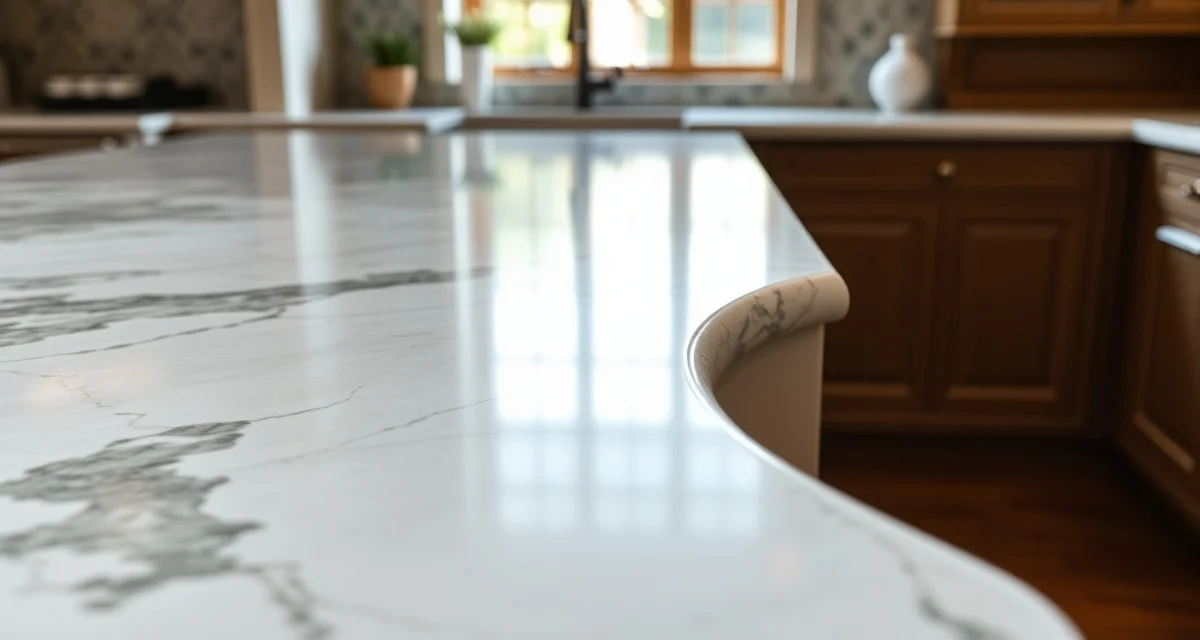
What Is Ogee Edge Profile?
Quick Definition
An ogee edge is a decorative countertop edge profile featuring an S-shaped curve - a concave arc that flows into a convex arc. It is one of the most ornamental standard edge profiles available, commonly associated with traditional, formal, and luxury kitchen designs. The ogee profile adds visual weight and elegance to stone countertops and typically costs $15-$35 per linear foot to fabricate, making it one of the more expensive edge options.
TL;DR
- Ogee is an S-shaped decorative edge with a concave curve flowing into a convex curve
- It costs $15-$35 per linear foot - more than basic profiles like eased or beveled
- Best suited for traditional and formal kitchen designs rather than modern or minimalist spaces
- Works best on 3 cm (1.25") thick stone - the thicker the material, the more dramatic the profile
- Harder materials (quartzite, granite) require more fabrication time and may cost more
- It collects dust and crumbs in the curves - more maintenance than flat edge profiles
- Fabricated using CNC routers or dedicated edge polishing machines with specific tooling
What Ogee Looks Like
The ogee profile consists of two arcs:
Calculate your material waste savings
See exactly how much slab material and money you could save with optimized cutting layouts.
Try the free Waste Calculator- Upper portion: A concave (inward-curving) arc near the top of the edge
- Lower portion: A convex (outward-curving) arc near the bottom of the edge
Together, these create a flowing S-curve that adds depth and shadow to the countertop edge. The profile is typically 1-1.5 inches in total height (on 3 cm material), with the curves taking up most of that space.
Ogee Variations
There are several variations of the ogee profile:
Standard Ogee: The classic single S-curve described above. This is what most people mean when they say "ogee."
Double Ogee: Two S-curves stacked on top of each other, creating a more elaborate profile. This requires thicker material (usually laminated 3+3 cm or 6 cm total) to accommodate both curves.
Ogee Bullnose (or Roman Ogee): An ogee curve at the top that flows into a rounded bullnose at the bottom. Combines the decorative element of the ogee with the soft finish of a bullnose.
Cove Ogee: The ogee shape with a flat cove (step) between the two curves. Creates a more defined, architectural look.
Ogee Edge Cost
Ogee is a premium edge profile. Here is how it compares to other common options:
| Edge Profile | Typical Cost per Linear Foot | Complexity |
|---|---|---|
| Eased (square with slight round) | $0-$10 (often included) | Simple |
| Beveled | $5-$15 | Simple |
| Half bullnose | $10-$20 | Moderate |
| Full bullnose | $10-$25 | Moderate |
| Ogee | $15-$35 | Complex |
| Double ogee | $25-$50 | Very complex |
| Mitered | $30-$60 | Complex (different technique) |
| Laminated ogee | $35-$60+ | Very complex |
For a typical kitchen with 40-50 linear feet of edge: An ogee upgrade adds $600-$1,750 to the project cost compared to an included eased edge. That is a significant line item, so customers should see it called out clearly on their quote.
Factors That Affect Ogee Pricing
Material hardness: Ogee on granite costs more than ogee on marble because the harder material requires more machine time and more polishing passes. Quartzite ogee is the most expensive due to its extreme hardness.
Material thickness: Standard 3 cm stone accommodates a full ogee. On 2 cm material, the profile is compressed and less dramatic - some fabricators will not do ogee on 2 cm stone because it does not look right.
Finish type: Polished ogee requires more polishing steps than honed ogee. Leathered finishes on ogee edges are possible but add more time.
Edge length: Longer runs allow more efficient CNC programming. Short pieces with multiple inside corners require more manual finishing, increasing cost.
How Ogee Is Fabricated
CNC Router Method (Most Common)
Modern fabrication shops produce ogee edges using CNC routers with specific profile bits:
- Rough cut: The CNC router makes the initial S-curve shape using a diamond profile wheel matched to the ogee geometry
- Progressive polishing: A series of increasingly fine polishing pads (50 grit through 3000+ grit) are run along the profile
- Final polish: The edge reaches the desired finish level (mirror polish for polished countertops, fine grit for honed)
CNC production is consistent and repeatable, which is critical when matching ogee profiles across multiple pieces of a countertop.
Dedicated Edge Polishing Machine
Some shops use inline edge polishers that run the stone through a series of profiling and polishing heads:
- The stone passes through a shaping head that cuts the ogee profile
- Multiple polishing heads progressively bring the edge to final finish
- The process is largely automated, with the operator setting the profile parameters
Manual Method (Becoming Rare)
Before CNC was common, ogee edges were cut and polished by hand using grinders and polishing pads. This is still done for:
- Repairs and touch-ups in the field
- Very small shops without CNC equipment
- Custom variations that do not match standard tooling
Manual ogee work is slower and less consistent, which is why CNC fabrication is now the standard.
Fabrication Challenges
Ogee edges present specific challenges for fabricators:
Inside corners: The S-curve profile makes inside corners (like where an L-shaped countertop meets) difficult to match perfectly. CNC machines handle straight runs well, but inside corners often require hand finishing.
Seam matching: At seams, the ogee profile on both pieces must align precisely. Even a 1/16" mismatch is visible because the curved profile creates shadow lines that highlight any offset.
Template accuracy: Because the ogee profile adds visual complexity to the countertop edge, any dimensional errors in the template become more noticeable. Straight edges can hide minor inaccuracies; decorative profiles like ogee cannot. This is where template verification tools like SlabWise add value - catching measurement errors before they become visible edge mismatches.
Which Materials Work Best with Ogee
Not all countertop materials are equally suited for ogee edges:
| Material | Ogee Suitability | Notes |
|---|---|---|
| Granite | Excellent | Takes profile well, holds polish, wide range of types |
| Marble | Excellent | Beautiful results, but softer edges are more vulnerable to chipping |
| Quartzite | Good | Holds profile, but harder to fabricate (more tooling wear, slower) |
| Engineered quartz | Good | Consistent results, but the resin can be sensitive to overheating during polishing |
| Porcelain slab | Poor | Thin material (12-20mm) does not support a full ogee; prone to chipping at thin profile sections |
| Solid surface (Corian) | Good | Easy to fabricate, but the material lacks the visual depth that makes ogee look its best |
| Laminate | Not applicable | Laminate countertops cannot have fabricated stone-style edges |
Best material for ogee: Granite and marble produce the most visually striking ogee edges because the natural stone depth and character enhance the profile's shadow lines.
Design Considerations
Where Ogee Works Well
Traditional kitchens: Ogee is the quintessential traditional edge. It pairs naturally with raised-panel cabinet doors, crown molding, and classical design elements.
Formal dining spaces: On bar tops and dining surfaces in formal settings, ogee adds refinement.
Bathroom vanities: Ogee on marble vanity tops is a classic combination, especially in traditional or transitional bathrooms.
Island edges: Using ogee on the exposed island edge while keeping perimeter counters with a simpler profile creates a focal point without overwhelming the space.
Where Ogee Does Not Work
Modern and minimalist kitchens: The ornamental curves of ogee conflict with clean-line, flat-panel modern designs. Eased, beveled, or mitered edges are better choices for contemporary spaces.
Small kitchens: The visual weight of an ogee edge can make a small kitchen feel heavier and more crowded. Simpler profiles keep the space feeling open.
High-activity areas: The concave section of the ogee profile can collect crumbs, dust, and moisture. In busy kitchens, this means more frequent edge cleaning compared to flat profiles.
Tight budgets: Ogee is one of the most expensive standard edge options. If the budget is tight, the $600-$1,750 ogee premium might be better spent on upgraded material.
Ogee vs. Other Decorative Edges
| Feature | Ogee | Bullnose | Dupont | Beveled |
|---|---|---|---|---|
| Visual complexity | High | Low-moderate | Moderate | Low |
| Design style | Traditional | Versatile | Traditional-transitional | Modern-transitional |
| Fabrication cost | $15-$35/lf | $10-$25/lf | $15-$30/lf | $5-$15/lf |
| Maintenance | Higher (curves trap debris) | Moderate | Moderate | Low |
| Chip risk | Moderate (thin sections) | Low (rounded) | Moderate | Low-moderate |
| 2 cm material | Not recommended | Works | Not recommended | Works well |
Maintenance and Durability
Cleaning Ogee Edges
The S-curve creates small areas where crumbs, water, and cleaning product residue can accumulate. To keep ogee edges clean:
- Wipe along the edge profile (not just across the flat surface) during daily cleaning
- Use a soft toothbrush or detail brush to clean the concave section periodically
- Dry the edge after cleaning to prevent water spots in the curves
- Avoid letting spills dry along the edge where they become harder to clean from the curves
Chip Risk
The convex lower portion of the ogee profile extends slightly outward, making it more vulnerable to impact damage than flat or rounded profiles. Tips for protecting ogee edges:
- Install corner protectors during construction if other trades are still working in the kitchen
- Be careful with heavy pots, pans, and mixing bowls near the edge
- Educate customers that the decorative profile requires slightly more care than a simple eased edge
Small chips in ogee edges can be repaired with color-matched epoxy by a skilled fabricator, but the repair is more visible than on flat edges because the profile creates shadow lines that highlight surface irregularities.
Frequently Asked Questions
How much does ogee edge cost? Ogee edges typically cost $15-$35 per linear foot of countertop edge. For an average kitchen with 40-50 linear feet of finished edge, that is $600-$1,750 additional cost over a basic eased edge.
Is ogee edge outdated? Ogee is not outdated - it is style-specific. It remains the preferred edge for traditional, formal, and classic kitchen designs. It is not appropriate for modern or minimalist kitchens, which favor simpler profiles.
Can you do ogee on 2 cm stone? It is technically possible but not recommended. The thinner material compresses the S-curve, resulting in a less dramatic profile that does not look proportionally correct. Most fabricators prefer 3 cm for ogee.
What is the difference between ogee and Dupont edge? The ogee has a continuous S-curve (concave into convex). The Dupont edge has a flat step at the top followed by a concave curve and a rounded bottom. The Dupont looks more architectural; the ogee looks more flowing and traditional.
Is ogee hard to fabricate? It is more complex than eased or beveled edges but standard work for any shop with CNC equipment. The main challenges are matching the profile at seams and inside corners, and achieving consistent polish across the curved surface.
Does ogee edge chip easily? The thin convex section at the bottom of the profile is somewhat vulnerable to impact. It chips more easily than a full bullnose or eased edge, but less easily than a sharp squared edge. Granite and quartzite hold up better than marble in this regard.
Can I add ogee to existing countertops? It is possible but rare. A stone fabricator would need to bring the countertop back to the shop or use portable edge profiling equipment in the field. The cost is usually not worth it compared to including the edge profile during initial fabrication.
What cabinet style goes best with ogee? Raised-panel cabinet doors in traditional styles pair best with ogee edges. Shaker cabinets can work in transitional designs. Flat-panel (slab) cabinet doors look mismatched with ogee.
How do you pronounce ogee? It is pronounced "OH-jee" with the emphasis on the first syllable. The term comes from the French word "ogive," referring to an S-shaped molding profile used in architecture.
Is double ogee worth the extra cost? Double ogee creates an impressive, high-end look but requires laminated or extra-thick material and costs $25-$50+ per linear foot. It is worth it on luxury projects where the edge is a design focal point, but overkill for most standard kitchens.
Can ogee be done on the backsplash edge? Yes, but a full ogee on a standard 4" backsplash is unusual. A small ogee or partial ogee on the top edge of the backsplash can add a decorative touch without overwhelming the thin piece.
Get Edge Profile Costs Into Your Quotes Fast
Different edge profiles, different prices - and your customers want those numbers quickly. SlabWise's Quick Quote tool lets you build detailed estimates with material-specific edge profile pricing in 3 minutes instead of 20. Standard, ogee, dupont, mitered - every option priced accurately and presented professionally. Start your 14-day free trial.
Try These Free Tools
- Photo to Template -- Snap a photo of an existing countertop and get an AI-generated DXF template.
- Template Compare -- Upload two templates and see every dimension change highlighted instantly.
- AI Template Verification -- Cross-check your template against manufacturer specs before cutting.
Sources & Further Reading
- Natural Stone Institute - Countertop Support Guidelines
- International Surface Fabricators Association - Structural Support Requirements
- National Kitchen & Bath Association - Countertop Installation Standards
- ASTM International - C1526 Standard Specification for Serpentine Dimension Stone