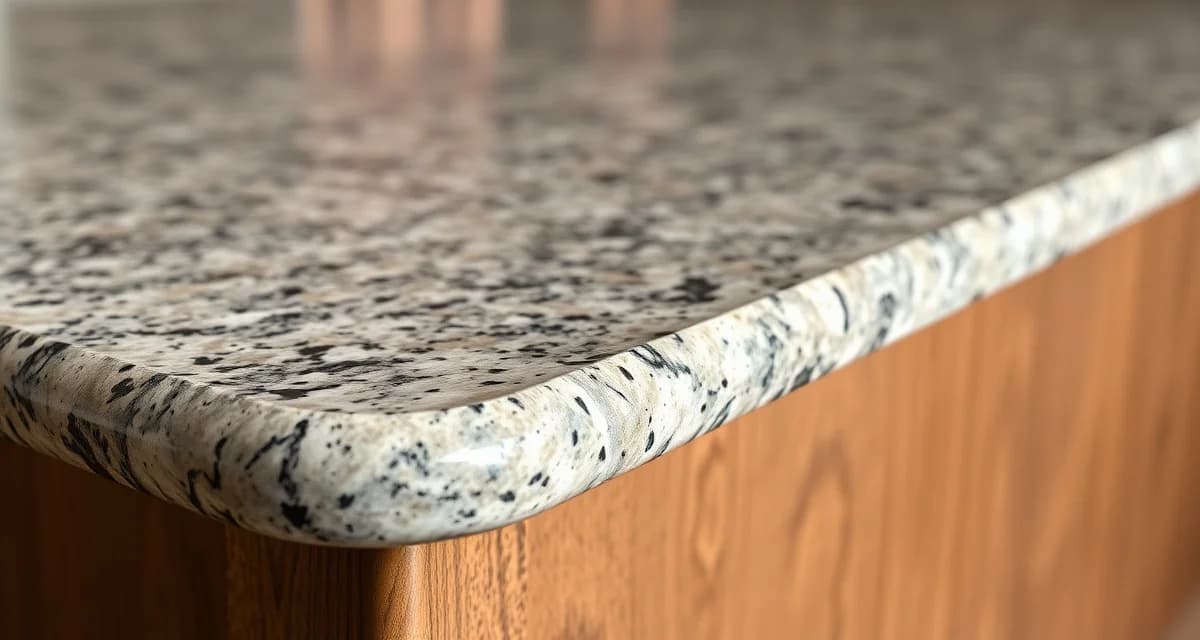
What Is Bullnose Edge?
A bullnose edge is a rounded countertop edge profile where the top edge curves smoothly downward instead of forming a sharp 90-degree angle. It's one of the most common edge treatments in countertop fabrication, available in full-round and half-round variations. You'll find it on granite, quartz, marble, and most other stone surfaces.
TL;DR
- Bullnose is a rounded edge profile - either fully rounded (full bullnose) or rounded on top only (half bullnose)
- It's the most popular edge choice for kitchen and bathroom countertops due to its classic look and safety
- Full bullnose costs $0-$10 per linear foot as an upgrade; half bullnose is often the standard included edge
- The rounded shape reduces chipping risk and eliminates sharp corners - important in homes with children
- Bullnose works on all stone thicknesses (2cm and 3cm) and on granite, quartz, marble, and quartzite
- It pairs well with traditional, transitional, and farmhouse kitchen styles
- Fabricators can produce bullnose edges using CNC machines or hand-held routers with specific profile bits
Full Bullnose vs. Half Bullnose: Key Differences
These two variations look quite different despite sharing a name. Understanding the distinction helps you pick the right one for your kitchen or bathroom project.
Calculate your material waste savings
See exactly how much slab material and money you could save with optimized cutting layouts.
Try the free Waste CalculatorFull Bullnose
A full bullnose (sometimes called a "pencil round" on thinner slabs) rounds both the top and bottom of the slab edge into a continuous half-circle shape. When you run your hand along the edge, you feel a smooth, unbroken curve from the countertop surface down to the underside.
Best for: Kitchens with young children, island seating areas, bathroom vanities where you lean against the edge.
Half Bullnose (Demi-Bullnose)
A half bullnose rounds only the top portion of the edge. The bottom remains flat or slightly squared off. This creates a subtle curve that's less dramatic than the full version but still eliminates the sharp top corner.
Best for: Transitional kitchens, perimeter countertops against walls, areas where you want a softer look without the fully rounded appearance.
| Feature | Full Bullnose | Half Bullnose |
|---|---|---|
| Shape | Completely rounded top and bottom | Rounded top, flat bottom |
| Cost (per linear foot) | $5-$10 upgrade | Often included as standard |
| Visual weight | Thinner appearance | Shows full slab thickness |
| Chip resistance | Excellent - no sharp edges at all | Very good - top edge protected |
| Style match | Traditional, classic | Transitional, modern-traditional |
| Maintenance | Easy to wipe clean | Easy, slight ledge on bottom |
How Much Does a Bullnose Edge Cost?
Edge pricing depends on your fabricator, material, and which variation you choose. Here's what to expect in 2025-2026:
- Half bullnose (demi): $0-$5 per linear foot. Many fabricators include this as their standard edge at no extra charge.
- Full bullnose: $5-$10 per linear foot upgrade over the standard edge.
- For a typical kitchen with 40-50 linear feet of edging, a full bullnose upgrade adds $200-$500 to the total project cost.
Compare that to more complex profiles like ogee ($15-$25/LF) or dupont ($20-$30/LF), and bullnose is clearly the budget-friendly option.
Where Bullnose Works Best (and Where It Doesn't)
Ideal Applications
- Family kitchens: The rounded profile is forgiving on hips, elbows, and little heads. No sharp corners means fewer bruises.
- Kitchen islands with seating: People sit and lean against island edges for hours. A bullnose edge is comfortable against forearms.
- Bathroom vanities: You lean into the vanity every morning. A rounded edge won't dig into your stomach.
- Laundry rooms and utility areas: High-traffic zones where you move quickly and bump into edges frequently.
Where Other Edges May Work Better
- Ultra-modern kitchens: A flat polished (eased) edge or mitered edge fits the clean-line aesthetic better than a rounded profile.
- Waterfall islands: These designs typically use a squared or mitered edge to maintain the continuous slab appearance.
- Thick slab installations (6cm+): Heavily rounded profiles on very thick slabs can look disproportionately bulky.
Bullnose by Material Type
Not every stone behaves the same way when a fabricator shapes the edge. Here's how bullnose performs across the most common countertop materials:
Granite
Granite takes a bullnose edge beautifully. The hard mineral structure polishes to a high gloss on the curved surface, and the rounded shape actually reduces granite's tendency to chip at sharp corners. This is why bullnose has been the default granite edge for decades.
Quartz (Engineered Stone)
Quartz countertops machine very consistently because the material is uniform throughout. A CNC router produces a precise bullnose curve with minimal hand-finishing. The resin binders in quartz also mean the rounded edge is extremely durable - chips are rare.
Marble
Marble is softer than granite (3-5 on the Mohs hardness scale vs. 6-7 for granite), so the bullnose edge helps protect against chipping. The rounded curve also reduces the surface area exposed to etching from acidic spills, though the face of the countertop is still vulnerable.
Quartzite
Natural quartzite (not to be confused with quartz) is extremely hard - often 7+ on the Mohs scale. The bullnose edge requires more time to fabricate on quartzite, which can add to labor costs. But the finished result is highly durable.
How Fabricators Create a Bullnose Edge
Modern countertop shops use one of two primary methods:
CNC Router
Most mid-to-large fabrication shops use CNC (Computer Numerical Control) machines to cut and profile edges. The operator programs the bullnose profile into the machine, and a diamond-tipped router bit traces the edge of the slab, grinding it into the specified curve. CNC produces the most consistent results.
A typical CNC bullnose operation takes 3-5 minutes per linear foot, depending on stone hardness and the finish quality required.
Hand-Held Router
Smaller shops or field installations may use a hand-held angle grinder with a bullnose profiling bit. This approach requires more skill and takes longer but works for on-site adjustments or shops without CNC equipment. Expect 8-12 minutes per linear foot for hand profiling.
After shaping, the edge goes through progressive polishing steps - typically 50-grit through 3000-grit - to achieve the final shine.
Bullnose vs. Other Popular Edge Profiles
| Edge Profile | Cost/LF | Best Style Match | Maintenance | Chip Risk |
|---|---|---|---|---|
| Bullnose (half) | $0-$5 | Traditional, transitional | Low | Low |
| Bullnose (full) | $5-$10 | Traditional, classic | Low | Very low |
| Eased/Flat | $0-$3 | Modern, contemporary | Low | Moderate |
| Bevel | $5-$10 | Transitional | Low | Low |
| Ogee | $15-$25 | Traditional, ornate | Moderate (detail catches crumbs) | Low |
| Mitered | $30-$50 | Modern, waterfall | Low | Low |
| Dupont | $20-$30 | Traditional, formal | Moderate | Low |
Common Misconceptions About Bullnose
"Bullnose is outdated." Not true. It's a classic profile that works across kitchen styles. What goes in and out of fashion are the more decorative edges like ogee and dupont. Bullnose is consistently one of the top 3 requested edges at fabrication shops nationwide.
"You can't get bullnose on thin (2cm) slabs." You can. The curve is just smaller. On a 2cm slab, a full bullnose creates a roughly 20mm-diameter curve. On a 3cm slab, it's about 30mm. Both look proportional to the slab thickness.
"All rounded edges are bullnose." Not quite. A pencil round just softens the corner slightly. A bullnose creates a true half-circle curve. The difference matters when specifying your edge to a fabricator - be specific about what you want.
FAQ
What does bullnose edge look like?
A bullnose edge has a smooth, rounded curve on the front edge of the countertop. Full bullnose forms a complete half-circle, while half bullnose rounds only the top portion and leaves the bottom flat.
Is bullnose edge more expensive?
Half bullnose is typically included as a standard edge at no extra cost. Full bullnose usually adds $5-$10 per linear foot, making it one of the most affordable edge upgrades.
Is bullnose edge outdated?
No. Bullnose remains one of the three most-requested edge profiles at fabrication shops. Its clean, simple curve fits traditional, transitional, and farmhouse styles equally well.
Can you do bullnose on quartz countertops?
Yes. Quartz is one of the easiest materials to profile with a bullnose edge because its uniform composition machines consistently and polishes to a smooth finish.
What is the difference between eased and bullnose?
An eased edge simply rounds the sharp corner slightly - just enough to remove the 90-degree angle. A bullnose creates a full, pronounced curve along the entire edge thickness.
Is bullnose edge good for families with kids?
Absolutely. The rounded profile eliminates sharp corners, which makes it one of the safest edge options for homes with young children. Full bullnose offers the most protection.
Does bullnose edge chip easily?
No. The rounded profile actually distributes impact forces across a curved surface rather than concentrating them at a sharp corner, which makes it one of the most chip-resistant edges available.
What is the most popular countertop edge?
Half bullnose and eased edges are the two most popular profiles. Together, they account for the majority of residential countertop installations in the United States.
Can you change a flat edge to bullnose after installation?
It's technically possible but not recommended. Re-profiling an installed countertop requires on-site grinding that creates significant dust and water, and achieving a polished finish outside a shop environment is difficult. It's far better to specify your edge profile before fabrication.
How do I clean a bullnose edge?
Wipe it with a soft cloth and mild soap or a stone-specific cleaner. The smooth curve has no crevices where dirt can collect, making bullnose one of the easiest edges to keep clean.
Get an Instant Countertop Estimate
Choosing between bullnose and other edge profiles? SlabWise's Quick Quote tool generates a detailed estimate - including edge profile upgrades - in about 3 minutes. Try it free with a 14-day trial and see exactly what your project will cost.
Try These Free Tools
- Cost Calculator -- Get instant countertop cost estimates by material, edge profile, and square footage.
- Compare Materials -- Side-by-side material comparison with pricing, durability, and maintenance ratings.
- Edge Profile Selector -- Browse edge profiles with cost impact and visual previews.