Dupont Edge Countertop: Complete Guide
Last October, Miguel Reyes walked me through his 4,200-square-foot shop in Mesa, Arizona, and pointed to a slab of Taj Mahal quartzite sitting on the bridge saw. "That dupont edge is a $1,400 upcharge on a $9,000 job," he said, pulling up his job costing sheet. "Three years ago I was pricing it at $8 a foot and losing money every time. Now it's $18 a foot and nobody blinks." His margin on edge work alone went from roughly 11% to 38% once he stopped guessing and started tracking.
That story captures everything worth knowing about the dupont edge: it's a profit lever disguised as a decorative detail. Done well, dupont edges sell the slab, justify the premium, and separate your shop from the guy quoting flat rates on Thumbtack. Done poorly, they eat your afternoon in rework and your evening in phone calls.
This article sits in the CNC Fabrication & Edge Profiles cluster, anchored by the Eased Edge hub. For the full operational picture of how edge profiling fits into your broader workflow, the Complete Guide to Countertop Fabrication ties every piece of the fab shop into one view. What follows is the working answer on dupont edge countertops from a shop-floor perspective, pulled from case studies, fabricator surveys, and the kind of conversations that happen at SFA and ISFA events after the booth lights go off.
What a Dupont Edge Actually Is (and Isn't)
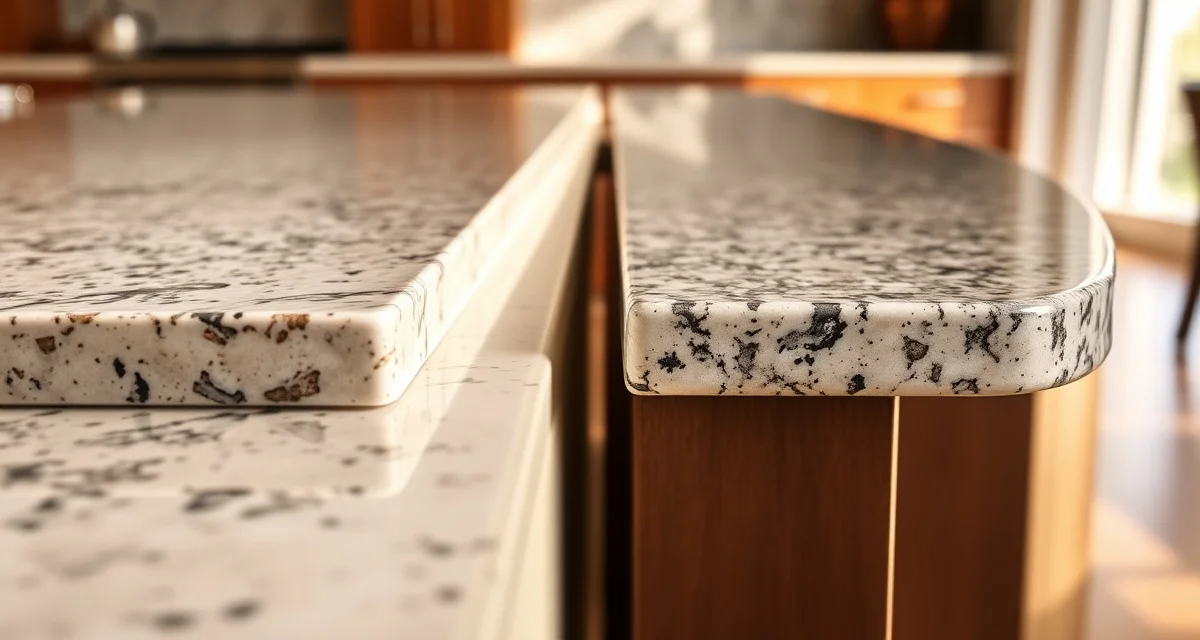
The dupont edge profile is a stepped detail: a flat top surface drops to a small vertical ledge (the "step"), then rounds into a curved lower portion that meets the underside of the slab. Think of it like a staircase in miniature along the front edge of your countertop. Some shops call it a "chiseled edge with a radius," which is technically wrong but close enough that customers understand.
Where people get confused: the dupont is not an ogee. An ogee has an S-curve. The dupont has a defined horizontal shelf before the curve. They look similar in catalog photos, which is why half the homeowners on Houzz use the terms interchangeably. Your job, if you're selling the work, is to have a sample piece in the showroom. Photos create arguments. Samples close them.
The profile runs two passes on CNC (one for the step, one for the radius) or considerable hand work if you're doing it manually. Either way, it's a Tier 3 edge, meaning it carries a real labor cost and should carry a real upcharge.
The Speed and Cost Math
Here's the thing about dupont edges: the gap between CNC and hand profiling is enormous.
Calculate your material waste savings
See exactly how much slab material and money you could save with optimized cutting layouts.
Try the free Waste CalculatorCNC edge profiling on a modern bridge saw with dedicated edge wheels runs 12 to 18 linear feet per hour. Hand profiling the same dupont edge runs 4 to 6 linear feet per hour. On a typical kitchen with 35 linear feet of exposed edge, that's roughly 2 to 3 hours on CNC versus a full day by hand.
The CNC pays for itself on edge work alone inside 18 months for shops doing 30-plus jobs a month. These numbers come from fabricator surveys and shop-floor benchmarking, not napkin math. Your shop will land somewhere in that range, but the range is wide enough to change whether you're making money or subsidizing your customer's kitchen.
Hand profiling still has a place. Tight inside corners, radius returns, and certain natural stones (looking at you, Blue Bahia) sometimes demand hand work. But if you're hand-profiling dupont edges on quartz because you haven't invested in the right tooling, you're leaving real money on the saw.
Pricing the Dupont Edge Without Leaving Margin on the Table
Most shops undercharge for dupont edges. Period. That's my genuinely held opinion after talking to fabricators in a dozen markets.
A clean tiered pricing structure looks like this:
Tier 1: Eased and pencil edges, included in the square-foot price. These are your bread and butter on modern kitchens, and the CNC time is essentially free.
Tier 2: Quarter round and half bullnose, included on residential jobs. Minimal incremental time, keeps the bid competitive.
Tier 3: Ogee and dupont, $12 to $20 per linear foot upcharge. This is where you start making real margin on edge work.
Tier 4: Mitered edges, priced by the job. Too variable for per-foot pricing because the adhesive work, clamping, and seam quality depend heavily on the material.
A CNC-profiled eased edge on quartz costs you almost nothing in incremental time. A hand-profiled ogee with a flame polish on quartzite runs $25 to $45 per linear foot in labor alone. Shops that lump these into one "upgraded edge" line item are handing customers a discount they never asked for.
Regional Differences That Change the Calculation
Cost of labor shifts the whole equation. A fully loaded shop hour in Salt Lake City and a fully loaded shop hour in the Boston metro don't look anything alike, and the dupont edge math moves with it.
Slab mix matters too. Coastal markets lean toward marble-look quartzite and Calacatta-style quartz, materials where dupont edges photograph beautifully and customers expect a premium look. Midwest shops see heavier veined granites and mid-tier quartz where eased edges dominate and the dupont is an occasional upsell rather than a staple.
Then there's the builder question. Markets with concentrated builder customers run dupont edge work as a standardized upgrade package (check the box, add $X to the contract). Markets dominated by direct-to-homeowner shops have more room to sell the edge as a design choice and capture higher margin. Neither approach is wrong. They're different businesses wearing the same apron.
The Edge Profile Library Every Shop Needs
If you don't have physical edge samples in your showroom, you're making your sales process harder than it needs to be. Period.
Every shop should maintain a current edge profile library with sample pieces for the showroom and reference photos in the fabrication file. The profiles that show up most: eased, pencil, half bullnose, full bullnose, ogee, double ogee, dupont, mitered. Each carries its own tooling cost, labor time, and customer perception.
Bullnose has fallen out of fashion in newer construction but still appears in renovations. Ogee and dupont edges command a premium and tend to land in higher-end homes. The dupont specifically reads as "formal but not fussy," which is why it keeps showing up in transitional kitchen designs where the homeowner wants something more interesting than eased but isn't ready for a full ogee.
Keep the samples labeled, keep them clean, and keep them where the customer can touch them. Touch sells edges. Photos don't.
A 30-Day Plan for Getting This Right
If you want to act on any of this, here's the order.
Week one. Observe and measure. Don't change anything. Track how your current dupont edge (and edge work generally) performs across 5 to 10 jobs. Write down three numbers: time per linear foot, callbacks related to edge quality, and what you're actually charging versus what it costs.
Week two. Find the single largest leak. Where is time, money, or quality slipping most? One leak. Not three.
Week three. Implement one change. Train the crew. Update the written process. Communicate clearly.
Week four. Measure the result against week one. Adjust. Document what worked.
Shops that follow this pattern consistently show 10% to 25% improvement on the tracked metric inside the first cycle. Repeat monthly and the gains compound over a quarter. It's boring. It works. (Like most things that actually work in a fab shop.)
Where the Trade Is Heading
The industry is consolidating around fewer software vendors and tighter integrations. Shops that bet on standalone tools five years ago are now dealing with integration headaches. The next five years favor shops with clean data flow between estimating, scheduling, fabrication, and install.
AI is showing up in fabrication-adjacent software, particularly around nesting, scheduling, and document handling. The early returns are real for shops that already have clean data. Shops with messy underlying processes don't get magical results from bolting on AI tools. It's like putting a turbo on an engine with bad rings.
The labor market keeps tightening. Shops that build their edge profiling workflow so it doesn't depend on one person staying for ten years are the ones positioned for the next decade. CNC capability is part of that answer. Documented processes are the rest of it.
A Note on Silica Safety
Anywhere a saw, router, or polisher meets engineered stone, respirable crystalline silica is part of the conversation. OSHA's permissible exposure limit is 50 micrograms per cubic meter of air as an 8-hour time-weighted average. Wet cutting, proper ventilation, and fit-tested respirators are the baseline. Shops cutting corners on silica controls are taking on liability that no margin improvement can offset. This applies whether you're templating, nesting, fabricating, or installing.
Frequently Asked Questions
How long does it take to see results from changing your approach to dupont edge work?
Most shops see measurable change inside 30 to 60 days. The numbers compound through the first two quarters. Shops with stable crews and clean workflows see results faster than shops fighting turnover.
Should a small two-person shop care about dupont edge profiling?
Yes. Smaller shops actually benefit more from getting this right because there's less slack to absorb mistakes. The owner is usually the bottleneck, and any process improvement clears that bottleneck directly.
What's the biggest mistake new shops make on dupont edges?
Treating pricing and process as a one-time decision instead of an ongoing practice. The first version of any system is wrong. The second is better. The fifth is what wins. Shops that keep iterating outperform shops that set and forget.
Do bigger shops handle dupont edge work differently?
The principles are the same; the scale changes. A shop running 30 jobs a month and a shop running 300 jobs a month face the same math, but the tooling and headcount needed look different. Pick the version that fits your stage.
How much should a shop budget for improvements tied to edge profiling?
Budget for time more than dollars. Most meaningful changes cost 5 to 20 hours of owner or manager time to set up and another 2 to 5 hours a month to maintain. Software costs, where they apply, run a few hundred a month for small shops up to a few thousand for larger operations. The ROI based on case studies generally lands well above the cost inside two quarters.
What's the first number I should track?
Pick one speed number and one accuracy number. For most shops, that's some version of turnaround time and some version of error or callback rate. Get those two on a whiteboard. Look at them every Monday morning. Everything else can wait.
Is the dupont edge going out of style?
Not in the foreseeable future. It cycles in and out of peak popularity, but it's been a consistent presence in mid-to-high-end kitchens for decades. As long as transitional design exists (and it shows no sign of leaving), the dupont edge has a home.
Related Reading
Start with the cluster hub on Eased Edge for the full overview of CNC fabrication and edge profiles in a modern fab shop. From there, the Complete Guide to Countertop Fabrication connects every cluster into one workflow.
Inside this cluster, related supporting articles worth reading next:
From adjacent clusters:
- Nesting Software For Small Shops Budget: Complete Guide
- Slab Nesting Tutorial Beginner: Complete Guide
For the broader shop-floor view, the Complete Guide to Countertop Fabrication brings every cluster into one frame, and the Eased Edge hub is where the rest of the CNC fabrication and edge profiles articles live.