Beveled vs Eased Edge: Which to Choose?
Quick Definition
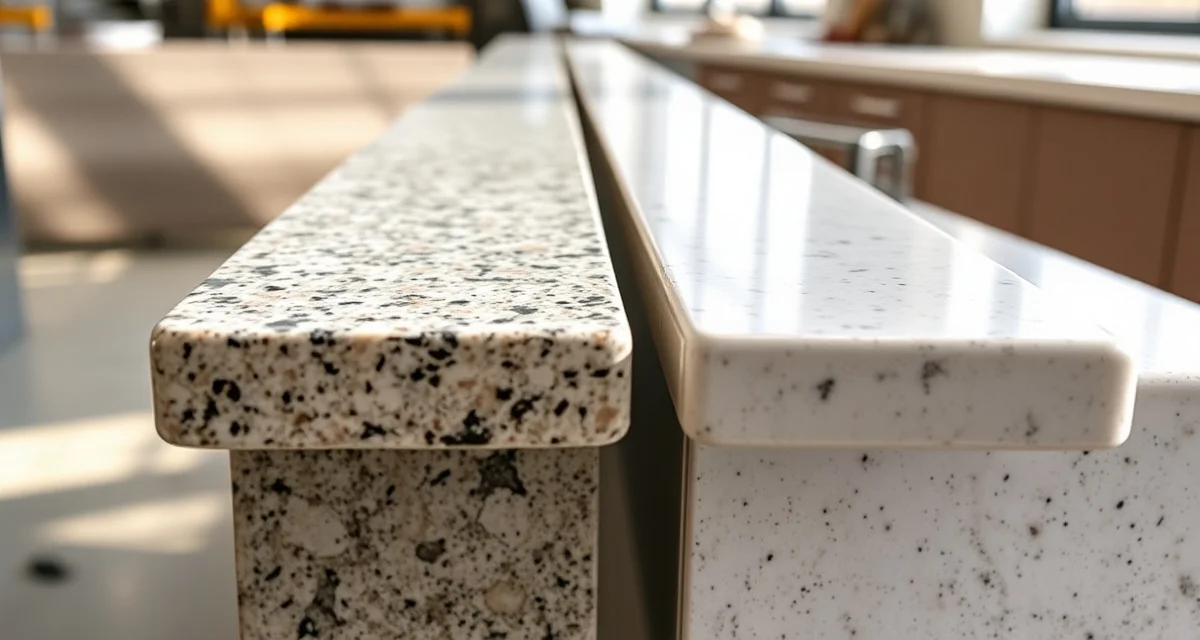
Beveled and eased are two of the most popular modern countertop edge profiles, and they are often confused with each other. An eased edge maintains the slab's flat square face with just a slight rounding on the top and bottom corners to prevent chipping. A beveled edge cuts a small angled flat (typically at 45 degrees) along the top edge, creating a defined chamfer that catches light differently than the main surface. The difference is subtle but visible.
TL;DR
- Both are budget-friendly: eased runs $0-$5/LF, bevel runs $3-$8/LF
- Beveled adds a visible 45-degree chamfer (usually 1/8" to 1/4" wide) along the top edge
- Eased simply softens corners with a tiny radius -- the edge looks essentially flat/square
- Both suit modern and contemporary kitchen designs
- Bevel creates a shadow line that adds subtle visual interest without ornamentation
- Eased is the fastest edge to fabricate; bevel adds only a few seconds per linear foot on CNC
- Both are equally durable in daily kitchen use
- Beveled edges are slightly more popular on quartz; eased edges are popular across all materials
Visual Comparison
| Feature | Beveled | Eased |
|---|---|---|
| Shape | Flat chamfer (angled cut) on top edge | Very slight rounding on corners |
| Angle | 45 degrees typical | No angle -- curved softening |
| Chamfer width | 1/8" to 1/4" | N/A |
| Visual effect | Thin light-catching line along edge | Clean, sharp, minimal |
| Shadow line | Defined line where bevel meets face | Barely visible |
| From distance | Subtle detail visible | Appears flat/square |
Cost Comparison
| Cost Factor | Beveled | Eased |
|---|---|---|
| Edge fabrication per linear foot | $3-$8 | $0-$5 (often included) |
| Typical 40-LF kitchen upcharge | $120-$320 | $0-$200 |
| Fabrication time per linear foot | 1.5-2.5 minutes | 1-2 minutes |
| Tooling requirements | Chamfer bit or CNC program | Standard easing bit |
| Polishing steps | 2-3 grit stages | 2-3 grit stages |
The cost difference between beveled and eased is small enough that many fabrication shops charge the same price for both. Some shops include both profiles in their "standard edge" pricing and reserve upcharges for bullnose, ogee, and other profiles that require more material removal.
Calculate your material waste savings
See exactly how much slab material and money you could save with optimized cutting layouts.
Try the free Waste CalculatorDurability and Maintenance
Performance in Daily Use
These two profiles perform nearly identically in kitchen use:
- Chip resistance: Beveled edges have a marginal advantage because the chamfer reduces the sharpness of the top corner. An impact that might chip an eased edge at the corner may only scuff the bevel's angled face. The difference is small in practice
- Stain resistance: Identical -- edge profile does not affect stone porosity or sealer performance
- Heat resistance: Identical -- edge profile does not affect thermal properties
- Cleaning: Both clean easily. The beveled chamfer does not create a groove deep enough to trap residue
Long-Term Wear
Over 15-25 years of daily use, both profiles show minimal wear. The main visible change is a very slight rounding of sharp transitions from repeated hand and arm contact along the counter edge. This natural softening is less noticeable on already-softened profiles like beveled and eased compared to sharper profiles.
Design and Style Fit
When to Choose Beveled
- Contemporary kitchens with subtle detail: Bevel adds a touch of visual interest without ornamentation, similar to how a thin cabinet rail adds dimension
- Quartz countertops: Major quartz brands (Caesarstone, Silestone, Cambria) frequently showcase beveled edges in marketing materials, making it a natural pairing
- Dark or solid-color stones: On surfaces without heavy veining, the bevel's shadow line provides a clean edge detail that prevents the countertop from looking like a plain slab
- Thick-slab installations: Bevel on 3cm or 6cm mitered edges adds a refined line that emphasizes the thickness
When to Choose Eased
- Ultra-minimalist kitchens: When the design goal is zero visible detail, eased provides the cleanest possible edge
- Veined or dramatic stone: On bold Calacatta marble or dramatic quartzite, an eased edge stays invisible, letting the stone pattern command attention
- Budget optimization: Eased is often included free, keeping the project cost as low as possible
- Waterfall islands: Eased edges on waterfall installations maintain the clean, uninterrupted stone surface that defines the waterfall look
The Hybrid: Eased with a Top Bevel
Some fabricators offer a "top bevel and eased bottom" profile that combines both treatments. The top gets a small chamfer while the bottom corner gets a standard ease. This hybrid costs the same as a full bevel and provides the subtle top detail with a less visible bottom edge.
Fabrication Perspective
Production Efficiency
Both profiles are fast to produce, making them ideal for high-volume shops:
| Metric | Beveled | Eased |
|---|---|---|
| CNC programming complexity | Very low | Lowest |
| Router passes | 1 | 1 |
| Hand finishing | Minimal | Minimal |
| Quality consistency (CNC) | Very high | Very high |
| Quality consistency (manual) | High | High |
| Rejection rate | Very low | Lowest |
For shops processing 6-10+ kitchens per day, eased and beveled edges keep production flowing without bottlenecks. The time saved on edge work compared to bullnose or ogee profiles directly translates to higher daily throughput.
Material Considerations
Both profiles work on all countertop materials without special considerations:
| Material | Beveled | Eased | Notes |
|---|---|---|---|
| Granite | Excellent | Excellent | No issues on any granite type |
| Quartz | Excellent | Excellent | Most common profiles for quartz |
| Marble | Excellent | Excellent | No thin sections to chip |
| Quartzite | Excellent | Excellent | Fast despite material hardness |
| Porcelain | Good | Good | Slight chip risk on porcelain edges regardless of profile |
Pricing Strategy for Shops
Because the fabrication cost difference between beveled and eased is minimal, many shops use a tiered pricing structure:
- Tier 1 (included): Eased and beveled -- no upcharge
- Tier 2 ($5-$15/LF): Half-bullnose, pencil round
- Tier 3 ($10-$20/LF): Full bullnose, chamfer variations
- Tier 4 ($15-$35/LF): Ogee, dupont, decorative profiles
This structure simplifies quoting and client communication while reserving meaningful upcharges for profiles that actually consume more production time.
How Clients Choose Between These Two
Most homeowners cannot tell the difference between beveled and eased edges from a verbal description. The most effective way to help clients choose:
- Show physical samples: Keep sample pieces with each edge profile available in your showroom. Let clients touch and compare
- Show installed photos: Photos of completed kitchens with each profile help clients envision the final result
- Default recommendation: If the client has no strong preference, recommend beveled for quartz and eased for natural stone with prominent veining
What is the difference between beveled and eased edges?
Beveled edges have a small angled cut (chamfer) along the top edge, creating a visible flat surface at 45 degrees. Eased edges simply round the sharp corners with a tiny radius. Beveled has a defined geometric detail; eased is a subtle softening.
Which edge profile is more modern?
Both are modern. Beveled is slightly more detailed (adding a visible line along the edge), while eased is more minimal. In current kitchen design, both are considered contemporary choices. Neither looks dated.
Is there a price difference between beveled and eased?
The price difference is minimal -- typically $0-$3/linear foot. Many fabrication shops charge the same price for both profiles. On a 40-linear-foot kitchen, the maximum difference is roughly $120, and often it is zero.
Can you see the difference from across the room?
At typical kitchen viewing distances (6-10 feet), the difference between beveled and eased is barely noticeable. The bevel's shadow line is most visible when standing directly at the counter. From across the room, both profiles appear clean and minimal.
Which is better for quartz countertops?
Both are popular on quartz. Beveled is slightly more common because quartz manufacturers tend to feature it in marketing, but eased works equally well. The choice is purely aesthetic -- quartz handles both profiles without any technical concerns.
Does beveled edge chip less than eased?
Marginally. The 45-degree chamfer on a beveled edge distributes impact force slightly better than the sharper eased corner. In practice, neither profile chips frequently under normal kitchen use, and the difference is negligible.
What bevel size is standard?
Most fabricators apply a 1/8" to 3/16" bevel as their standard chamfer. Larger bevels (1/4" to 3/8") are available on request and create a more visible edge detail, though they are less common.
Can I get a bevel on both the top and bottom edges?
Yes, a double bevel (top and bottom chamfer) is available and creates a slightly more defined edge appearance. It costs the same as or slightly more than a single top bevel. Double bevels are less common than single top bevels.
Which edge profile do designers recommend most?
Interior designers working on modern and transitional kitchens most frequently specify eased or beveled edges. The choice between them often depends on the designer's personal style and the overall kitchen design direction. Both are considered safe, current choices.
Is pencil edge the same as eased?
No. Pencil edge has a noticeably larger radius along the top edge -- enough to be clearly visible. Eased has a much smaller radius that is barely perceptible. Pencil edge falls between eased and half-bullnose in the profile spectrum.
simplify Quoting for Standard Edge Profiles
Whether your clients choose beveled, eased, or any other edge profile, SlabWise's Quick Quote tool generates accurate estimates in 3 minutes. Set your per-linear-foot pricing for each profile tier, and the system calculates edge costs automatically based on the project layout. Faster quotes mean faster approvals and more jobs per month.
Try These Free Tools
- Cost Calculator -- Compare material costs instantly across different countertop options.
- Compare Materials -- Side-by-side material comparison with pricing, durability, and maintenance.
- Kitchen Visualizer -- Let customers preview countertop materials in their actual kitchen.
Sources & Further Reading
-
Natural Stone Institute - Technology and Software Solutions for Stone Fabricators
-
International Surface Fabricators Association - Fabrication Software and Digital Tools
-
National Kitchen & Bath Association - Technology Integration in Countertop Design
-
Marble Institute of America - Digital Fabrication and Software Standards
Internal Links
- Bullnose vs Eased Edge -- Compare eased with a rounder traditional option
- Pencil vs Eased Edge -- See how pencil round differs from eased
- Countertop Pricing Calculator -- Build quotes with edge profile costs built in
- Ogee vs Bullnose Edge -- Explore more ornate profile options