Ogee vs Bullnose Edge: Which to Choose?
Quick Definition
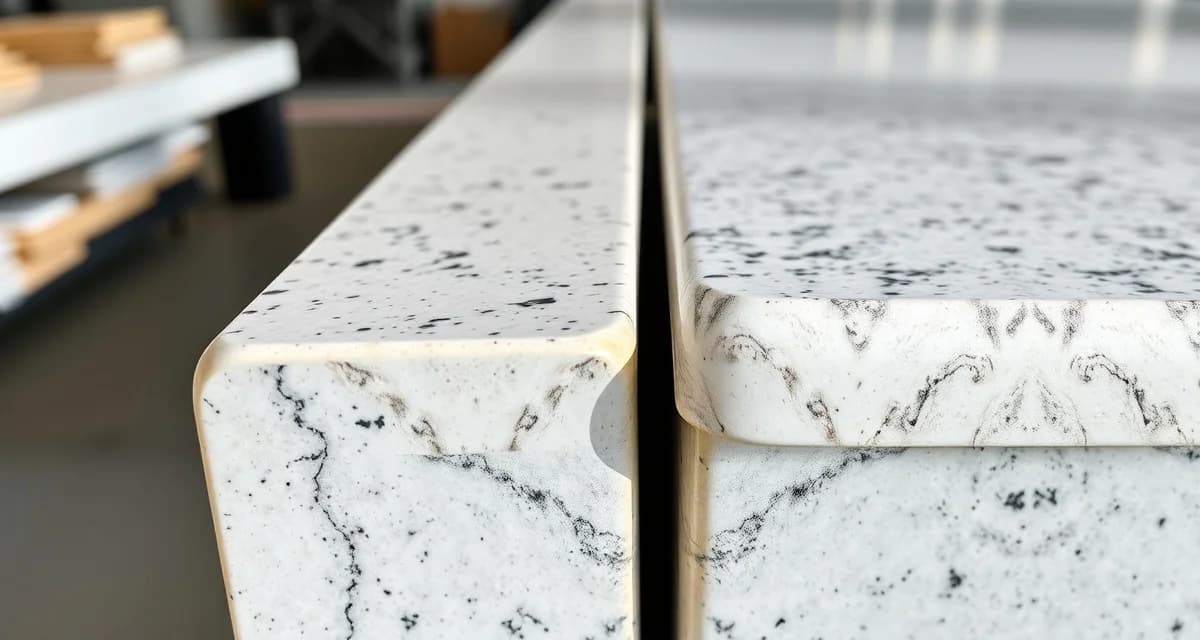
Ogee and bullnose are two popular countertop edge profiles that serve different design intentions. Bullnose creates a simple, fully rounded semicircle along the slab edge. Ogee features an S-shaped curve -- a concave arc flowing into a convex arc -- that adds decorative detail and visual depth. Both are classic profiles, but ogee carries more ornamentation while bullnose stays understated.
TL;DR
- Bullnose costs $8-$15/linear foot; ogee costs $15-$30/linear foot
- Ogee adds 50-100% more fabrication time than bullnose due to the compound curve
- Bullnose fits traditional and transitional kitchens; ogee fits formal, high-end traditional designs
- Ogee is more prone to chipping at the thin concave section, especially on brittle materials
- Bullnose is easier to repair when damage occurs
- Both profiles are declining in popularity relative to simpler edges (eased, beveled), but maintain demand in luxury traditional projects
- Ogee on marble or soft stone requires experienced fabricators -- the profile exposes the stone to breakage risk
Visual Comparison
| Feature | Ogee | Bullnose |
|---|---|---|
| Shape | S-curve (concave + convex) | Full semicircle (180-degree round) |
| Visual complexity | High -- decorative, ornate | Low -- simple, clean curve |
| Shadow lines | Multiple shadow lines from S-curve | Single soft shadow |
| Edge thickness appearance | Slab appears thinner at the concave section | Slab appears uniformly thick |
| Design era | Formal traditional, classic | Versatile traditional to transitional |
Cost Comparison
| Cost Factor | Ogee | Bullnose |
|---|---|---|
| Edge fabrication per linear foot | $15-$30 | $8-$15 |
| Typical 40-LF kitchen upcharge | $600-$1,200 | $320-$600 |
| Fabrication time per linear foot | 6-10 minutes | 3-5 minutes |
| Tooling requirements | Specialized ogee router bit | Standard radius bit |
| Polishing difficulty | High (concave area tricky) | Moderate |
| Breakage risk during fabrication | Higher | Lower |
The ogee profile is one of the more profitable edge options for shops that invest in the right tooling and train their operators. The upcharge to clients is substantial, and experienced fabricators can produce consistent results that justify the premium.
Calculate your material waste savings
See exactly how much slab material and money you could save with optimized cutting layouts.
Try the free Waste CalculatorDurability and Maintenance
Structural Integrity
The ogee profile's S-curve creates a thin section where the concave curve transitions to the convex bulge. This thin area is the profile's structural weakness:
- On granite (Mohs 6-7), the thin section holds up well under normal kitchen use
- On marble (Mohs 3-4), the concave section is more susceptible to impact damage
- On quartz, the engineered resin binder provides good structural support through the thin section
- On quartzite, the extreme hardness makes ogee durable but more difficult to fabricate
Bullnose has no thin section -- the full semicircle maintains consistent material thickness throughout. This makes bullnose structurally stronger and less prone to edge failure.
Chip Repair
When chips occur:
- Ogee: Chips in the concave section are difficult to repair invisibly. The compound curve makes it hard to apply epoxy and shape it to match the profile. Often, the damaged section needs to be ground down and re-profiled
- Bullnose: Chips on the simple curve are easier to fill with color-matched epoxy and sand smooth. The single radius is more forgiving for repair work
Cleaning
Ogee edges collect dust and cooking residue in the concave curve. This is a minor but real maintenance difference -- clients who do not wipe down their counter edges regularly will notice buildup in the ogee's recessed area. Bullnose has no concave areas, making it slightly easier to keep clean.
Design and Style Fit
When to Choose Ogee
- Formal traditional kitchens: Raised-panel cabinets, crown molding, decorative corbels, and ornate hardware call for an edge with similar detail
- High-end residential projects: Ogee communicates craftsmanship and investment -- it is an intentional design choice that signals quality
- Thick slab presentations: Ogee on 3cm material (or laminated 6cm edge) creates a substantial, furniture-like appearance
- Marble feature pieces: An ogee-edged marble island makes a visual statement in luxury kitchens
When to Choose Bullnose
- Transitional kitchens: Bullnose bridges traditional and contemporary without committing to either extreme
- Family-oriented spaces: The simple rounded profile is safe, durable, and does not compete with other design elements
- Material showcase: When the stone itself is the star (exotic granite, dramatic quartzite), bullnose lets the material speak without edge distraction
- Budget-conscious traditional: Clients who want a traditional feel without ogee pricing
Fabrication Perspective
Equipment and Tooling
| Requirement | Ogee | Bullnose |
|---|---|---|
| Router bit type | Specialized ogee bit ($200-$500) | Standard radius bit ($100-$200) |
| CNC capability | Strongly recommended | Helpful but not required |
| Hand finishing skill | High -- concave polishing is demanding | Moderate |
| Polishing pad access | Narrow pads needed for concave | Standard flexible pads work |
| Quality check difficulty | Multiple curve points to verify | Single radius to verify |
Production Considerations
Ogee fabrication adds meaningful time to production schedules:
- CNC programming: Ogee requires precise toolpath programming. The compound curve must be consistent along the entire edge run, including inside corners
- Multiple passes: The deep S-curve typically requires 2-3 router passes to achieve the full profile depth without overloading the bit
- Inside corners: Ogee inside corners (where an L-shaped countertop turns) require hand finishing because router bits cannot reach the full profile into tight corners. Budget 15-30 minutes per inside corner for hand work
- Polishing: The concave section of the ogee profile is the hardest area to polish evenly. Uneven polish shows as a matte band within the S-curve, which is visible on polished dark stones
For shops running tight production schedules, ogee jobs should be scheduled with extra buffer time. Rushing ogee fabrication leads to visible quality issues that clients will notice.
Material-Specific Guidance
| Material | Ogee Suitability | Notes |
|---|---|---|
| Granite | Good | Most granites handle ogee well; avoid very coarse-grained varieties |
| Quartz | Good | Consistent material makes ogee predictable |
| Marble | Fair | Softer stone chips easier at the concave; slower feed rates required |
| Quartzite | Fair | Very hard; increases tool wear and fabrication time significantly |
| Porcelain | Poor | Brittle material tends to fracture at the thin ogee transition |
Market Trends
Ogee and bullnose both peaked in popularity during the early 2000s when traditional kitchen design dominated the residential market. Current trends show:
- Eased and beveled edges now account for 50-60% of residential countertop installations
- Bullnose holds roughly 20-25% market share, primarily in traditional and transitional homes
- Ogee accounts for approximately 5-10% of residential projects, concentrated in luxury traditional renovations and custom homes
- Regional variation: Ogee remains more popular in the Southeast US and Midwest than in coastal markets where modern design trends dominate
For fabrication shops, maintaining ogee capability is still worthwhile because the jobs carry higher margins and differentiate your shop from competitors who only offer simple profiles.
Is ogee edge more expensive than bullnose?
Yes. Ogee typically costs $15-$30/linear foot compared to $8-$15/linear foot for bullnose. On a standard kitchen with 40 linear feet of edge, that means ogee adds $600-$1,200 to the project versus $320-$600 for bullnose.
Which edge profile is more durable?
Bullnose is more durable because its consistent semicircle maintains uniform material thickness. Ogee's thin concave section is more vulnerable to impact damage, particularly on softer stones like marble.
Can I get ogee edge on quartz countertops?
Yes. All major quartz manufacturers support ogee edge profiles. Quartz actually handles ogee well because the engineered material is consistent throughout, with no natural weak points or vein lines that might compromise the thin section.
Is ogee edge outdated?
Ogee is not outdated in the right design context. It remains the correct choice for formal traditional kitchens with detailed cabinetry and ornate finishes. It would look out of place in a modern or minimalist kitchen, but that does not make it outdated -- it makes it style-specific.
How does ogee look on a kitchen island?
Ogee creates a furniture-like appearance on kitchen islands, especially on 3cm or laminated thick-edge presentations. The profile is particularly striking on islands with decorative corbels or turned legs that echo the S-curve detail.
Can any fabrication shop do ogee edges?
Most equipped shops can produce ogee, but quality varies. Shops with CNC routers produce more consistent ogee profiles than shops relying on hand-held routers. Ask to see completed ogee projects in your stone material before committing.
Which profile works better on dark granite?
On dark stones, ogee's compound curve creates more visible shadow lines that add visual interest. Bullnose on dark granite can appear plain. However, any polishing imperfections on ogee are more visible on dark polished surfaces, so quality execution matters more.
Does edge profile affect resale value?
Edge profile has minimal direct impact on home resale value. Buyers care more about countertop material, condition, and overall kitchen design than the specific edge detail. However, an edge profile that clashes with the kitchen style (like ogee in a modern kitchen) can make the space feel dated.
Is double ogee worth the extra cost?
Double ogee (also called French ogee) adds a second S-curve to the profile, creating a more elaborate edge. It costs $25-$45/linear foot -- nearly double the standard ogee. It is worth considering only in high-end traditional kitchens where the additional detail matches the overall design investment.
How long does ogee edge fabrication take per kitchen?
A typical 40-linear-foot kitchen with ogee edges requires 4-7 hours of edge fabrication time, including routing, polishing, and hand finishing at inside corners. This compares to 2-3.5 hours for bullnose and 1-2 hours for eased edges.
Price Edge Profiles Accurately on Every Quote
Whether you are quoting ogee, bullnose, or eased edges, accurate per-linear-foot pricing keeps your margins healthy. SlabWise's Quick Quote tool calculates edge profile costs automatically based on your shop's rates, material type, and linear footage -- generating complete client quotes in 3 minutes.
Try These Free Tools
- Cost Calculator -- Compare material costs instantly across different countertop options.
- Compare Materials -- Side-by-side material comparison with pricing, durability, and maintenance.
- Kitchen Visualizer -- Let customers preview countertop materials in their actual kitchen.
Sources & Further Reading
-
Natural Stone Institute - Technology and Software Solutions for Stone Fabricators
-
International Surface Fabricators Association - Fabrication Software and Digital Tools
-
National Kitchen & Bath Association - Technology Integration in Countertop Design
-
Marble Institute of America - Digital Fabrication and Software Standards
Internal Links
- Bullnose vs Eased Edge -- Compare bullnose with the most popular modern edge
- Dupont vs Ogee Edge -- Compare two ornate traditional edge options
- Countertop Pricing Calculator -- Build quotes with accurate edge profile pricing
- Waterfall vs Mitered Edge -- Explore modern edge treatments for islands