Bullnose vs Eased Edge: Which to Choose?
Quick Definition
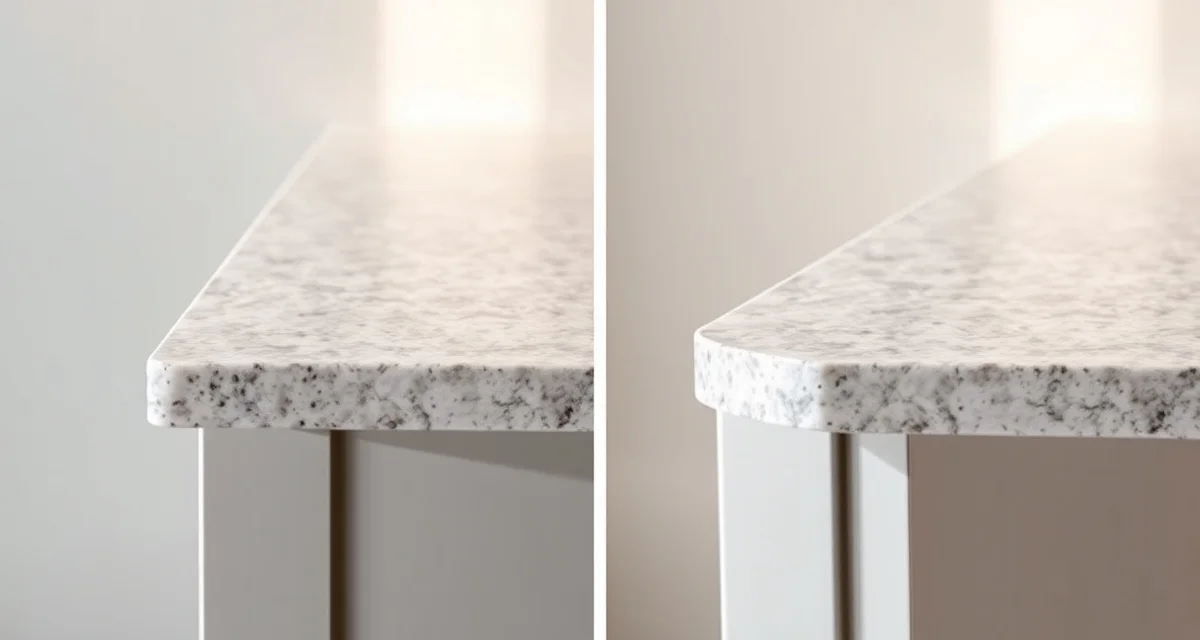
Bullnose and eased are two of the most common countertop edge profiles. Bullnose features a fully rounded edge that curves from the top surface to the bottom, creating a smooth semicircle. Eased (also called straight or flat) keeps the slab's natural square edge but softens the top and bottom corners with a slight round-over to prevent chipping.
TL;DR
- Eased edge is the default, most affordable option -- typically included free or at minimal cost with countertop fabrication
- Bullnose adds $8-$15/linear foot to the project depending on material and shop pricing
- Eased edges suit modern, contemporary, and minimalist kitchen designs
- Bullnose works better in traditional, transitional, and family-friendly kitchens
- Eased edges are faster to fabricate (30-50% less edge processing time than bullnose)
- Bullnose hides minor chips better due to the rounded profile
- Both profiles work on granite, quartz, marble, and quartzite
Visual Comparison
| Feature | Bullnose | Eased |
|---|---|---|
| Shape | Full semicircle (180-degree round) | Square with slightly softened corners |
| Visual weight | Heavier, thicker appearance | Clean, sharp, modern look |
| Edge thickness appearance | Slab appears thicker | Shows true slab thickness |
| Light reflection | Soft, diffused light on curve | Defined shadow line at edge |
Cost Comparison
| Cost Factor | Bullnose | Eased |
|---|---|---|
| Edge fabrication per linear foot | $8-$15 | $0-$5 (often included) |
| Typical 40-LF kitchen upcharge | $320-$600 | $0-$200 |
| Fabrication time per linear foot | 3-5 minutes | 1-2 minutes |
| Tooling wear | Higher (full radius routing) | Lower (minimal removal) |
| Polishing steps | 5-7 grit stages on curve | 2-3 grit stages on corners |
For fabrication shops, eased edges are the most profitable profile relative to time invested. The minimal material removal and quick polishing make eased jobs fast to turn around. Bullnose adds labor time but also adds billable upcharge -- the net profit per linear foot is similar if you price appropriately.
Calculate your material waste savings
See exactly how much slab material and money you could save with optimized cutting layouts.
Try the free Waste CalculatorDurability and Maintenance
Chip Resistance
Eased edges have a slight vulnerability at the top corner. Even with the softened round-over, the relatively sharp geometry can chip if struck by a heavy object (cast iron pan, ceramic dish). The good news: small chips on eased edges are easier to repair with color-matched epoxy because the flat surface provides a stable repair area.
Bullnose edges resist chipping better because the rounded profile distributes impact force across a broader area. However, when a bullnose edge does chip, the repair is more visible because the curved surface makes it harder to blend epoxy smoothly.
Cleaning
Both edges clean easily with standard countertop spray. Bullnose has no sharp corners where grime accumulates, giving it a slight advantage in kitchens where the edge meets a wall or backsplash. Eased edges can collect residue in the small radius where the flat top meets the softened corner, though this is a minor consideration.
Long-Term Wear
Neither profile degrades meaningfully over a kitchen countertop's lifespan (15-30+ years for granite or quartz). Polished bullnose edges may show dulling on the curved surface from years of contact with hands and arms leaning on the counter -- this is more visible on dark stones. Eased edges show wear primarily as minor rounding of the top corner over decades of use.
Design and Style Fit
When to Choose Eased
- Modern and contemporary kitchens: Clean lines and sharp geometry define these styles. Eased edges complement flat-panel cabinets, waterfall islands, and minimalist hardware
- Thick slab look: 3cm (1-1/4") and especially mitered 6cm countertops look best with eased edges that showcase the full slab thickness
- Quartz installations: Most quartz manufacturers design their patterns to look best with an eased or slightly beveled edge
- Budget projects: When the client wants to allocate budget elsewhere (better material, upgraded sink), the eased edge delivers a polished result at minimal cost
When to Choose Bullnose
- Traditional and transitional kitchens: Raised-panel cabinets, crown molding, and ornate hardware pair naturally with the rounded bullnose profile
- Family kitchens: The rounded edge is more forgiving when toddlers bump into it -- no sharp corners
- Bathroom vanities: Bullnose softens the look of smaller vanity counters
- Retrofit projects: Replacing old laminate countertops in traditional homes where the client expects a rounded edge
Fabrication Perspective
Shop Efficiency
For fabricators running production schedules, edge profile choice affects throughput:
| Metric | Bullnose | Eased |
|---|---|---|
| CNC programming time | 5-10 min | 2-5 min |
| Router passes required | 3-4 | 1 |
| Hand finishing needed | Moderate | Minimal |
| Polishing pads per edge | 5-7 grits | 2-3 grits |
| Average time per kitchen (edge work only) | 45-90 min | 15-30 min |
A shop that processes 8 kitchens per day can gain 2-4 hours of daily capacity by steering clients toward eased edges when appropriate. That recovered time translates directly to additional jobs per week.
Material Considerations
Bullnose fabrication removes more material from the slab edge, which matters on certain stones:
- Marble: The rounded bullnose profile can expose subsurface veining or color variations not visible on the face. Inspect edges before committing to bullnose on highly veined marble
- Quartz: Bullnose works well on all quartz brands. The engineered consistency means no surprises in the edge profile
- Granite with large crystals: Stones like Baltic Brown or Black Galaxy may show crystal boundaries on the bullnose curve that are less visible on a flat eased edge
- Quartzite: Hard quartzites require slower feed rates for bullnose routing. Factor this into your production schedule
What About Half-Bullnose?
Half-bullnose (also called demi-bullnose) rounds only the top edge while leaving the bottom square. It splits the difference between full bullnose and eased:
| Feature | Full Bullnose | Half-Bullnose | Eased |
|---|---|---|---|
| Top edge | Rounded | Rounded | Slightly softened |
| Bottom edge | Rounded | Square | Slightly softened |
| Cost per LF | $8-$15 | $5-$10 | $0-$5 |
| Style fit | Traditional | Transitional | Modern |
| Fabrication time | Highest | Middle | Lowest |
Half-bullnose is a good compromise option to present to clients who are torn between the two. It provides the soft top edge for safety while maintaining a cleaner bottom profile.
Which edge profile is more popular right now?
Eased edges have dominated residential countertop projects since approximately 2015, coinciding with the rise of modern and transitional kitchen designs. Industry estimates suggest 50-60% of residential countertops now specify eased or beveled edges, with bullnose accounting for roughly 20-25%.
Does the edge profile affect countertop price significantly?
On a typical 40-linear-foot kitchen, choosing bullnose over eased adds $320-$600 to the total project cost. This is 5-10% of most countertop installations -- noticeable but not a primary budget driver.
Can I get bullnose on 2cm (thin) slabs?
Yes, but the result differs from 3cm bullnose. A full bullnose on 2cm material creates a smaller radius that looks proportionally different. Many fabricators recommend half-bullnose or eased edges on 2cm material for a better visual proportion.
Is eased edge the same as flat polished?
Nearly. Eased edge maintains the flat slab face but softens the top and bottom corners with a small round-over (typically 1/16" to 1/8" radius). A truly flat polished edge with zero radius is sharper and more prone to chipping. Most fabricators apply at least a minimal ease to any "flat" edge.
Which edge profile is better for quartz countertops?
Both work well on quartz. Eased edge is the most popular choice because it matches the contemporary aesthetic that quartz buyers typically prefer. Quartz manufacturers like Caesarstone, Silestone, and Cambria design their marketing imagery primarily with eased edges.
Does bullnose edge make the counter look thicker?
Yes. The rounded profile creates a visual illusion of greater thickness because the curve draws the eye around the edge. On 3cm material, a full bullnose makes the countertop appear 15-20% thicker than the same slab with an eased edge.
Can I change my edge profile after installation?
Not practically. Changing the edge profile requires removing the countertop, re-fabricating the edges, and reinstalling. This is essentially a new fabrication job. Choose your edge profile during the initial selection process.
Which edge is easier to repair if it chips?
Eased edges are easier to repair because the flat surface provides a predictable area for epoxy fill and sanding. Bullnose chip repairs require matching the curved profile, which is more difficult and often leaves a visible patch.
Is bullnose edge safer for kids?
The rounded bullnose profile eliminates sharp corners, making it more forgiving for small children who may bump into the counter edge. Eased edges are not dangerously sharp, but the more defined corner can cause more discomfort on impact.
Do fabricators charge more for bullnose on marble vs. granite?
Some shops charge a material-based premium because marble requires slower feed rates and more careful polishing to avoid heat damage on the curved surface. Expect 10-20% higher edge pricing for bullnose on marble compared to granite or quartz.
Get Accurate Edge Profile Pricing in Your Quotes
Edge profile selection affects fabrication time, tooling costs, and labor allocation. SlabWise's Quick Quote tool factors in edge profile pricing automatically, generating client-ready estimates in 3 minutes that account for linear footage, material type, and profile complexity. Stop undercharging for edge work.
Try These Free Tools
- Cost Calculator -- Compare material costs instantly across different countertop options.
- Compare Materials -- Side-by-side material comparison with pricing, durability, and maintenance.
- Kitchen Visualizer -- Let customers preview countertop materials in their actual kitchen.
Sources & Further Reading
-
Natural Stone Institute - Technology and Software Solutions for Stone Fabricators
-
International Surface Fabricators Association - Fabrication Software and Digital Tools
-
National Kitchen & Bath Association - Technology Integration in Countertop Design
-
Marble Institute of America - Digital Fabrication and Software Standards
Internal Links
- Ogee vs Bullnose Edge -- Compare bullnose with a more ornate option
- Bullnose vs Half-Bullnose Edge -- See the differences between full and half round profiles
- Countertop Pricing Calculator -- Build accurate quotes with edge profile costs included
- Beveled vs Eased Edge -- Compare two popular modern edge profiles