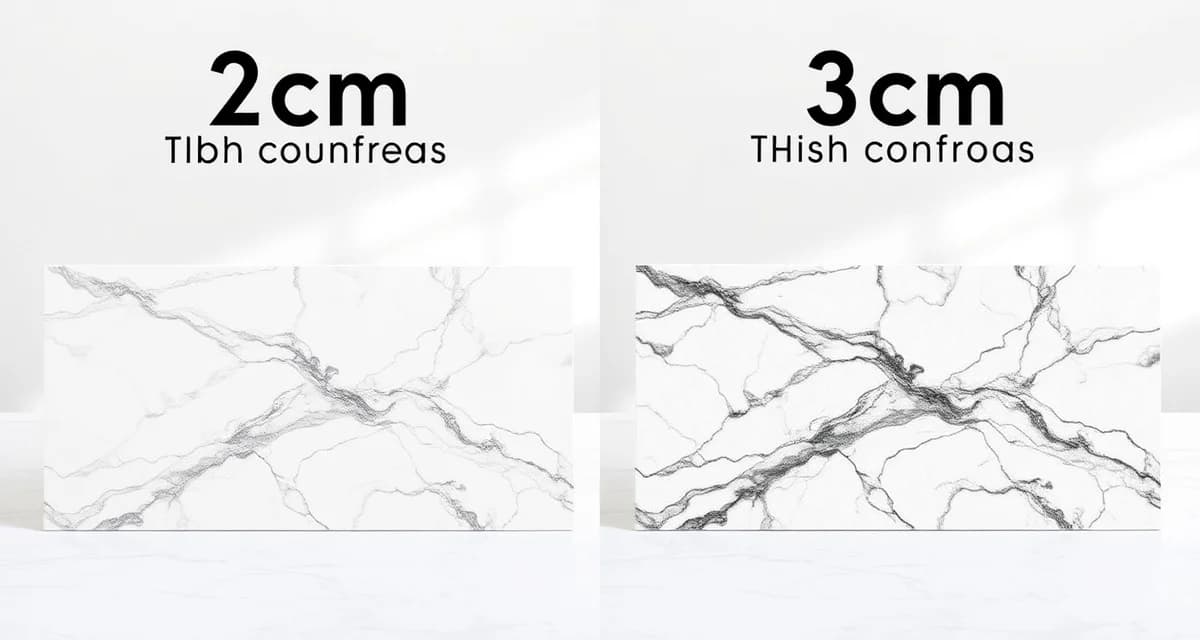
Countertop Thickness: 2cm vs 3cm - Which Should You Choose?
Quick Definition
Countertop thickness refers to the slab depth, measured in centimeters. The two standard options are 2cm (approximately 3/4 inch) and 3cm (approximately 1-1/4 inches). 3cm is the North American standard for kitchen countertops, while 2cm is common in Europe and used in the US primarily for backsplashes, bathroom vanities, and fireplace surrounds. The choice affects cost, structural requirements, aesthetics, and durability.
TL;DR
- 3cm is the standard in the US - most kitchen countertop installations use 3cm material
- 2cm costs 20-30% less per slab but requires plywood support underneath, narrowing the price gap
- 3cm sits directly on cabinets without plywood backing - faster install, cleaner look
- 2cm weighs roughly 35% less - easier to handle and transport, fewer crew members needed
- Edge profiles are more limited in 2cm - thick edges like ogee or dupont need laminated buildup
- Most fabricators prefer 3cm because it's stronger, less breakage-prone, and fewer callbacks
- Vanity tops often use 2cm because spans are shorter and aesthetics favor a thinner profile
Understanding the Measurements
Let's clear up the numbers, because they're not as intuitive as they seem:
Calculate your material waste savings
See exactly how much slab material and money you could save with optimized cutting layouts.
Try the free Waste Calculator| Measurement | Metric | Imperial Equivalent | Common Name |
|---|---|---|---|
| 2cm | 20mm | ~3/4 inch (0.787") | "Two centimeter" or "thin slab" |
| 3cm | 30mm | ~1-1/4 inch (1.181") | "Three centimeter" or "standard slab" |
There's also 1cm (used for wall cladding and some tile applications) and custom thicknesses available from some quartz manufacturers, but 2cm and 3cm cover 95%+ of residential countertop work.
3cm Countertops: The North American Standard
Why 3cm Dominates in the US
The American market settled on 3cm as the default for several practical reasons:
Self-supporting strength. A 3cm slab spans standard cabinet gaps (up to 24 inches for granite, 18 inches for quartz without support) without needing plywood underneath. This saves on material and labor during installation.
Durability at edges. The most vulnerable part of any countertop is the front edge. 3cm gives you 1.25 inches of material thickness to absorb impacts. Drop a cast iron skillet on a 3cm granite edge and you might get a small chip. The same impact on 2cm can cause a crack that runs into the counter surface.
Edge profile options. With 3cm material, fabricators can cut virtually any standard edge profile directly into the stone:
- Eased/straight
- Beveled
- Half bullnose
- Full bullnose
- Ogee
- Dupont
- Cove
With 2cm material, thick profiles like ogee and dupont require laminating two pieces together at the edge, adding labor cost and creating a visible seam line.
No plywood requirement. 3cm sits directly on top of cabinet frames. Skip the step of cutting, fitting, and attaching 3/4" plywood support. That saves 30-60 minutes of installation time per kitchen and eliminates a $100-$200 material cost.
3cm Cost Breakdown
| Component | 3cm Cost |
|---|---|
| Material (granite, per sq ft) | $25-$60 |
| Fabrication | $10-$20/sq ft |
| Installation | $8-$15/sq ft |
| Plywood support | $0 (not needed) |
| Total installed | $43-$95/sq ft |
2cm Countertops: Where They Make Sense
Common 2cm Applications
- Bathroom vanities: Shorter spans (24"-60") don't need 3cm strength
- Backsplashes: Wall-mounted, no structural load
- Fireplace surrounds: Aesthetic application, no impact risk
- Furniture tops: Side tables, desks, accent pieces
- European-style kitchens: Where the thinner aesthetic is preferred
2cm Kitchen Countertops: The Trade-Offs
Using 2cm for kitchen counters is possible but comes with requirements:
Plywood support is mandatory. A sheet of 3/4" plywood must be cut to match the countertop outline and secured to the cabinet tops before the stone goes down. The stone is then adhered to the plywood with silicone or construction adhesive.
The plywood changes the math:
| Component | 2cm Cost |
|---|---|
| Material (granite, per sq ft) | $18-$45 |
| Plywood support material | $3-$5/sq ft |
| Plywood cutting and installation labor | $5-$8/sq ft |
| Fabrication | $10-$20/sq ft |
| Installation | $8-$15/sq ft |
| Total installed | $44-$93/sq ft |
The material savings of 2cm ($7-$15/sq ft less than 3cm) get eaten up by the plywood requirement. On a 40-square-foot kitchen, you might save $0-$200 total - not enough to justify the trade-offs for most homeowners.
Side-by-Side Comparison
| Factor | 2cm | 3cm |
|---|---|---|
| Thickness | 3/4 inch | 1-1/4 inch |
| Weight per sq ft (granite) | 12-13 lbs | 18-20 lbs |
| Needs plywood support | Yes | No |
| Edge profile options | Limited (or requires lamination) | Full range |
| Breakage risk during handling | Higher | Lower |
| Impact resistance (installed) | Moderate | High |
| Slab cost | 20-30% less | Standard pricing |
| Total installed cost | Similar after plywood | Standard |
| Typical use in US | Vanities, backsplash | Kitchens, islands |
| European preference | Kitchens and vanities | Less common |
What Fabricators Need to Know
Handling and Breakage
2cm slabs are more fragile at every stage:
- Transport: More susceptible to vibration damage in delivery trucks
- Shop handling: Crane and A-frame movements risk corner breakage
- CNC cutting: Requires slower feed rates and more conservative tooling pressures
- Installation: More prone to cracking when tightened against uneven cabinets
The industry estimates 2cm breakage rates at 3-5% versus 1-2% for 3cm material. On a shop doing 30 kitchens per month, that's the difference between one broken piece and potentially two or three.
Fabrication Time Differences
Counter-intuitively, 2cm material doesn't always fabricate faster despite being thinner:
- Cutting: Slightly faster saw time (15-20% less material to cut through)
- Edge polishing: Similar time for simple edges; longer for laminated edges
- Sink cutouts: Faster cutting, but more careful handling required
- Overall: Net time difference is minimal - maybe 10-15% faster per piece
The real time difference comes at installation. 2cm with plywood support takes 30-60 minutes longer per kitchen than 3cm direct-mount.
Inventory and Stocking Considerations
Most US distributors stock 3cm as the default. 2cm availability is lower and may require:
- Longer lead times (2-4 weeks for special orders)
- Higher minimum order quantities
- Fewer color options in stock
- Import from different slab suppliers
Fabricators who regularly offer 2cm need to plan inventory carefully or accept longer lead times.
Thickness and Specific Materials
Quartz
Most quartz manufacturers offer both 2cm and 3cm. However, 3cm quartz is especially important because quartz is slightly more flexible than natural stone. Without plywood support, 2cm quartz can deflect (sag) over time when spanning cabinet gaps - a problem that leads to callbacks and warranty claims.
Granite
Granite is the most forgiving material at both thicknesses because of its natural rigidity. 3cm granite spans well and handles impacts. 2cm granite works fine for vanities but needs support for kitchen spans.
Marble
Marble at 2cm is particularly risky for kitchens. It's softer than granite or quartz, more prone to breakage during fabrication, and more susceptible to cracking when installed on uneven surfaces. Most fabricators strongly recommend 3cm for any marble kitchen application.
Quartzite
Quartzite is extremely hard and handles both thicknesses well structurally. However, quartzite can be brittle along its natural cleavage planes. 3cm provides more material to absorb stress at these weak points.
The Mitered Edge: Making 2cm Look Like 3cm (or More)
Some designers want the look of a thick countertop with the weight savings of thinner material. The solution: a mitered edge.
A fabricator cuts 2cm strips and attaches them to the exposed edge of a 2cm countertop at a 45-degree miter joint. The result looks like a 4cm (1.5-inch) slab from the front.
Mitered edge considerations:
- Adds $15-$30 per linear foot of edge
- Requires precise 45-degree cuts and skilled bonding
- Creates a visible seam line on close inspection
- Popular for modern, thick-edge aesthetic
- Available in both natural stone and quartz
FAQ
Is 2cm or 3cm better for kitchen countertops?
3cm is better for kitchen countertops in the US. It doesn't need plywood support, offers more edge profile options, resists impacts better, and the total installed cost is nearly identical to 2cm once you factor in the required plywood backing.
How much cheaper is 2cm than 3cm?
The slab itself costs 20-30% less. However, 2cm requires 3/4" plywood support underneath ($8-$13 per square foot for material and labor), which brings the total installed cost to within $0-$5 per square foot of 3cm.
Can I use 2cm granite for a kitchen island?
You can, but it requires full plywood support and careful handling. Kitchen islands often have long unsupported spans (4-8 feet), making 3cm the much safer choice. A 2cm island without proper support risks sagging or cracking within months.
Why do Europeans use 2cm for kitchens?
European kitchen design traditionally uses thinner countertops with more elaborate edge treatments. European cabinetry is also designed with continuous top support (rather than the open-frame style common in American cabinets), so the 2cm material has full backing.
Does thickness affect countertop durability?
Yes. 3cm material is roughly 50% stronger than 2cm in flexural strength tests. It resists impact damage at the edges, handles weight loads better, and is less likely to crack during installation or from daily use stress.
What thickness should I use for a bathroom vanity?
2cm is the standard for bathroom vanities. Spans are shorter (24"-60" max), there's no heavy appliance impact risk, and the thinner profile looks proportionate to vanity cabinets. Most vanity tops come pre-fabricated in 2cm.
Can I mix 2cm and 3cm in the same kitchen?
It's not recommended. The height difference (approximately 1/2 inch) creates a visible and functional step between sections. If you need to mix thicknesses, plan for a natural break point like an island that's separate from the perimeter counters.
What about 1cm countertop material?
1cm (3/8 inch) material is used for wall cladding, backsplashes, and large-format porcelain applications. It's too thin for any countertop surface without extensive structural support underneath. Some porcelain slab manufacturers offer 1.2cm material designed for counter use with special support systems.
Does thickness affect seam visibility?
Yes. 3cm seams are slightly more visible from the edge view because there's more material showing. However, 3cm seams are easier for fabricators to align properly because the extra thickness provides more bonding surface. Poorly aligned 2cm seams are more obvious because any height mismatch is proportionally larger.
How do I know if my countertop is 2cm or 3cm?
Measure the edge of an exposed section with a tape measure or calipers. 2cm measures approximately 3/4 inch (19-20mm). 3cm measures approximately 1-1/4 inches (29-31mm). If your counter has a laminated edge, measure at a corner or underneath near the wall.
Get the Thickness Right the First Time
Wrong thickness means wrong template, wrong fabrication, and an expensive remake. SlabWise's Template Verification runs a 3-layer check on every measurement - including material thickness specifications - so your shop catches mismatches before the saw starts. That's $1,500-$4,000 saved per avoided remake.
[Start Your 14-Day Free Trial →]
Try These Free Tools
- Cost Calculator -- Compare material costs instantly across different countertop options.
- Compare Materials -- Side-by-side material comparison with pricing, durability, and maintenance.
- Kitchen Visualizer -- Let customers preview countertop materials in their actual kitchen.
Sources & Further Reading
-
International Surface Fabricators Association - Countertop Fabrication Standards
-
National Kitchen & Bath Association - Countertop Selection and Installation Guidelines
-
ASTM International - Standard Specification for Natural Stone Dimension