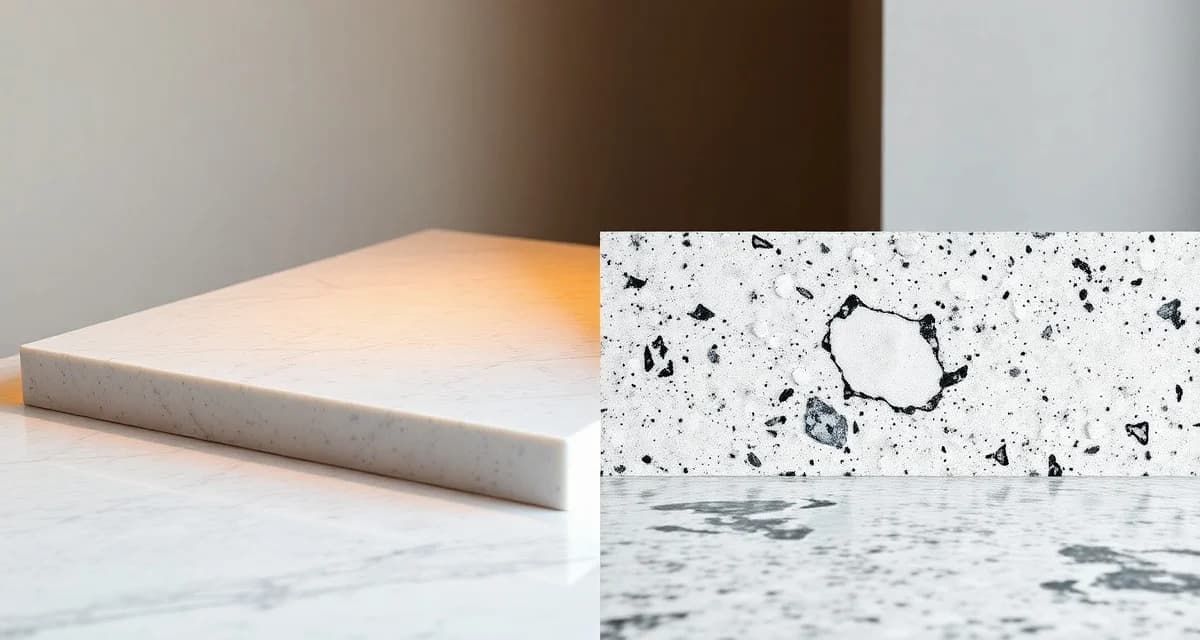
Engineered vs Natural Stone Countertops: A Complete Comparison
Quick Definition: Engineered stone (quartz) is manufactured from ~90-93% ground natural quartz crystals bound with polymer resin, while natural stone (granite, marble, quartzite, soapstone) is quarried from the earth and cut into slabs. Each has distinct advantages: engineered stone offers consistency and low maintenance, while natural stone provides unique patterns and superior heat resistance.
TL;DR
- Engineered stone (quartz): Manufactured, consistent color/pattern, non-porous, no sealing needed, less heat resistant
- Natural stone (granite, marble, quartzite): Quarried, every slab unique, porous (most need sealing), more heat resistant
- Cost: Both range from $50-$150+ per square foot installed -- price depends more on specific variety than category
- Durability: Quartz resists stains better; granite and quartzite resist heat better
- Appearance: Natural stone has more variation; quartz offers more predictable colors
- Maintenance: Quartz needs virtually no maintenance; most natural stone needs annual sealing
- Market share is roughly split 50/50 between quartz and natural stone in US residential kitchens
What Is Engineered Stone?
Engineered stone -- marketed under brands like Caesarstone, Silestone, Cambria, MSI Q, and Viatera -- is a manufactured composite material. Here's what's inside:
Calculate your material waste savings
See exactly how much slab material and money you could save with optimized cutting layouts.
Try the free Waste Calculator| Component | Percentage | Purpose |
|---|---|---|
| Ground quartz crystals | 90-93% | Hardness and structure |
| Polymer resin (polyester/acrylic) | 7-10% | Binds crystals together |
| Pigments and additives | <1% | Color and pattern |
The manufacturing process involves combining these ingredients, pressing them into slabs under intense vibration and vacuum, then curing the resin with heat. The result is a dense, non-porous surface with controlled color and pattern.
Engineered Stone Pros
- Non-porous: Doesn't absorb liquids, resists staining without sealing
- Consistent: What you see in the showroom sample closely matches the installed slab
- Low maintenance: Wipe clean with soap and water, no sealing needed
- Wide color range: Available in colors and patterns not found in nature
- Uniform thickness: Factory-controlled dimensions
Engineered Stone Cons
- Heat sensitive: Resin softens at ~300degF; hot pans can cause damage
- UV sensitive: Direct sunlight can cause yellowing or fading over time (not ideal for outdoor use)
- Not unique: Multiple slabs look nearly identical
- Harder to repair: Chips and cracks are difficult to fill invisibly
- Silica dust concern: Fabrication creates hazardous respirable silica, requiring strict dust controls
What Is Natural Stone?
Natural stone countertops are cut from rock quarried from the earth. The main types used for countertops:
Granite
- Composition: Igneous rock (quartz, feldspar, mica)
- Hardness: 6-7 on Mohs scale
- Porosity: Low to moderate (needs sealing every 1-2 years)
- Heat resistance: Excellent (handles 900degF+)
- Cost: $45-$200 per SF installed
Marble
- Composition: Metamorphosed limestone (calcite)
- Hardness: 3-5 on Mohs scale
- Porosity: Higher (needs regular sealing)
- Heat resistance: Good for heat, but stains and etches easily
- Cost: $50-$200+ per SF installed
Quartzite
- Composition: Metamorphosed sandstone (nearly pure quartz)
- Hardness: 7-8 on Mohs scale
- Porosity: Low (some varieties need minimal sealing)
- Heat resistance: Excellent
- Cost: $60-$200+ per SF installed
Soapstone
- Composition: Metamorphic rock (talc, chlorite, pyroxenes)
- Hardness: 1-3 on Mohs scale (soft but durable)
- Porosity: Non-porous
- Heat resistance: Excellent (used historically around wood stoves)
- Cost: $70-$150 per SF installed
Natural Stone Pros
- Every slab is unique -- genuine one-of-a-kind patterns
- Heat resistant -- granite and quartzite handle hot pans
- UV stable -- natural stone doesn't fade in sunlight
- Repairable -- chips can be filled, surfaces can be re-polished
- Timeless -- natural stone has been used in high-end construction for centuries
Natural Stone Cons
- Requires sealing (except soapstone) -- annual maintenance for most
- Porous -- can absorb liquids if not sealed properly
- Variable -- the installed slab may differ from the showroom sample
- Can chip or crack -- especially thin overhangs or around cutouts
- Marble etches -- acidic substances (lemon juice, wine, vinegar) leave dull marks on marble
Head-to-Head Comparison
| Factor | Engineered (Quartz) | Natural Stone |
|---|---|---|
| Stain resistance | Excellent (non-porous) | Good when sealed; varies by type |
| Heat resistance | Poor (~300-400degF) | Excellent (900degF+) |
| Scratch resistance | Good (7 Mohs) | Varies (granite 6-7, marble 3-5, quartzite 7-8) |
| Sealing required | No | Yes (annually for most) |
| UV resistance | Poor (can yellow) | Excellent |
| Pattern uniqueness | Low (manufactured) | High (every slab different) |
| Color options | Very wide | Limited to natural colors |
| Repairability | Difficult | Good (re-polishing, filling) |
| Outdoor use | Not recommended | Yes (granite, quartzite) |
| Resale value | High | High |
| Cost range | $50-$150/SF | $45-$200+/SF |
| Typical lifespan | 25-50+ years | 50-100+ years |
Which Is Better for Specific Situations?
Choose Engineered Quartz If:
- You want low-maintenance countertops (no sealing)
- You prefer a consistent, predictable color
- You want white or light colors that resist staining (white marble stains; white quartz doesn't)
- Your kitchen doesn't get direct sunlight on the counters
- You're OK using trivets for hot pans
Choose Natural Stone If:
- You want a truly unique slab pattern
- You do heavy stovetop cooking and place hot pans directly on the counter
- The countertop will get direct sunlight (outdoor kitchen, sunroom)
- You prefer the depth and movement of natural material
- You're planning an outdoor kitchen
- You don't mind annual sealing
For the Look of Marble Without the Maintenance:
This is one of the top reasons people choose quartz. Marble-look quartz (like Caesarstone Calacatta Nuvo or Cambria Brittanicca) mimics marble veining without the etching, staining, and sealing requirements. For many homeowners, this is the sweet spot.
What Fabricators Need to Know
From a fabrication perspective, the two materials handle differently:
| Fabrication Factor | Engineered Quartz | Natural Stone |
|---|---|---|
| Cutting | CNC or bridge saw with water | Bridge saw with water |
| Dust hazard | Very high silica content | Lower silica (varies) |
| Edge polishing | Requires specific pads | Standard stone polishing |
| Seam adhesive | Color-matched epoxy | Color-matched epoxy |
| Weight (3cm) | ~20 lbs/SF | ~18-22 lbs/SF |
| Breakage risk | Moderate (resin adds flexibility) | Varies (granite is brittle) |
The biggest fabrication difference is the silica dust hazard. Quartz generates extremely high levels of respirable crystalline silica during cutting and grinding. OSHA's silica standard (29 CFR 1926.1153) requires wet cutting, dust collection, exposure monitoring, and medical surveillance for workers. This is a serious workplace safety issue that has led to increased regulation of quartz fabrication shops.
For shops processing both materials, tools like SlabWise help manage material-specific workflows, ensuring the right safety protocols and cutting parameters are applied to each job.
Market Trends
The US countertop market has shifted significantly over the past decade:
- 2010: Natural stone dominated residential countertops (~65% market share)
- 2015: Quartz gained rapidly, reaching about 40% of new installations
- 2020-2024: Roughly even split, with quartz at ~45-50% and natural stone holding steady
- Emerging trend: Large-format porcelain slabs (Dekton, Neolith) are a growing third option
The trend toward quartz has been driven by its low maintenance and the popularity of marble-look designs. Natural stone retains strong demand among homeowners who value uniqueness and heat resistance.
FAQ
Is quartz or granite more expensive? They overlap significantly in price. Standard granite runs $45-$90/SF installed; standard quartz runs $55-$100/SF installed. Premium versions of both can exceed $150/SF. The specific variety matters more than the category.
Does quartz look fake? Modern quartz has come a long way. High-end quartz closely mimics marble and natural stone patterns. However, a trained eye can usually tell -- quartz patterns repeat more and lack the depth of natural stone.
Is granite outdated? No. Granite remains one of the top countertop choices. What's dated is specific granite colors and patterns popular in the 2000s (like Santa Cecilia or Ubatuba). Current granite trends favor whites, dramatic veining, and exotic varieties.
Which countertop adds more home value? Both quartz and granite are considered premium countertop materials by real estate professionals. Neither provides a clear advantage in home value over the other.
Can you mix engineered and natural stone in the same kitchen? Absolutely. A common design is quartz on perimeter counters (for easy maintenance near the sink) and natural stone on the island (as a design statement).
Does quartz chip easier than granite? They're similar in chip resistance. Quartz is slightly more flexible due to the resin binder, which can help it absorb minor impacts. However, once chipped, quartz is harder to repair invisibly.
Which lasts longer? Natural stone has a longer theoretical lifespan (50-100+ years vs. 25-50+ for quartz). However, both will outlast most kitchens. You'll likely remodel before either material wears out.
Is quartzite the same as quartz? No. Quartzite is a natural stone (metamorphosed sandstone). Quartz (engineered stone) is a manufactured product. The similar names cause frequent confusion. Quartzite is harder, more heat resistant, and more expensive than quartz.
Which is easier to fabricate? Both require CNC or bridge saw cutting. Quartz generates more hazardous dust and requires stricter safety controls. Granite can be more unpredictable due to natural fissures and variations.
Are there environmental differences? Natural stone is quarried (environmental impact from mining). Quartz is manufactured (energy-intensive process plus resin chemicals). Neither is clearly "greener" -- both have environmental trade-offs.
Help Customers Choose With Confidence
Fabricators: the engineered vs. natural stone question is one of the first things customers ask, and it often leads to long phone conversations. SlabWise's Customer Portal provides side-by-side material comparisons so homeowners can self-educate before contacting your shop -- cutting inquiry calls by up to 70%.
Try These Free Tools
- Cost Calculator -- Compare material costs instantly across different countertop options.
- Compare Materials -- Side-by-side material comparison with pricing, durability, and maintenance.
- Kitchen Visualizer -- Let customers preview countertop materials in their actual kitchen.
Sources & Further Reading
-
International Surface Fabricators Association - Countertop Fabrication Standards
-
National Kitchen & Bath Association - Countertop Selection and Installation Guidelines
-
ASTM International - Standard Specification for Natural Stone Dimension