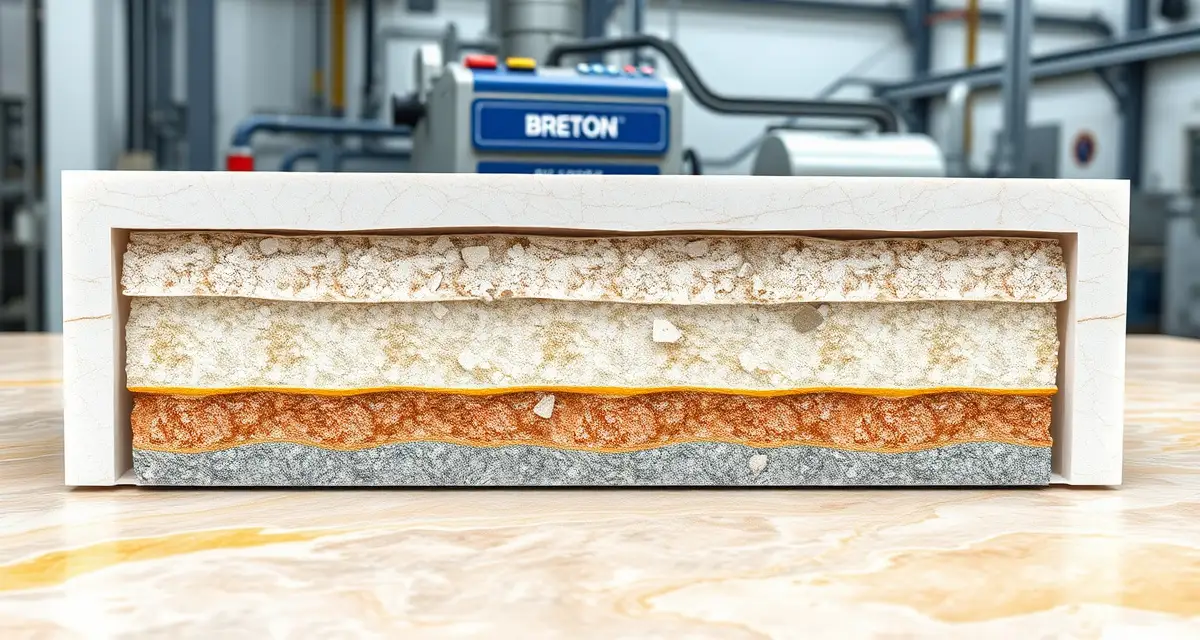
How Is Quartz Manufactured?
Quick Definition: Quartz countertops are manufactured by combining roughly 90-93% ground natural quartz crystals with 7-10% polymer resin binder and pigments. The mixture is compacted under intense vacuum and vibration (the Breton process), then cured with heat to create a dense, non-porous slab. The process was invented in 1963 by the Italian company Breton S.p.A. and is the foundation for virtually all engineered quartz produced today.
TL;DR
- Quartz countertops are manufactured composites, not natural stone
- The recipe: ~90-93% ground quartz + 7-10% polyester resin + pigments
- The Breton process (vacuum compaction + vibration) is used by nearly all manufacturers
- Manufacturing takes place in large factories -- not quarries
- A single production line can produce 100-300+ slabs per day
- The process was invented in Italy in 1963 and licensed worldwide
- Major manufacturers include Caesarstone (Israel), Cosentino/Silestone (Spain), Cambria (USA), and many Chinese producers
- The finished slab is non-porous, consistent in color, and doesn't require sealing
- Quartz manufacturing generates respirable crystalline silica dust -- a significant occupational health concern during both production and fabrication
The Raw Materials
Ground Quartz Crystals (90-93%)
The primary ingredient is natural quartz -- one of the most abundant minerals on Earth. Quartz crystals (silicon dioxide, SiO2) are sourced from quarries, then crushed and ground to specific particle sizes:
Calculate your material waste savings
See exactly how much slab material and money you could save with optimized cutting layouts.
Try the free Waste Calculator| Particle Size | Purpose |
|---|---|
| Coarse (2-5mm) | Creates visible crystal appearance and structural mass |
| Medium (0.5-2mm) | Fills gaps between coarse particles |
| Fine (0.1-0.5mm) | Creates density and smooth surface |
| Powder (<0.1mm) | Fills microscopic voids for non-porosity |
The blend of particle sizes is carefully controlled. Different size ratios produce different visual effects -- more coarse particles create a granular, granite-like look; more fine particles create a smoother, more uniform appearance.
Polymer Resin (7-10%)
The binder is typically unsaturated polyester resin, though some manufacturers use acrylic or a hybrid. The resin serves several functions:
- Bonds the quartz particles into a solid mass
- Fills voids to create a non-porous surface
- Provides slight flexibility (reducing brittleness compared to natural stone)
- Carries pigments for color
Pigments and Additives (<1%)
Metal oxides and other pigments create the desired color. Additional additives may include:
- UV stabilizers (to reduce yellowing from sunlight exposure)
- Coupling agents (to improve the bond between quartz and resin)
- Mirror chips or metallic particles (for sparkle effects)
- Recycled glass or other materials (for specialty appearances)
The Manufacturing Process (Step by Step)
Step 1: Raw Material Preparation
Quartz rock is sourced from mines, crushed, and sorted by particle size using screens and classifiers. The sorted particles are washed to remove impurities and dried.
Step 2: Mixing
The quartz particles, resin, pigments, and additives are combined in large industrial mixers. The proportions are precisely measured to achieve the target color and performance. For veined or patterned designs, multiple color batches are prepared.
Step 3: Distribution
The mixed material is spread onto a large mold (typically ~55" x 120" for standard slabs). For solid colors, the mix is distributed evenly. For veined designs (like marble-look quartz), different colored mixes are carefully laid out in specific patterns.
Pattern creation for veined quartz is where art meets manufacturing. Skilled operators arrange veining material by hand, or automated systems deposit different colored mixes in controlled patterns. This is why marble-look quartz from different manufacturers looks different -- the veining technique is proprietary.
Step 4: Vacuum Compaction and Vibration (The Breton Process)
This is the critical step. The mold enters a vacuum press where:
- Air is evacuated from the chamber (creating a vacuum), which removes air trapped between particles
- The mixture is vibrated at high frequency, causing the particles to settle and compact tightly
- Pressure is applied from above, further compacting the material
- The combination of vacuum, vibration, and pressure produces an extremely dense slab with virtually zero porosity
This process takes approximately 30-60 seconds per slab. The raw slab emerges as a solid but uncured composite.
Step 5: Curing
The compacted slab moves through a curing oven at approximately 180-220degF (85-105degC) for 30-45 minutes. The heat triggers the polyester resin to cross-link and harden, permanently binding the quartz particles.
Step 6: Gauging and Calibration
After curing, the slab surface is ground to a uniform thickness:
- 2cm slabs: ~0.79" thick
- 3cm slabs: ~1.18" thick
High-precision calibrating machines ensure consistent thickness across the entire slab.
Step 7: Polishing
The slab passes through a series of polishing heads with progressively finer diamond abrasive pads:
- Rough grinding (50-100 grit)
- Medium grinding (200-400 grit)
- Fine polishing (800-1500 grit)
- Final polish (3000 grit)
The polishing process takes 15-30 minutes per slab. The result is the glossy, smooth surface you see in the showroom.
For honed (matte) finishes, the polishing sequence stops before the final high-grit passes.
Step 8: Quality Inspection
Each slab is inspected for:
- Color consistency (compared to master samples)
- Surface defects (pits, scratches, discoloration)
- Dimensional accuracy (thickness, squareness)
- Structural integrity (no cracks or delamination)
Slabs that don't pass inspection are rejected or downgraded.
Step 9: Packaging and Shipping
Approved slabs are bundled on wooden A-frames (8-15 slabs per bundle), wrapped in protective material, and loaded into shipping containers for distribution.
Major Quartz Manufacturers
| Manufacturer | Brand(s) | Headquarters | Founded |
|---|---|---|---|
| Caesarstone | Caesarstone | Israel | 1987 |
| Cosentino | Silestone, Dekton | Spain | 1979 |
| Cambria | Cambria | USA (Minnesota) | 2001 |
| Breton S.p.A. | Breton (equipment maker) | Italy | 1963 |
| Vicostone | Vicostone | Vietnam | 2002 |
| LG Hausys | Viatera | South Korea | 1947 |
| MSI | MSI Q Premium | USA (sourced globally) | 1975 |
| Compac | Compac | Spain | 1975 |
Notable: A significant and growing share of global quartz production comes from Chinese manufacturers, who produce slabs under various brand names and for private-label distribution.
The Silica Dust Problem
Quartz manufacturing and fabrication generate respirable crystalline silica (RCS) dust, which is a serious occupational health hazard. Prolonged silica dust exposure causes silicosis, an irreversible and potentially fatal lung disease.
At the Manufacturing Plant
Modern quartz factories use wet processing, enclosed systems, and dust collection to minimize worker exposure. Most manufacturing steps involve water, which suppresses dust.
At the Fabrication Shop
This is where the greater risk exists. When fabricators cut, grind, and polish quartz slabs, the process generates fine silica dust. OSHA's silica standard (29 CFR 1926.1153) requires:
- Wet cutting and grinding
- Dust collection systems
- Air monitoring
- Worker respiratory protection
- Medical surveillance
The silica issue has led to increased regulation in several countries (Australia banned certain high-silica engineered stone products in 2024) and heightened attention to fabrication shop safety in the US.
For fabricators, managing silica exposure is both a safety necessity and a compliance requirement. SlabWise helps shops track material types in their workflow, ensuring proper safety protocols are applied when processing quartz versus natural stone.
FAQ
Is quartz a natural material? Partially. Quartz countertops contain ~90-93% natural quartz crystals, but the finished product is manufactured using polymer resin and pigments. It's classified as "engineered stone."
Where are quartz countertops manufactured? In factories worldwide. Major production centers include Israel, Spain, Vietnam, China, Turkey, India, and the USA (Cambria produces in Minnesota).
What is the Breton process? The Breton process is a patented manufacturing method that uses vacuum compaction and vibration to create dense, non-porous quartz slabs. It was developed by the Italian company Breton S.p.A. in 1963.
Why is quartz non-porous? The combination of vacuum compaction (which removes air), vibration (which packs particles tightly), and resin binder (which fills remaining voids) creates a material with virtually zero porosity.
Can quartz be recycled? Currently, quartz countertops are difficult to recycle due to the resin binder. Some manufacturers are developing recycling programs, but they're not yet widespread.
Why does quartz cost what it does? Quartz pricing reflects raw material costs, energy-intensive manufacturing, licensing fees (for the Breton process), quality control, branding, and distribution. Premium brands charge more for design innovation and consistency.
How long does a quartz slab take to manufacture? Individual slab production takes approximately 1-2 hours from mixing to polished finish. A factory production line can produce 100-300+ slabs per day.
Is quartz manufacturing environmentally friendly? Quartz manufacturing is energy-intensive and uses polymer chemicals. However, the raw material (quartz) is abundant, and the finished product lasts decades. The environmental comparison to natural stone (which requires quarrying) is mixed.
What's the difference between quartz countertops and quartz crystals? Quartz crystals are the raw mineral (SiO2). Quartz countertops are manufactured products that use ground quartz crystals as the main ingredient, bound with resin.
Why do different quartz brands look different? Each manufacturer uses different particle size blends, pigment formulations, and veining techniques. The Breton process is the same, but the recipes and artistic execution vary significantly.
Help Customers Understand What They're Buying
For fabricators, explaining the difference between quartz and natural stone is a daily conversation. SlabWise's Customer Portal provides material education content that helps homeowners understand their options -- so your team spends time fabricating, not giving geology lessons.
Try These Free Tools
- Cost Calculator -- Get instant countertop cost estimates by material, edge profile, and square footage.
- Compare Materials -- Side-by-side material comparison with pricing, durability, and maintenance ratings.
- Edge Profile Selector -- Browse edge profiles with cost impact and visual previews.
Sources & Further Reading
- Natural Stone Institute - Stone Thickness Guidelines
- International Surface Fabricators Association - Countertop Specifications
- National Kitchen & Bath Association - Countertop Installation Standards
- ASTM International - Standard Test Methods for Stone Thickness