Quartz Near a Stove: Is It Safe?
Placing a quartz near a stove requires understanding material limitations.
Quick Definition: Quartz countertops can be installed next to a stove or cooktop, but they're more heat-sensitive than granite or quartzite. Quartz manufacturers rate their products for sustained temperatures up to about 300-400degF. Placing hot pans directly on quartz can cause discoloration, cracking, or thermal shock. Using trivets and heat pads prevents damage.
TL;DR
- Quartz can be installed adjacent to a stove -- millions of kitchens have this setup
- The resin binder in quartz (7-10% of the material) is the weak point -- it softens at ~300degF and can scorch above 400degF
- Never place hot pans directly on quartz -- always use trivets or heat pads
- The biggest risk is thermal shock (sudden temperature change), not gradual heat
- Most quartz warranties exclude heat damage
- A range or cooktop with proper clearance installed into a quartz countertop is fine -- the cutout creates an air gap
- Granite, quartzite, and porcelain slab are more heat-resistant alternatives near stoves
- Standard practice: leave 1/8" to 1/4" clearance between the cooktop frame and the quartz surface
How Quartz Responds to Heat
Quartz countertops are engineered stone -- roughly 90-93% ground natural quartz crystals bound together with 7-10% polymer resin (usually polyester or acrylic). The quartz mineral itself can handle extreme heat (it melts at over 3,000degF). The resin is what creates the problem.
Calculate your material waste savings
See exactly how much slab material and money you could save with optimized cutting layouts.
Try the free Waste CalculatorTemperature Thresholds
| Temperature | What Happens to Quartz |
|---|---|
| Under 150degF | No damage -- normal kitchen use |
| 150-300degF | Generally safe for brief contact |
| 300-400degF | Resin begins to soften; prolonged contact can cause discoloration |
| 400-500degF | Risk of yellowing, scorch marks, or white spots |
| 500degF+ | Cracking, permanent discoloration, surface damage |
For reference, here are common kitchen heat sources:
| Heat Source | Temperature |
|---|---|
| Cup of coffee | 160-185degF |
| Boiling water pot (bottom) | 212degF+ on the surface |
| Sheet pan from 350degF oven | 350degF+ |
| Cast iron skillet from stovetop | 400-700degF |
| Pizza stone from oven | 450-550degF |
| Crockpot/slow cooker base | 170-280degF |
A cast iron skillet pulled off a hot burner is the most common source of quartz heat damage. It can easily exceed 500degF and holds heat for a long time.
The Real Risks Near a Stove
Risk 1: Hot Pan Placement
The number-one cause of heat damage. You're cooking, the counter is right there, and instinct says "put the pan down." On granite, no problem. On quartz, you might leave a permanent scorch mark.
Prevention: Always keep a trivet or silicone mat on the counter next to the stove. Make it part of your kitchen setup, not something you have to remember to grab.
Risk 2: Thermal Shock
Thermal shock occurs when a small area of the countertop experiences rapid temperature change -- like a 500degF pan landing on a 70degF counter. The sudden expansion can crack the resin bond and even fracture the slab. This is a bigger risk than gradual warming.
Risk 3: Radiant Heat from the Stove
A freestanding range pushes radiant heat sideways from its oven and burners. The countertop section immediately adjacent to the range can get warmer over time. This usually isn't enough to cause damage, but over years of daily cooking, it can cause subtle discoloration along that edge.
Risk 4: Cooktop Installation Stress
When a cooktop is installed into a quartz countertop cutout, the frame of the cooktop transmits heat to the stone edge. Most cooktop manufacturers specify minimum clearance requirements (typically 1/8" to 1/4" air gap between the cooktop frame and the counter surface).
Is It OK to Install a Cooktop in a Quartz Countertop?
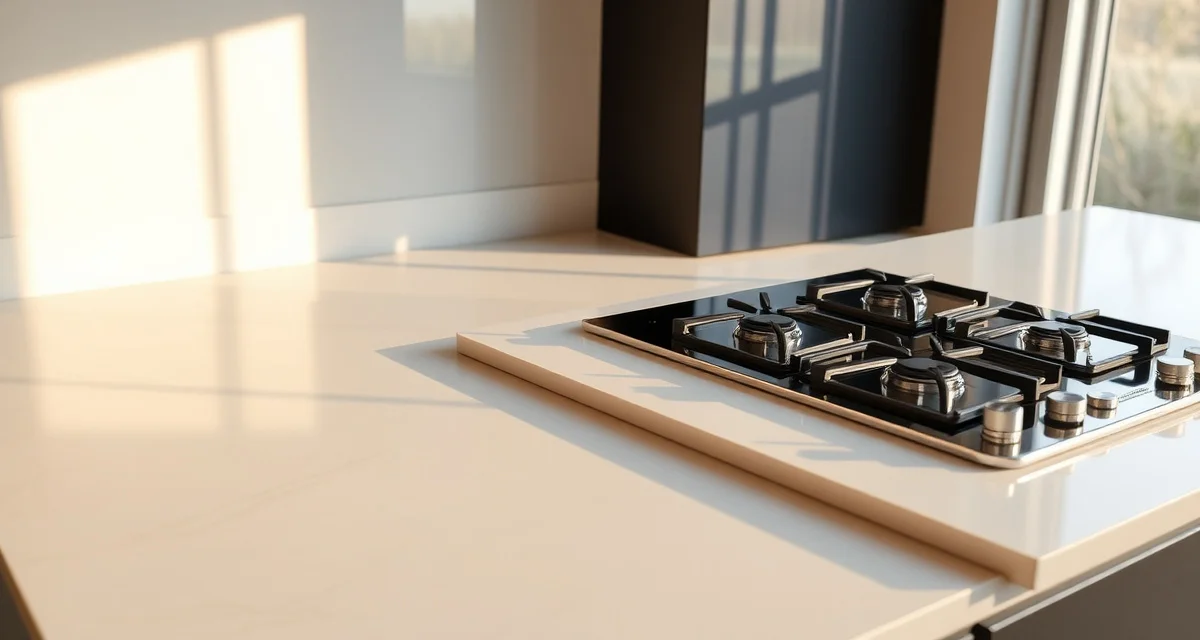
Yes, and it's done routinely. The cutout creates an air gap between the cooktop and the quartz, and the cooktop's built-in insulation directs heat upward toward the cookware, not outward toward the countertop.
Key requirements:
- Follow the cooktop manufacturer's cutout dimensions exactly
- Maintain specified clearance (usually 1/8" to 1/4")
- Some fabricators apply a heat-reflective strip along the cutout edge
- Gas cooktops produce less lateral heat than some high-powered induction or electric models
For fabricators: cooktop cutout dimensions must match the manufacturer's specs precisely. A too-tight cutout puts the quartz edge too close to the heat source. SlabWise's Template Verification cross-references appliance specs with cutout dimensions to flag potential clearance issues before fabrication.
Quartz vs. Other Materials Near Heat
| Material | Max Temp Tolerance | Hot Pan Safe? | Cooktop Safe? |
|---|---|---|---|
| Quartz (engineered) | ~300-400degF sustained | No -- use trivets | Yes, with clearance |
| Granite | 900degF+ | Yes (brief contact) | Yes |
| Quartzite | 1,000degF+ | Yes | Yes |
| Marble | 900degF+ (but stains easily) | Yes for heat, but oils are a concern | Yes |
| Porcelain slab | 1,000degF+ | Yes | Yes |
| Soapstone | 1,000degF+ | Yes | Yes |
| Laminate | ~275degF | No | Not recommended near heat |
| Butcher block | ~350degF (scorches) | No | Not recommended |
If heat resistance is your top priority and you do a lot of heavy stovetop cooking, granite, quartzite, or porcelain slab are safer bets for the area immediately surrounding the stove.
What Heat Damage Looks Like on Quartz
Heat damage on quartz shows up in several ways:
- White or light spots: The resin has been bleached or melted, leaving a lighter area
- Yellow or brown discoloration: Scorching from sustained or high heat
- Rough texture: The surface finish (polish) has been damaged
- Hairline cracks: Thermal shock fractures radiating from the point of heat contact
- Bubbling: In severe cases, the resin literally bubbles under the surface
Can heat damage be repaired?
Minor surface discoloration can sometimes be buffed out by a professional stone restoration technician. Deep scorch marks, cracks, and bubbling are permanent. Most quartz manufacturers (Caesarstone, Silestone, Cambria) specifically exclude heat damage from warranty coverage.
Best Practices for Quartz Near a Stove
- Always use trivets. Keep two or three trivets permanently stationed near the stove area.
- Use a heat pad under slow cookers and instant pots. These appliances sit in one place for hours and can gradually overheat the surface beneath them.
- Don't lean a cookie sheet against the backsplash. A hot sheet pan can damage the quartz backsplash too.
- Keep a silicone baking mat on the counter next to the range. Silicone mats handle up to 500degF.
- Ensure proper cooktop clearance. If installing a cooktop into quartz, verify the air gap meets manufacturer specs.
- Consider a granite or quartzite insert. Some designers install a small section of heat-resistant stone (like a granite "hot zone") next to the stove within an otherwise quartz kitchen.
FAQ
Can you put quartz countertops next to a stove? Yes. Quartz is commonly installed adjacent to stoves and ranges. The key is never placing hot cookware directly on the quartz surface. Use trivets and maintain recommended clearances.
Will a hot pan ruin quartz countertops? It can. A pan above 400degF placed directly on quartz can cause scorch marks, white spots, or cracks. The damage is often permanent and not covered by warranty.
What temperature can quartz countertops withstand? Most manufacturers rate quartz for brief contact up to about 300degF and advise against sustained heat above 150degF. The resin binder begins to soften around 300-400degF.
Does the quartz warranty cover heat damage? Almost never. Major manufacturers including Caesarstone, Silestone, Cambria, and MSI specifically exclude heat damage from their warranties.
Is granite better than quartz near a stove? For heat resistance, yes. Granite tolerates temperatures over 900degF and can handle hot pan contact without damage. It's a stronger choice for the area immediately adjacent to a stove.
Can you install a cooktop in a quartz countertop? Yes. Cooktop cutouts in quartz are standard practice. The air gap between the cooktop frame and the quartz, combined with the appliance's built-in insulation, keeps the stone within safe temperature ranges.
How do you fix a burn mark on quartz? Minor discoloration may be buffed out by a professional. Deep scorch marks, bubbling, or cracks are usually permanent. Contact a stone restoration specialist for an assessment.
Should I put a different material next to my stove? If you do heavy cooking with cast iron or frequently move hot items from oven to counter, consider granite or quartzite for the section next to the stove. You can mix materials in the same kitchen.
Can a crockpot damage quartz? Potentially. Slow cooker bases can reach 250-300degF on high settings and sit in one place for hours. Always use a heat pad or trivet under a crockpot on quartz.
Does quartz discolor over time near a stove? Cumulative radiant heat exposure over years can cause subtle yellowing or color shift on the quartz closest to a stove. This is rare but documented, especially with lighter colors.
Help Your Customers Choose the Right Material
For fabricators, educating homeowners about heat performance reduces callbacks and improves satisfaction. SlabWise's Customer Portal gives your clients material comparison info -- including heat tolerance -- so they make informed decisions before you cut the slab.
Try These Free Tools
- Photo to Template -- Snap a photo of an existing countertop and get an AI-generated DXF template.
- Template Compare -- Upload two templates and see every dimension change highlighted instantly.
- AI Template Verification -- Cross-check your template against manufacturer specs before cutting.
Sources & Further Reading
- Natural Stone Institute - Countertop Support Guidelines
- International Surface Fabricators Association - Structural Support Requirements
- National Kitchen & Bath Association - Countertop Installation Standards
- ASTM International - C1526 Standard Specification for Serpentine Dimension Stone