TL;DR
- Quartz countertop quotes from different fabricators can differ by $1,000 or more on the same kitchen.
- They measure square footage differently, price slab grades separately, bundle or unbundle edges and cutouts, and carry very different overhead.
- Once you know each variable, you can line up bids that only looked different on paper.
What is the typical price range for quartz countertops, and why is it so wide?
Installed quartz runs $50 to $200 per square foot, depending on material grade, fabricator, and region [1]. That is not a typo. The same Silestone or Caesarstone slab can turn into a countertop quoted at $75 per square foot by one shop and $130 by the shop two miles down the road.
The national average for installed mid-grade quartz sits around $75 to $90 per square foot, per data from the Home Innovation Research Labs builder survey [2]. But averages hide the real story. A basic 2-cm entry-level color with a straight eased edge and no cutouts prices near the low end. A 3-cm book-matched slab with a waterfall edge, an undermount sink cutout, a cooktop cutout, and a radius corner hits the high end with nobody padding a margin.
Here is the honest answer. Quartz pricing has at least eight independent variables, and every shop handles each one its own way. Some roll it all into one per-square-foot number. Others charge separately for edge feet, cutouts, template trips, and delivery miles. Get two quotes built on different structures and they look wildly apart even when the final total is nearly the same.
How do fabricators measure square footage differently, and does it change the price?
Measurement convention is the most underappreciated reason quotes don't line up. Most fabricators charge the gross slab area they cut from, not the net surface left after cutouts. A 30-by-21-inch undermount sink opening removes about 4.4 square feet of quartz, and most shops still charge that piece because it gets scrapped.
That's standard and defensible. But some shops subtract large cutouts. If Shop A drops a 4.4-square-foot sink cutout from a 45-square-foot job, they quote 40.6 square feet. Shop B charges the full 45. At $80 per square foot, that's a $352 gap from measurement convention alone, no difference in margin or quality.
Minimum square footage policies stretch the gap wider. Plenty of fabricators set a job minimum of 15 to 25 square feet, so an 8-square-foot bathroom vanity gets billed at the minimum. Some shops tell you upfront. Others quietly round the measured square footage up to hit their floor.
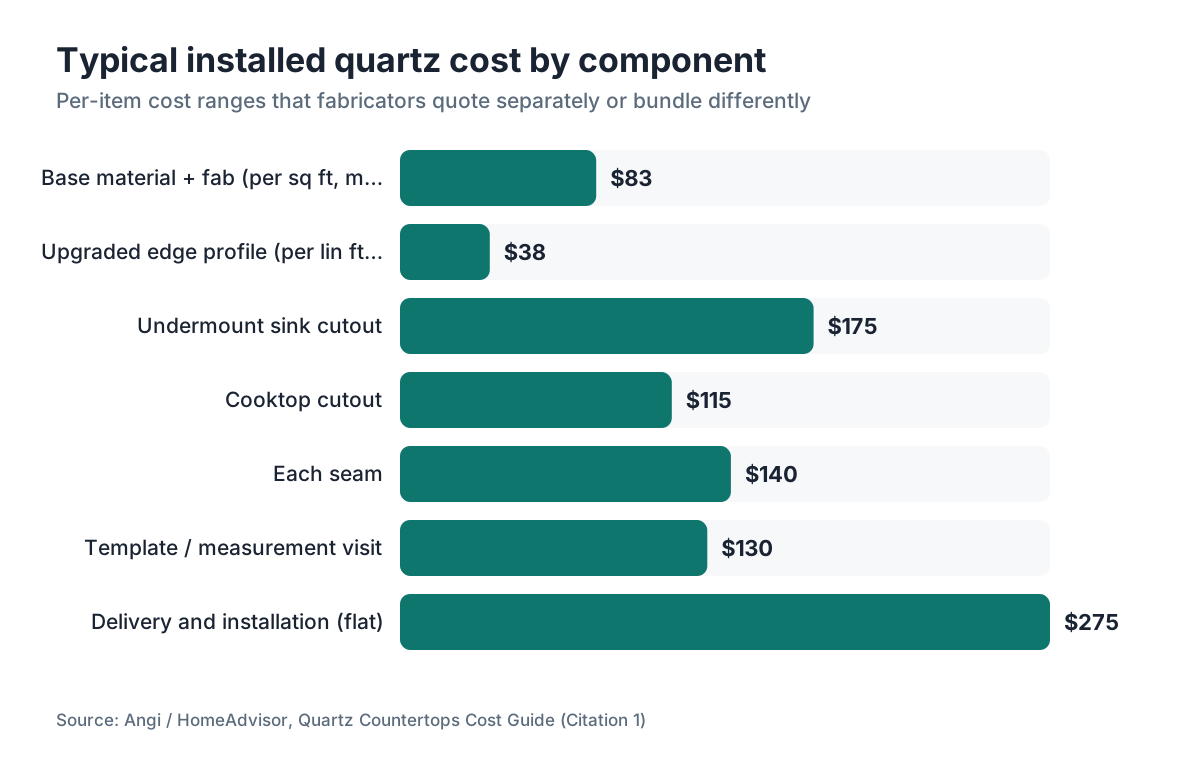
Edge footage sits in its own layer. A 40-square-foot top might carry 25 linear feet of exposed edge. Bundle that edge work into the square-foot price and you see one clean number. Itemize it at $15 to $40 per linear foot for anything past a basic eased edge, and the quote reads completely differently even when the totals nearly match [1].
So the first question to ask every shop: does this include edge work, cutouts, and template? And is it net or gross square footage?
How much do slab grade and material tier affect the quote?
Material tier can double the quote before a single hour of labor gets added. Quartz is engineered, and the makers tier their own lines by color complexity, thickness, and pattern. Caesarstone, Cambria, Silestone, MSI, and the rest all publish dealer pricing split into entry, standard, and premium bands, though they rarely label them that way in public [3].
Entry-level colors, usually solid or lightly flecked designs in 2-cm thickness, cost fabricators $10 to $18 per square foot wholesale. Premium large-format book-matched or marble-look slabs in 3-cm run $35 to $60 per square foot wholesale [8]. Fabricators mark up their material cost, so a quote built on a premium slab starts 2 to 3 times higher than one on an entry-level slab.
The trap is that quotes don't always name the tier. A homeowner comparing one quote for "Silestone" against another for "Silestone" might be pitting an Eternal Calacatta (premium) against a Blanco Stellar (entry). Not the same product. Verify the exact product name, color, and thickness before you treat two quotes as equal.
Sourcing splits the price further. Some fabricators buy straight from the manufacturer's regional distributor at negotiated contractor rates. Others buy through a stone yard that layers on a markup. The same Cambria slab costs a high-volume shop less than a small shop running ten jobs a month, and that spread lands in your quote [10].
For a look at a premium quartz brand's full line and what drives its price tier, the Cambria countertops guide breaks the brand's structure down in detail.
What overhead and business costs explain different labor rates between shops?
Overhead is the invisible line item behind every labor rate. A fabricator with a 10,000-square-foot shop, a CNC saw, a waterjet, two bridge saws, and six full-time employees carries a very different cost base than a two-person crew running a portable saw out of a rented 2,000-square-foot bay.
Shop overhead, meaning rent, equipment loans, insurance, and payroll burden, typically runs 25 to 40 percent of revenue for a mid-size fabrication shop, based on figures from the Natural Stone Institute (formerly the Marble Institute of America) [4]. A shop in San Francisco or Boston pays more for labor and rent than one in a mid-size Southeastern market. Geography alone can account for $15 to $25 per square foot on an identical job.
Insurance deserves its own callout. A properly insured fabricator carries general liability, workers' compensation, and often commercial auto for delivery trucks. Those policies cost real money. A cut-rate shop that skips workers' comp or runs minimal liability can undercut an insured competitor by $8 to $12 per square foot and still keep the same margin. That's fine right up until someone gets hurt or drops a slab on your new cabinets.
Warranty terms track the same line. Some fabricators write a one-year workmanship warranty on seams and installation. Others put nothing in writing. The shops offering real coverage have priced that risk in.
Lead time tells you something too. A shop quoting four weeks has more work than it can rush. A shop offering a one-week turnaround might be hungry, or it might have open capacity because its quality never filled the schedule.
What line items are often hidden or unbundled in quartz countertop quotes?
Line items are where a quote that looked $400 apart turns out identical, or where a low headline number balloons the second you start asking questions.
Here's what some fabricators bundle and others break out:
| Line Item | Typical Separate Charge | Often Bundled By |
|---|---|---|
| Template / measurement fee | $75 to $200 | High-volume shops |
| Standard eased edge (per LF) | $0 to $8 | Most full-service shops |
| Upgraded edge profile (per LF) | $15 to $45 | Almost everyone |
| Sink cutout (undermount) | $100 to $250 | Rarely bundled |
| Cooktop cutout | $75 to $150 | Rarely bundled |
| Faucet holes (each) | $25 to $65 | Sometimes bundled |
| Seam (each) | $75 to $200 | Often hidden |
| Delivery and installation | $150 to $400 | Often bundled |
| Haul-away of old countertops | $50 to $150 | Rarely bundled |
| Plumbing disconnect / reconnect | Varies by plumber | Almost never included |
Seams earn special attention. A large L-shaped kitchen might need two or three of them. At $100 to $200 each, that's $200 to $600 added to a quote that never mentioned seams. If a quote is silent on seams, ask.
Faucet holes seem trivial, then add up. Four holes at $40 each is $160 that one quote includes and another doesn't.
Delivery and installation shift with your distance from the shop, whether there are stairs, and the crew size needed. A heavy 3-cm island top on a second-floor renovation costs more to set than a straight run at ground level.
Does the edge profile choice really change the total price that much?
Yes, and more than most homeowners expect. A basic eased or bevel edge, the straight-cut default, is either free or costs $5 to $8 per linear foot over the square-foot base. An ogee, a full bullnose, a waterfall, or a laminated mitered edge runs $30 to $60 per linear foot. On a kitchen with 30 linear feet of exposed edge, that's the difference between $0 and $1,800 in edge charges alone.
Waterfall edges on islands reward a close look. A waterfall on both ends of a 7-foot island needs two full slab-height panels dropped to the floor. Depending on slab size, that might eat two extra square feet of material, or it might force a second slab entirely. Some fabricators quote the waterfall panels at the same per-square-foot rate. Others add a fabrication premium on top of material, because the mitered joint at the top demands very precise cutting and polishing.
The edge you pick can swing the total by $500 to $2,500 on a typical kitchen, and every shop prices that swing its own way.
How does the thickness of the slab (2 cm vs. 3 cm) change the quote?
Thickness alone can move a full kitchen quote by $250 to $600. Quartz comes in two main thicknesses: 2 centimeter (about 3/4 inch) and 3 centimeter (about 1-1/4 inch). Three-centimeter is heavier, needs fewer support builds, and is the standard for most residential kitchens today [10]. Two-centimeter is thinner and cheaper, but most fabricators laminate a build-up onto the edge to make it look thick, which adds labor.
The material cost difference between 2-cm and 3-cm in the same color typically runs $5 to $12 per square foot at the fabricator level [7]. A 50-square-foot kitchen sees a $250 to $600 material swing from thickness alone. If one shop quotes 2-cm and another quotes 3-cm, the two quotes are not comparable.
Confirm thickness in every quote. It belongs in the written document, more than a verbal aside.
Can the fabricator's quoting software or process cause quote differences?
Yes, more than you'd guess. Plenty of smaller shops still quote by hand, with a tape measure, a notepad, and mental math. Measurement errors of 5 to 10 percent are common in manual templating, a point raised often in fabrication education at the International Surface Event (TISE) [5]. A shop that measures long charges you for stone it never cuts. A shop that measures short might run out of material and hit you with a change order mid-job.
Digital templating with laser tools and layout software produces steadier numbers. Shops that digitize the template and price straight from the layout carry less human error in their square footage. The catch is that the equipment costs money, and that can show in the rate.
Quoting software that calculates yield, seam placement, and waste before the bid goes out means fewer surprises after work starts. SlabWise, for one, builds quoting and nesting into a single workflow, so the square footage a customer sees reflects the actual slab layout instead of a hand estimate. That kind of transparency tends to produce a more accurate first quote.
For homeowners, the practical question is simple: did you get a formal written quote with line items, or a ballpark number scribbled on a business card? Itemized written quotes are easier to compare and harder for a shop to quietly inflate later.
Does buying from a big-box store vs. an independent fabricator change the price?
It changes the structure more than the number. The big-box route, through Home Depot or Lowe's kitchen countertop programs, uses a third-party fabricator contracted through the retailer. The pricing usually bundles template, fabrication, and installation into one package.
For standard mid-grade quartz, big-box programs often price $65 to $100 per square foot installed, though most charge separately for upgraded edges and cutouts. The upside is a single contract and the retailer backing the job. The downside is less control over who actually does the work, longer lead times in many markets, and thinner material selection than a stone yard.
Independent fabricators run the range from budget shops to high-end custom houses. A well-run independent with strong supplier relationships can often beat the big-box price on the same material. A small shop without volume purchasing power may cost more on material even when its labor is cheaper.
Here's the honest take. For a complex job with unusual edges, tight tolerances, or premium material, an experienced independent fabricator is usually the better call. For a simple straight-run kitchen in a standard color, the big-box program is a reasonable pick with less coordination on your end.
What questions should you ask every fabricator before comparing quotes?
To compare quotes fairly, make every shop answer the same list. Here it is:
- Is the square footage net (after cutouts) or gross (before cutouts)?
- Does the price include edge work, and which profiles?
- Is the template or measurement visit included or billed separately?
- How many seams do you anticipate, and what's the charge per seam?
- What are the cutout charges for sink, cooktop, and faucet holes?
- What thickness and exact product name and color is this quote based on?
- What's your warranty on workmanship and seams?
- Is delivery and installation included or itemized?
- Do you haul away the old countertops, and what does that cost?
- What's your current lead time from signed contract to installation?
Get the answers in writing, not over the phone. A verbal answer that changes later is worthless.
If you're still weighing materials, the kitchen countertops overview covers how quartz stacks up against other surfaces on price, durability, and maintenance.
Are cheaper quartz quotes a red flag, or just a more efficient fabricator?
Both, depending on the situation. Some genuinely good fabricators run lean and price aggressively on low overhead, efficient equipment, or high-volume supplier pricing. A quote 15 percent under the market average is worth investigating, not rejecting on sight.
A quote 35 to 40 percent below every other bid is almost certainly leaving something out. Maybe the material is a lower grade than you were told, the measurement is wrong, the edge pricing got skipped, or the shop is under-insured and cutting corners on install. Any one of those turns into a real problem after the countertop is in.
Check reviews for two things specifically: seam quality and how the shop responds when something goes wrong. A clean seam on quartz is harder than it looks, and it's exactly where budget shops fall short. On a dark solid color, a bad seam is obvious from across the room. On a busy pattern it hides better, but it still matters over the years.
For fabricators trying to see where their own pricing lands against competitors, the quoting module in SlabWise lets you model jobs with consistent line items, so you can tell exactly where your number sits and why.
A low quote from a shop with strong Google reviews, a clean portfolio, and a detailed written estimate is a good sign. A low quote with no portfolio, a verbal handshake, and no warranty is a gamble.
How do regional markets affect quartz countertop pricing?
Labor costs, commercial real estate, and local competition push prices around by region. The Bureau of Labor Statistics Occupational Employment and Wage Statistics program tracks wages for stone cutters and slabbers under SOC code 51-9194 [6]. Median hourly wages for this group range from about $17 in lower-cost Southern markets to $28 to $32 in high-cost metros like Seattle, Boston, or the San Francisco Bay Area [6]. On a 40-square-foot kitchen that takes 8 hours of labor, that's an $88 to $120 swing in labor cost alone, straight into your quote.
Distribution matters too. Quartz slabs are heavy and expensive to ship. A fabricator in a market served by several distributors gets more competitive material pricing than a shop in a rural market buying from a single source. At the distributor level, that difference can run $5 to $15 per square foot on the same product.
So don't use a national average to judge whether your local quotes are fair. Compare locally, and get at least three quotes from fabricators who actually serve your area.
Frequently asked questions
Why is one quartz quote $2,000 higher than another for the same kitchen?
The usual reasons: one quote includes edge work, cutouts, and template while the other itemizes them; the shops are quoting different material grades or thicknesses; one uses gross square footage and the other net; or they simply carry different overhead and margin. Ask each shop to itemize every line so you're comparing the same components, not two different structures.
Do quartz countertop quotes include installation, or is that extra?
It depends on the shop. Most full-service fabricators include delivery and installation in their per-square-foot price. Smaller operations often itemize installation separately at $150 to $400 per job. Always confirm in writing whether install is in the number. Plumbing reconnection after the new top goes in is almost never included by the fabricator; that's usually a separate plumber visit.
Is a higher quartz quote always better quality?
No. A higher quote can mean higher overhead, a premium brand, better warranty terms, or just more aggressive margin. A lower quote isn't automatically worse workmanship. Review each shop's portfolio for seam quality and edge finish, read recent reviews about the install experience, and check that the quote includes warranty language. Price alone tells you very little about the final result.
What is a reasonable price per square foot for installed quartz in 2024?
For mid-grade quartz (2 cm or 3 cm, standard color, eased edge, one undermount sink cutout included), most markets run $75 to $110 per square foot installed. Premium materials, complex edges, or high-cost metros push toward $130 to $175. Entry-level colors in competitive markets can land as low as $55 to $65 installed. Get local quotes; national averages don't reflect your regional labor market.
Should I get my own slab and have a fabricator just cut and install it?
You can, and it sometimes saves money if you find a good stone yard deal. But many fabricators add a surcharge for customer-supplied material, since they lose their material margin and take on liability for a slab they didn't pick. The surcharge often runs $8 to $15 per square foot. Do the math first, and confirm the fabricator accepts customer-supplied material before you buy.
Why does the edge profile cost so much extra?
Upgraded edges like ogee, full bullnose, or mitered waterfall need more machine time, multiple polishing passes, and more skilled labor than a basic eased or bevel edge. Tooling wears faster on complex profiles too. A kitchen with 30 linear feet of exposed edge at a $35 per linear foot ogee upcharge adds $1,050 to the base price. That's real fabrication cost, not padding.
What is a seam charge and why does it vary so much?
A seam is the joint between two slab pieces, needed when one slab can't span a long run or an L-corner. Fabricators charge $75 to $200 per seam for the extra cutting, polishing, alignment, and epoxy work. The variation reflects local labor rates and how hard it is to color-match the epoxy on a busy pattern. Always ask how many seams a quote anticipates; some shops don't list them unless asked.
Does the brand of quartz (Cambria vs. Silestone vs. MSI) change the fabricator's quote?
Yes. Brand tiers reflect wholesale cost to the fabricator, and that cost rolls into the quote. Cambria, a direct manufacturer with domestic production in Minnesota, generally sits at a premium price point. MSI and similar warehouse brands run less per square foot wholesale. Within any brand, color and pattern complexity drives the tier. A Calacatta-look quartz costs more than a solid white or black regardless of brand.
How do I know if a cheap quartz quote is hiding something?
Ask for a fully itemized quote in writing. If the shop won't break out edge work, cutouts, template, and delivery, that's your answer. Also verify: what exact product and color is quoted, is it 2 cm or 3 cm, how many seams are planned, and what's the workmanship warranty. A shop that resists these questions is likely hiding something. A shop with nothing to hide answers them right away.
Will quartz countertop prices go down if I wait?
Probably not in any meaningful way. Quartz pricing tracks manufacturer wholesale costs, labor rates, and overhead, none of which tend to fall. There can be seasonal slowdowns in late winter when fewer kitchens get remodeled, and some fabricators offer mild discounts to fill schedule gaps then. But waiting six months for a structural price drop isn't a reliable plan. Material and labor costs trend upward over time [9].
What is net vs. gross square footage in a countertop quote, and which is better for me?
Gross square footage charges the full slab area cut, including material removed for sink and cooktop openings. Net square footage subtracts those cutouts, so it produces a lower quoted figure. Most fabricators use gross because the wasted material is a real cost to them. Either method can be fair. What matters is knowing which one your quote uses so you can compare accurately.
Do fabricators charge more for islands than for perimeter countertops?
Sometimes. Islands often have four exposed edges instead of one or two, which means more edge linear footage billed. An island with a waterfall on both ends is a much more complex fabrication job than a straight perimeter run. If an island needs a seam because of its width, that's another charge. The per-square-foot material rate is usually the same, but the extra charges stack up faster on islands.
Is there a way to compare quartz countertop quotes side by side without getting confused?
Build a simple spreadsheet with rows for material cost per sq ft, square footage used, edge charge per linear foot, linear feet of edge, number and cost of cutouts, number and cost of seams, template fee, delivery and installation, and warranty. Fill each column from each quote. This normalizes the structure and makes the real differences visible. Most quote gaps come from one shop including something another left out.
Sources
- HomeAdvisor / Angi, Quartz Countertops Cost Guide: Installed quartz countertops cost $50 to $200 per square foot depending on material grade, with upgraded edge profiles ranging $15 to $60 per linear foot
- Home Innovation Research Labs, Annual Builder Practices Survey: National average for installed quartz countertops in residential kitchens tracks in the $75 to $90 per square foot range for mid-grade material
- Cambria, Product and Pricing Overview: Quartz manufacturers tier pricing by design complexity and thickness; premium large-format designs command significantly higher wholesale costs than entry-level solid colors
- Natural Stone Institute (formerly Marble Institute of America), Industry Resources: Shop overhead including rent, equipment, insurance, and payroll typically runs 25 to 40 percent of revenue for a mid-size fabrication shop
- International Surface Event (TISE), Education Sessions and Industry Research: Manual templating measurement errors of 5 to 10 percent are commonly discussed in fabrication industry education as a source of pricing discrepancy
- U.S. Bureau of Labor Statistics, Occupational Employment and Wage Statistics, Stone Cutters and Slabbers (SOC 51-9194): Median hourly wages for stone cutters and slabbers range from approximately $17 per hour in lower-cost Southern markets to $28 to $32 per hour in high-cost metros
- Silestone by Cosentino, Product Specifications: Quartz slabs are available in 2-cm and 3-cm thicknesses with material cost differences of $5 to $12 per square foot between thicknesses in the same color
- MSI Surfaces, Quartz Product Line and Dealer Resources: Wholesale quartz slab cost to fabricators varies significantly by manufacturer and line, with entry-level colors running $10 to $18 per square foot and premium designs $35 to $60 per square foot
- U.S. Bureau of Labor Statistics, Consumer Price Index: Construction labor costs and material prices trend upward over time, making waiting for lower countertop prices a generally unreliable strategy
- Caesarstone, Product and Technical Specifications: Major quartz manufacturers including Caesarstone publish tiered product lines by design complexity; 3-cm thickness is the current residential standard
Last updated 2026-07-09