TL;DR
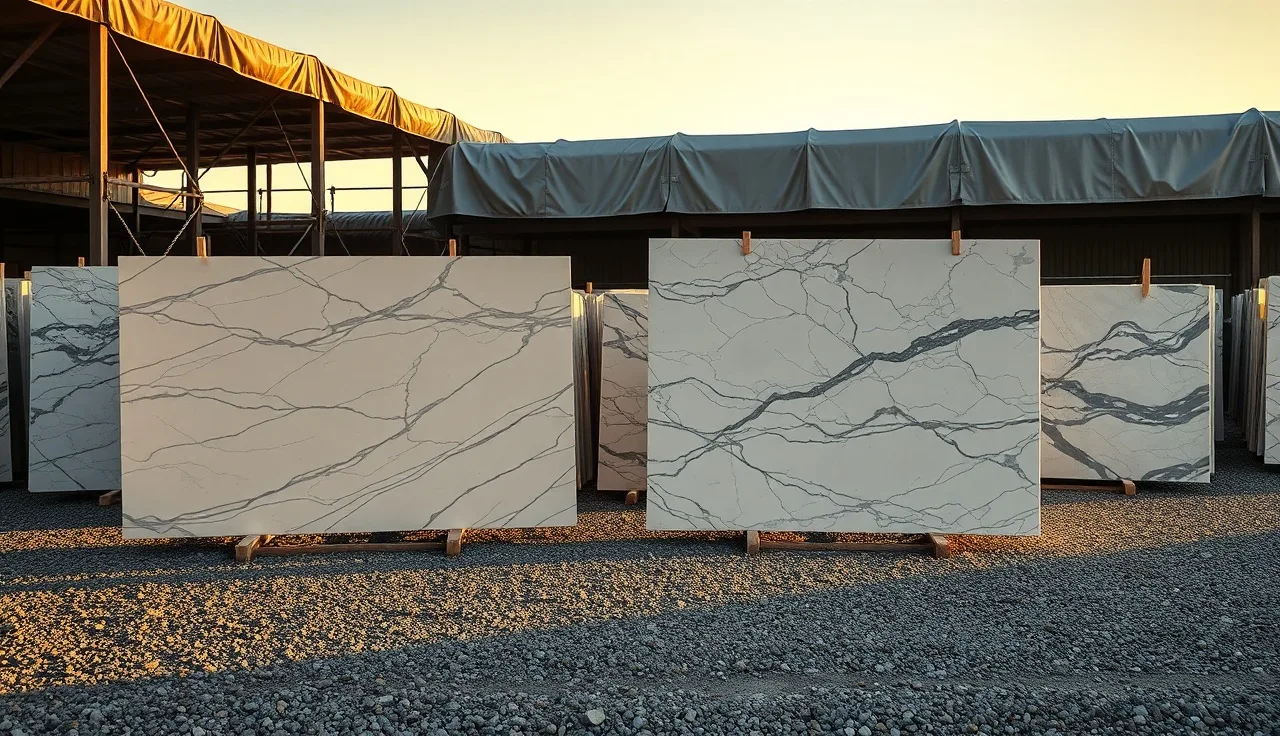
- For outdoor slab storage, a 6-to-12-mil reinforced polyethylene tarp held off the slab surface by a simple frame is the practical standard.
- It blocks UV, rain, and debris without trapping condensation.
- Breathable woven poly covers win in humid climates.
- Never lay a tarp flat on stone: pooled moisture under plastic causes staining and, on marble or limestone, etching.
Why does outdoor slab storage need a cover at all?
Stone looks indestructible. Mostly it is. But the threats to a bare slab sitting outside are real, and they hide until the damage is already done.
Sunlight is the first problem. UV does not crack granite, but it degrades the adhesives in mesh-backed mosaics and the resin in some engineered products. The bigger issue is heat cycling. Stone expands and contracts at rates that vary by mineral, and granite moves at roughly 7 to 9 micrometers per meter per degree Celsius [1]. A slab baking in afternoon sun can run 30 to 40°F above the air around it, which puts real differential stress across a large piece.
Rain is quieter and sneakier. Water rarely hurts dense granite or quartz on its own, but it carries dissolved minerals, acids leached from tree debris, and in industrial areas sulfur dioxide that turns into sulfuric acid once it dissolves. On calcite-bearing stones like marble or limestone, even mildly acidic water etches a polished face. On travertine and other porous stones, repeated wetting and drying pulls minerals to the surface and causes efflorescence.
Debris is the most immediate risk. A twig dropped from a tree. A forklift clipping an unsupported edge. Wind-blown grit scouring a polished face. A proper cover stops nearly all of it.
What types of covers are available for outdoor slab storage?
There are five options that actually get used in yards, and each has a real tradeoff.
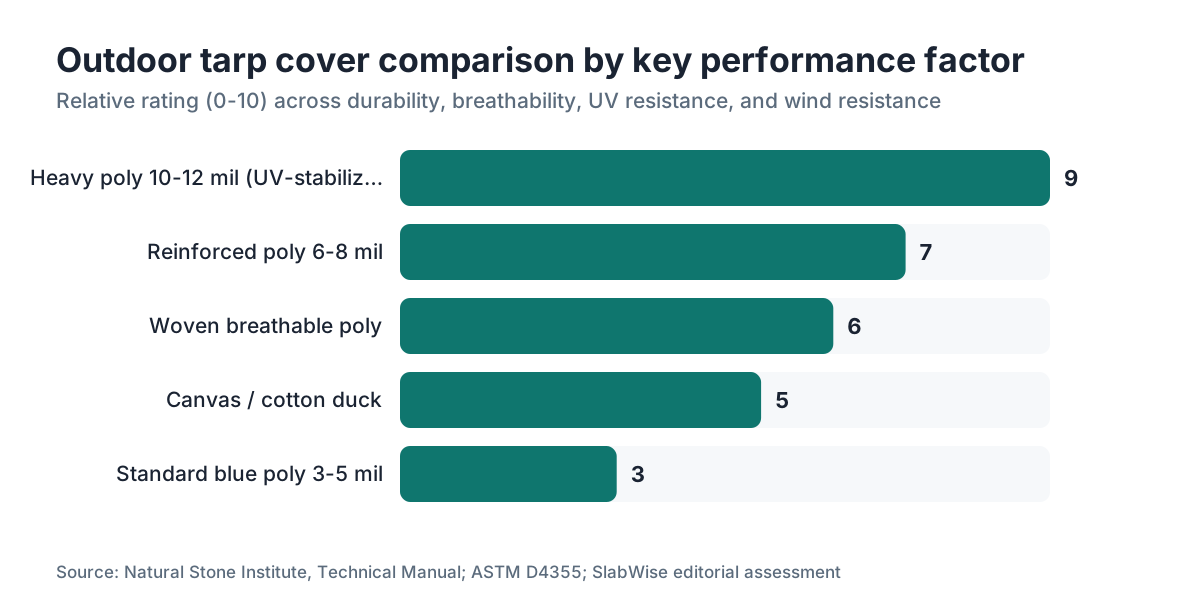
Polyethylene tarps (standard blue or silver, 3 to 5 mil): The cheapest and most common. Fine for days to a couple of weeks. They tear at the grommets under wind, pool water in low spots, and go brittle fast in sun. A blue poly tarp rated for 90 days of UV is not a storage solution. If it is what you already own, use a frame and plan to toss it every season.
Heavy-duty reinforced polyethylene tarps (6 to 12 mil): This is where most fabricators and serious homeowners land. Woven polyethylene laminated on both sides, UV-stabilized, and usually rated for several years outdoors. The woven weave holds at the grommets instead of ripping through. Sizes run from 8x10 feet up to 30x50 feet or larger on custom orders. Weight runs about 6 oz per square yard at the light end to 12 oz at the heavy end. Expect $0.08 to $0.20 per square foot for commercial grade.
Woven poly breathable covers: These look like burlap but are loosely woven polypropylene. Treated with a water-resistant coating, they shed rain, block debris, and let water vapor escape. In humid climates this is the smarter pick, because condensation under a sealed tarp stains certain stones. The catch: they block less UV and wear faster in direct sun.
Canvas or cotton duck tarps: Traditional, breathable, heavy. Canvas breathes well, will not trap moisture, and shrugs off abrasion. It is also expensive, awkward to handle solo, and rots if you store it wet. Some masonry suppliers still stock it for exactly this job. Good for smaller yards with a covered staging area. For full exposure, canvas needs a fresh coat of waterproofing every year or two.
Insulated or padded covers: Specialty products sold for monument and premium slab protection. A quilted poly shell over a thin batting layer. They fight thermal shock in freeze-thaw climates, cut condensation, and cushion edge hits. The price is steep at $2 to $5 per square foot for custom sizes. Mostly monument fabricators and high-end yards storing top-shelf granite countertops material buy these.
What mil thickness tarp actually holds up outdoors?
Mil is the film thickness in thousandths of an inch. For outdoor slab storage, treat 6 mil as the floor. Anything thinner fails fast.
Below 6 mil, tarps rip through the grommets under repeated wind and turn brittle in less than a season of UV. A 3-mil poly tarp on slabs in a Texas yard will be cracked and leaking inside three to four months of summer sun.
At 6 to 8 mil, you get a usable tarp that handles moderate wind, sheds rain, and lasts one to two full seasons in most climates. The reinforced woven versions beat solid-film versions at the same thickness because the weave keeps the laminate together even after the outer layer starts to craze.
At 10 to 12 mil, you are in commercial territory. These stay pliable in cold, resist UV for three years or more, and take frequent handling by one or two people. This is the sweet spot for a yard that moves slabs regularly.
Above 12 mil is truck-tarping weight. Stiff, hard to fold without a crew, and overkill for storage. One exception: if you cover a full A-frame outdoors and need the tarp to span several feet without sagging under rain weight, a heavier tarp or a purpose-built cover with sewn-in rafter channels earns its keep.
UV stabilization matters as much as thickness. Look for a UV rating in hours (often 1000 to 2000 hours of direct exposure) or a rated lifespan in years. ASTM D4355 is the test method for UV degradation of geotextiles and related poly fabrics, and better commercial tarp specs cite it [2].
Should you lay the tarp directly on the slab or use a frame?
Never lay a tarp flat on the slab face. This is the single most common mistake, and it causes real damage.
Drape plastic on polished stone and you build a sealed microclimate. Overnight the temperature drops, condensation forms on the underside of the tarp, and that water sits on the slab with nowhere to go. On marble and limestone, the condensate absorbs CO2 from the air, forms carbonic acid, and etches the polish [3]. On dark granites, evaporating water leaves a white mineral haze. On engineered quartz, seam filler and edge treatments can discolor.
The fix is cheap. Hold the tarp up with a light frame. PVC pipe bent into low arcs and clipped to the rack, 2x4 crosspieces laid across the top of the rack before the tarp goes on, or a purpose-built tarp support frame from a farm supply store. You want three to six inches of airspace between the stone and the underside of the cover. That gap lets air move, lets moisture leave, and lets rain drain off the sides instead of pooling in the middle.
For slabs lying flat, this matters even more. Set a few wooden blocks or rubber bumpers around the perimeter to lift the tarp off the face, then tie down the corners so wind cannot work the cover loose.
On vertical A-frame racks, a correctly sized cover hangs away from the slab faces on its own. Size the tarp to drape past the bottom of the rack by at least 12 inches on every side, then stake or weight the hem so wind cannot lift the bottom edge and funnel rain inward.
How should slabs be stored outdoors before covering them?
The cover is the last step. Position and ground prep come first, and they decide whether the cover even has a fair chance.
Vertical storage on an A-frame rack beats horizontal almost every time. Vertical slabs drain naturally, collect less debris, and pull for templating without wrestling. Size the rack for the stone weight: granite runs 13 to 15 pounds per square foot at a typical 3/4-inch thickness [4], so a 10x5-foot slab is roughly 650 to 750 pounds. The rack has to carry that without flexing.
If slabs must lie flat, support them across the full length, more than at the ends. Stone does not sag under its own weight over a few feet the way lumber does, but an unsupported end can crack if the slab gets bumped or the rack surface is uneven.
The ground under the rack should be compacted and level. Concrete or compacted gravel is ideal. Soft soil lets a rack sink unevenly, and that tilts vertical slabs past their safe angle. Most A-frame designs stay safe up to about 15 degrees of lean. Past that, the odds of a slab slipping or the rack tipping climb fast.
Leave space between slabs for airflow, even under cover. Slabs pressed face-to-face trap moisture and can transfer color or adhesive residue. A half-inch of foam padding or a strip of carpet between adjacent slabs is standard at larger yards.
Does climate change what cover works best?
Yes, a lot. No single cover wins everywhere, and matching the cover to your weather is most of the battle.
Hot, dry climates (Southwest US): UV is the killer here. Buy the highest UV-rated reinforced poly you can find, 1500 hours or more. Silver or white reflects heat and keeps the stone cooler than a dark tarp. Breathability barely matters because condensation is rare, so fully sealed poly is fine.
Humid, subtropical climates (Southeast US, Gulf Coast): Condensation and mold are the threats. A woven breathable cover, or a poly tarp with a 6-inch-plus ventilation gap, beats a sealed tarp every time. If you go with poly, size it generously so air can enter at the base.
Freeze-thaw climates (upper Midwest, Northeast, Mountain West): Water that enters cracks freezes, expands about 9%, and can drive fissures deeper into natural stone [5]. The cover has to be watertight and anchored hard against wind. Heavy reinforced poly or insulated covers work. The sleeper risk is snow load pulling the tarp down onto the slab, so the support frame has to carry the weight of wet snow, which can reach 20 pounds per square foot in heavy snowfall regions [6].
High-wind areas (plains, coastal): Wind resistance is the whole game. Use tarps with reinforced edges and doubled corner rings, stake or sandbag the hem, and use bungee loops instead of cord ties that abrade the tarp edge under constant tension. Some yards run cargo straps around the entire rack-plus-tarp assembly.
How do you secure a tarp over slab racks so wind does not destroy it?
Wind kills tarps, not rain or UV alone. The failure point is almost always the grommet or the hem, and once one lets go the rest unzips in a single storm.
Cheap tarps use stamped aluminum grommets set into a flat edge. Under sustained wind the grommet pulls straight through the material. Commercial tarps use welded D-ring patches: a reinforced square sewn and heat-welded over the grommet area, spreading the load across several inches of fabric instead of one hole.
Tie-down strategy is where most people go wrong. Run straps or ropes over the tarp and under the rack frame, not through the corner grommets. Rigging the cover like a fitted sheet with straps crossing underneath is far steadier than corner ties. For A-frame racks, loop the straps around the legs at ground level.
For long-term storage where you are not moving the tarp often, many fabricators combine sandbags on the hem with two cross-straps running lengthwise over the top. The sandbags stop wind from lifting the base and channeling air underneath, which is the upward pressure that eventually tears any tarp free.
Bungee cords alone will not hold in sustained wind. They are fine for short-term use or for adding tension to a strap system, but a gust that loads a single bungee with 50 pounds will pop the bungee or the grommet inside one storm season.
What covers work for different stone types, including marble, quartzite, and engineered stone?
The stone type shifts the priority, not the basic approach. You are still holding a tarp off the face with a frame. What changes is what you are protecting against.
Marble and limestone: Calcite-based, and they etch from acidic condensate. The breathability argument is strongest here. In a humid climate, use a woven breathable cover or guarantee a real air gap under poly. Direct rain matters too: water landing on a polished marble face carries enough dilute acid from atmospheric CO2 to dull the finish over months [3]. Keep these stones fully covered, never under a partial tarp.
Quartzite: Often confused with quartz, but it is a metamorphic rock, denser than marble yet still calcite-adjacent if it carries any marble banding. Store it like marble. A guide to how to clean quartzite countertops walks through the chemistry, but the storage rule is the same: no standing water on the face.
Granite: The forgiving one. Dense, acid-resistant, and easy with UV and moisture. A reinforced poly tarp on a frame is plenty. The main granite risk in outdoor storage is cosmetic: hard-water mineral deposits left by rain running under a poorly fitted tarp.
Engineered quartz (Silestone, Cambria, etc.): The stone is inert, but the resin binder is UV-sensitive. Long direct sun can shift the color slightly, and Cambria countertops guidance calls for keeping quartz out of prolonged UV exposure. A UV-blocking tarp matters more here than breathability.
Porcelain slabs: Nearly impervious to water, acid, and UV. The risk is mechanical: an unsecured tarp abrading the surface, or a loose cover blowing off and letting debris strike the slab. Secure the cover well and stop worrying about chemistry.
How long can slabs safely stay outside under a tarp?
There is no hard number, and anyone who hands you a precise one is guessing. It depends on the stone, the climate, and how well you maintain the cover system.
Granite and engineered quartz under a proper air-gap or breathable cover in a temperate climate can sit outside for months with almost no degradation. Plenty of yards store granite outdoors year-round with no indoor space at all.
Marble, limestone, and some quartzites accumulate risk faster. Months is still workable with a good cover. A full year of outdoor storage on marble without regular inspection is risky enough that most high-end yards flat-out refuse to do it.
The real limit is tarp integrity. A 6-mil reinforced poly tarp in a sunny climate needs inspection every 90 days and likely replacement every one to two years. Once a tarp develops a hole, tears at a grommet, or starts pooling water and the fix gets put off, the protection drops to near zero in a hurry.
If you are a fabricator tracking yard inventory and storage time for job costing, software that timestamps slab intake can flag material sitting past a set threshold. SlabWise (slabwise.com) includes slab inventory tracking in its shop management tools, which is one way to keep a slab from getting forgotten for a season.
For homeowners waiting on countertop installation: get the slabs into a garage or covered space as soon as you can. A few weeks outside under a good tarp is fine. Several months is asking for a problem you could have avoided.
What tarp accessories make outdoor slab storage safer?
A cover is a system, more than a sheet of plastic. A handful of cheap accessories decide whether it lasts a season or a week.
Foam pipe insulation or edge protectors: Before the tarp goes on, wrap any sharp top edges of the A-frame in foam pipe insulation. Those edges saw through the tarp from the inside as it moves in wind, and you will not spot the hole until rain has been getting in for weeks.
Tarp clips or ball bungees: Better than threading rope through grommets when you want adjustable tension. Ball bungees (the molded-ball type) grab the tarp to fence posts, rack legs, or stakes without cutting into the hem.
Wooden battens or conduit spacers: These build the air gap. Lay 2x2 lumber or lengths of electrical conduit across the top of the rack, then drape the tarp over them. A few dollars of scrap wood stops months of moisture damage.
Ground stakes and ratchet straps: For A-frames not bolted to concrete, ratchet straps around the base, staked into compacted soil or clipped to concrete anchors, stop both rack movement and tarp liftoff in one rigging step.
Tarp repair tape: Polyethylene repair tape, not standard duct tape, which fails outdoors. Patch a small hole before it grows into a tear. Keep a roll in the yard. Cheap insurance.
What does proper outdoor slab storage actually cost?
The numbers are easy to pin down, and the math almost always favors doing it right.
A 20x30-foot heavy-duty reinforced poly tarp (enough for a standard single A-frame plus overhang) costs $60 to $120 from commercial suppliers. The same size in a woven breathable cover runs $90 to $180. Canvas at that size is $200 to $400 or more depending on weight.
Accessories (stakes, straps, foam pipe insulation, repair tape) run $30 to $60 total for a standard setup.
A basic steel square-tube A-frame runs $400 to $900 bought, or $150 to $300 in materials if you fabricate your own. Some shops build wooden A-frames from 4x4 and 2x6 lumber for under $200 in materials.
So a complete covered outdoor setup for one A-frame holding 10 to 20 slabs runs roughly $300 to $600 all-in if you build from scratch, or $90 to $180 a year in tarp replacement once the rack is in place.
Now weigh that against one ruined slab. Raw 3cm granite runs $200 to $600 for the material depending on stone and grade [7]. A premium marble slab can hit $500 to $2,000 or more. One damaged slab pays for several seasons of proper covers.
Are there any rules or codes that affect outdoor slab storage?
Most fabrication shops fall under general commercial zoning and occupancy rules, not stone-specific storage codes. But a few regulations do reach the yard.
OSHA's general industry standards (29 CFR Part 1910) cover material storage in ways that apply to stone yards, especially stability of stored material and aisle clearance [8]. The rule on materials handling says stored material must not create a hazard, and that materials stacked in tiers should be blocked, interlocked, and height-limited to prevent sliding or collapse. Slab racks on a commercial site fall under that principle.
Local fire codes in some jurisdictions cap outdoor storage area, set building setbacks, and restrict combustible tarps near structures. Standard polyethylene tarps are flammable. If your storage sits within 10 to 20 feet of a building, ask your local fire marshal whether flame-retardant-treated covers are required. Some commercial outdoor storage areas mandate this under NFPA 1 [9].
For homeowners, a temporary tarp over a driveway or side-yard delivery is almost never subject to code review. A permanent roofed storage structure might trigger a permit, usually once it passes 120 to 200 square feet of covered area, though the threshold varies by jurisdiction.
Frequently asked questions
Can I use a regular blue poly tarp from a hardware store to cover slabs?
A standard 3-to-5-mil blue poly tarp works for a few days to a couple of weeks. Longer than that is not worth the risk. These tarps go brittle fast in UV, tear at the grommets in wind, and pool water in the center. A 6-to-12-mil reinforced poly tarp costs only a little more and lasts one to three seasons. Buy the heavy version once instead of replacing cheap tarps every few months.
Will a tarp damage a polished stone surface if it touches it?
A clean tarp draped on a polished surface will not scratch it short term, but trapped condensation will do harm. Moisture sealed between plastic and stone etches calcite-based stones like marble and limestone, and leaves mineral deposits on any stone. Always hold the tarp off the slab face by at least three to six inches with a frame, blocks, or battens.
What is the best way to cover marble slabs stored outside?
Marble needs a breathable cover or a poly tarp with a guaranteed air gap underneath. The calcite in marble reacts with mildly acidic condensate, dulling the polished face. In humid climates, a woven breathable poly cover beats solid poly. In dry climates, a UV-stabilized reinforced poly tarp on a frame is fine. Never let rain pool on a polished marble face for long.
How do I keep my tarp from blowing off slabs in wind?
Loop ratchet or cargo straps under the rack frame instead of relying on grommet ties at the corners. Weight the hem with sandbags on all sides. Pick a tarp with reinforced D-ring patches rather than stamped grommets. For A-frames, cross-strap the whole assembly top to bottom and anchor the rack base to the ground. Bungee cords alone fail in sustained wind.
How often should I replace the tarp covering outdoor slabs?
Inspect every 90 days. A 6-to-8-mil reinforced poly tarp typically lasts one to two seasons in a sunny climate and two to four in a shaded or temperate spot. Watch for brittleness or cracking, torn grommets, and areas that pool water. Patch small holes right away with polyethylene repair tape. Replace the tarp before it fails, not after.
Can I store quartzite and marble together under the same cover?
Yes, as long as each slab is separated on the rack with foam or carpet strips to prevent face-to-face contact. Both stones want the same cover approach: breathable or air-gap poly, with protection from direct rain on polished faces. Quartzite is generally denser than marble but can still hold calcite bands that etch, so treat it with the same care.
Does tarp color matter for outdoor slab storage?
It matters in hot climates. A white or silver tarp reflects solar radiation and keeps the stone surface cooler, cutting thermal cycling stress. A dark tarp absorbs heat and can push surface temperature 20 to 30°F above ambient on a sunny day. In freeze-thaw climates, a dark cover can help by melting surface ice faster. For most uses, silver or white is the better default.
What is the difference between a breathable poly cover and a standard poly tarp?
A breathable cover is woven loosely enough to let water vapor pass while still shedding liquid rain, especially when treated with a water-resistant coating. A standard poly tarp is impermeable; nothing moves through it. Breathable covers prevent condensation buildup. Standard tarps are cheaper and more UV-resistant but need an air gap to avoid trapping moisture. Climate decides which one is right.
How much overhang should a tarp have beyond the edges of a slab rack?
At least 12 inches on all sides, and 18 to 24 inches is better. Overhang acts like an eave, directing rain away from the base rather than letting it run down the rack and wick under the cover. On A-frames, weight or stake the hem on all sides so wind cannot channel up under the cover from the base.
Is it safe to store engineered quartz slabs outdoors under a tarp?
Yes, for months at a time with a proper cover. Engineered quartz is nearly impervious to water and acid. The main risk is UV hitting the resin binder, which can shift the color slightly over many months of direct sun. Use a UV-blocking tarp and keep the slab out of prolonged sun. A loose tarp blowing off and letting debris strike the slab is a bigger practical risk than chemistry.
Do I need a permit to store stone slabs outdoors at a residential property?
For a temporary tarp over a material delivery lasting days to a few weeks, almost never. If you build a permanent covered storage structure, rules vary: many jurisdictions require a permit for covered structures over 120 to 200 square feet. Check with your local building or planning department before you build anything beyond a simple rack and tarp.
What should I put under slab racks to keep them stable outdoors?
Compacted gravel or concrete is the right base. Avoid soft or uneven soil, which lets racks sink or tilt over time. Most A-frame designs stay stable up to about 15 degrees of lean; past that, slippage risk rises. For a gravel base, lay crushed stone or road base at least four inches deep and compact it well before setting the rack.
Can I use a canvas tarp instead of poly for outdoor slab storage?
Canvas is breathable, heavy, and abrasion-resistant, which are real advantages. The downsides: expensive, awkward to handle solo, and it rots if left wet. For covered staging areas or short-duration protection, canvas works well. For fully exposed storage in rain-heavy climates, you have to retreat it with a waterproofing compound every one to two years to keep it performing.
Sources
- ASTM International, ASTM D4355: Standard Test Method for Deterioration of Geotextiles by Exposure to Light, Moisture and Heat: ASTM D4355 is the standard referenced for UV degradation testing of polyethylene and poly-fabric outdoor covers
- Natural Stone Institute, Technical Manual: Care and Maintenance of Natural Stone: Calcite-based stones like marble and limestone are etched by mildly acidic water, including condensate containing dissolved CO2, which degrades polished surfaces
- Indiana Geological and Water Survey, Indiana University: Physical properties of common building stones: Granite at 3/4-inch thickness weighs approximately 13 to 15 pounds per square foot
- U.S. Army Corps of Engineers, Cold Regions Research and Engineering Laboratory: Frost action in soils and stone: Freeze-thaw cycling in porous stone propagates existing fissures as water expands approximately 9% upon freezing
- American Society of Civil Engineers, ASCE 7-22: Minimum Design Loads for Buildings and Other Structures: Ground snow loads in heavy snowfall regions can reach 20 pounds per square foot or more, used to size tarp frame load capacity
- HomeAdvisor (Angi), Granite Countertops Cost Guide 2024: Raw granite slab material costs approximately $200 to $600 per slab depending on stone type and grade
- OSHA, 29 CFR 1910.176: Handling Materials, General Industry Standards: OSHA 29 CFR 1910.176 requires that stored materials not create a hazard and that stacked materials be limited in height to prevent sliding or collapse
- National Fire Protection Association, NFPA 1: Fire Code: NFPA 1 governs outdoor storage of combustible materials including flammable tarps near structures; some jurisdictions require flame-retardant covers in commercial storage areas
- Natural Stone Institute, Dimension Stone Design Manual, 8th edition: Slab storage recommendations include vertical A-frame storage as preferred method, with protection from weather and debris as standard practice
Last updated 2026-07-11