TL;DR
- A stone fabrication water system collects slurry-laden coolant from saws, CNC routers, and polishers, drops out the silica and stone fines through settling and flocculation, and pumps clean water back to the machines.
- Shops recover 85 to 95% of process water.
- Costs run from about $3,000 for a dewatering bag setup to $80,000 and up for a closed-loop plant.
Why does a stone fabrication shop need a water system at all?
Every wet cut and wet polish in a stone shop makes slurry: water, silica dust, and stone fines mixed together. A mid-size shop running two bridge saws and a CNC router can push 5,000 to 15,000 gallons of that slurry through its machines every day [1]. That water goes one of two places. Down a floor drain (illegal under the Clean Water Act for anything above trace suspended solids [2]), or onto a truck that hauls it away at real cost.
You're solving two problems at once. The first is regulatory. Wastewater loaded with crystalline silica and stone particulates is a regulated discharge. The EPA's National Pollutant Discharge Elimination System (NPDES) bars discharging process wastewater with total suspended solids (TSS) above permit limits, usually 30 to 100 mg/L depending on the permit category, into a storm drain or surface water [2]. Cities often stack pretreatment standards on top of that for shops tied to a sewer.
The second problem is operational. Fresh water costs money. Coolant flow decides how long your blades and tooling last. And hauling slurry off-site gets expensive fast.
A properly sized water system handles both. It cleans the water enough to legally discharge or reuse, and it keeps coolant clean, which stretches blade life. Shops that install a closed-loop system commonly report cutting city water use by more than 90% [3].
What happens inside a stone fabrication water treatment system?
Simple in principle, fiddly in practice. Dirty water from the machines runs by gravity into a collection sump or pit. From there it moves through a sequence of stages before it heads back to the machines or out the drain.
Stage 1 is coarse settling. The big stuff, grit and saw offcuts, drops out in a settling tank or a run of baffled chambers. Gravity alone pulls out maybe 50 to 70% of suspended solids here [3].
Stage 2 is chemical clarification. Most systems inject a flocculant, usually a polyacrylamide polymer, that makes the fine silica clump into heavier flocs. Those flocs settle in a clarifier tank, often a conical-bottom unit. Skip this step and the superfine silica (particles under 10 microns) stays suspended forever and never settles on its own [4].
Stage 3 is sludge handling. The settled solids, called cake or sludge, have to go somewhere. Systems either pump them into a filter press that squeezes out water and produces dry cakes (10 to 25% moisture) ready for the landfill, or they use geotextile bag dewatering for smaller volumes [3].
Stage 4 is polishing, and only sometimes. Shops discharging to storm drains with tight TSS limits add a sand filter or cartridge filter after the clarifier to hit targets below 30 mg/L. Shops that only reuse the water internally can usually skip it.
The treated water lands in a clean-water holding tank, and a pump sends it back to the machine coolant lines. That closed loop is why recovery rates run so high.
What types of stone fabrication water treatment systems exist?
There's no single design. Systems scale from two settling tanks chained together up to a fully automated plant with PLC controls. Here are the main types you'll run into.
Gravity settling tanks (sump-and-baffles): The simplest, cheapest approach. Water moves slowly through concrete or polyethylene tanks separated by baffles, and coarse particles drop out. Doesn't handle fine silica well without a flocculant. Good for very small shops or as a pretreatment stage feeding a clarifier.
Tube or plate settler clarifiers: Inclined tubes or parallel plates inside a tank give fine particles a short distance to fall, which multiplies effective settling area per square foot of floor. These are the workhorses of mid-size shops. A unit handling 15 to 30 gallons per minute (GPM) fits in roughly a 6x6 footprint [3].
Filter press systems: A hydraulic press squeezes a stack of filter cloths packed with slurry. The output is a dry cake (sometimes called a puck) that a standard roll-off dumpster can take. A filter press is the right call when you need to shrink liquid waste volume or your local landfill only accepts dry cake. It adds capital cost and cuts ongoing disposal cost sharply.
Geotextile bag (dewatering bag) systems: Slurry pumps into a permeable bag, water weeps through the fabric, solids stay inside. Very low capital cost, but labor-heavy because you're swapping and hauling bags. Good for shops under about 5 GPM of slurry flow.
Fully automated closed-loop plants: High-volume shops (20-plus employees, three or more CNC machines) often step up to systems with automatic flocculant dosing, level sensors, PLC controls, and continuous filter press cycles. They run largely unattended and handle 50 to 100 GPM or more. Capital cost is high, but so is the water and waste they move.
How much does a stone fabrication water treatment system cost?
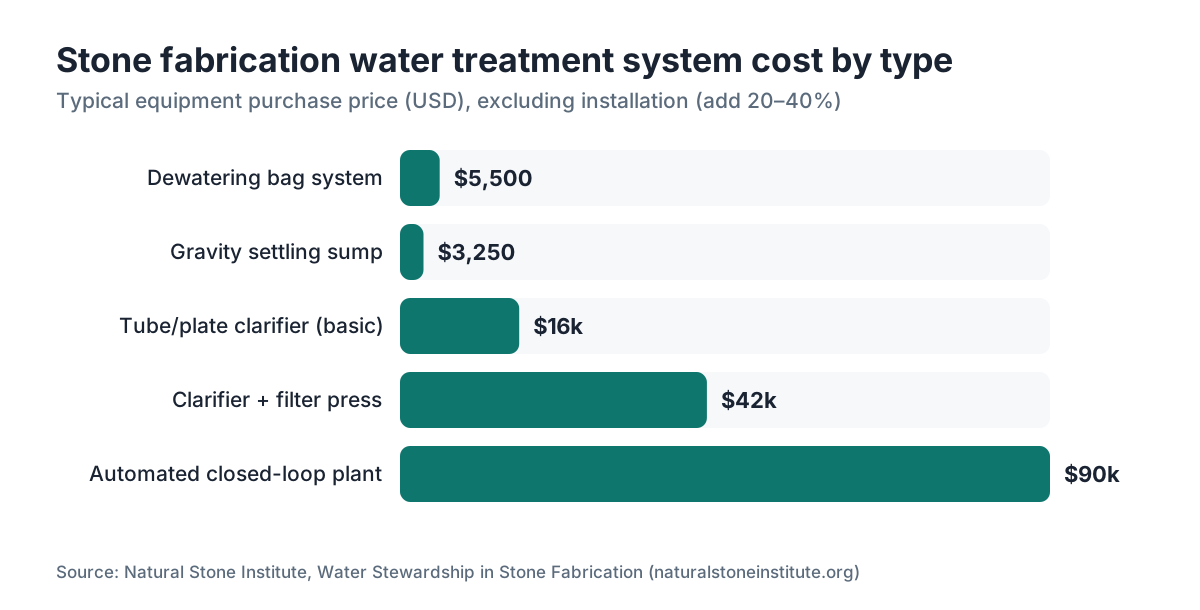
Ranges matter more than single numbers here, because pricing swings hard on flow rate and automation. The figures below are equipment purchase price. Installation (electrical, plumbing, concrete pit work) usually adds 20 to 40% on top.
| System type | Typical flow capacity | Equipment cost (USD) | Best fit |
|---|---|---|---|
| Gravity settling sump | 1 to 5 GPM | $1,500 to $5,000 | 1-man shop, tile cutting |
| Tube/plate clarifier, basic | 5 to 20 GPM | $8,000 to $25,000 | Small-mid shop |
| Tube/plate clarifier + filter press | 15 to 40 GPM | $25,000 to $60,000 | Mid-size fabricator |
| Automated closed-loop plant | 40 to 100+ GPM | $60,000 to $120,000+ | High-volume shop |
| Dewatering bag system | 1 to 5 GPM | $3,000 to $8,000 | Budget entry point |
Operating costs add up fast if you ignore them. Flocculant polymer runs roughly $0.50 to $2.00 per 1,000 gallons treated depending on chemistry and slurry concentration [3]. Filter cloth gets replaced periodically. Sludge disposal to a lined landfill runs $40 to $120 per ton across most U.S. regions, and it varies a lot by state [5].
Here's a number worth chewing on. A shop making 2 tons of cake per week at $80 a ton is writing a $640 monthly disposal check, which makes the case for better dewatering obvious.
Payback depends on your water bill. Shops on municipal water paying $5 to $10 per thousand gallons often see a closed-loop system pay back in 3 to 6 years on water savings alone, before you count reduced slurry hauling. Shops on free well water have a longer water-savings payback, but they still come out ahead on disposal cost and regulatory risk.
What are the regulatory requirements for stone shop wastewater?
Federal law under the Clean Water Act bars unpermitted discharge of pollutants to waters of the United States, including storm drains that flow to surface water [2]. Stone slurry counts as a pollutant under that definition because of its high TSS and its crystalline silica content.
The practical rules split three ways, depending on where the water goes.
Discharge to a storm drain and you almost certainly need a stormwater permit or an industrial general permit. EPA's Multi-Sector General Permit (MSGP) covers many facilities with sector-specific monitoring and discharge requirements [10]. Limits vary, but TSS below 100 mg/L is a common benchmark, and some permits require monthly monitoring.
Discharge to a municipal sewer (a POTW) and local pretreatment standards kick in. Most cities cap TSS at 150 to 300 mg/L for industrial users and reject pH outside 5.5 to 10.0. Some jurisdictions specifically list crystalline silica compounds as restricted. Call your local publicly owned treatment works and ask for the industrial pretreatment coordinator before you design anything.
Discharge zero and you get the most freedom on treatment quality, but you still have to dump the sludge legally. Stone slurry cake is generally non-hazardous solid waste under RCRA Subtitle D [5], which means a permitted solid waste landfill, not a hazardous waste facility. Confirm with your state environmental agency anyway. Some states run stricter classifications.
OSHA's silica rule (29 CFR 1926.1153 and 1910.1053) governs airborne silica, not wastewater [6]. But a water system that keeps slurry wet and contained also keeps dried slurry from turning into airborne dust in the shop, so there's a real safety benefit riding alongside the environmental one.
How do you size a water treatment system for your shop?
Sizing starts with flow rate, not total volume. You need to know how many gallons per minute of slurry your machines make when they're all running at once.
A rough rule of thumb: a bridge saw uses 3 to 8 GPM of coolant, a CNC router 2 to 5 GPM, an edge polisher 1 to 3 GPM [3]. Add up your machines assuming they all run together (because eventually they will), then tack on 25 to 30% buffer.
Work an example. Two bridge saws, one CNC router, two edge polishers: (2 x 6) + (1 x 4) + (2 x 2) = 20 GPM peak. Add 30% and you want a system rated for 26 GPM. Round up to the next standard size, probably 30 GPM.
Size the holding tank too. Treatment systems don't run continuously. There are batch cycles, especially with filter presses. A clean-water holding tank sized for 20 to 30 minutes of peak machine flow keeps the machines running through a press cycle. For a 26 GPM shop, that's a 500 to 800 gallon clean tank.
Sludge production is the input everybody forgets. Rough estimate: for every 1,000 gallons of slurry processed, expect 15 to 40 pounds of dry-weight solids depending on material (granite makes more than quartz engineered stone, marble makes less than hard granites) [4]. Size your filter press plates and cake storage to match.
One more thing. If you're planning a shop expansion in the next 3 to 5 years, size the water system for the future shop, not today's. Upgrading after installation costs more than buying the right size once.
What's the difference between a clarifier and a filter press, and do you need both?
A clarifier separates solids from liquid. It puts out clarified water and a wet sludge (typically 3 to 8% solids by weight). The clarified water is what you reuse or discharge. The wet sludge still holds a lot of water and weighs a lot, which makes disposal expensive.
A filter press dewaters that sludge. It takes the wet sludge from the clarifier and squeezes it to 20 to 40% solids, producing a semi-dry cake. The press-water coming out is clean enough to send back to the clarifier or straight to drain, depending on your permit. The cake is far lighter and drier than raw sludge, so disposal cost drops.
Most shops doing real volume want both. The clarifier handles continuous flow. The filter press handles sludge in batches, usually one or two cycles a day. Very small shops (under 5 GPM) sometimes get by with a clarifier plus dewatering bags for sludge, but anything over that usually justifies a filter press within two years of disposal savings.
Some vendors sell combined units that fold both functions into one skid. Convenient, but they tend to cost more per GPM of capacity than a separate clarifier and press. Ask for a lifecycle cost comparison before you buy a combo unit.
How do flocculants work in stone fabrication water treatment?
Silica particles from stone cutting sit mostly in the 1 to 50 micron range [4]. Particles that small carry an electrostatic surface charge that keeps them repelling each other and staying suspended. Gravity won't settle them in any tank residence time you can afford.
A flocculant, usually an anionic polyacrylamide polymer, neutralizes that charge and bridges particles together into larger aggregates called flocs. Flocs run 100 to 1,000 times heavier than individual particles and settle in minutes instead of hours [4].
Dose matters a lot. Too little flocculant and you don't get full settling. Too much and you make a sticky mess that gums up filters and, at very high concentrations, actually re-disperses the floc. Most systems use a peristaltic pump to inject polymer into the slurry stream just ahead of the clarifier inlet, then a mixing chamber or static mixer makes sure it contacts the water. A jar test (mixing flocculant into a sample and watching it settle) is the standard way to dial in dose for your stone types and slurry concentration [3].
Flocculants generally aren't hazardous under EPA guidelines when used as directed [5]. Keep the safety data sheet on file and train your crew on handling anyway, because some formulations irritate skin.
One practical tip. Your dose changes when you switch materials. A shop cutting quartzite one week and marble the next may need different doses because of differences in particle size and surface chemistry. Treating marble countertops and granite countertops makes very different slurries.
How do you maintain a stone fabrication water treatment system?
Maintenance is where most shops fail. The system runs great for 3 months, then somebody stops cleaning the settling chambers, polymer runs low, and suddenly dirty water backs up into the machines and the coolant lines silt over. It's a predictable failure.
Daily: check flocculant level and refill; eyeball the clarifier for floating scum (a sign of overdose or pH shift); drop the filter press if it finished a cycle; check clean-water tank level.
Weekly: clean settling sumps and coarse screens; inspect pump impellers for wear from abrasive slurry; check flocculant injection tubing for cracks or blockage; test incoming and outgoing water TSS if you're self-monitoring for a permit.
Monthly: inspect filter cloths for tears or blinding (mineral buildup that chokes flow); flush the clean-water holding tank; test pH of process water (silica slurry runs slightly alkaline, pH 7.5 to 9, and wild swings mean chemistry trouble).
Annually: replace filter cloths (lifespan varies by manufacturer and slurry type, typically 6 to 24 months); service pumps; inspect concrete pit walls for cracking or seepage.
Shops that run clean operations write everything down. If you're running quoting and shop operations through software like SlabWise, use the job notes or work order system to trigger maintenance reminders tied to job volume rather than calendar dates. A busy week produces more slurry and wears the system faster than a slow week.
Track your disposal weights. If monthly sludge tonnage climbs without a matching bump in job volume, something's underperforming, and you'll catch it before it turns into a compliance violation.
Can you retrofit a water treatment system into an existing shop?
Yes, and most installations are retrofits. Purpose-built shops with a water treatment room drawn into the footprint are the exception. Most fabricators work out of a converted warehouse or industrial bay.
A retrofit usually means three jobs: digging or installing a collection pit, routing floor drains and machine coolant returns to the pit, and finding floor space for the treatment gear and sludge handling area. The pit excavation is the hardest part in most shops, especially with a thick concrete slab or a high water table. Get a concrete contractor with industrial experience to assess the slab and soil before you commit to a design.
If excavation isn't practical (rented space, bad soil, landlord restrictions), above-grade systems exist. They pump slurry from a shallow collection trench up to elevated treatment tanks. Above-grade costs more to pump and eats more floor space, but it works.
Electrical load is the other surprise. A full clarifier-and-press system might draw 10 to 20 amps at 240V. Check your panel capacity before you buy anything. Plenty of older industrial buildings are already near the edge.
A good equipment vendor does a site visit before proposing a system. If a vendor quotes you a system without ever seeing your shop layout, that's a yellow flag.
What about water treatment for CNC stone routers vs. bridge saws?
The two machines make different slurry problems. Bridge saws cut long straight lines and put out relatively coarse particles with lower water-to-solid ratios. CNC routers, especially while profiling and drilling, throw off very fine stone flour in high water volumes because the tooling orbits at high speed over a small contact area [3].
Very fine particles settle harder, even with flocculant. If your shop is CNC-heavy, budget for a higher flocculant dose and think about a longer clarifier residence time or a plate settler with tighter plate spacing. Some shops route CNC coolant return to a separate pre-settling tank before it mixes into the main clarifier feed, which lifts overall clarifier performance.
Edge polishers and hand polishers make fine slurry too, often with some mineral oil or water-soluble lubricant mixed in. Those additives can interfere with flocculation and leave an oily sheen on clarified water, which may push you toward a separate polishing filtration step before discharge.
Engineered stone (quartz composites) raises its own question. The binders and pigments in engineered stone add trace organics to the slurry. Published research on this is thin, so most shops treat engineered stone slurry the same as natural stone slurry, leaning on TSS removal rather than chemical-specific treatment. If you're discharging to a sensitive watershed, ask your equipment vendor whether your permit calls for testing organic compounds beyond TSS.
How does a stone shop water system connect to overall shop efficiency?
Shop owners undervalue this until they watch a blade overheat because the coolant line clogged with silt. Clean coolant is more than an environmental nicety. It ties directly to tooling life, cut quality, and machine uptime.
Diamond blades run cooler and last longer on clean water. A blade rated for 2,000 linear feet of cuts in clean water might last only 1,200 to 1,500 feet in recycled water carrying even 200 mg/L of residual solids [3]. That's a real cost. Diamond bridge saw blades run $400 to $1,500 each, so a well-designed water system pays for part of itself on blade savings alone.
CNC tooling is even fussier. Core bits and profile wheels running in gritty coolant wear faster at the bond layer, loosening segments early. Many CNC tool manufacturers write a maximum coolant TSS into their warranty terms, and some set the limit at 50 mg/L.
The link to operations doesn't stop at the machines. Shops using fabrication software to track material usage and job costs often overlook water and waste as a variable cost. If you're quoting countertop installation jobs with complex edge profiles or heavy CNC work, the water treatment operating cost (flocculant, disposal, water) is a real per-job input. Tracking it sharpens your quotes.
SlabWise users get production and nesting tools that shape how much material gets cut, which drives slurry volume. Tighter nesting means fewer cuts, less coolant used, and less sludge. Water and waste savings are a quiet downstream payoff of good nesting.
What's the environmental case for a closed-loop stone fabrication water system?
Stone cutting makes crystalline silica-bearing waste. The EPA has flagged crystalline silica as a chemical of concern across several regulatory contexts, and several states (California most loudly) list respirable crystalline silica as a known carcinogen under Proposition 65 [7]. Set aside the airborne dust question that OSHA's silica rule covers [6], and there's still the water side: aquatic toxicology work has found that high-TSS discharges from industrial operations can smother benthic organisms and shift pH in sensitive receiving waters.
A closed-loop system that recycles 90%-plus of process water and captures sludge for dry disposal to a lined landfill basically cuts off the aquatic pathway. That's the honest environmental benefit. The dry sludge cake is still solid waste, and landfilling it carries its own footprint, but it's controlled disposal instead of an uncontrolled slurry dump.
Water conservation is the other angle. In water-stressed regions (the American Southwest, parts of California and Texas), industrial water use faces regulatory pressure beyond wastewater quality. A stone shop pulling 10,000 gallons a day of potable city water in a drought-prone area faces cost exposure and possible future restrictions. Closed-loop systems that drop city water intake to a few hundred gallons a day of make-up water are genuinely worth having in those markets.
Some fabricators chase green certifications (LEED points for manufacturing facilities, state environmental excellence awards) using documented water recycling rates. Whether that helps your marketing depends on your customers. Shops serving commercial projects with sustainability requirements may find it worth documenting.
Frequently asked questions
How much water does a stone fabrication shop use per day?
A small shop with one bridge saw might use 1,000 to 3,000 gallons a day. A mid-size operation running two saws and a CNC router typically uses 5,000 to 15,000 gallons a day without recycling. With a closed-loop water treatment system, daily city water makeup drops to 200 to 1,000 gallons, just enough to replace evaporation and water locked in the sludge cake. The cut is usually 85 to 95%.
Is stone slurry considered hazardous waste?
In most U.S. states, natural stone slurry and the dry cake it produces after treatment are non-hazardous solid waste under EPA's RCRA Subtitle D framework, not RCRA hazardous waste. That means disposal at a permitted solid waste landfill, not a hazardous waste facility. Some states impose more. California and New Jersey run stricter industrial waste rules, so confirm classification with your state environmental agency before you assume standard landfill disposal is fine.
Can I discharge stone slurry into the city sewer?
Only with pretreatment that meets your local publicly owned treatment works (POTW) standards. Most cities cap industrial discharge at TSS below 150 to 300 mg/L and pH between 5.5 and 10. Raw stone slurry can run 5,000 to 50,000 mg/L TSS, far above any sewer limit. You'll need a working clarifier system and, in many places, a formal industrial pretreatment permit before you can legally tie into the sewer.
How long does a filter press take to run a cycle?
A typical stone shop filter press cycle (fill, press, drop cake) runs 30 to 90 minutes depending on press size and slurry concentration. Smaller presses (10 to 20 plate) cycle faster. During the cycle the press is offline, but the clarifier keeps making clean water that piles up in the holding tank. Most shops run one to three cycles per shift. Automated presses cycle unattended; manual units need an operator to open the press and scrape the cakes.
What chemicals are used in stone fabrication water treatment?
The main chemistry is flocculant, usually an anionic polyacrylamide polymer dissolved in water and dosed at 1 to 10 parts per million into the slurry stream. Some systems add a coagulant (an aluminum or iron salt) upstream of the flocculant to help with very fine particles. pH adjustment (sodium hydroxide or sulfuric acid) is occasionally needed if process water drifts outside the 6 to 9 range most flocculants like. No hazardous chemicals are required for standard stone slurry treatment.
Does a water treatment system help with OSHA silica compliance?
Indirectly, yes. OSHA's silica rule (29 CFR 1910.1053 for general industry, 1926.1153 for construction) governs airborne respirable crystalline silica, not wastewater. But a water treatment system that keeps slurry wet and contained in a closed loop stops it from drying on shop floors and going airborne. Wet methods are listed as an engineering control in OSHA's silica standard, so a good water system supports your silica exposure control plan even though the wastewater rules don't require it.
How often do you need to replace the filter cloths in a filter press?
Filter cloth life runs from 6 months to 2 years depending on slurry abrasiveness, operating pressure, and how well the cloths get cleaned between cycles. Granite and quartzite slurry is harder on cloths than marble or limestone. Signs of failure: longer cycle times to reach target pressure, wetter-than-usual cake, or visible tears. Most vendors recommend keeping at least one spare set on hand so a torn cloth doesn't shut you down.
What is the best water treatment system for a small one-man stone shop?
A dewatering bag system paired with a basic tube settler or baffled settling tank is the most practical entry setup. Capital cost is $3,000 to $8,000, maintenance is simple, and it handles the 1 to 5 GPM flow of a one-saw operation. The main downside is labor: you're swapping full geotextile bags regularly. A step up to a small packaged clarifier with a bag dewatering station ($10,000 to $18,000 installed) buys more automation and is worth it if you cut more than 3 to 4 days a week.
What TSS level does treated stone shop water need to reach before discharge?
Depends on where it goes. Storm drain discharge under an industrial stormwater permit often requires TSS below 100 mg/L. Sewer discharge under a local pretreatment program is usually 150 to 300 mg/L. Discharge to a sensitive water body under an individual NPDES permit can require 30 mg/L or lower. Check your specific permit. A good clarifier-plus-filter system typically hits 20 to 60 mg/L, which satisfies most permit categories.
Can engineered quartz slurry be treated the same way as natural stone slurry?
For the most part, yes. The same clarifier-flocculant-filter press process pulls the solid particles out of engineered quartz slurry fine. The difference is that engineered stone binders and pigments add a trace organic load natural stone doesn't have. Most municipal sewer permits don't require specific testing for those organics, but with a discharge permit to surface water, ask your permit writer whether you need a BOD or COD test on top of the standard TSS measurement.
How do I get a quote for a stone fabrication water treatment system?
Contact at least three vendors who specialize in stone shop water systems, not general industrial wastewater vendors who have never set foot in a fabrication shop. Give them your machine list, estimated daily water use or job volume, and a copy of your local discharge permit or sewer ordinance. Ask each one for a lifecycle cost analysis covering equipment, installation, flocculant, and sludge disposal, more than the purchase price. Site visits should be standard before any serious proposal.
What happens if I don't have a water treatment system and just let slurry go down the drain?
You're exposing yourself to Clean Water Act violations, which can carry substantial civil penalties per day per violation under EPA enforcement, and higher for willful violations [2]. Beyond federal law, most states have their own water quality statutes with parallel penalties. Local municipalities can revoke your sewer connection. Plenty of small shops run without proper treatment for years without incident, but a single neighbor complaint or routine municipal inspection can trigger enforcement that costs more than the system would have.
Does a water treatment system affect the quality of cuts or finishes on stone?
Clean recycled water, meaning water treated to below 50 to 100 mg/L TSS, performs essentially the same as fresh water for cutting and polishing. Water carrying residual grit speeds up tooling wear and can scratch polished surfaces when it recirculates through a polisher. Your treatment output quality feeds straight into finished product quality. That's why shops cutting premium material for marble or granite countertops maintain their treatment system for the finish, not only for compliance.
Sources
- EPA, Industrial Wastewater Technology Fact Sheet: Granular Filtration: Stone and mineral processing operations generate significant process wastewater volumes with high suspended solids concentrations.
- EPA, National Pollutant Discharge Elimination System (NPDES): The Clean Water Act prohibits discharge of pollutants from point sources to waters of the United States without an NPDES permit; industrial stormwater permits set TSS limits typically in the 30 to 100 mg/L range.
- Natural Stone Institute, Water Stewardship in Stone Fabrication: Closed-loop water treatment systems recover 85 to 95% of process water; bridge saws use 3 to 8 GPM; a tube settler rated 15 to 30 GPM fits in roughly a 6x6 footprint; flocculant cost runs $0.50, $2.00 per 1,000 gallons; dry cake moisture content is 10 to 25%.
- USGS, Crystalline Silica Primer: Silica particles from stone cutting are predominantly in the 1 to 50 micron range; fine particles maintain electrostatic surface charges that prevent gravitational settling; flocculants aggregate particles into flocs 100 to 1,000 times heavier than individual particles.
- EPA, Resource Conservation and Recovery Act (RCRA) Subtitle D Overview: Stone slurry cake is generally classified as non-hazardous solid waste under RCRA Subtitle D, requiring disposal at a permitted solid waste landfill; polyacrylamide flocculants are not listed as hazardous when used as directed.
- OSHA, Occupational Exposure to Respirable Crystalline Silica (29 CFR 1910.1053 and 1926.1153): OSHA's silica standard covers airborne respirable crystalline silica; wet methods are listed as an engineering control; the standard applies to general industry and construction operations including stone fabrication.
- California OEHHA, Proposition 65 Listed Chemicals: Crystalline Silica (Respirable): California's Proposition 65 list classifies respirable crystalline silica as a known carcinogen; the listing applies to stone fabrication operations.
- EPA, Industrial Stormwater Fact Sheet: Multi-Sector General Permit (MSGP): The EPA's Multi-Sector General Permit covers many manufacturing and processing facilities including stone fabrication operations with sector-specific monitoring and discharge requirements.
Last updated 2026-07-09