TL;DR
- Wet-cutting stone generates 50 to 200 gallons of silica-laden slurry per hour.
- A closed-loop recycling system filters that slurry, reclaims 80 to 95 percent of the water, and keeps a shop compliant with EPA and local stormwater rules.
- Systems run from about $8,000 for a basic settling tank setup to $80,000 or more for a full automated reclaim unit.
Why does stone fabrication use so much water?
Every wet saw, bridge saw, CNC router, and edge polisher in a stone shop needs a steady stream of water. That water does two jobs. It cools the diamond tooling so blades don't burn out in minutes, and it holds down the fine silica dust that turns into a serious respiratory hazard the second it goes airborne.
The volume adds up fast. A single bridge saw running full production burns 50 to 100 gallons an hour. A CNC with multiple spindles runs closer to 100 to 200 gallons an hour [1]. Run two bridge saws and a CNC through an eight-hour day and you can pull 2,000 to 3,500 gallons before the doors close. None of that water disappears. It comes back as gray-white slurry loaded with calcium carbonate (from marble and limestone), silica fines, resin particles from engineered stone, and diamond grit shed by worn tooling.
Dispose of that slurry wrong and you have three problems at once. A permit violation. A wasted input you paid for. And a real risk of silica-rich discharge reaching a waterway. Recycle it right and you cut the water bill, stay legal, and protect your crew by keeping wet processes wet.
What regulations require water recycling in fabrication shops?
No single federal rule says a stone shop must recycle water. But several rules stack up to make uncontrolled discharge effectively illegal for most shops.
The EPA's National Pollutant Discharge Elimination System (NPDES), authorized under the Clean Water Act, bans discharge of process wastewater to storm drains or surface waters without a permit [2]. Stone slurry runs high pH (often 9 to 12 from calcium-carbonate-rich stone), high total suspended solids, and settled silica. It almost never qualifies for an exemption. Most shops fall under industrial stormwater permit rules the moment any process water can reach an outdoor drain.
Local utilities add their own limits. Municipal pretreatment standards commonly cap total suspended solids at 250 mg/L before anything hits the sanitary sewer, and many set a pH window of 6.0 to 9.0 [3]. Raw slurry blows through both without treatment.
OSHA's silica rule (29 CFR 1926.1153 for construction, 29 CFR 1910.1053 for general industry) requires engineering controls that hold respirable crystalline silica below the permissible exposure limit of 50 micrograms per cubic meter as an eight-hour time-weighted average [4]. Wet methods are one of the named controls. That creates a second obligation. You need the water flowing, which means you need somewhere for the water to go.
California, New York, and other states pile their own rules on top. California's Industrial General Permit under the State Water Resources Control Board requires a Stormwater Pollution Prevention Plan (SWPPP) for covered industrial facilities [5]. Smaller shops that dodge that still face local municipal separate storm sewer system (MS4) permits, which prohibit any non-stormwater discharge to the drain.
How does a stone fabrication water recycling system actually work?
Every recycling system runs on the same idea: a multi-stage settling and filtration process. The hardware and price change by vendor. The physics don't.
Stage 1 is primary settling. Slurry from every saw and polisher flows by gravity into a pit or tank where the water slows down and the heaviest particles (large stone chips, coarse grit) drop to the bottom. That tank usually holds 500 to 2,000 gallons depending on production volume.
Stage 2 is secondary settling, or flocculation. Smaller particles need help clumping so they settle faster. Most systems inject a flocculant, usually a polyacrylamide or polyelectrolyte, that pulls fine silica and calcium into larger flocs that drop out of suspension in minutes instead of hours. Skip this step and you'd need tanks the size of a backyard pool to get the same clarity.
Stage 3 is clarification. The clean water off the top (the effluent, or reclaim water) gets drawn off and pumped back to the machines. Most systems recirculate 80 to 95 percent of the water at this point [1]. The missing 5 to 20 percent is evaporation, water the stone soaks up, and intentional blowdown to keep total dissolved solids from building up.
Sludge management is the part people underestimate. Settled solids form a wet cake at the bottom of the tanks. You either pump that to a dewatering system (a filter press, a belt press, or plain drying beds) or you have someone vacuum the tanks on a schedule. A filter press cuts sludge volume by 70 to 80 percent and makes a dry cake that can often go to a construction landfill instead of a hazardous waste facility. Confirm that with your local authority having jurisdiction before you count on it.
Better systems add pH adjustment (dosing CO2 or a weak acid to bring effluent from pH 11 into range), turbidity sensors that automate flocculant dosing, and makeup water meters that track exactly how much fresh water you add to cover losses.
What types of water recycling systems are available for stone shops?
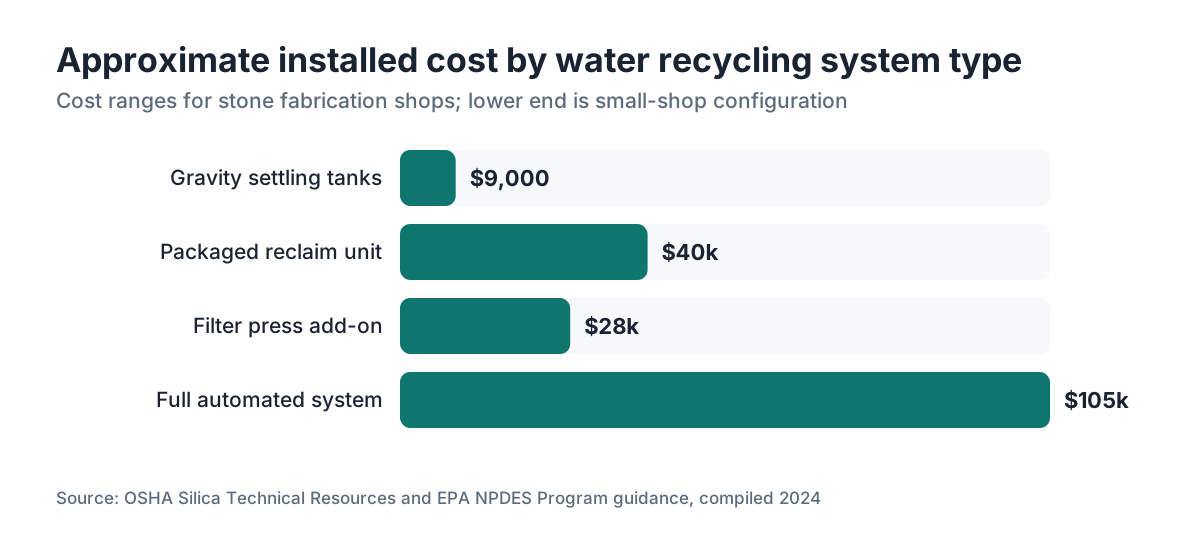
The market splits into roughly four tiers. The right one depends on your daily slab count, your floor space, and how hard your local authority enforces discharge rules.
Gravity settling tanks (DIY or prefab): The cheapest way in. A series of concrete or polyethylene tanks plumbed in sequence. Water flows in, solids settle, clean water returns. No moving parts except a recirculating pump. Cost: $3,000 to $15,000 installed for a small shop. Downside: you're removing sludge by hand every few days, and without added chemical treatment it often can't hit the suspended-solids numbers a sewer discharge needs.
Packaged reclaim units: Pre-engineered skid-mounted systems that pack a settling chamber, flocculant dosing, and a recirculating pump into a footprint of 100 to 400 square feet. Vendors like Technidrill, Ecotone, and Hydrotech sell into this tier. Cost: $20,000 to $60,000 depending on flow capacity (rated in gallons per minute). This is the common pick for shops cutting 15 to 60 slabs a day.
Filter press systems: Bolt a filter press onto the back end of any settling system to mechanically dewater sludge into a handleable dry cake. The press runs $15,000 to $40,000. The trade is labor. Someone opens, cleans, and reloads the press on a cycle that tracks your sludge rate, usually every one to three days at full production.
Full automated closed-loop systems: The top end. Automated sludge pumping, continuous turbidity monitoring, automatic flocculant dosing, pH neutralization, and real-time water reporting. These show up in large production shops cutting 80-plus slabs a day, or in facilities under strict municipal permits. Cost: $60,000 to $150,000 installed.
| System type | Approx. cost (installed) | Reclaim rate | Sludge handling | Best for |
|---|---|---|---|---|
| Gravity settling tanks | $3,000-$15,000 | 70-85% | Manual vacuum | Small shops, low-volume |
| Packaged reclaim unit | $20,000-$60,000 | 85-95% | Semi-auto pump-out | Mid-volume shops |
| Filter press add-on | +$15,000-$40,000 | Same as base | Automated cake discharge | Any shop reducing haul-off cost |
| Full automated system | $60,000-$150,000 | 90-95%+ | Fully automated | High-volume, strict permits |
How much does stone fabrication water recycling cost, and what does it save?
Payback swings hard by region, water price, and how much you currently pay to haul wastewater away. But the math usually lands in your favor.
Where industrial water costs $0.01 to $0.02 a gallon (including sewer charges), a shop using 2,000 gallons a day pays $20 to $40 daily, or $5,000 to $10,000 a year [6]. A system that reclaims 90 percent drops that to $2 to $4 a day. Water savings alone pay off even a $30,000 system in three to six years. And that's before the avoided costs.
The avoided costs often beat the direct water savings:
- Wastewater hauling: If a tanker service currently removes your slurry, expect $0.10 to $0.25 a gallon depending on region. A shop generating 500 gallons of hauled slurry a day pays $50 to $125 daily, or $13,000 to $32,000 a year. A filter press that cuts sludge volume by 75 percent pays for itself in under two years in many markets.
- Permit and fine avoidance: EPA NPDES violations carry civil penalties up to $25,000 per day per violation [2]. A single formal notice of violation from a local MS4 permittee usually drags in engineering fees, legal fees, and compliance plans that dwarf the cost of a basic recycling system.
- Tool life: Diamond tooling suppliers consistently report that recycled water carrying silica fines above about 1,000 NTU (nephelometric turbidity units) speeds up blade wear. Keep reclaim water below 500 NTU and application notes from tooling suppliers put the blade-life gain at 15 to 30 percent. Peer-reviewed data on that specific number is thin, so treat it as a supplier claim, not a lab result.
Maintenance is a real cost vendors sometimes soft-pedal. Flocculant runs $0.50 to $2.00 per 1,000 gallons treated. Filter press cloths need swapping every one to three years at $2,000 to $8,000 a set. Pump seals, wear parts, and annual cleaning add another $2,000 to $6,000 a year on a mid-sized system. Budget for it up front.
What are the silica and health considerations that make water recycling essential?
Engineered quartz (Cambria and others) runs 90 to 95 percent crystalline silica by weight. Natural granite runs 25 to 60 percent [7]. Dry-cut it, or let wet-cutting water evaporate before cleanup, and you generate respirable crystalline silica: particles small enough to reach the deepest part of the lung and cause silicosis, an irreversible, progressive fibrotic lung disease.
OSHA's 2016 silica rule set a permissible exposure limit of 50 micrograms per cubic meter (as an 8-hour TWA) and an action level of 25 micrograms per cubic meter [4]. The rule names wet methods, properly applied, as an acceptable engineering control for most stone cutting and grinding. "Properly applied" is the phrase that matters. A wet saw fed dirty reclaim water above 2,000 NTU with settled fines in the lines can still throw a silica aerosol as water atomizes off the blade. Clean reclaim water is part of the silica control chain, more than a disposal convenience.
The National Institute for Occupational Safety and Health (NIOSH) has documented clusters of accelerated silicosis in countertop fabricators, mostly among engineered stone workers. A 2019 Morbidity and Mortality Weekly Report described 18 cases of silicosis in engineered stone workers across California, Texas, and Colorado, with a median age at diagnosis of 35 [8]. That report called out wet methods and local exhaust ventilation as primary controls.
For granite countertops and marble countertops, silica content sits below engineered stone but still runs high enough that any shop serious about OSHA compliance treats wet cutting as non-negotiable.
How do you size a water recycling system for your shop?
Sizing starts with peak flow, not average flow. If your busiest shift runs three machines at once, size for all three at full water draw, not the daily average.
A practical rule of thumb: total the gallons-per-hour draw from your equipment specs (or measure it with a flow meter), then multiply by 1.5 for margin. That's your minimum recirculation pump capacity. Tank volume should hold at least 20 to 30 minutes of total flow at peak so particles have time to settle before the water recirculates.
Take a shop with two bridge saws (70 GPH each) and one CNC at 120 GPH. Peak flow is 260 GPH. Add the 1.5x margin and you want a system rated for at least 390 GPH, or 6.5 GPM. Active settling volume should run 130 to 195 gallons, not counting the sludge zone.
Use vendors who will do a site visit and a water balance calculation before quoting. A vendor who prices a system off a phone call, with no equipment list, floor plan, or local discharge rules in hand, is not helping you. Get the sizing in writing with the assumptions documented, so you have recourse if the system underperforms.
If you already run shop management or quoting software to track job volume, you're sitting on most of the data a sizing calculation needs. SlabWise tracks slab throughput by machine, which maps straight to the water-use inputs a vendor asks for. Pull that report before the vendor call and save everyone a week.
Plan for growth too. A system right-sized for today with zero headroom becomes a bottleneck in two years the minute you add a machine. Most packaged systems offer expandable tank modules. Spec that option even if you don't buy it on day one.
What does stone fabrication water filtration actually remove?
"Filtration" gets thrown around loosely in this trade. What a recycling system actually removes depends entirely on which treatment stages it runs, and that difference matters for both discharge compliance and machine health.
Sedimentation removes particles above roughly 50 to 100 microns by gravity alone. That catches most large stone chips and coarse grit but leaves fine silica (1 to 50 microns) in suspension, which is where turbidity and most of the regulatory heat sits.
Flocculation and coagulation, dosed right, clump fine particles into aggregates that settle in minutes. Well-dosed flocculation can pull total suspended solids from several thousand mg/L in raw slurry down under 100 mg/L in the reclaim water, comfortably inside typical sewer pretreatment limits.
Here's what most stone filtration systems do NOT remove: dissolved minerals (hardness, calcium, magnesium), any dissolved heavy metals, and flocculant residual. Dissolved calcium from cutting limestone and marble raises hardness over time, which scales up pump seals, spray nozzles, and water lines. A blowdown schedule (draining and replacing a fraction of the reclaim water with fresh) keeps TDS in check. Shops in very hard water areas sometimes add a small softener on the makeup water feed.
Cut a lot of exotic or imported stone that might carry trace heavy metals? Ask your local pretreatment authority whether a metals analysis of your effluent is required before you tie into the sanitary sewer. It's uncommon, but not unheard of in jurisdictions with strict industrial pretreatment programs.
What permits do stone fabricators need for water discharge?
The permit picture is genuinely fragmented. The answer depends on your state, your county, and whether you discharge to a storm drain, a sanitary sewer, or surface water.
Sanitary sewer discharge: Most shops need an industrial pretreatment permit, or at minimum have to show compliance with the local POTW's (publicly owned treatment works) pretreatment standards. The application usually asks you to characterize your wastewater (pH, TSS, sometimes metals) and describe your treatment. Processing runs from a few weeks to several months depending on the jurisdiction.
Stormwater: If any process water can reach an outdoor drain or leave your property as runoff, you likely need coverage under a general industrial stormwater permit (the EPA's Multi-Sector General Permit or a state equivalent) [11]. That means writing a Stormwater Pollution Prevention Plan and running periodic inspections and monitoring. Some small shops qualify for a No Exposure Certification if every industrial activity and material is fully covered, but that's hard to pull off in a stone shop where slabs sit outside.
Zero-discharge operations: A small but growing group of shops run true zero-discharge, where 100 percent of process water recirculates and all sludge hauls off-site. That mostly erases discharge permit obligations, but it demands disciplined sludge management and a reliable haul-off contractor. Expensive, and clean from a regulatory standpoint.
Call your state environmental agency before you install anything. Many states run small business assistance programs that walk a fabricator through permit requirements at no cost [9]. One phone call can change which system you buy.
How do fabricators manage sludge from stone cutting water?
Sludge gets the least attention during the sales pitch and the most during operations. Get it wrong and it costs you.
Wet sludge from a stone shop is mostly calcium carbonate, silica, and water. It's generally not hazardous waste under RCRA (the Resource Conservation and Recovery Act) because stone fines don't usually show ignitability, corrosivity, reactivity, or toxicity at regulatory thresholds [10]. Confirm it with your state environmental agency anyway, especially if you cut coatings, resins, or stone with unusual mineral content.
The usual disposal paths:
- Drying beds: Shallow concrete pads where wet sludge spreads out to air-dry. Cheap, but it eats space and time, and wet weather kills your throughput.
- Vacuum tanker service: A contractor vacuums your settling tanks on a schedule. No equipment to buy, but ongoing cost and you're at the mercy of someone else's calendar.
- Filter press: Squeezes water out of sludge in 30 to 60 minutes a batch. Produces a dry cake (often 55 to 70 percent solids) that's far cheaper to haul and sometimes fine for construction fill or landfill.
- Repurposing: Some stone fines, especially calcium-rich slurry, have tested out as agricultural lime amendments. Niche, and it needs lab analysis and state approval, but a handful of shops in farming regions have made it work.
Whichever path you pick, track disposal with manifests. If you haul, keep receipts. Enforcement agencies trace disposal chains back to the generator, and they do it more than you'd think.
What should fabricators look for when buying a water recycling system?
Buying the wrong system is common and expensive. Here's what separates a good system from an undersized or overpriced one.
First, get a performance guarantee in writing. The vendor should state the effluent turbidity (in NTU) or TSS (in mg/L) the system hits at your peak flow rate. If they won't put a number on paper, that's your answer.
Second, ask about flocculant compatibility. Different stone makes slurry with different chemistry. A flocculant tuned for granite may do nothing on resin-heavy engineered quartz slurry. Good vendors run jar tests with your actual slurry before they recommend a chemistry.
Third, check the sludge handling design. How often does the system need manual intervention? Who pumps the sludge, and how? What happens if you skip a pump-out cycle? Systems that demand daily hand work are fine if you staff for it. Most shops learn the real cost of that commitment at month three, not month one.
Fourth, get local references. Ask for two or three fabricators near you with similar throughput who have run the system at least 18 months. Call them. Ask about maintenance burden, flocculant cost, and whether the system actually hit its promised recirculation rate.
Fifth, confirm compliance support. Does the vendor know your local discharge limits? Will they hand you documentation (system specs, treatment process descriptions) you can submit to your POTW or state agency with a pretreatment application? A vendor who's never heard of your local permit requirements is selling you a tank, not a compliance solution.
If you're also tightening up production, the same data discipline behind shop management software (job throughput, machine time, material waste) builds the paper trail that system sizing and permit applications need. SlabWise's job tracking overlaps directly with the slab-per-day numbers a vendor will ask for.
How does water quality affect stone cutting tools and finished slabs?
Reclaim water that's too dirty wears out your tooling faster and can hurt cut quality. Easy to miss when you're focused on the regulatory side.
Diamond blades and core bits use a metal matrix that holds diamond crystals in place. Abrasive particles in the water, especially sharp silica fines above about 1,000 NTU, act like a lapping compound against that bond matrix and speed up wear. Crystals pull out before they're spent, and blade life drops. The effect compounds. A worn blade throws more heat, which calls for more water, which makes more slurry, which demands better recycling to keep the next blade's water clean.
High dissolved calcium (from cutting marble and limestone) scales up nozzles. Scale restricts flow, creates hot spots on the blade, and eventually plugs the spray bars that keep the cut zone wet. Descaling with dilute acid is a maintenance task everybody pushes off until something fails.
On the slab itself, dirty reclaim water leaves residue in cut edges and polish lines. For honed or polished finishes on marble countertops or granite countertops, a final rinse with clean water before polishing is standard in shops running recycled systems. Some edge polishers have a dedicated clean-water hookup for the final polishing stages while recycled water feeds the rough and medium grits.
For homeowners wondering how their countertop gets made: it starts with a slab that's been wet-cut several times. Countertop installation goes smoother when fabrication tolerances are tight, and tight tolerances lean partly on tooling that's in good shape, which loops right back to clean cutting water.
Frequently asked questions
How much water does a stone fabrication shop use per day?
A typical mid-size shop with two bridge saws and one CNC uses 1,500 to 3,500 gallons a day. One bridge saw at full production uses 50 to 100 gallons an hour, and a CNC can reach 100 to 200 gallons an hour. Total daily volume depends on shift length, machine count, and stone type. Without recycling, all of that water becomes slurry that has to be managed.
Is stone cutting slurry considered hazardous waste?
In most cases, no. Stone cutting slurry is generally not hazardous under RCRA because stone fines (silica, calcium carbonate, feldspar) don't usually meet the EPA's hazardous characteristic thresholds. But it depends on what you cut and what's in your water. If you process coated or resin-treated materials, or stone with unusual mineral content, confirm the classification with your state environmental agency before you assume standard landfill disposal is fine.
Can I discharge stone fabrication wastewater to the sanitary sewer?
Possibly, but only after treatment and with a pretreatment permit or compliance agreement from your local publicly owned treatment works. Most POTWs cap total suspended solids at 250 mg/L and require pH between 6.0 and 9.0. Raw stone slurry exceeds both. A well-run settling and flocculation system can bring effluent into compliance. Contact your local utility before you discharge anything.
What is the payback period for a stone shop water recycling system?
Payback runs from under two years to six or more, depending on water costs, current hauling costs, and system price. Shops paying tanker services to remove slurry often see payback in two to three years from hauling savings alone. Shops in low water-cost areas with no hauling costs may see five to seven years on water savings only. Avoided permit violation costs can shorten payback sharply if enforcement risk is real.
How often do settling tanks need to be cleaned out?
For a mid-volume shop, primary settling tanks usually need sludge removal every two to five days without a filter press, or weekly to bi-weekly with an automated sludge pump. Frequency tracks slab throughput, stone type (calcium-rich stone makes more fines), and tank volume. Skipping cleanouts is one of the most common system failures. Tanks fill with sludge, effective settling volume shrinks, and effluent quality drops fast.
What flocculants are used in stone fabrication water treatment?
Polyacrylamide-based flocculants are the common choice. They come in anionic, cationic, and nonionic formulations, and the right chemistry depends on your slurry pH and particle surface charge. Most vendors run a bench test (a jar test) with your actual slurry to pick the flocculant type and dose. The wrong chemistry means poor settling and higher chemical costs. Dosing rates typically run 1 to 5 mg/L of active polymer.
Do water recycling systems work for engineered quartz fabrication?
Yes, with some differences. Engineered quartz slurry carries resin particles on top of silica fines, which can change flocculant performance and make sludge stickier. Shops cutting high volumes of engineered quartz sometimes report needing higher flocculant doses or a different polymer than they'd use for natural stone. The filtration and settling mechanics are the same. It's the chemistry that needs more attention, which matters given how much silica engineered quartz holds.
What OSHA requirements relate to water use in stone fabrication?
OSHA's crystalline silica standard (29 CFR 1910.1053 for general industry, 29 CFR 1926.1153 for construction) sets a permissible exposure limit of 50 micrograms per cubic meter as an 8-hour time-weighted average. Wet methods are listed as an engineering control that can hit compliance during stone cutting and grinding. The rule also requires exposure assessment, written exposure control plans, medical surveillance for workers over the action level, and training.
Can small stone shops afford water recycling, or is it only for large facilities?
Small shops can get basic gravity settling systems for $3,000 to $15,000 installed, within reach for even a one- or two-saw operation. The economics favor recycling at almost any scale once you count wastewater disposal costs and regulatory risk. Several states run small business environmental assistance programs that provide free technical help with permit requirements, which cuts the compliance cost for smaller shops.
How does pH affect stone fabrication wastewater, and how is it corrected?
Cutting calcium-carbonate-rich stone like marble and limestone dissolves alkaline minerals into the water, pushing pH to 9 to 12. Most POTWs and some surface water permits require effluent between 6.0 and 9.0. You lower pH by injecting CO2 (which forms carbonic acid) or adding dilute acid (sulfuric or citric). CO2 is safer to handle and harder to overdose than acid. Shops with heavy marble throughput often need automatic pH control to stay in range.
What happens to the sludge cake from a filter press in a stone shop?
Filter press cake from stone fabrication, usually 55 to 70 percent solids, is generally disposed of as non-hazardous solid waste at a construction and demolition landfill or general industrial landfill. The calcium carbonate and silica make it inert by most regulatory definitions. Some shops have looked at agricultural lime uses for calcium-rich cake, but that takes laboratory analysis and state agricultural approval. Always confirm acceptable disposal routes with your local landfill and state environmental agency first.
What is turbidity and why does it matter for stone fabrication reclaim water?
Turbidity measures how much suspended particulate blocks light passing through water, expressed in nephelometric turbidity units (NTU). Clean tap water runs below 1 NTU; raw stone slurry can top 5,000 NTU. For reclaim water, keeping turbidity below 500 NTU is a common target for protecting tooling and getting acceptable cut quality. For sewer discharge, the limit is usually written as total suspended solids in mg/L (250 mg/L is common). Turbidity sensors in automated systems adjust flocculant dosing in real time.
Do water recycling systems require special building permits or utility connections?
Most do. Indoor tank installations may need building permits for structural loading (a 2,000-gallon tank full of slurry weighs over 16,000 pounds). Electrical connections for pumps and controls need permits and licensed electricians in most jurisdictions. Any discharge to the sanitary sewer requires coordination with the local utility and possibly a formal pretreatment permit. Starting the permit process early, ideally before you buy, avoids delays and sometimes changes which system you pick.
What should I ask a water recycling vendor before buying?
Ask for a written performance guarantee specifying effluent turbidity or TSS at your peak flow rate. Ask for local references from similar-size shops running the same system at least 18 months. Ask how often manual intervention is required and exactly what it involves. Ask whether the vendor can support your local discharge permit application with documentation. Ask about flocculant cost per month at your volume. A vendor who can't answer these concretely is selling specs, not solutions.
Sources
- Occupational Safety and Health Administration, Crystalline Silica Safety and Health Topics: Wet-cutting stone equipment including CNC machines uses 50 to 200 gallons of water per hour in production operations
- U.S. EPA, National Pollutant Discharge Elimination System (NPDES) Overview: NPDES prohibits discharge of process wastewater to storm drains or surface waters without a permit; civil penalties up to $25,000 per day per violation
- U.S. EPA, National Pretreatment Program (NPDES section): Municipal wastewater utilities commonly cap total suspended solids at 250 mg/L before discharge to sanitary sewer under local pretreatment standards
- OSHA, Occupational Exposure to Respirable Crystalline Silica (29 CFR 1910.1053 and 29 CFR 1926.1153): OSHA permissible exposure limit for respirable crystalline silica is 50 micrograms per cubic meter as an 8-hour time-weighted average; wet methods are specified as an engineering control
- California State Water Resources Control Board, Stormwater Program: California's Industrial General Permit requires a Stormwater Pollution Prevention Plan for covered industrial facilities including stone fabrication
- U.S. Geological Survey, Water Science School: Industrial water costs in the United States range approximately $0.01 to $0.02 per gallon including sewer charges, varying significantly by region
- NIOSH, Health Effects of Occupational Exposure to Respirable Crystalline Silica: Natural granite contains 25 to 60 percent crystalline silica by weight; engineered quartz contains 90 to 95 percent crystalline silica by weight
- Centers for Disease Control and Prevention, Morbidity and Mortality Weekly Report (MMWR), 2019: A 2019 MMWR report described 18 cases of silicosis in engineered stone countertop fabrication workers in California, Texas, and Colorado with median age of diagnosis of 35 years
- U.S. EPA, Small Business Environmental Assistance: Many state EPA equivalents run Small Business Environmental Assistance Programs that provide free technical help with permit requirements for small fabrication operations
- U.S. EPA, Hazardous Waste (RCRA) Characteristics: Stone cutting slurry is generally not classified as hazardous waste under RCRA because stone fines do not typically exhibit ignitability, corrosivity, reactivity, or toxicity at regulatory threshold levels
- U.S. EPA, National Pollutant Discharge Elimination System (NPDES), Stormwater Program: Fabrication facilities where process water can reach outdoor drains or leave as surface runoff typically need coverage under EPA's Multi-Sector General Permit or a state equivalent
Last updated 2026-07-09