TL;DR
- Quartz bathroom countertops cost roughly $50 to $120 per square foot installed, depending on brand, edge profile, and cutouts.
- The non-porous surface resists moisture and staining better than marble or granite, never needs sealing, and holds up in high-humidity bathrooms.
- The two real tradeoffs: heat sensitivity from flat irons and curling irons, and a manufactured consistency some people find flat next to natural stone.
What makes quartz a good choice for bathroom countertops?
Quartz is an engineered stone, roughly 90 to 94% ground quartz aggregate bound with polymer resins and pigments. The surface is non-porous. Bacteria and mold can't take hold the way they do in unsealed natural stone, and that matters most in a bathroom, where standing water and humidity are constant.
The resin binders make quartz more forgiving than granite on impact. Drop a heavy bottle on a granite vanity and you might chip the edge. Quartz is tougher, though not indestructible. It sits around 7 on the Mohs hardness scale, close to granite, so everyday scratches from razors or tweezers are not a concern [1].
Here's a mix-up fabricators hear constantly: homeowners think quartz and quartzite are the same material. They aren't. Quartzite is a natural metamorphic rock that still needs sealing. Engineered quartz does not. The non-porous surface is the single biggest practical advantage for bathroom use.
Quartz also stays consistent slab to slab. Natural stone has veining that shifts between pieces, which turns into a headache when you're templating a bathroom with multiple vanity sections. A dye lot from one quartz manufacturer matches closely, so the fabrication goes smoother and the finished vanity looks intentional.
How much do quartz bathroom countertops cost?
Installed prices in most U.S. markets run $50 to $120 per square foot for a quartz bathroom vanity top, all in [2]. That range covers slab material, fabrication (cutting, polishing, sink cutout), and basic installation. It does not cover plumbing reconnection, demo of the old top, or a new undermount sink.
Where you land depends on a handful of variables.
Brand and slab tier. Entry-level quartz from Silestone or MSI costs less than top-tier Calacatta-look slabs from Cambria or Viatera. A base color on a 60-inch vanity runs around $400 to $600 for material only. Premium veined designs push $900 to $1,400 for the same footprint.
Edge profile. An eased or beveled edge is usually in the base fabrication price. An ogee or mitered waterfall edge adds $15 to $30 per linear foot, which stacks up fast on a long double vanity.
Sink cutout. A single undermount cutout typically runs $80 to $150. A second bowl adds another $80 to $150. Some fabricators bundle one cutout into the base price, so verify before you sign.
Thickness. Most vanity tops use 2 cm (3/4 inch) or 3 cm (1-1/4 inch) slabs. The 3 cm slab is heavier, looks chunkier, and skips the built-up edge laminate, which cuts a fabrication step. The 2 cm slab costs a little less in material but needs edge lamination to look substantial, and the extra labor can erase the savings.
For a 60-inch single-bowl vanity, budget roughly $600 to $1,200 installed as a realistic middle estimate in most suburban U.S. markets.
What quartz colors and styles work best in a bathroom?
White and light gray quartz are the most-requested bathroom colors, and the reasons are practical. They photograph well, show off the veining, and make small bathrooms feel larger. Carrara-look whites (white background, soft gray veining) have held demand for over a decade [3].
Charcoal and black quartz show soap residue and water spots hard, so they're a bigger maintenance commitment. They look sharp in a spa-style bath with matte black fixtures. Be honest with yourself about whether you'll wipe the vanity down daily. Most people don't.
Warmer tones (beige, taupe, soft gold) work in bathrooms with wood-tone cabinetry. Many current mid-range lines have moved toward warm whites and greige backgrounds to track the shift in cabinet finishes.
Thicker Calacatta-style veining is extremely popular and costs more per slab because the color blending is harder to manufacture. If you love the marble look but can't stomach the maintenance marble demands, Calacatta quartz is the practical alternative. Marble countertops are beautiful and porous, and a bathroom vanity takes daily water and product contact that natural marble handles poorly without steady sealing.
Matte finishes are gaining on polished, especially in modern and transitional bathrooms. Honed quartz shows fewer water spots than high-gloss, though it can be a bit harder to clean because the surface has more micro-texture. If you have hard water, polished quartz is actually easier to keep looking clean day to day.
How thick should quartz be for a bathroom vanity?
The two options are 2 cm (about 3/4 inch) and 3 cm (about 1-1/4 inch). For bathrooms, 3 cm is the right call in most situations.
Here's why. A 3 cm slab is rigid enough to span a typical undermount sink opening without flexing, and the finished edge looks clean and substantial with no laminated build-up. The extra weight, around 18 to 20 pounds per square foot for 3 cm quartz, isn't a structural problem for standard bathroom vanity cabinets [4].
A 2 cm top is lighter and a little cheaper per square foot, but fabricators add a laminated edge strip to bring the front edge up to an acceptable visual thickness. Done well, it looks fine. Done poorly, you see the seam. On a 24-inch-deep vanity you're paying the material savings back in fabrication time. My honest take: unless you're on a tight budget, go 3 cm and skip the complication.
One exception. Floating or wall-mounted vanities sometimes use 2 cm to cut weight on the wall anchors. If that's you, confirm the mounting hardware is rated for the slab weight and the wall backing can handle it.
How does quartz compare to other bathroom countertop materials?
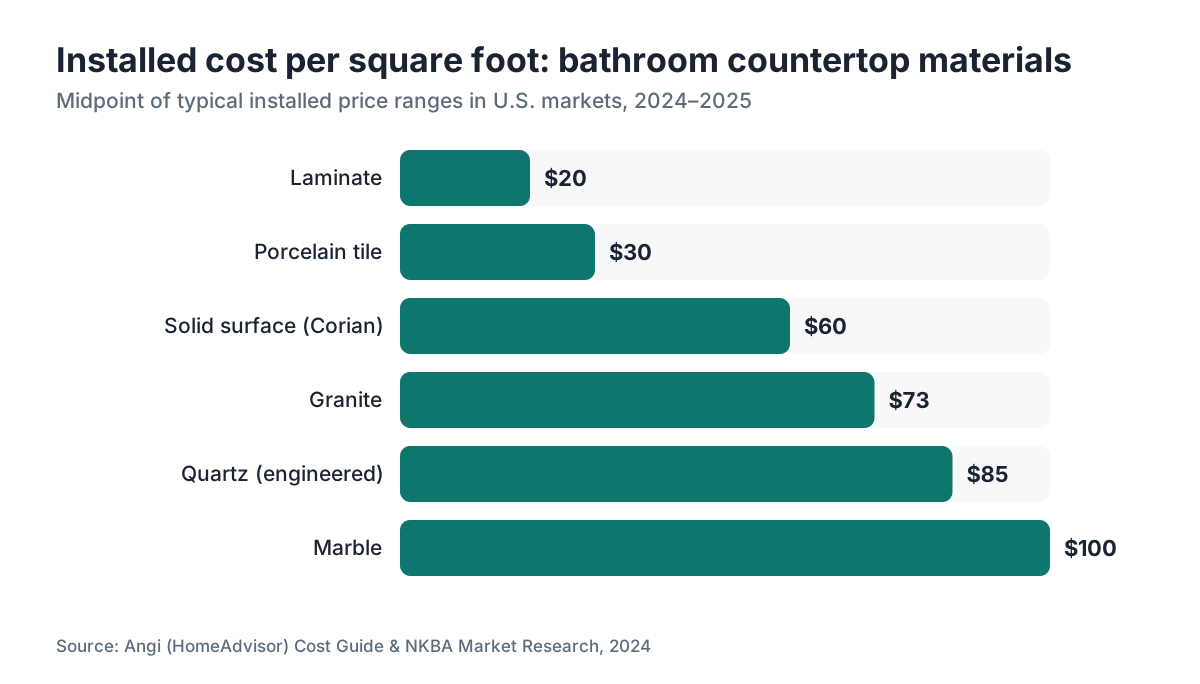
This table shows how the main bathroom countertop materials stack up on the factors that matter in a wet, humid room.
| Material | Avg. installed cost ($/sq ft) | Sealing required | Heat resistance | Scratch resistance | Moisture resistance |
|---|---|---|---|---|---|
| Quartz (engineered) | $50, $120 | No | Moderate (can discolor above 300°F) | High (Mohs ~7) | Excellent |
| Granite | $45, $100 | Yes (annually) | High | High (Mohs 6 to 7) | Good (if sealed) |
| Marble | $50, $150 | Yes (frequently) | High | Moderate (Mohs 3 to 4) | Poor (if unsealed) |
| Solid surface (Corian) | $35, $85 | No | Low | Moderate | Excellent |
| Laminate | $10, $30 | No | Low | Low | Fair |
| Porcelain tile | $15, $45 | Grout only | High | High | Excellent |
Cost ranges from Angi (HomeAdvisor) cost surveys and NKBA market data [2][5].
Granite countertops are a solid bathroom option and often cheaper than quartz, but the annual sealing is a real chore most homeowners skip, and skipping it leads to staining. Corian countertops and other solid surfaces are fully non-porous and repairable but feel less premium and tolerate less heat. Laminate countertops make sense for a budget renovation, but the exposed particleboard core swells if water gets under the surface film, which happens around sink cutouts over the years.
For a bathroom, quartz sits in a genuinely strong spot. It beats marble on maintenance, beats granite on sealing, and outlasts laminate on durability, all without a huge premium over mid-range alternatives.
Does quartz hold up in a humid bathroom?
Yes. The polymer resin binders make the surface non-porous, so humidity, shower steam, and standing water around a faucet don't penetrate the material. This is quartz's best argument over natural stone in a bathroom.
The U.S. Environmental Protection Agency's guidance on mold and moisture is blunt about the mechanism: mold needs moisture and a porous surface to grow. The EPA states that controlling moisture is the key to controlling indoor mold, and non-porous surfaces give mold nothing to grab [6]. Engineered quartz sidesteps the porous-surface half of that equation entirely.
There are two real limits. Prolonged UV from a skylight or sun-facing window can yellow or fade some quartz over years, because the resins are not UV-stable. And extreme heat (a flat iron left face-down, a curling iron set directly on the surface) can discolor or crack the resin. Use a heat-resistant mat. Most manufacturers say quartz handles brief contact with objects up to about 150°F without damage, but a curling iron at working temperature runs 250 to 450°F, well past that line [7].
How do you clean and maintain quartz bathroom countertops?
Maintenance is one of the main reasons people pick quartz, and it really is easy. A damp microfiber cloth with a drop of dish soap handles 95% of daily bathroom grime: toothpaste, makeup, soap scum, water spots.
For stubborn deposits like dried hairspray or nail polish, a plastic scraper and a little isopropyl alcohol work well. Skip Brillo pads, steel wool, and abrasive cleaners. They won't ruin the surface overnight, but they dull the finish over time.
Avoid bleach-heavy cleaners and anything with a pH above about 10. The resin binders degrade under sustained exposure to very alkaline or very acidic solutions. Neutral-pH bathroom cleaners are fine [8].
You never seal quartz. Anyone selling you a sealer for a quartz surface is either uninformed or padding the invoice. The non-porous resin doesn't absorb sealer, so it's money down the drain.
For broader stone and engineered-stone cleaning principles, how to clean stone countertops has a framework that applies to quartz too.
What should you know before templating a quartz bathroom vanity?
Templating a bathroom vanity has quirks kitchen work doesn't. The spaces are tighter, walls are rarely square, and the sink-to-faucet layout means precise drilling.
Decide on sink type before the template. An undermount sink means the fabricator cuts the opening precisely and polishes the underside of the cutout. A drop-in sink is less demanding, but the rim sits on top of the stone and traps water. A vessel sink needs no cutout at all, just a flat surface and drilled faucet holes.
Faucet hole placement matters. Standard faucet centers are 4-inch or 8-inch spread. Buying a widespread faucet? Confirm the spread and let the fabricator drill to spec. Quartz can't be drilled in the field after installation without risking a crack, so nail this at template time.
Wall tile behind the vanity top creates a scribing issue. If the tile is already set, the fabricator scribes the back edge of the slab to the tile face, which adds time and complexity. Setting tile after the countertop is much simpler.
Seams are less common in bathrooms than kitchens because vanity runs are short, but a long double vanity can need one. Ask where the seam would fall relative to sink locations. A seam directly over or near a cutout is structurally weaker and should be avoided.
Fabricators running quoting and nesting software can show you exact material yield and seam placement before cutting. SlabWise, for one, lets a shop generate a quote with scaled cutout layouts so nothing surprises either party at installation.
Are there any drawbacks to quartz in a bathroom?
A few honest ones.
Heat damage is real. Flat irons, curling irons, and hot rollers run hot enough to scorch or crack quartz if set directly on the surface. A small heat mat is cheap insurance. Not a dealbreaker, but it's a habit change some homeowners don't see coming.
Cost. Quartz costs more than laminate or ceramic tile. For a small powder room vanity that gets light use, laminate or a solid-surface top might be perfectly fine. Spending $800 on a 24-inch powder room top is hard to justify on performance alone.
The manufactured look. Some people find quartz's consistency beautiful. Others find it flat next to the movement and depth of real quartzite or marble. That's subjective, so look at samples in person before you commit.
Repair difficulty. Quartz chips at edges if something heavy and sharp hits them, and chips or cracks are hard to fix invisibly. Epoxy fills work but rarely match perfectly. Granite countertops are similarly hard to repair, though natural stone chips sometimes hide better in the variation. Not a reason to avoid quartz, just something to know.
Weight. A 3 cm quartz slab on a 60-inch double vanity can weigh 150 to 200 pounds. Older cabinets and wall-mount brackets may not be rated for it. Confirm cabinet and wall-anchor capacity before ordering, especially in older homes.
Which quartz brands make bathroom vanity tops?
The major engineered quartz makers sold through fabricators and big-box stores in the U.S. include Cambria, Silestone (Cosentino), Caesarstone, MSI Q Premium, Viatera (LG Hausys), and HanStone. Each sells through authorized fabricators, not direct to consumers.
Cambria is American-made (Minnesota) and consistently ranked at the premium end for quality and warranty. Its warranty is lifetime for residential use and covers manufacturing defects [9]. MSI and HanStone sit mid-tier and offer the widest color selection at lower prices. Silestone has a strong track record and introduced a hybrid mineral-polymer surface (Silestone XM) that differs slightly in composition from standard quartz.
For a bathroom, the brand matters less than the specific slab. Get real samples, look at them in your bathroom lighting (daylight and artificial), and run them past your fabricator for any quirks with that brand's material.
Big-box stores (Home Depot, Lowe's) sell pre-cut quartz vanity tops under house labels and brands like Allen+Roth. These prefab tops run $150 to $400 for a standard size and sometimes include an integrated bowl. They're a reasonable pick for a standard-dimension vanity when you don't want a custom run.
What questions should you ask a fabricator before ordering?
A few things to pin down before you sign off on any job.
Ask about the seam policy. Where will the seam fall? Can you see a sample seam in their shop? A good quartz seam is tight and barely visible. A bad one nags at you every day.
Ask what's in the quote. Is the cutout included? How many faucet holes? Are template and installation included or separate line items? Get every element itemized in writing.
Ask about lead time. Custom quartz for a bathroom vanity typically runs 1 to 3 weeks from template to install, depending on shop backlog. On a renovation clock, confirm the fabricator can hit your schedule before you deposit.
Ask about edge profiles and their costs. Some shops include a standard eased edge and charge for anything fancier. Know what you want going in so you don't get upsold on a profile you don't need.
Ask how they handle damage during installation. Quartz cracks on install more often than anyone admits out loud. The policy should be clear: if a slab cracks during install, who pays, and how fast is the remake?
Fabricators building out their own quoting workflow can use a tool like SlabWise to generate line-item quotes that cover all these variables and cut the back-and-forth with clients.
Is quartz worth the cost for a small bathroom or powder room?
Honest answer: it depends on how long you're staying and how much you're spending on the rest of the room.
A powder room vanity might be 24 to 30 inches wide with a single small sink. Total square footage is often under 5. At $80 per square foot installed, that's under $500. At that price, quartz makes sense even for a short time horizon, because the absolute material cost is low.
A primary bathroom double vanity at 72 inches wide is a different math problem. Staying 3 to 5 years? The durability-and-resale argument for quartz is weaker than if you're staying 10-plus. That said, real estate agents consistently report that quartz in bathrooms reads as an upgrade to buyers and can set a listing apart in a competitive market [10].
If the whole bathroom is being renovated at once, the step up from laminate to quartz on a small vanity is often $300 to $600. That's usually worth it. If you're only swapping the countertop in an otherwise untouched bathroom, the cost-benefit rides on your motivation.
Frequently asked questions
Can you use quartz in a bathroom with a steam shower nearby?
Yes. Quartz handles bathroom humidity and steam well because the surface is non-porous. The concern isn't moisture penetration, it's prolonged direct heat. If the vanity top sits right in the path of a steam shower opening, occasional direct steam is fine. Sustained very high-temperature steam over years could theoretically affect the resin, but in normal bathroom layouts this is not a practical problem.
How long do quartz bathroom countertops last?
Realistically 20 to 30 years or more with normal care. The resin can yellow slightly from sustained UV over decades, and chips or cracks from impact are permanent. But daily bathroom use, water, soap, and cleaning products cause very little degradation. Major manufacturers offer lifetime residential warranties on manufacturing defects, which reflects their confidence in longevity.
Does quartz add value to a home?
It usually helps buyer perception, though isolating a dollar figure is hard. The National Association of Realtors consistently lists updated bathrooms among remodels with positive return. Stone or engineered stone countertops read as an upgrade over laminate or cultured marble, the common builder-grade alternatives. Whether you recoup the full cost depends on your market and the rest of the bathroom's condition.
Is quartz or granite better for a bathroom vanity?
Quartz wins on maintenance. It never needs sealing, resists moisture better, and stains less from toothpaste and cosmetics. Granite is beautiful and often cheaper per square foot, but it needs annual sealing to stay stain-resistant. In a bathroom where the top takes daily water and product contact, skipping that sealing is common and eventually causes staining. For most homeowners, quartz is the easier long-term choice.
Can quartz countertops be repaired if they chip?
Chips can be filled with color-matched epoxy, but a truly invisible repair is difficult, especially on polished surfaces. Best results come from a fabricator with epoxy experience and access to the original material or a close match. Edge chips are the most common and most visible. The repair holds structurally but rarely disappears. This is an honest limit of quartz compared to solid surface like Corian, which can be sanded and restored.
Do quartz vanity countertops stain from hair dye or nail polish?
Hair dye can stain quartz if left sitting a long time. The non-porous surface resists absorption, but highly pigmented dye can discolor the resin with prolonged contact. Wipe up hair dye immediately and clean with isopropyl alcohol. Nail polish remover (acetone) can dull the finish, so use it carefully and rinse quickly. Dried nail polish itself comes off best with a plastic scraper, not acetone.
What edge profile looks best on a bathroom quartz countertop?
For most bathrooms, a simple eased, beveled, or bullnose edge looks clean and suits most cabinet styles. An ogee adds traditional detail but collects dust in the crevice and costs more. A square or pencil edge reads modern and cleans easily. The choice mostly follows the cabinet door style. Shaker cabinets pair well with an eased or pencil edge; raised-panel cabinets often look better with a bullnose or beveled edge.
What thickness of quartz is standard for bathroom vanity tops?
3 cm (roughly 1-1/4 inch) is the most common thickness in bathroom fabrication and what most fabricators recommend for a clean, substantial look with no laminated edge build-up. Some budget jobs use 2 cm with a laminated edge, which saves material but adds labor. For wall-mount or floating vanities where weight matters, 2 cm is sometimes specified. In all other cases, 3 cm is the default.
Can you use a vessel sink with a quartz bathroom countertop?
Yes. A vessel sink sits on top of the quartz, so the fabricator only drills faucet holes, no bowl cutout needed. That actually simplifies the job. Make sure the surface is level and the faucet hole placement accounts for the vessel's height, since a taller vessel needs a taller faucet to clear the rim. Most fabricators can drill faucet holes in the shop or on site.
Is engineered quartz the same as quartzite?
No. Engineered quartz is a manufactured product, roughly 90 to 94% ground quartz bound with polymer resins. Quartzite is a natural metamorphic rock quarried from the earth with no resin binders. Quartzite is porous and needs sealing like granite. Engineered quartz is non-porous and never needs sealing. The names are confusingly similar, and the difference matters a lot for maintenance. Always confirm what material you're buying.
How do prefab quartz vanity tops compare to custom fabricated ones?
Prefab quartz tops from home improvement stores cost much less ($150 to $400 for a standard size) but only come in standard widths (typically 25, 31, 37, 43, 49, 61 inches). They often include an integrated bowl and backsplash, which limits customization. Custom-fabricated tops cost more but fit any dimension, allow any sink and edge combination, and use full-slab material that often looks better. For non-standard widths, custom is the only option.
Do quartz countertops yellow in bathrooms over time?
Some quartz formulations yellow slightly with prolonged UV exposure, especially white and very light colors. In a bathroom with a sun-facing skylight or large window, UV-blocking window film cuts the risk. Standard artificial bathroom lighting causes no yellowing. Repeated bleach-based cleaners can also contribute to discoloration in light quartz. Stick to neutral-pH cleaners and you should see no meaningful color shift under normal use.
What is the best way to get an accurate quote for a quartz bathroom vanity?
Measure your vanity cabinet accurately (width, depth, height), note the sink type (undermount, drop-in, vessel), count the faucet holes, and photograph the space. Give all of it to at least two local fabricators for a written quote. Quotes should itemize material, edge profile, cutouts, templating, and installation separately. Online estimators give a ballpark, but an accurate price needs a physical template visit.
Sources
- National Park Service, Mohs Hardness Scale (Geology education resource): Quartz sits at about 7 on the Mohs hardness scale, comparable to granite
- Angi (HomeAdvisor), Countertop Installation Cost Guide: Installed quartz countertop prices average $50 to $120 per square foot depending on region, brand, and complexity
- National Kitchen and Bath Association, Design Trends Research: White and gray quartz with Carrara-style veining remain among the top requested bathroom countertop colors
- Natural Stone Institute, Dimension Stone Design Manual: 3 cm engineered stone weighs approximately 18 to 20 pounds per square foot
- National Kitchen and Bath Association, Market Research: Installed cost ranges for granite, marble, solid surface, and laminate countertops in bathroom applications
- U.S. Environmental Protection Agency, Mold and Moisture guidance: Controlling moisture is the key to controlling indoor mold; mold needs moisture and a porous surface to grow
- Cambria, Warranty and Care Documentation: Most quartz manufacturers specify that prolonged direct heat above approximately 150 degrees F can damage the resin surface
- Silestone by Cosentino, Care and Maintenance Guide: Avoid high-pH or acidic cleaners on quartz; neutral-pH cleaning products are recommended
- Cambria, Residential Warranty Documentation: Cambria offers a lifetime warranty for residential quartz installations covering manufacturing defects
- National Association of Realtors, Remodeling Impact Report: Updated bathrooms with stone or engineered stone countertops are rated positively by buyers and contribute to positive ROI
- U.S. Environmental Protection Agency, Indoor Air Quality resources: Moisture-resistant non-porous surfaces reduce conditions favorable to mold growth in high-humidity areas like bathrooms
Last updated 2026-07-09