TL;DR
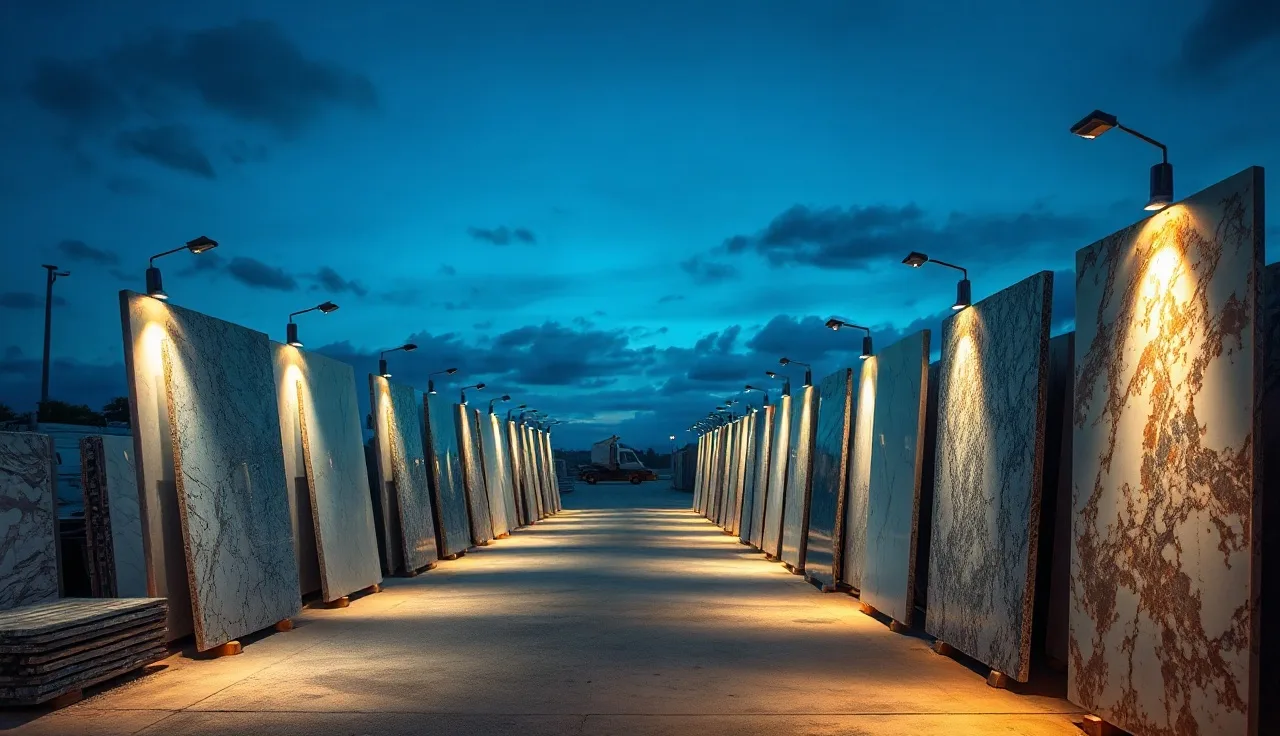
- The best slab viewing light is daylight-balanced (5000 to 6500K, high CRI of 90+), positioned at a low angle so it rakes across the stone surface and pulls out veining, movement, and defects.
- Most stone yards run overhead LED high-bays for fill plus portable angled flood stands for direction.
- Budget roughly $800 to $2,500 for a serious display bay setup, depending on bay size.
Why does lighting matter so much for slab sales?
Stone looks like a different material under different light. A slab of Calacatta marble that glows under 6000K daylight-balanced LEDs can read flat and gray under a 3000K warm warehouse fixture. Veining disappears. Movement dies. Customers stare at a stone they would have loved and walk away unimpressed.
The problem is twofold. The human eye adapts fast, so customers comparing slabs under inconsistent lighting are making decisions on unreliable information. And stone has specular reflectance: light hits a polished surface and bounces at a predictable angle. Put your light source in the wrong position and you're blinding your customer with glare instead of lighting up the pattern underneath.
For fabricators, poor lighting is a real cost. Customers who can't see what they're buying ask for more time, more visits, more samples. Sales cycles stretch.
For homeowners visiting a yard, know this: a slab looks dramatically different at home than it did in a badly lit showroom. Understanding how a yard is lit helps you account for that gap before you sign. Good slab lighting pays back in shorter sales cycles, fewer buyer's remorse calls, and fewer arguments about grain direction later.
What color temperature and CRI should slab viewing lights be?
Color temperature is measured in Kelvin. The range that works best for stone is 5000K to 6500K [1]. That bracket matches overcast natural daylight, which is the closest thing to a neutral reference point you can build a room around. Warmer lights (2700K, 3500K) push stone toward yellow and orange. Cooler than 6500K makes warm stones look blue-shifted and clinical.
CRI (Color Rendering Index) is the other number that matters. It runs 0 to 100 and measures how accurately a light source reveals color against a reference illuminant. The Illuminating Engineering Society recommends CRI 90 or above where accurate color evaluation is critical [2]. For stone yards, 90 is a realistic floor. Some high-end display bays push to CRI 95 or 97, which earns its cost if you're selling exotic quartzite or book-matched slabs where color accuracy moves the sale price.
One practical note: not all LED products report CRI honestly. Ask suppliers for a spectral power distribution (SPD) sheet instead of trusting the marketing spec. The R9 value (deep red rendering) is a good secondary check. An R9 above 50 means the fixture renders reds and warm tones well, which matters for stones with pink or burgundy veining [11].
Keep high-pressure sodium and metal halide fixtures out of a slab display area. Both have poor CRI and a spiky spectral profile that distorts stone tone badly [3].
What light angle actually shows stone veining and texture?
This is the part most yard owners get wrong. Straight-down overhead lighting flattens stone. It kills the shadow contrast that reveals veining and depth in the first place.
The technique that works is grazing or raking light. You position the source at a low angle relative to the slab face, typically 15 to 35 degrees from the slab plane, so light travels across the surface rather than straight into it. That grazing angle creates micro-shadows in pit marks and veining channels, and it makes three-dimensional character visible that direct overhead light hides entirely.
For vertically racked slabs (the A-frame or lean-to style common in most yards), put the source above and forward of the slab, angled down at roughly 30 to 45 degrees. That keeps the fixture out of the customer's line of sight while still raking across the face.
For horizontal slab tables (less common, used for smaller remnants), side lighting from a low adjustable stand beats anything overhead.
The practical rule: stand where the customer stands. If you can see the light source directly, it's causing glare and washing out the stone. Reposition until the fixture is out of your direct sightline.
What type of fixtures work best for a stone yard slab bay?
Most stone yards run some combination of three fixture types.
LED high-bay fixtures are the workhorse of the overhead layer. A standard 100W UFO-style high-bay at 5000K, CRI 90, hung at 12 to 18 feet, covers roughly 200 to 300 square feet per fixture. For a 30-foot slab display bay, you'd typically want 2 to 3 fixtures in a row, spaced evenly. These run $80 to $200 per fixture at most electrical distributors [4].
Adjustable linear LED flood bars (sometimes called stadium lights or wall-wash bars) give you the directionality a UFO high-bay can't. Mount them on the wall or on pipe stands aimed at a low angle toward the slabs. That directional throw is what creates the raking effect. Expect $150 to $400 per fixture for a commercial-grade unit with a beam angle under 60 degrees.
Portable tripod flood stands with LED panels are the most flexible option and a good starting point if you're building out incrementally. A solid 200W LED daylight panel on a 10-foot stand costs $250 to $600 and moves wherever your rack layout goes. Plenty of yards wire in high-bays for ambient fill and use portable panels for the raking effect. That hybrid is a sensible way to spend the money.
Skip recessed can lights in slab display areas. They're great for retail interiors, but the downward-only beam angle is exactly wrong for stone.
| Fixture Type | Typical Wattage | Price Range | Best Use |
|---|---|---|---|
| UFO LED High-Bay | 100 to 200W | $80 to $200 | Ambient overhead fill |
| Linear LED Flood Bar | 50 to 150W | $150 to $400 | Directional raking light |
| Portable LED Panel Stand | 100 to 300W | $250 to $600 | Flexible accent/raking |
| T8 LED Shop Light | 40 to 80W | $30 to $80 | Low-clearance backup only |
How much does it cost to properly light a slab display area?
A realistic budget depends heavily on bay size and whether you're wiring new circuits or retrofitting existing drops.
For a single 30-foot display bay with two to three overhead high-bays plus two directional flood bars, expect $800 to $1,500 on fixtures alone. Add $500 to $1,500 for electrical labor if you need new circuits or conduit runs. A full lighting upgrade for a mid-size stone yard with four to six display bays runs $5,000 to $15,000 installed, based on commercial contractor estimates [4].
Running a smaller shop or just starting out? Two 200W portable LED panel stands on tripods cover a lot of ground for $500 to $1,200 and need no electrical work. That's the honest starting point for a yard that wants to look dramatically better without a capital project.
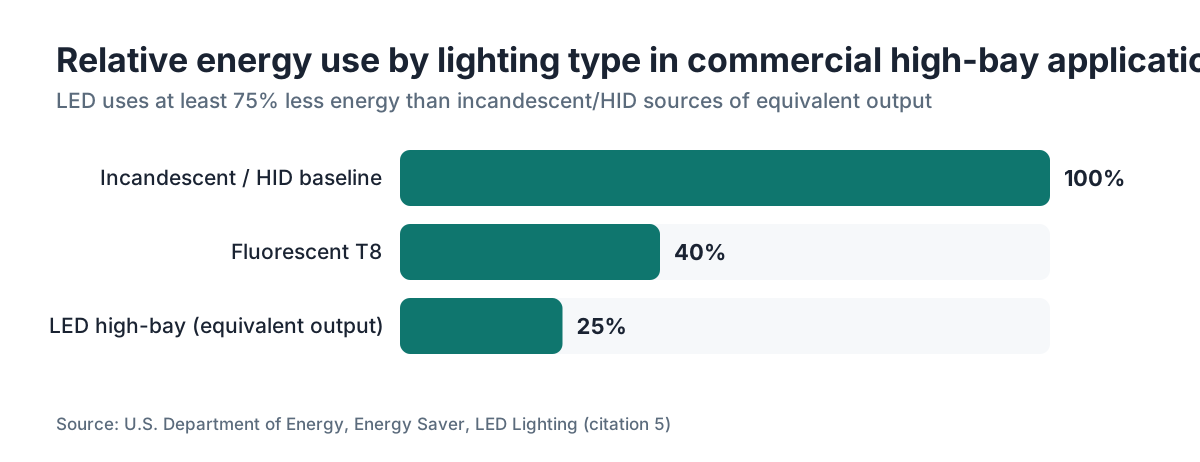
Operating cost matters too. A 100W LED high-bay running 10 hours a day at $0.10 per kWh costs roughly $36.50 per year per fixture. The Department of Energy reports that LED fixtures use at least 75% less energy than comparable incandescent or metal halide sources [5]. In a yard that once ran 400W metal halide high-bays, the LED swap pays back in energy savings within 2 to 4 years.
Don't forget controls. A simple occupancy sensor and daylight-linked dimmer on your display lighting cuts runtime and extends fixture life. Those controls add $50 to $200 per zone, and they earn it in a yard that sits empty half the day.
How should lights be positioned relative to the slab rack layout?
Slab racks come in a few configurations: A-frame bundles (slabs leaning back-to-back), single-face lean-to racks against a wall, and cantilever saddle racks. The lighting strategy shifts for each.
For A-frame bundles in a wide open bay, overhead lighting alone rarely gives good stone reveal because it only lights the topmost slab and drops the lower slabs into shadow. Add forward-positioned flood bars angled down and across the rack face. Position the bar so the beam hits the middle of the rack at roughly 30 degrees.
For single-face lean-to racks against a wall, the best geometry is a ceiling-mounted flood bar on the opposite wall or ceiling, angled back toward the rack face. That keeps the source behind the customer's shoulder as they face the stone.
For pull-out viewing walls or display easels (where individual slabs tilt out for viewing), a dedicated overhead track system with adjustable heads gives you the most control. Track lighting with 90+ CRI adjustable heads costs $100 to $300 per 4-foot section and lets you dial in angle without moving fixtures [6].
Leave at least 8 to 10 feet of clearance in front of the rack for the customer to step back. Lighting that looks terrible from 3 feet often looks excellent from 8 feet, because the eye integrates reflected light differently at distance. The viewing distance is part of the optical system.
What about natural light, and should you rely on it?
Natural light is genuinely the gold standard for color evaluation, which is why many top stone yards have covered but open-sided display areas that let in diffuse daylight. The IES notes that north-facing skylights, producing diffuse and non-directional light, give the most color-neutral viewing conditions [2].
The catch with relying on natural light in a working yard: it changes constantly. Morning sun throws warm 3000K light with hard directional shadows. Overcast noon is a neutral 6500K wash. Late afternoon goes warm again, directional from the opposite side. Customers visiting at different hours see the same stone under wildly different conditions.
The fix most serious yards use is a hybrid. A covered viewing area admits diffuse natural light while a consistent artificial layer tops it up. The artificial lights stay on at a fixed output, and daylight from translucent roof panels adds to the ambient without dominating it. That holds the environment steadier than pure natural or pure artificial ever could.
Full skylights cost real money. Installed commercial translucent roof panels run $15 to $40 per square foot [7]. This is a renovation-level decision, not a quick fix. If you're building a new slab display structure, though, design it in from the start.
Are there electrical codes or safety requirements to know about?
Yes, and they're not optional. Stone yard lighting installations fall under the National Electrical Code (NEC), which NFPA publishes and most states adopt [8]. A few points apply directly.
In wet or damp locations (outdoor or partially outdoor yard areas), all fixtures must be rated for wet or damp use per NEC Article 410.10. A spec sheet that says 'dry location only' cannot legally go in an open-sided slab bay [6].
High-bay fixtures above 277V require appropriate wiring and a disconnect means within sight of the fixture. Most stone yards run 277V or 480V high-bays on three-phase service.
Grounding and bonding requirements for metal rack structures near stone slabs live under NEC Article 250 [10]. Stone isn't a conductor, but metal cutting tools, water, and wet slabs create shock hazard conditions fast if nearby equipment isn't properly bonded.
OSHA's general industry standards (29 CFR 1910.303) require electrical equipment to be installed in a safe manner with overcurrent protection appropriate for the circuit [9]. A licensed electrician who knows commercial and industrial work should pull permits and do the wiring. The permit cost is trivial next to the liability of an improperly wired fixture hanging over a wet stone-cutting floor.
Local jurisdictions may add lighting minimums for commercial workplaces. OSHA's technical guidance lists minimum illuminance for general warehouse and storage work at 30 foot-candles (roughly 320 lux) at the work surface [9]. Customer viewing areas should run well above that.
How do you test whether your slab lighting is actually working?
You don't need expensive gear to check your setup. A $20 to $50 lux meter (electrical supply houses or Amazon) tells you the illuminance at the slab face. Aim for 500 lux or higher at the surface for a quality display. Below 300 lux feels dim even when the wattage looks fine on paper.
A color temperature meter (around $80 to $150) verifies you're actually hitting the 5000 to 6500K range. Some LED products drift well off their rated temperature at real operating voltage, especially cheap offshore fixtures.
The real-world test that costs nothing: bring a physical paint chip in a known neutral gray (Sherwin-Williams Repose Gray is a common reference, but any neutral works), hold it under your slab lights, then carry it outside to compare. If the color reads identically, your lighting is calibrated. If the chip looks warmer, cooler, or yellower under your lights, you know exactly which direction to correct.
For veining visibility, test with a piece of travertine or a heavily veined marble. Under good raking light, every vein channel should throw a visible micro-shadow. Under flat overhead light, those same channels wash out. That one visual test tells you immediately whether you have enough directionality.
If you run multiple yard locations or quote customers remotely, tools that standardize how you document and present slab inventory matter as much as the physical lights. SlabWise, for example, lets fabricators attach slab photos and dimensions directly to customer quotes, so the digital record matches what the customer saw in the yard.
What mistakes do most stone yards make with their slab lighting?
The single most common mistake: treating a slab display like a warehouse. High-bays hung 20 feet overhead for maximum coverage per fixture dollar give you flat, directionless light that shows nothing of the stone's character. Warehouses light a floor. Stone displays light a vertical surface at an angle.
Second mistake: mixing color temperatures. A yard with 5000K LEDs in one bay, leftover 3500K fluorescents in another, and warm incandescent accents at the front counter creates color confusion. Customers use the light as a reference without realizing it. When it's inconsistent, their color memory goes unreliable and they second-guess the stone they picked.
Third mistake: ignoring the background. Dark walls behind slabs absorb light and make the stone look darker than it is. Light gray or white walls reflect light back onto the slab face and give you free fill without another fixture. Painting your slab bay walls a neutral light gray is a free performance upgrade.
Fourth mistake: living with glare. If customers squint when facing your display, you've failed. The fix is usually repositioning fixtures above the sightline or adding a diffuser or louver to redirect the beam. Glare hurts more than the eyes. It constricts the pupil and cuts how much detail the customer can actually see in the stone.
Fifth: selling remotely with product photos shot under bad yard lighting. If your in-yard light is poor, your phone photos come out worse, and customers who can't visit decide on inaccurate information. Fix the physical lighting first. Then photograph.
How do fabricators tie good lighting into their overall sales process?
Lighting is part of the customer experience, more than a facilities line item. The yards that close the highest percentage of slab sales tend to share a few habits beyond good fixtures.
They keep a dedicated pull-out viewing area where a single slab tilts into a lit position, separate from the main rack storage. That moment of isolating one slab under controlled light is where most buying decisions happen. It removes visual noise and lets the customer focus.
They photograph slabs the same way every time, under the same lighting setup, so the digital and physical experience match. A customer who found the slab online and drove in to confirm should see the stone they saw on screen, not a surprise.
They train customer-facing staff to use light as a selling tool. Walking a customer through how the stone changes as you tilt your perspective isn't manipulation. It's education. Customers who understand what they're seeing decide faster and with more confidence.
For fabricators using quoting and job management software, dropping well-lit slab photos into your quote documents closes the loop. The customer gets a written quote showing the actual slab they're buying, which cuts scope creep and color disputes at install. You can see how marble countertops and granite countertops photograph differently under various lighting conditions, which reinforces why consistent yard lighting affects the whole job from selection through countertop installation.
SlabWise's quoting workflow is built around exactly this: attaching the real slab photo and footage to the line item so fabricator and homeowner are looking at the same thing the whole way through.
Frequently asked questions
What Kelvin rating is best for slab viewing lights?
5000K to 6500K is the right range for stone display lighting. That bracket matches overcast daylight, the closest thing to a neutral reference. Warmer light (under 4000K) pushes stone toward yellow and distorts warm-toned stones like honey onyx or gold granite. Cooler than 6500K makes some stones look artificially blue. Stick to 5000 to 6500K and you'll see stone close to how it looks in real home environments.
What CRI do I need for stone yard lights?
90 CRI is the practical minimum. The Illuminating Engineering Society recommends CRI 90 or above for applications requiring accurate color evaluation. For exotic or high-value slabs like book-matched quartzite or rare marbles, look for CRI 95 or higher. Also check the R9 value on the spec sheet; R9 above 50 means the fixture renders deep reds accurately, which matters for stones with pink or burgundy veining.
How many lumens do I need to light a slab display bay?
Aim for at least 500 lux (about 46 foot-candles) at the slab face, measured with a lux meter. For a 30-foot display bay with 14-foot ceilings, that usually means 2 to 3 high-bay fixtures rated 10,000 to 15,000 lumens each, plus directional flood bars for raking. Lumens alone don't tell the whole story; position and angle matter as much as raw output for revealing stone texture.
Can I use LED shop lights for slab viewing?
Basic T8 LED shop lights work as a fallback in low-clearance areas, but they're not ideal. Most shop lights are built for flat overhead illumination, which flattens stone rather than revealing it. If you use them, add a directional flood bar at an angle to create some raking light. For any serious slab display investment, directional LED flood bars or adjustable track heads do a much better job for the money.
Does lighting really affect how much slab I sell?
Anecdotally, yes, and the mechanism is clear even if controlled sales studies are hard to find. Poor lighting stretches the customer decision cycle because customers aren't confident in what they're seeing. They revisit, ask for samples, and stall. Yards with dedicated lit viewing bays report faster close rates in industry forums. The investment for a single bay is typically $800 to $2,500, which pays back quickly if it shortens even a few sales cycles a month.
Should slab viewing lights be on during the whole business day or only when customers are present?
Occupancy sensors make the most sense for energy management. LED high-bays running 10 hours a day cost roughly $36.50 per fixture per year at $0.10/kWh, so always-on isn't expensive, but sensors extend fixture life by cutting runtime. The important thing is that lights come on before the customer enters the bay, not as they walk in. A warm-up period with some LED dimming systems can make the lighting feel inconsistent.
What's the best way to photograph slabs for online listings after improving yard lighting?
Photograph each slab in the same lit viewing bay under the same fixture configuration every time. Shoot perpendicular to the slab face (not at an angle) to avoid perspective distortion. Avoid flash, which flattens texture. The consistent 5000 to 6500K background light gives your phone camera a neutral starting point. White-balance the phone to the existing lights before shooting. That consistency means your online photos match what the customer sees in person.
Do outdoor or partially outdoor slab displays need special light fixtures?
Yes. NEC Article 410.10 requires fixtures in wet or damp locations to be rated accordingly. An open-sided yard structure counts as a damp location at minimum, and an uncovered area is a wet location. Check that every fixture you install carries a wet or damp location rating on its UL listing. Fixtures not rated for the environment can corrode, fail, or create shock hazards. This is a code requirement, not a suggestion.
How do I reduce glare in a slab viewing area?
Glare comes from seeing the light source directly. Reposition fixtures so they sit above the customer's sightline when they face the rack. Add optical louvers or deep-dish reflectors to narrow the beam. Paint surrounding walls light gray or white so the room reflects diffuse light back without creating point-source glare. If customers squint or shade their eyes in your display area, the fixture angle is the first thing to adjust.
How is slab viewing lighting different from general warehouse lighting?
Warehouse lighting is built to illuminate horizontal floors and shelving from above, prioritizing coverage and lumen output. Slab display lighting needs to light a vertical surface (the slab face) at a low angle to reveal texture and veining, with high CRI for accurate color. The same high-bay that works perfectly in a warehouse will flatten stone and hide character in a display bay. Different goals, different fixture choices.
What background color should the walls be behind slab racks?
Light gray or white. Dark walls absorb light and make slabs appear darker than they are. Light-colored walls reflect ambient light back onto the slab face and give you free fill illumination. This costs nothing if you're painting a new bay, and it makes a noticeable difference in how slabs read. Avoid warm-toned wall colors (beige, tan) that bias the stone color toward yellow.
Is it worth getting adjustable track lighting for a slab display area?
Yes, if you have a pull-out or easel-style slab display where individual slabs get brought forward for viewing. Adjustable track heads let you change the beam angle as the viewing distance changes. Expect $100 to $300 per 4-foot section with heads rated CRI 90 or above. For fixed A-frame or lean-to rack storage, adjustable track adds cost without much benefit; directional flood bars at fixed positions work just as well.
How do lighting conditions in the stone yard compare to lighting in a customer's home?
Most homes have warmer, dimmer light than a well-designed stone yard. A kitchen with 3000K recessed LEDs makes the same stone look warmer and slightly darker than it did under your 5000K display lights. Warn customers about this gap. Some yards keep a few 3000K fixtures on hand to show how a slab reads under warm residential light, which builds trust and heads off buyer's remorse after installation.
Sources
- Illuminating Engineering Society, ANSI/IES TM-30 Color Rendition Overview: Color temperature range of 5000 to 6500K corresponds to daylight-balanced conditions suitable for accurate color evaluation of materials.
- Illuminating Engineering Society, The Lighting Handbook 10th Edition: CRI 90 or above is recommended for applications where accurate color evaluation is critical; north-facing skylights provide the most color-neutral natural light for material evaluation.
- U.S. Department of Energy, Office of Energy Efficiency and Renewable Energy, Lighting Basics: High-pressure sodium and metal halide lamps have poor color rendering compared to modern LEDs, with characteristic spectral spikes that distort perceived material color.
- U.S. Department of Energy, Commercial Lighting Solutions, High-Bay Lighting: Commercial LED high-bay fixtures for industrial and retail environments are available in the $80 to $200 range per fixture at electrical distributors; full installed lighting upgrades for commercial spaces vary widely by bay size and electrical infrastructure.
- U.S. Department of Energy, Energy Saver, LED Lighting: LED lighting uses at least 75% less energy than incandescent lighting and lasts far longer, with strong savings over metal halide and other legacy sources.
- NFPA 70, National Electrical Code, Article 410, Luminaires, Lampholders, and Lamps: NEC Article 410.10 requires luminaires installed in wet or damp locations to be listed and marked for the applicable location type.
- U.S. Department of Energy, Office of Energy Efficiency and Renewable Energy, Daylighting in Commercial Buildings: Translucent commercial roof panel systems (skylights) for daylighting in commercial buildings have installed costs ranging from roughly $15 to $40 per square foot depending on panel type and structural requirements.
- NFPA 70, National Electrical Code, Overview: The National Electrical Code is the benchmark for safe electrical design, installation, and inspection in the United States and is adopted by most states.
- OSHA, 29 CFR 1910.303, General Requirements for Electrical Installations: OSHA's general industry electrical standards require equipment to be installed in a safe manner with appropriate overcurrent protection; OSHA technical guidance recommends minimum 30 foot-candles illuminance for general warehouse and storage work.
- NFPA 70, National Electrical Code, Article 250, Grounding and Bonding: NEC Article 250 sets grounding and bonding requirements for metal structures and equipment in commercial environments to prevent shock hazard.
- U.S. Department of Energy, Solid-State Lighting R&D Program, Spectral Power Distribution and Color Quality: The R9 value in the extended TM-30 or CRI metric measures a fixture's ability to render saturated red tones; values above 50 indicate good red rendering, relevant for materials with warm or pink color content.
Last updated 2026-07-11