TL;DR
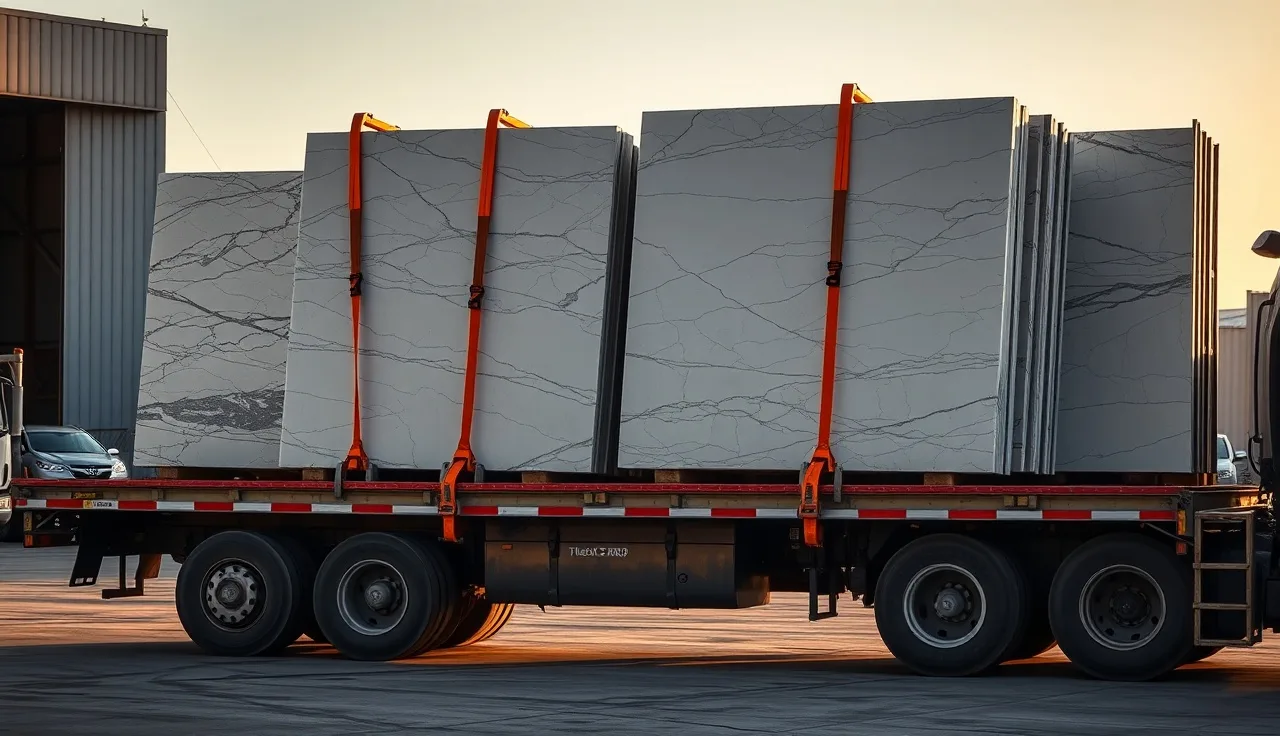
- Stone slabs ride upright on A-frames at 3 to 5 degrees past vertical, leaning toward the rack.
- Tie-downs must total at least half the load weight in working-load capacity, with a minimum of two straps, per 49 CFR Part 393.
- A 3 cm granite slab weighs 15 to 18 lbs per square foot, so a full slab pushes 700 lbs.
- Under-tension a strap and that mass moves.
Why does slab securement matter so much compared to other freight?
Stone slabs are dense, brittle, and top-heavy in ways most freight isn't. A 2 cm quartz slab measuring 60 by 130 inches weighs close to 500 lbs on its own. A 3 cm granite slab that size pushes 700 lbs or more. [1] Stack two on a badly angled rack and you're hauling over half a ton of material that can shift, crack, or come off the truck under hard braking.
The failure mode is different too. Slabs don't crumple or compress the way lumber and appliances do. They tip. When a slab breaks free of its restraint, it goes all at once, and the mass-times-velocity math turns ugly fast. FMCSA's cargo-securement rules exist partly because dense, rigid loads fail exactly this way. [2]
Slab delivery is one of the highest-liability legs of the whole job for a fabricator running trucks. Damage on a poorly secured load happens often enough that experienced shops treat securement as a fixed step, never a spot-check.
What federal rules govern stone slab cargo securement?
The governing standard is 49 CFR Part 393, Subpart I, which sets cargo-securement requirements for commercial motor vehicles. [2] It applies any time you move slabs on a vehicle with a gross vehicle weight rating (GVWR) over 10,000 lbs, which is nearly every flatbed or purpose-built slab truck on the road.
Three numbers carry most of the weight. Aggregate working load limit (WLL) of your tie-downs must be at least half the cargo weight. Cargo can't shift more than 3 inches in any direction. You need at least one tie-down per 10 feet of cargo length, and never fewer than two, no matter how short the load. [2][7]
No subsection names stone directly. Inspectors evaluate slab loads under the general cargo rules. The core language from FMCSA's securement standard: "Cargo must be firmly immobilized or secured on or within a vehicle by structures of adequate strength, dunnage or dunnage bags, shoring bars, tiedowns or a combination of these." [2]
State rules can run stricter. California's CHP enforcement mirrors the federal standard but with more active roadside inspection of flatbed loads. Check your state DOT before you treat federal minimums as the ceiling.
Most stone shops strap well past the federal floor anyway. A cracked slab or a failed roadside inspection costs far more than the ten seconds it takes to throw one more strap.
What is the right angle for A-frames and slab racks?
This is where shops get burned. Slabs should ride 3 to 5 degrees past vertical, leaning toward the back of the rack. [3] Dead vertical feels right and is actually the worst angle: any side-to-side sway in a turn can carry the slab past center, and then a single outer strap is holding the load instead of gravity.
The slight lean-back keeps gravity working for you, pressing the slab into the padded upright instead of fighting it. Lean too far, past roughly 10 to 12 degrees, and you load the bottom edge with shear stress. That's how corners chip and break before the truck ever reaches the site.
A-frames come in a few configurations. The common one for slab shops is a steel A-frame welded to the bed with adjustable cross-bracing. Double-sided A-frames (people call them "butterfly" or "cathedral" racks) let you load both sides and counterbalance weight, which helps handling. They also demand careful balancing to keep the truck's center of gravity in check.
Padding earns its place. Contact points between steel and stone need rubber or carpet at least 1/2 inch thick. Skip it and point loads land on slab edges, so you get chipping even when nothing goes wrong in transit. Fracture-prone stones feel this most, which matters for marble countertops and quartzite more than for granite.
How many straps do you need and what working load limit is required?
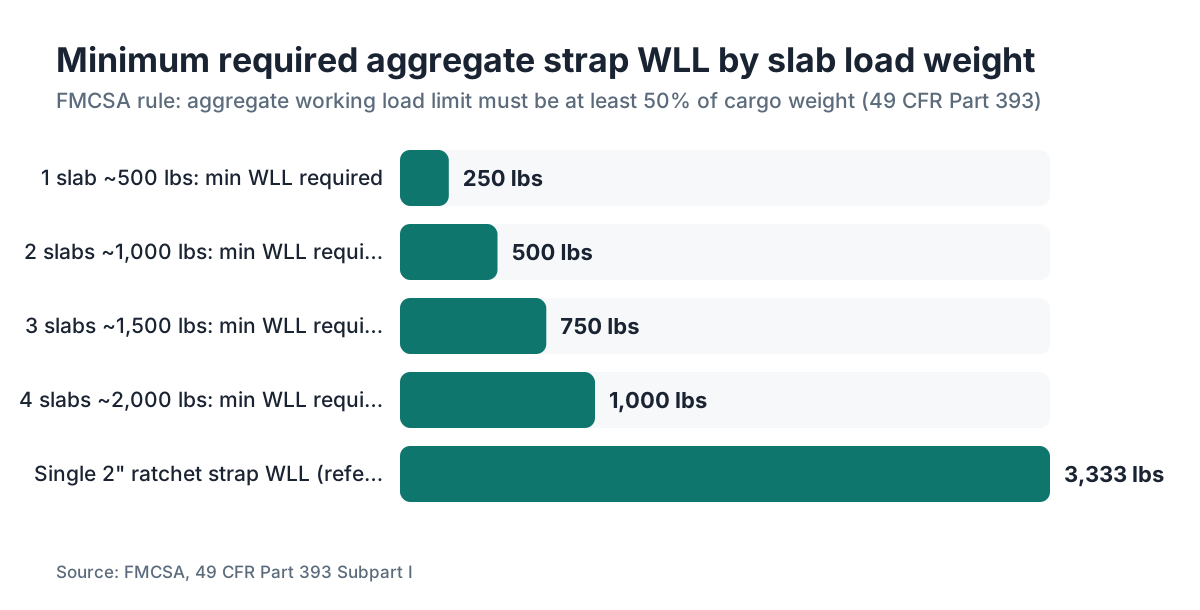
Federal minimums: aggregate WLL of tie-downs at least 50% of cargo weight, and at least two tie-downs. [2] Most experienced stone haulers run four straps per A-frame load section, two across the top third of the stack and two near the base, crossing in an X where the geometry allows.
Here's why four, not two. A 1,500 lb load (two to three slabs) needs a minimum aggregate WLL of 750 lbs. A single 2-inch web strap with an orange end fitting carries a WLL around 3,333 lbs, so one strap technically clears the federal minimum. The catch is shock loading. Emergency braking can spike dynamic force to two or three times the static weight. Four straps handle that reality. Two handle the paperwork.
Ratchet straps beat cam buckle straps for stone, and it isn't close. Cam buckles suit light, compressible freight. Stone is neither. Ratchets let you set consistent, measurable tension and re-tension mid-route if you hear something move.
Load binders (chain binders) come in for very heavy loads, like multiple thick slabs or a bundle of stacked remnants. Grade 70 or Grade 80 chain with proper hooks is common on flatbed stone trucks.
| Strap type | Typical WLL | Best use case for stone |
|---|---|---|
| 2" ratchet web strap | 3,333 lbs | Standard slab loads, A-frame |
| 4" ratchet web strap | 5,400 lbs | Heavy slab bundles, remnants |
| Grade 70 chain, 5/16" | 4,700 lbs | Very heavy loads, rough road |
| Cam buckle strap | 833 to 1,000 lbs | Not recommended for stone |
Retire any strap or chain with cuts, fraying, corrosion, or deformed hooks. FMCSA prohibits use of damaged tie-downs regardless of what strength is left in them. [2]
How should you load slabs to balance the truck properly?
Load the heaviest slabs closest to the rear axle, not out over the rear overhang. That keeps the center of gravity over the axle cluster, which sharpens braking and cuts rear-sag. Loading the overhang is a common miss on double-sided A-frames when a driver piles one side heavy first.
Mirror the weight left to right on double-sided racks as closely as you can. A 200 lb side-to-side imbalance shows up in handling on a highway curve. Weigh the stacks if you're running near axle limits, especially with cut pieces and remnants riding along.
Granite is denser than marble and quartzite, which run denser than engineered stone. A granite countertops slab and an engineered quartz slab of the same size can differ 10 to 15 percent in weight. Don't guess by eye. Get a weight chart from your supplier.
Remnants are harder than full slabs. Odd shapes, uneven weights, and they won't stand on a rack the way a full slab does. Most shops wrap them in moving blankets and strap them flat to the bed over anti-slip mats. A low-profile steel remnant rack that bolts to the bed pays for itself if you move remnants often.
One more thing. Never load slabs directly face to face without separation. Even with good rack padding, two slabs rubbing edge to edge over road vibration will chip. Put carpet squares or foam between them.
What type of truck or trailer is best for hauling stone slabs?
Purpose-built slab trucks are the standard everyone else measures against. Usually 16 to 24 foot flatbed or stake-body trucks with factory-welded A-frame racks, integrated anchor points, and often a hydraulic lift gate. They're common in stone import and distribution, and high-volume fabricators tend to justify owning one. [3]
Smaller shops and occasional runs do fine on a standard flatbed trailer or flatbed truck with a bolted-on A-frame, as long as the frame is rated and anchored to the bed. The anchor points for the A-frame legs need to be load-rated hardware, not whatever structural steel happened to be sitting there.
Pickups with A-frame inserts handle small loads, usually one to three residential slabs. They work, inside two limits: the truck's payload rating and the bed dimensions. A half-ton pickup carries roughly 1,500 to 2,000 lbs of payload depending on trim, and a few thick granite slabs blow past that. Read the GVWR sticker on the door jamb and stay under it.
Dump trucks and enclosed box trucks are poor picks for slabs. Dump trucks lack stable rack geometry. Enclosed trucks make securement and unloading miserable because you can't work from the side. Some shops run enclosed trailers for cut pieces and remnants, but full slabs belong on open trucks with side access.
If you're sizing a delivery fleet while running the rest of the shop, SlabWise can track which jobs need delivery runs and flag load weights during job planning, so you right-size the truck before the crew rolls out of the yard.
How do you load and unload slabs safely at the job site?
Unloading is where people get hurt. The slab is vertical and heavy, and you're working a driveway or garage with tight space and a floor that may not be level. Two people is the minimum for any slab over about 200 lbs. Three is smarter for anything full-size.
Slab carts (stone dollies, A-frame dollies) are the right tool for moving slabs off the truck and into position. A good one has padded uprights, locking casters, and enough height to clear a standard threshold. Never drag a slab flat across concrete. The edge contact chips it and the friction load is unpredictable.
Past about 600 lbs, a suction-cup lifting system is standard. Vacuum lifters rated for stone let two workers handle what would otherwise take four. Check suction on the actual slab surface before you lift. Porous stones like some quartzites and sandstones don't hold vacuum as well as polished granite or quartz.
Check the floor before you roll a loaded dolly. A 3/4-inch threshold or a soft subfloor section can tip a loaded cart. Bring transition ramps if there's any chance of it. Most edge-damage callbacks trace to the last 20 feet of the slab's trip, not the 20 miles on the truck.
For the countertop installation itself, coordinate so cabinets are set and level before the slab shows up. Carrying a slab through a half-built kitchen to wait on another trade is how it breaks.
What PPE and safety equipment do slab haulers need?
Cut-resistant gloves come first. Stone edges, especially freshly cut granite and quartzite, are as sharp as glass. Standard work gloves won't cut it. Look for ANSI cut-level D or higher on the ANSI/ISEA 105 scale.
Steel-toed boots with a composite shank are the baseline. A dropped slab corner on a leather boot ends the day. Some shops add metatarsal guards for anyone in the unloading zone.
Hearing protection matters less during delivery than in the shop, but if you run pneumatic tools or a masonry saw on-site during install, put it on. OSHA regulates silica dust from stone cutting under the construction standard, 29 CFR 1926.1153, with a permissible exposure limit of 50 micrograms per cubic meter of air as an 8-hour time-weighted average. [4] That's mostly a shop concern, but any on-site cutting triggers the rule.
Back braces have mixed evidence behind them. Trained lifting mechanics do not: bend at the knees, keep the load close, talk to your partner. The Bureau of Labor Statistics data shows musculoskeletal injuries as the leading nonfatal injury type in stone and tile work. [5]
How do you protect the slab surface from scratching and cracking during transit?
The finished face never touches bare steel. Full stop. Between the rack's steel uprights and the slab face, run at least 1/2-inch closed-cell foam or rubber. Plenty of shops glue carpet offcuts to the uprights, which works and costs almost nothing to replace.
Between slabs in a stack, carpet or foam cut to slab size is standard. For polished surfaces, some shops wrap the face in craft paper before loading, which also protects it during strapping. The strap itself never crosses the polished face. Route it over the top edge and down to the rack uprights or bed anchors.
High-value materials, like thin quartzite slabs or heavily patterned statement stones, sometimes ride in custom wooden crates. A crate adds labor and cost and nearly eliminates vibration scratching and edge contact. It's common for imported exotics that run $50 to $150 per square foot or more.
Inspect padding on a schedule. Rubber breaks down under UV and oil. Carpet wears through faster than you'd think. Padding that's compressed flat or cracked isn't doing the job it looks like it's doing.
What should a pre-trip securement checklist cover?
A written pre-trip checklist is more than good practice. It's the standard FMCSA inspectors ask about during a compliance review. [2] A complete slab-specific checklist covers five areas.
Rack and frame: All A-frame anchor bolts tight with no visible movement. Weld integrity at base points checked by eye. Padding on every contact point intact, not compressed flat.
Load: Slab count and approximate weight documented. Slabs separated with padding. No slab extends past the rear of the truck beyond the legal overhang (up to 4 feet without a red flag marker under FMCSA general rules). [2]
Tie-downs: Every strap or chain undamaged, properly rated, and seated correctly in its ratchet or binder. Tension verified after loading and again after the first 10 to 15 miles, which is the re-check stop most experienced haulers make. [9]
Vehicle: Tire pressure at spec for the load. Lug nuts checked. Trailer lights working if applicable. Mirrors set for the load configuration.
Documentation: Bill of lading or delivery order in the cab. Driver's CDL or correct license for the vehicle class. FMCSA hours-of-service records current if applicable. [10]
Keep the checklist in the cab and have the driver sign it. After an incident, a signed checklist is real documentation. A shop that can't produce one looks negligent whether or not the load was actually fine.
Does delivering stone slabs require a CDL?
It rides on the vehicle's GVWR, not on what you're hauling. A Class B CDL is required for any single vehicle with a GVWR over 26,001 lbs. [6] Purpose-built slab trucks in the 16-to-24-foot range have GVWRs between roughly 19,500 and 33,000 lbs depending on configuration, so some need a CDL and some don't.
Pickups and light-duty flatbeds used for small residential deliveries almost always sit under the 26,001 lb line and don't need a CDL. Once you step up to a heavy-duty truck, read the door-jamb sticker before you decide your driver is clear. A non-CDL driver in a CDL-required vehicle is an immediate out-of-service violation and a serious liability hole.
Some states add requirements around stone or aggregate transport, often scale compliance and weight tickets. California requires weight receipts for certain aggregate loads, for example. Check your state DMV and transportation agency.
For a mixed fleet, the practical move is getting key drivers their Class B CDL regardless of the current truck. It covers future equipment and ends any argument about who can drive what.
What are common mistakes that cause slab damage or accidents during delivery?
Under-tensioned straps top the list. Ratchet straps need real tension, more than a closed buckle. A hand-tight strap feels fine in the shop lot and lets a slab rock 2 inches on the highway. Put your weight into the handle.
Wrong rack angle is second. Slabs loaded dead-vertical or leaning forward toward the cab depend on friction and straps instead of geometry. Gravity should be your first line, not your backup.
Over-stacking is third. Three 3 cm slabs on a rack built for two shows up whenever a shop is dodging a second delivery run. The combined weight changes the load dynamics completely and usually exceeds the rack's rated capacity.
Skipping the re-check stop is fourth. Most securement failures in stone freight begin in the first 20 miles, because settling compresses padding and relaxes strap tension. Pull over after 15 minutes and re-tension everything. It costs four minutes.
Ignoring road conditions is fifth. A route with railroad tracks, unpaved access roads, or steep driveways calls for slower speeds and sometimes a different approach angle to keep the load from tipping. Drivers who run the same route daily get careless on the bad sections.
Sequencing helps more than it sounds. When you track which slabs are on which truck and in what delivery order, you avoid the misrouted stop that forces an unnecessary turnaround on a steep driveway. That turnaround is exactly where accidents happen.
Frequently asked questions
How many straps are required to secure stone slabs on a truck?
Federal rules under 49 CFR Part 393 require at least two tie-downs regardless of cargo length, with aggregate working load limit (WLL) at least 50% of the cargo weight. In practice most stone haulers run four straps per load section, because shock loading during braking can spike forces to two or three times the static weight. Two straps meet the letter of the law. Four straps meet the physics.
At what angle should stone slabs sit on an A-frame rack?
Slabs should lean 3 to 5 degrees past vertical toward the rear of the rack. That angle puts gravity on your side, pressing the slab into the padded upright instead of leaving straps to do all the work. Dead vertical is unstable. More than 10 to 12 degrees concentrates shear stress on the bottom slab edge and drives chipping.
What type of straps work best for securing stone on a delivery truck?
Ratchet web straps are the right call for stone. A 2-inch ratchet strap carries a working load limit around 3,333 lbs, and the ratchet lets you set and hold real, measurable tension. Cam buckle straps work for light compressible freight but can't maintain the tension stone needs. Grade 70 or Grade 80 chain with binders is the alternative for very heavy slab bundles.
Do I need a CDL to deliver stone slabs?
It depends on the truck's GVWR, not the cargo. A Class B CDL is required for any single vehicle with a GVWR over 26,001 lbs. Many purpose-built slab trucks land in that range. Lighter flatbeds and pickups used for small residential deliveries usually don't require a CDL, but always read the door-jamb sticker for the actual GVWR before assuming.
What padding should go between the rack and the stone slab?
At least 1/2-inch closed-cell foam or rubber at every contact point between the steel rack and the stone. Between adjacent slabs in a stack, use carpet squares or foam cut to size. Never let a polished slab face touch bare steel. Inspect padding regularly, since rubber degrades under UV and carpet compresses and wears through with use.
How much can stone slabs weigh and how does that affect truck selection?
A 2 cm slab runs roughly 12 to 14 lbs per square foot; 3 cm is 15 to 18 lbs per square foot. A full granite slab at 60 by 120 inches and 3 cm thickness weighs around 650 to 750 lbs. Stacking a few slabs easily beats a half-ton pickup's payload rating. Check the truck's GVWR and rated payload before loading, and use a rated slab truck for larger deliveries.
Is it safe to haul stone slabs in a pickup truck?
For small loads, yes, with the right setup. A half-ton pickup typically has a payload rating of 1,500 to 2,000 lbs depending on configuration. One or two residential slabs, secured on a bolt-in A-frame rack and inside the payload limit, deliver safely. Beyond two 3 cm slabs you're likely over the limit. Always verify the truck's specific payload capacity and use rated anchor points.
What causes stone slabs to crack during delivery?
The usual causes: slabs leaning forward instead of slightly back (wrong A-frame angle), thin padding that allows edge-to-edge contact over road vibration, over-stacking past the rack's capacity, and under-tensioned straps that let small movements build into large oscillations. Corner chipping almost always traces back to contact with bare steel or another slab with no padding between them.
How do you safely unload stone slabs at a job site?
Use a slab cart or A-frame dolly with padded uprights and locking casters. Two people minimum for slabs over 200 lbs, three for full-size heavy slabs. Vacuum lifters rated for stone simplify handling. Check the floor for thresholds and soft sections before rolling. Never drag a slab flat. Route it into the space before cabinets come out or trades are working the path.
What PPE should stone slab delivery crews wear?
Cut-resistant gloves at ANSI cut-level D or higher, steel-toed boots with a composite shank, and eye protection during any on-site cutting. OSHA's silica standard (29 CFR 1926.1153) sets a permissible exposure limit of 50 micrograms per cubic meter for respirable crystalline silica if cutting happens on-site. Back injuries are the most common issue, and proper lifting mechanics with a partner matter more than a back brace.
How often should straps be re-tensioned during a stone delivery run?
Pull over and re-check strap tension after the first 10 to 15 miles, or about 15 minutes of driving. Load settling compresses padding and relaxes ratchet tension early in the trip, which is when most securement failures start. After the initial re-check, inspect again at any stop longer than a few minutes. The routine adds a few minutes and prevents most mid-route shifts.
What documentation should be in the cab during a stone slab delivery?
Carry the bill of lading or delivery order, the driver's license (and CDL if the vehicle requires one), FMCSA hours-of-service logs if applicable, and a signed pre-trip securement checklist. The checklist documents that straps were inspected and tensioned before departure. In a roadside inspection or after an incident, that paperwork is the difference between a clean report and a negligence finding.
Are there federal cargo-securement rules specific to stone?
Stone slabs fall under the general cargo-securement requirements in 49 CFR Part 393, Subpart I, since no stone-specific subsection exists in FMCSA rules. The general rules require aggregate tie-down WLL of at least 50% of cargo weight, a minimum of two tie-downs, and cargo that can't shift more than 3 inches. Inspectors evaluate stone loads under these standards and can issue out-of-service orders for violations.
What is the maximum rear overhang allowed for stone slabs on a truck?
Under FMCSA general rules, cargo may extend up to 4 feet past the rear of the vehicle before a red warning flag is required in daylight, with a red light or reflector required at night. Some states set stricter limits. Beyond 6 feet of overhang, some jurisdictions require a follow vehicle and permits. Overhanging stone is also a pedestrian hazard at job sites, so keep it minimal even when it's technically legal.
Sources
- Natural Stone Institute (formerly Marble Institute of America), stone weight reference guidance: Natural stone slabs at 3 cm thickness weigh approximately 15 to 18 lbs per square foot depending on the density of the stone type.
- FMCSA, 49 CFR Part 393 Subpart I: Protection Against Shifting and Falling Cargo: Federal cargo-securement rules require aggregate WLL of tie-downs at least 50% of cargo weight, a minimum of two tie-downs, and cargo that cannot shift more than 3 inches; the standard also requires cargo to be 'firmly immobilized or secured on or within a vehicle.'
- Natural Stone Institute, safety and transportation resources: Industry guidance recommends A-frame racks with slabs angled 3 to 5 degrees past vertical toward the rack for safe stone transport.
- OSHA, Respirable Crystalline Silica standard (29 CFR 1926.1153), construction: OSHA's silica standard for construction sets a permissible exposure limit of 50 micrograms per cubic meter of air as an 8-hour time-weighted average for respirable crystalline silica.
- Bureau of Labor Statistics, Injuries, Illnesses, and Fatalities program: Musculoskeletal disorders are consistently among the leading nonfatal injury types in stone, glass, and tile work occupations.
- FMCSA, Commercial Driver's License requirements: A Class B CDL is required for any single vehicle with a GVWR over 26,001 lbs.
- FMCSA, cargo securement rules and driver resources: FMCSA requires at least one tie-down per 10 feet of cargo length, with a minimum of two tie-downs regardless of cargo length.
- FMCSA, cargo securement guidance for flatbed loads: Re-checking and re-tensioning tie-downs after the first portion of a trip is standard practice recommended for dense, rigid loads that can settle and compress padding.
- FMCSA, Hours of Service regulations: Commercial vehicle drivers operating vehicles over 10,001 lbs GVWR in interstate commerce are subject to FMCSA hours-of-service record requirements.
Last updated 2026-07-10