TL;DR
- Cutting a cooktop opening in quartz takes a 4-inch angle grinder or circular saw fitted with a continuous-rim diamond blade, run wet or with a vacuum shroud, at low RPM.
- Mark the cutout from the cooktop template, drill 3/8-inch holes at each corner, then cut slowly.
- One wrong move cracks an irreplaceable slab.
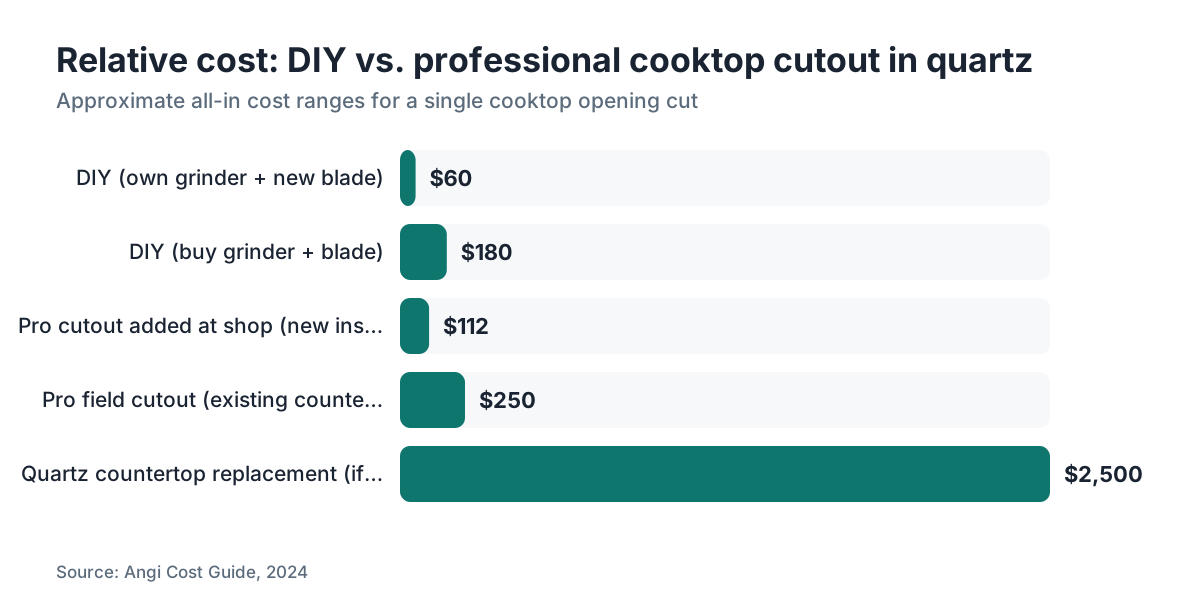
- Most fabricators charge $75 to $200 to add a cutout.
Can you cut a cooktop opening in quartz yourself, or is this a job for a fabricator?
You can cut quartz yourself. Homeowners do it every day with the right blade and enough patience. Quartz is one of the more punishing materials for a DIY cutout, though, because it's engineered stone, roughly 90 to 93% bound quartz aggregate set in polymer resin [1]. That density makes it harder than most natural stone on a blade, and it chips badly at the kerf if you rush or grab the wrong tool.
A fabricator has a CNC router or a water-cooled bridge saw that makes a clean edge in minutes. If you're already having a slab fabricated and installed, the cooktop cutout belongs in that original job. Cutting it at the shop, before installation, beats doing it in place on your cabinets every time.
The DIY question really shows up in three spots: you're swapping an old cooktop for one with different dimensions, you bought a slab that got installed without a cutout, or a fabricator cut an opening that's the wrong size. In those cases, cutting in place is sometimes the only road.
Honest risk read: the most common failure is a crack that runs from a cutout corner toward the nearest slab edge. That totals a countertop that cost $2,000 to $6,000 [2]. If your counter has less than 3 inches between the cooktop opening and the front edge, or veining that runs diagonally across that zone, pay the fabricator. I would.
What tools do you need to cut a quartz cooktop opening?
The blade is everything. You need a continuous-rim diamond blade, sometimes sold as turbo-rim or segmented continuous rim, rated for wet cutting of stone or engineered stone. A 4-inch blade on an angle grinder is the standard for in-place cutouts. A 4-1/2 inch or 7-inch continuous-rim blade on a circular saw works too, but a circular saw fights you on plunge cuts and corners.
Blade speed matters. Most stone fabricators run diamond blades on quartz at 3,000 to 4,000 surface feet per minute (SFPM), which comes out to roughly 5,000 to 6,000 RPM on a 4-inch blade [3]. Too fast, and the heat burns the resin binder and dulls the diamond segment quickly. Too slow, and the blade drags and chips the edge.
Here's the full tool list:
- Angle grinder (4 or 4-1/2 inch) or circular saw
- Continuous-rim diamond blade, 4 to 7 inch, rated for engineered stone or porcelain
- Drill with a 3/8-inch masonry or diamond-tipped drill bit
- Water source or a vacuum-shroud dust extraction system
- Masking tape
- Pencil or silver Sharpie
- Straight-edge clamps or guide rails
- Safety glasses, hearing protection, N95 or P100 respirator (mandatory, not optional)
- A helper or suction-cup handle to hold the cutout piece as it drops free
On dust: quartz dust carries respirable crystalline silica. OSHA's permissible exposure limit for respirable crystalline silica is 50 micrograms per cubic meter of air as an 8-hour time-weighted average [4]. A single dry cut on quartz with no ventilation can blow past that limit in seconds. Wet cutting or HEPA vacuum shroud extraction isn't safety theater. It's the line between a morning project and long-term lung damage.
What does the cooktop template tell you, and how do you mark the cutout?
Every drop-in or slide-in cooktop ships with a paper or cardboard cutout template. It gives the exact opening size, always smaller than the cooktop's total footprint so the lip overlaps the stone and hides the edge. Use that template. Don't improvise dimensions off the cooktop's outer frame.
If the template is missing, the owner's manual states the cutout dimensions. For common 30-inch cooktops, a typical cutout runs 28-1/2 inches wide by 19-1/2 inches deep, but this swings by brand and model by as much as a half-inch in each direction. Check the manual for your exact unit.
To transfer the template:
- Find the centerline of the base cabinet opening and mark it lightly on the countertop surface.
- Center the template left-to-right on that mark, then set it front-to-back at the manufacturer's minimum distance from the front edge (usually 2 to 4 inches for the cooktop lip to clear).
- Tape the template down so it can't shift.
- Trace the cutout line with a pencil or silver marker on masking tape. The tape protects the surface from scratches, and the pencil line reads clearly on tape.
- Pull the template and re-check all four dimensions with a tape measure before you drill anything.
How do you make the entry holes for the saw blade?
Diamond blades can't plunge-cut cleanly from zero on quartz the way a jigsaw does on wood. You need a starter hole at each corner of the cutout rectangle.
Drill a 3/8-inch hole at each of the four corners, just inside the cutout line, so the hole sits in the waste piece that falls out, not on your finished slab. Use a diamond-tipped core bit or a masonry bit. Keep drill speed low and feed water or a wet sponge to the bit the whole time. Quartz fights a dry bit and can crack from the heat.
The hole needs room for your blade to enter and start the cut. A 3/8-inch hole is the minimum for a 4-inch blade. Some fabricators drill 1/2 inch for more clearance. You want a round entry that lets you ease the blade in without forcing it.
After drilling, clamp a straight-edge to the slab surface as a cutting guide. Freehanding a straight 20-inch cut on quartz gives you a wavy edge that shows under the cooktop lip if it's even slightly off, and it can cause fit problems.
What is the correct cutting technique for quartz?
Slow is the rule. Quartz cuts best at a feed rate that feels almost uncomfortably slow. If you're moving faster than about 1 inch every 2 to 3 seconds, you're going too fast for in-place DIY work.
The sequence for each side:
- Set the blade in the drilled corner hole with the tool off.
- Start the tool and let the blade reach full RPM before it touches stone.
- Move along the clamped straight-edge in one steady direction with light, even forward pressure. Don't rock or twist.
- Stop before you reach the next corner hole. Let the blade coast to a full stop before you back it out.
- Move to the next corner and work toward the previous stop point to connect the cut.
Cut the three shorter passes first (two short sides, one long side). Leave one long side for last. Before that final cut, use suction cups or have a helper hold the waste piece from below so it doesn't drop and torque the slab as the last inch of stone releases. A falling cutout has cracked plenty of slabs at that final moment.
Wet cutting: if you're running water, aim it at the blade-stone contact point without stopping. A spray bottle in a helper's hand works fine. The water holds blade temperature down and knocks silica dust into a slurry instead of the air.
Do not stop mid-cut and restart from the same spot. Blade wobble on restart causes chipping. If you have to stop, back the blade all the way out, then re-enter from the corner hole side.
How do you finish and polish the cut edge inside the opening?
The raw cut edge inside the cooktop opening almost always hides under the cooktop's frame. Most homeowners never touch it. But if your cooktop has a frameless design with visible edges, or you're the type who notices rough cuts even when nobody else will, you'll want to smooth the edge.
Diamond hand-polishing pads work well on quartz edges. They come in progressive grits, typically 50, 100, 200, 400, 800, 1500, and 3000. Start at 50 or 100 grit if the cut edge is heavily chipped, or 200 to 400 if it's just rough from the saw. Work wet, move the pad in small circular strokes, and step up through the grits until the edge matches your countertop surface.
For a standard factory finish on engineered quartz, aim for roughly a 400 to 800 grit honed look on the interior edge. Hand pads alone won't match a fully polished surface.
One practical reality: the interior edge of a drop-in cooktop cutout will never be seen by anyone. Spending two hours polishing it is your call, but I wouldn't bother unless the cooktop needs a smooth seating surface for its gasket.
What can go wrong, and how do you avoid the most common mistakes?
Cracking at the corners is far and away the most common failure. It happens when the blade gets forced through a corner instead of approaching from a drilled hole, or when the operator tries to pivot the blade in the cut to change direction. Quartz has no tolerance for lateral blade stress. Always drill the corners. Always stop before the corner and come back at it from the other direction.
Chipping along the cut line usually points to one of three things: a worn-out blade, too much speed, or a segmented blade meant for concrete instead of a continuous-rim blade for stone. A worn diamond blade skips and chatters. If it seems glazed, dress it by tapping a few passes against a whetstone block or a concrete edge before you cut.
Slab cracking from vibration shows up when the cabinets don't fully support the stone near the cut zone. Before cutting, check that the slab sits well-supported on all sides of the planned opening. Any flex when you press on the countertop means the cut will send vibration through the stone in ways you can't predict.
Dimensional errors are preventable only by measuring twice. A cutout that's 1/4 inch too large won't get covered by the cooktop lip. There's no fix except a new countertop.
For fabricators running job-site cutouts or re-cuts, a tool like SlabWise can track cooktop specs per job so the right dimensions get confirmed before anyone picks up a blade. Errors at the template stage cost far less to fix than errors in stone.
How much does it cost to have a fabricator cut the cooktop opening?
A cooktop cutout added to a new fabrication job typically costs $75 to $150 as a line item [2]. Done at the shop on a bridge saw or CNC, it's a 5-minute operation, and the price covers template setup and machine time.
A field cutout, where a fabricator drives to your home to cut an opening in an already-installed counter, costs more: usually $150 to $350, depending on your region and the shop's minimum service call fee. Some shops won't do field cuts at all because of the liability if something cracks.
Emergency re-cuts (wrong size from the factory, a new cooktop with different dimensions) sometimes carry a premium because they need a site visit and the risk runs higher. Get a written scope before you agree to any field cut.
For context, a quartz slab costs roughly $50 to $120 per square foot installed, putting a 30-square-foot kitchen counter at $1,500 to $3,600 [2]. Paying $200 to have the cutout done right is cheap insurance against cracking a $2,000 slab.
Are there any building codes or manufacturer rules about cooktop cutouts in quartz?
No federal building code governs how a cooktop cutout gets made in stone. The National Electrical Code (NEC), NFPA 70, governs the electrical connections to the cooktop itself, including circuit sizing (a 240V, 40 to 50 amp circuit for most electric cooktops) and clearances from combustibles, but it says nothing about countertop cutting methods [5].
Local jurisdictions may require a permit for the electrical work in a cooktop swap even when the countertop work needs none. Check with your building department. In California, for example, a new or altered 240V branch circuit typically needs an electrical permit under Title 24 [6].
On the manufacturer side, nearly every major quartz brand, Cambria, Silestone, and Caesarstone included, puts cutout guidelines in its installation instructions. These usually give minimum edge distances (the gap from cutout edge to slab edge, typically 1.5 to 3 inches minimum), corner radius requirements (some call for a minimum 3/8-inch radius at interior corners to cut stress concentration), and whether field cutting voids the warranty.
Cambria's published installation guidance, for one, states that field modifications including cutouts should be done by a trained fabricator and that improper cutting voids the warranty. Caesarstone's technical documentation likewise gives minimum distances from cutouts to slab edges. Read your specific brand's paperwork before cutting, because the warranty stakes are real.
For kitchen countertops in general, the clearances between a cooktop and nearby surfaces like walls, cabinets, and overhead microwaves come from the cooktop manufacturer's installation manual, not a universal code.
How is cutting quartz different from cutting granite or other stone countertops?
Quartz (engineered stone) and granite both cut with diamond blades, but they behave differently under the saw.
Granite is natural stone with mineral hardness that varies across the slab. It can chip unevenly based on crystal grain orientation, but it generally doesn't crack catastrophically from a corner if you're careful. Quartz engineered stone is more uniform, but the polymer binder heats up and gums the blade if you don't hold your speed and cooling.
Marble, travertine, and softer natural stones cut easier than either quartz or granite because they sit lower on the Mohs hardness scale. Marble countertops take the same diamond blade at a slightly faster feed rate.
Laminate countertops like Formica countertops cut with a jigsaw and a fine-tooth blade, no diamond required. The technique is a different animal.
Butcher block and butcher block countertops cut with a jigsaw or circular saw and a wood blade. Far more forgiving for DIY.
Corian countertops (solid surface) cut a lot like dense hardwood, using a router and straight bit. Solid surface is the friendliest material for DIY cutouts.
For granite countertops, the DIY process is nearly identical to quartz: diamond blade, drilled corners, slow feed, wet cut. The one difference is granite forgives heat at the blade contact point a bit more, because there's no polymer resin to degrade.
The table below sums up the key cutting differences:
| Material | Best tool | Blade type | Corner drilling | Wet cut required |
|---|---|---|---|---|
| Quartz (engineered) | Angle grinder / circ saw | Continuous-rim diamond | Yes | Strongly yes |
| Granite | Angle grinder / circ saw | Continuous-rim diamond | Yes | Strongly yes |
| Marble | Angle grinder / circ saw | Continuous-rim diamond | Yes | Recommended |
| Laminate (Formica) | Jigsaw | Fine-tooth bi-metal | No | No |
| Solid surface (Corian) | Router | Straight carbide bit | No | No |
| Butcher block | Jigsaw / circ saw | Wood blade | No | No |
What safety precautions are non-negotiable when cutting quartz?
Silica dust is the main hazard, and it's serious enough to sit at the top of your list. OSHA's silica standard for construction (29 CFR 1926.1153) requires engineering controls, meaning wet methods or local exhaust ventilation, when cutting or grinding materials that contain crystalline silica [4]. Quartz countertop material is roughly 90% crystalline silica [1]. A P100 half-face respirator is the minimum respiratory protection for dry cutting. An N95 isn't adequate for high-silica dry cutting under OSHA guidance.
Eye protection: a full face shield over safety glasses, not glasses alone. Diamond blade segments can shed at high RPM.
Hearing: an angle grinder cutting stone runs 95 to 105 dB at the operator's ear. OSHA's action level for hearing protection is 85 dB over 8 hours, and peak exposures matter too [7]. Wear plugs or muffs.
Secure the slab. Never cut a countertop that isn't fully supported on its cabinet base. If the slab rocks or flexes, stop and add support before cutting.
Keep bystanders out of the room. Blade debris and slurry travel.
Turn off the gas or electricity to the cooktop location before you touch anything. This sounds obvious, but people forget, especially when they're swapping a gas cooktop and the shutoff valve sits underneath the counter.
When should you just replace the countertop instead of cutting an opening?
A few situations make cutting in place a worse bet than replacement or a full re-fabrication:
The new cooktop is bigger than the old one and you need to widen an existing opening. Widening a quartz cutout in place, without a bridge saw or CNC, gives you ugly results and real crack risk.
The existing slab has visible cracks or repairs near the planned cut zone. Any existing weakness multiplies the odds of a cut-induced crack.
The countertop is a waterfall-edge or mitered design with structural silicone joints near the cooktop location. Vibration from cutting can open those joints.
The distance from the planned cutout edge to the nearest countertop edge is less than 2 inches. Most fabricators won't warranty a cutout that close to an edge, and for good reason.
For countertop installation projects where the cooktop moves to a different location on the counter entirely, replacement is almost always cheaper than trying to patch the old opening and cut a new one.
If you end up needing a full replacement or a new fabrication quote, SlabWise's instant quote tool gives you a real price from your slab dimensions and edge profiles without a sales call.
Frequently asked questions
Can I use a regular circular saw blade to cut quartz?
No. A standard carbide wood-cutting blade will shatter on quartz in seconds. You need a continuous-rim diamond blade rated for stone or engineered stone. These cost $20 to $60 for a 4-inch version and stock at most home improvement stores or online stone supply shops.
How long does it take to cut a cooktop opening in quartz?
Allow 2 to 4 hours for a DIY in-place cut including setup, marking, drilling corners, making the four cuts, and cleanup. A professional fabricator with a bridge saw or CNC does the same cut in 10 to 15 minutes at the shop. Field cuts by a pro take longer because of setup and dust containment.
Do I need to cut quartz wet, or can I dry cut it?
Wet cutting is strongly preferred, and in many professional settings OSHA's silica standard requires it. Dry cutting without a HEPA vacuum shroud creates dangerous airborne silica dust. Dry cutting also overheats the blade and the resin binder in engineered quartz, wrecking cut quality. Use water or a vacuum-shroud system.
What is the minimum distance from a cooktop cutout to the edge of a quartz slab?
Most quartz manufacturers specify a minimum of 1.5 to 3 inches between the cooktop cutout edge and the nearest slab edge. Cambria, Caesarstone, and Silestone all publish minimum edge distances in their installation guides. Going closer than 1.5 inches raises crack risk sharply, and most fabricators won't warranty a cutout that close.
What corner radius do you need at the inside corners of a cooktop cutout?
A radius of at least 3/8 inch (about 10mm) at each inside corner is the standard recommendation from most stone fabricators and several quartz manufacturers. Sharp 90-degree inside corners concentrate stress and are a primary cause of crack propagation. The drilled entry hole naturally creates a radius if you size it at 3/8 inch.
Will cutting a cooktop opening void my quartz warranty?
It can. Cambria and Caesarstone both state in their installation guidelines that field modifications should be done by a trained fabricator and that improper cutting can void coverage. If your countertop is still under warranty, contact the fabricator or manufacturer before making any cuts. A professional shop cut typically does not void the warranty.
Can I enlarge an existing cooktop opening in quartz for a bigger cooktop?
Technically yes, but it's one of the riskier in-place cuts you can make. Widening an opening means cutting parallel to an existing edge with very little material left in between, which drives up crack risk. If the new cooktop runs more than about 1/2 inch wider or deeper than the existing opening, a professional shop cut or countertop replacement is the safer path.
What blade size is best for cutting a quartz countertop opening?
A 4-inch or 4.5-inch continuous-rim diamond blade on an angle grinder is the standard for in-place field cuts. It gives good maneuverability and enough depth to cut through a standard 3/4-inch or 1-1/4-inch quartz slab. Larger blades (7-inch) on a circular saw can work but are harder to control for plunge entries and corner approaches.
How do I support the cutout piece so it doesn't crack the slab when it drops?
Use suction cups attached to the waste piece before the final cut. One suction cup per side works, or have a helper reach underneath the cabinet opening to support the piece from below. The moment the last inch of stone releases, the waste piece can torque sharply, and that sudden movement has cracked many slabs at the last second.
Is it cheaper to DIY the cooktop cutout or hire a fabricator?
Tool and blade costs for a single DIY cutout run $40 to $80 if you already own an angle grinder, or $120 to $200 with a new grinder. A professional field cut costs $150 to $350. On pure economics they're close. Factor in that a cracked slab costs $1,500 to $3,600 to replace, and paying a fabricator looks like the better bet unless you have stone-cutting experience.
What RPM should I run the angle grinder for cutting quartz?
For a 4-inch continuous-rim diamond blade on quartz, 5,000 to 6,000 RPM is the general target, which produces roughly 3,000 to 4,000 surface feet per minute at the blade rim. Most 4-inch angle grinders run 10,000 to 12,000 RPM at no load, so use the grinder's speed control if it has one, and let the blade do the work without forcing it.
Can you cut a gas cooktop opening the same way as an electric cooktop opening?
Yes, the cutting process is identical. The cooktop opening is just a rectangular hole in the stone regardless of whether gas or electric equipment goes in. The difference is in the utility connections, not the stone work. For gas, turn off the gas supply valve and verify zero pressure before cutting, since even a small spark from a blade on stone can ignite residual gas.
What do I do if the quartz cracks during cutting?
Stop immediately. Don't try to finish the cut. If the crack sits in the waste piece only, you may be able to proceed carefully, but get a second opinion. If the crack runs into the finished countertop surface, the slab may be salvageable with epoxy color-fill repair by a professional stone restorer, but a crack that reaches an edge usually means replacement.
Sources
- USGS National Minerals Information Center, Silica statistics and information: Engineered quartz countertop material is approximately 90 to 93% crystalline quartz aggregate bound in polymer resin
- Angi (formerly HomeAdvisor), Quartz Countertop Cost Guide: Quartz countertops cost $50 to $120 per square foot installed; cooktop cutouts typically add $75 to $150 to a fabrication job
- OSHA, Controlling Silica Exposures in Construction (stone fabrication guidance): Recommended surface speed for diamond blades on engineered stone is 3,000 to 4,000 SFPM; wet cutting controls dust and heat
- OSHA, Occupational Exposure to Respirable Crystalline Silica, 29 CFR 1926.1153: OSHA permissible exposure limit for respirable crystalline silica is 50 micrograms per cubic meter as an 8-hour TWA; engineering controls are required for cutting silica-containing materials
- NFPA 70, National Electrical Code (NEC), Article 422 Appliances: NEC Article 422 governs electrical connections and circuit requirements for built-in cooktops, typically 240V 40 to 50 amp circuits
- California Energy Commission, Title 24 Building Energy Efficiency Standards: California Title 24 and local codes require permits for new or altered 240V branch circuits, including cooktop installations
- OSHA, Occupational Noise Exposure, 29 CFR 1910.95: OSHA action level for hearing conservation is 85 dB over an 8-hour TWA; angle grinders cutting stone typically produce 95 to 105 dB at the operator
- CDC/NIOSH, Silica and engineered stone fabrication health hazards: Cutting and grinding engineered stone generates high respirable crystalline silica exposures linked to silicosis in fabrication workers
- Marble Institute of America / Natural Stone Institute, Dimension Stone Design Manual: Industry guidance recommends minimum distances from cutouts to slab edges and corner radii to reduce stress concentration in stone countertops
- OSHA, Silica in Construction: Table 1 Specified Exposure Control Methods: OSHA Table 1 for construction requires wet methods or local exhaust ventilation when cutting or grinding materials containing crystalline silica
Last updated 2026-07-11