
TL;DR
- A dedicated countertop templater measures and maps your kitchen or bath before any stone gets cut.
- Hiring one means checking for material-specific experience, verifying liability insurance, confirming they use digital tools, and knowing that pay runs about $18 to $28 per hour or $75 to $150 per template.
- A good templater catches expensive cut errors before the saw touches the slab.
What does a countertop templater actually do?
A countertop templater visits the job site before any stone is cut and makes an exact map of every surface that needs material. That map is called a template. It captures the dimensions of your countertop run, the sink cutout location, the cooktop opening, the angle of every inside and outside corner, and whether the walls are actually square (they almost never are).
Templates used to be cut from thin strips of luan plywood or cardboard, then hauled to the shop so a CNC machine or hand cutter could follow the outline. Most professional templaters now use digital systems. A handheld laser or probe reads the room and sends a file straight to the CNC software. Both approaches work. Digital catches subtle wall-bow errors that a cardboard strip can miss.
The templater's job ends when a verified, dimensioned file or physical template leaves the site. Everything after that, the cutting, polishing, and drop-in, belongs to the fabrication and installation team. That narrow focus is exactly why some shops hire a dedicated person to do nothing else.
Why hire a dedicated templater instead of using your fabrication crew?
Most small shops hand templating to whoever is free that morning: a fabricator, an installer, sometimes the foreman. That works when volume is low. Once a shop runs 15 or more jobs a week, using fabricators as templaters turns into a daily scheduling fight. The fabricator who drove to an 8 a.m. template appointment is not at the saw at 8 a.m., and material sits idle.
A dedicated templater fixes throughput. One person can template four to six kitchens in a single day. A fabricator splitting duty might manage two before he has to be back for afternoon production. For shops above roughly 10 to 12 jobs a week, a dedicated role often pays for itself in less rework and faster turnaround.
Homeowners face a slightly different question. You are not hiring a templater as an employee. You are hiring one through a fabrication shop. So the real choice is between a shop that runs a dedicated specialist and a shop where someone doubles up. Shops that invest in a specialist tend to hold tighter tolerances and eat fewer remakes. A single granite remake on a kitchen can cost $800 to $2,500 in material and labor alone, so the math on hiring well is not subtle [1].
If you are planning kitchen countertops or a full countertop installation, ask the shop directly: who does your templates, and how many have they run?
What skills and experience should a countertop templater have?
The core skill is spatial reading. Walk into a room, see where the walls are out of plumb, spot a sink that is not centered on the cabinet, and turn all of it into a measurement file that produces a part that fits. This is not abstract. It comes from repetition.
For a dedicated hire, look for:
- At least 12 months of hands-on templating experience, not general construction measuring. Framing carpenters measure well. That does not make them stone templaters.
- Familiarity with the materials being templated. Granite countertops and marble countertops behave differently under expansion than engineered quartz, though the templating process is mostly the same. Material knowledge matters when the templater decides how tight to scribe against a wall.
- Experience with the shop's actual system, digital or physical. If your shop runs Slabsmith or a Proliner, a templater trained only on cardboard needs a ramp. Ask about it up front.
- Clear communication. A templater who finds a plumbing stub-out two inches off the plan needs to flag it on the spot, not bury a note in the file.
Some templaters also handle sink removal and a rough cabinet check before the full crew arrives. That scope varies by shop.
How much does a countertop templater get paid?
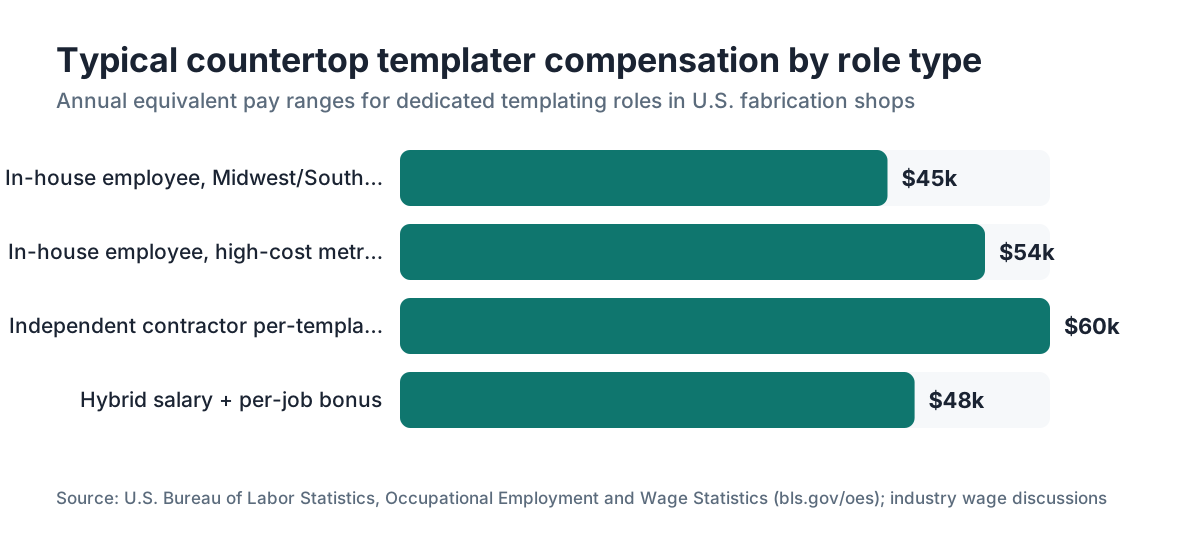
Pay depends on whether the templater is an employee or a contractor, and on your regional labor rates. Based on national wage data, the 2024 picture looks roughly like this [2]:
| Role type | Typical pay range | Notes |
|---|---|---|
| In-house employee (hourly) | $18 to $28/hr | Median around $21 to $23 in Midwest/South; $25 to $28 in high cost-of-living metros |
| Independent contractor (per template) | $75 to $150 per template | Varies with job complexity and travel |
| Hybrid (salary + per-job bonus) | $40,000 to $55,000/yr | Common in mid-size shops |
These numbers do not come from a single federal survey specific to templaters. BLS files this work under installation and repair trades, so the figures above are a composite of industry forums, job postings, and fabrication wage discussions. The honest answer is that nobody publishes a clean dataset just for countertop templaters.
Here is a practical rule for shops. If a dedicated templater prevents one granite remake a month at $1,200 in losses, the position pays for $24,000 in annual wages at the floor, before you count a dollar of throughput gain.
Should a templater be an employee or an independent contractor?
This is a legal question, not a preference. The IRS uses behavioral control and financial control tests to decide whether a worker is an employee or a contractor [3]. If you direct when, where, and how the templater works, supply the tools, and they work only for you, the IRS will likely call them an employee no matter what your contract says.
Misclassifying an employee as a contractor exposes a shop to back payroll taxes, penalties, and state labor board action. Several states, including California under AB5 and Massachusetts, run stricter classification rules than the federal standard [4].
For most fabrication shops, a full-time dedicated templater is an employee. A sub who templates for three or four different shops on a per-job basis has a stronger case for contractor status.
If you are a homeowner even thinking about this, you are almost certainly dealing with a shop employee. The classification question belongs to the shop owner.
What equipment does a professional templater need?
Physical templating needs a tape measure, a long level, a scribing tool, pencils, and sheets of luan or cardboard cut into manageable strips. Total cost is under $50. That is why physical templating refuses to die.
Digital templating uses a laser measurement device. The most common in U.S. shops are the Proliner from Prodim and various LT2D3D systems. A Proliner runs $8,000 to $15,000 new. Used units show up on the secondary market for $3,000 to $6,000. These devices capture a room profile as a digital file that feeds straight to a CNC or waterjet, skipping the manual transfer step where error creeps in.
For a dedicated hire, the shop usually supplies the digital device. If the role is independent contracting, settle who owns and maintains the equipment before the first job. A contractor who owns a calibrated Proliner commands a premium rate because they bring capital equipment, more than labor.
Some shops also send templaters out with a camera or tablet to photograph edge conditions, existing tile backsplashes, and plumbing rough-ins. That documentation kills callbacks.
How do you vet a templater before hiring?
The trial run tells you more than the interview. Ask for a working reference from a fabrication shop that can speak to the accuracy of the templates, not the candidate's attitude on the job. If someone's templates keep coming back with fit issues, the shop will tell you.
Check these specifics:
- Ask them to describe the last time a template caused a fabrication error and what happened next. A real templater has a story. Claiming it never happened is a red flag.
- Watch them template one job before you commit. See whether they check for square on every corner, how they handle a cabinet run that is not level, and whether they document their process or work from memory.
- Verify insurance. A templater working in finished homes should carry general liability at minimum. If they damage a cabinet, a homeowner's floor, or fresh tile during templating, someone has to cover it. Some shops add templaters to their own policy. A sub should carry their own.
- Check for a background in measurement-critical trades: stone installation, tile setting, cabinetry. Pure general labor with no precision history takes longer to train.
For shops running digital systems, add a hands-on test on the actual device.
What questions should homeowners ask about templating before signing a fabrication contract?
As a homeowner, you are probably not hiring a templater directly. You are hiring a fabrication shop, and the templater is their person. The questions you ask still tell you a lot about shop quality.
Ask these:
- Who does your templates, and how many have they run? This separates shops that respect the step from shops that treat it as an afterthought.
- Digital templating or physical? Either is fine. Digital is faster and usually more accurate on complex layouts.
- What happens if the template is wrong and my stone gets cut incorrectly? Get the answer in writing. Good shops eat remakes. Some do not.
- How far in advance do cabinets need to be installed before you can template? Uppers and lowers should be fully set and level, appliances roughed in, and the sink location confirmed. Rushing this is a top cause of errors.
- Can I be present for the template appointment? You should be. Being there lets you confirm sink placement, overhang depth, and edge profile in person.
If you are comparing materials like Cambria countertops or laminate countertops, know that engineered products often carry stricter installation tolerances than laminate, which makes an accurate template matter even more.
How long does a countertop template appointment take?
A standard kitchen runs 45 to 90 minutes for an experienced templater using a digital device. Physical templating on the same kitchen takes about the same or a little longer, because strips have to be labeled and organized for transport.
Bathroom vanities go faster, usually 15 to 25 minutes each. A whole-house job with several bathrooms plus a kitchen might run 2.5 to 3.5 hours on-site.
What slows a template down: walls that are badly out of plumb and need extra scribing, cabinets that are not fully installed or are still getting adjusted, appliances that have not shown up yet (the templater cannot confirm a 30-inch range opening if the range is not there), and complex features like waterfall edges or integrated drainboards.
Schedule the template only after cabinets are 100 percent set and level, not 90 percent. The half-day you save by templating early usually costs you a full remake day later.
What are the most common templating mistakes and how do you prevent them?
The most expensive templating error is a wrong sink location. A sink cut two inches left of where it belongs on a granite slab means the slab is scrap. You cannot patch granite. Verify the sink rough-in at the template appointment, not after.
Other common misses:
- Not checking cabinets for level before templating. A half-inch bow the templater ignores becomes a stone that rocks or gaps.
- Assuming inside corners are 90 degrees. In older homes they rarely are. Skip the check and you get a visible gap at the wall.
- Skipping the seam conversation. Long runs have to be seamed. Seam location changes both appearance and strength. Decide it at template time, with the homeowner, not back at the shop.
- Unlabeled physical template pieces. If the vanity strips and the island strips get mixed up in the truck, the mistake might not surface until the stone is already cut.
Digital systems reduce these errors. They do not erase them. A Proliner captures what you point it at. Point it at the wrong datum and the file is still wrong.
How does templating connect to countertop fabrication software?
A digital template outputs a DXF or proprietary file that feeds straight into fabrication software. That software runs nesting, the process of arranging cut parts on a slab to minimize waste, and generates the CNC toolpaths.
When the template file is clean and accurate, the rest of the shop runs faster. When it is riddled with small errors, fabricators burn time correcting before they cut, or they hit problems mid-job. Both are expensive.
Shops that run the full pipeline from quote through nesting in one platform get the most out of accurate templates. SlabWise, for one, connects quoting and nesting so what got measured in the field ties directly to material usage, which keeps job cost estimates honest. That kind of integration makes a skilled templater worth even more, because their accuracy compounds across every step downstream.
If you run a shop and want to see how tight template-to-nest workflows cut material waste, the demo is worth a look.
What are the legal and insurance requirements for a countertop templater?
At the federal level, there is no license specific to countertop templating. It is not a licensed trade the way electrical or plumbing work is. That does not make it unregulated.
Workers' compensation is required for employees in all 50 states, with narrow exceptions for very small employers [5]. If a templater wrenches their back lifting a heavy template board in a customer's kitchen and they are your employee, your workers' comp covers it.
General liability insurance covers property damage at the job site. A templater who tips a newly set cabinet, chips a tile floor, or dents a homeowner's appliance during a visit creates a claim. Shops should confirm their GL policy covers templating work, and independent contractor templaters should carry their own.
For granite countertops and heavier stone, some states require the fabrication business to hold a contractor's license for installation work. Templating alone is generally not installation, but the line blurs if the templater is also pulling old tops or doing light prep. Check your state's contractor licensing board [7].
OSHA's general industry standards apply to shop employees, including templaters who come back to the facility [6]. Job-site rules like fall protection and PPE on active construction sites may also apply, depending on the condition of the site during a template visit.
When does hiring a dedicated templater not make sense?
If a shop runs fewer than eight jobs a week, a dedicated templater probably does not pay. The role needs enough daily volume to keep one person busy. Below that line, the throughput math falls apart, and cross-training fabricators to template well is the smarter move.
Solo fabricators doing custom residential work usually template their own jobs, and for good reason. The person who measured knows exactly what was tricky about the fit. Splitting that role in a one-person shop breaks the feedback loop that makes the work good.
For homeowners, there is no normal scenario where you hire a templater separately from a fabrication shop for a standard kitchen. The template is part of the fabrication service. If someone pitches you a standalone templating fee for a standard job, scrutinize it.
The exception is large commercial work, where an owner-hired project manager might want an independent template verification before a shop's file goes to cut. That exists. It is unusual.
Frequently asked questions
How much does a countertop templating appointment cost?
Most fabrication shops fold the template into the overall project price. When it is broken out, expect $75 to $150 for a standard kitchen template and $25 to $50 per bathroom vanity. Shops that charge separately often waive the fee if you go ahead with fabrication. Ask before you schedule.
Can a homeowner do their own countertop template to save money?
Technically yes, but most shops will not cut from a homeowner-supplied template, because doing so shifts fit liability onto them. A few accept homeowner measurements for simple straight runs. Add any complexity, corners, curves, or sink cutouts, and a professional template is the only practical path to a correct cut.
How do I find a freelance countertop templater?
Start with local stone trade associations and fabrication supply dealers, who often know the independent templaters in your area. Stone-specific job boards exist but are thin. Asking a regional fabrication shop whether they know a sub taking work is usually the fastest route. Proliner owners who freelance sometimes advertise in stone trade Facebook groups.
What is digital templating and is it better than cardboard templates?
Digital templating uses a laser-probe device like a Prodim Proliner to capture a room's exact dimensions as a computer file. It removes the manual transfer step of cardboard templates, which is where many errors start. Digital is generally more accurate on complex layouts and feeds directly to CNC machines. Physical templates still work fine for simple straight runs and cost almost nothing in materials.
How far in advance should I schedule a template appointment?
Schedule it only after your cabinets are fully installed and level. Most shops can template within one to two weeks of your call, but the bottleneck is usually cabinet readiness, not the shop's calendar. Do not call to schedule until every cabinet is set, shimmed, and the installer has signed off.
What should cabinets look like before a templater arrives?
All uppers and lowers should be mounted, leveled, and secured to the wall. Appliance cutouts should be confirmed. The sink location should be decided. Island cabinets should be anchored to the floor. If the plumber has not finalized the sink rough-in, reschedule rather than guess. A templater working off unfinished cabinets produces an inaccurate template.
What happens if a countertop template is wrong after stone is cut?
If the shop's templater made the error, a reputable shop remakes the piece at their cost. If the error traces to homeowner-supplied measurements or cabinets that moved after templating, cost allocation depends on the contract. Get the remake policy in writing before you sign. Some shops offer no guarantee. Most good ones cover fabrication errors.
Do templaters need to be present when the sink is installed?
No, but the sink model must be confirmed before templating. The templater needs the exact sink dimensions to lay out the cutout. Undermount cutouts in particular must match the sink's rim exactly. Changing sink models after templating can force a full redo if the cutout dimensions differ meaningfully.
Is there any certification for countertop templaters?
There is no nationally recognized certification specific to countertop templating. The Natural Stone Institute runs training programs for stone fabrication and installation broadly, and some device makers like Prodim offer courses on their equipment. Experience and reference-verified accuracy are the real credentials in this trade.
How many templates can a dedicated templater do in a day?
Four to six kitchen templates a day is realistic for an experienced templater on a digital system, assuming the jobs are geographically clustered. Physical templating at the same volume is possible but slower to document and transport. Vanity-only jobs go faster. Traffic, distant sites, and complex layouts all cut into that number.
What is the difference between a templater and a countertop installer?
A templater measures the space before stone is cut. An installer delivers and sets the finished stone after it is cut. Different jobs, different skills. Some people do both, but higher-volume shops keep them separate. The templater's accuracy decides whether the installer's day is simple or a problem-solving marathon.
Should I tip the countertop templater?
Tipping is not a standard expectation in the countertop trade. Templaters are paid a wage or a per-job rate by the shop. A cold drink on a hot day always lands well. If you want to recognize great work, a positive review of the shop that names the templater does more for them professionally than cash.
Sources
- National Kitchen and Bath Association, kitchen remodeling cost research: Granite countertop remakes in residential kitchens can cost $800 to $2,500 in material and labor; NKBA is the primary industry body tracking kitchen remodeling costs.
- U.S. Bureau of Labor Statistics, Occupational Employment and Wage Statistics: BLS groups countertop templating under installation and repair trades; wage data for related precision measurement roles shows a national median in the $20 to $25/hr range for skilled installation trades.
- IRS, Independent Contractor (Self-Employed) or Employee guidance: The IRS uses behavioral control, financial control, and type-of-relationship tests to determine worker classification; misclassification triggers back payroll taxes and penalties.
- U.S. Department of Labor, Wage and Hour Division, worker classification: Several states, including California under AB5 and Massachusetts, apply stricter worker classification standards than the federal test.
- U.S. Department of Labor, Workers' Compensation overview: Workers' compensation coverage is required for employees in all 50 states, with narrow exceptions for very small employers in some states.
- OSHA, General Industry Standards (29 CFR 1910): OSHA's general industry standards apply to shop employees including templaters who work in fabrication facilities; construction site exposure rules may apply on active job sites.
- Natural Stone Institute, fabrication and installation standards: NSI is the primary trade body for the stone fabrication industry; it publishes installation and measurement standards relevant to templating practice.
- U.S. Small Business Administration, hire and manage employees guide: SBA guidance on hiring employees vs. independent contractors references the IRS classification test and state-level variations that affect small fabrication businesses.
- U.S. Bureau of Labor Statistics, Occupational Outlook Handbook, construction and extraction occupations: BLS OOH data for construction and installation trades provides wage and employment context for templating-adjacent skilled measurement roles in residential settings.
Last updated 2026-07-11