TL;DR
- Stone shop inspections focus on three things: crystalline silica dust exposure (OSHA PEL is 50 µg/m³ as an 8-hour TWA), process wastewater discharge (EPA effluent limits under the Clean Water Act), and hazardous waste handling.
- Shops that run wet cutting, keep exposure monitoring records, and have a written hazard communication program pass most inspections without surprises.
What do environmental inspectors actually look for in a stone fabrication shop?
Inspectors from OSHA, the EPA, or your state environmental agency are not there to fail you. They work from checklists. Learn the checklist and you can walk it yourself.
Four areas take up most of their attention: worker exposure to respirable crystalline silica, process water and slurry management, hazardous materials storage, and air emissions from dust-generating equipment. Noise, stormwater control, and chemical labeling come next.
Most stone shops answer to several rulebooks at once. OSHA 29 CFR 1910.1053 (general industry) or 29 CFR 1926.1153 (construction) covers silica. EPA's Clean Water Act rules govern wastewater discharge. State agencies stack their own air-quality and solid-waste permits on top of both [1][2].
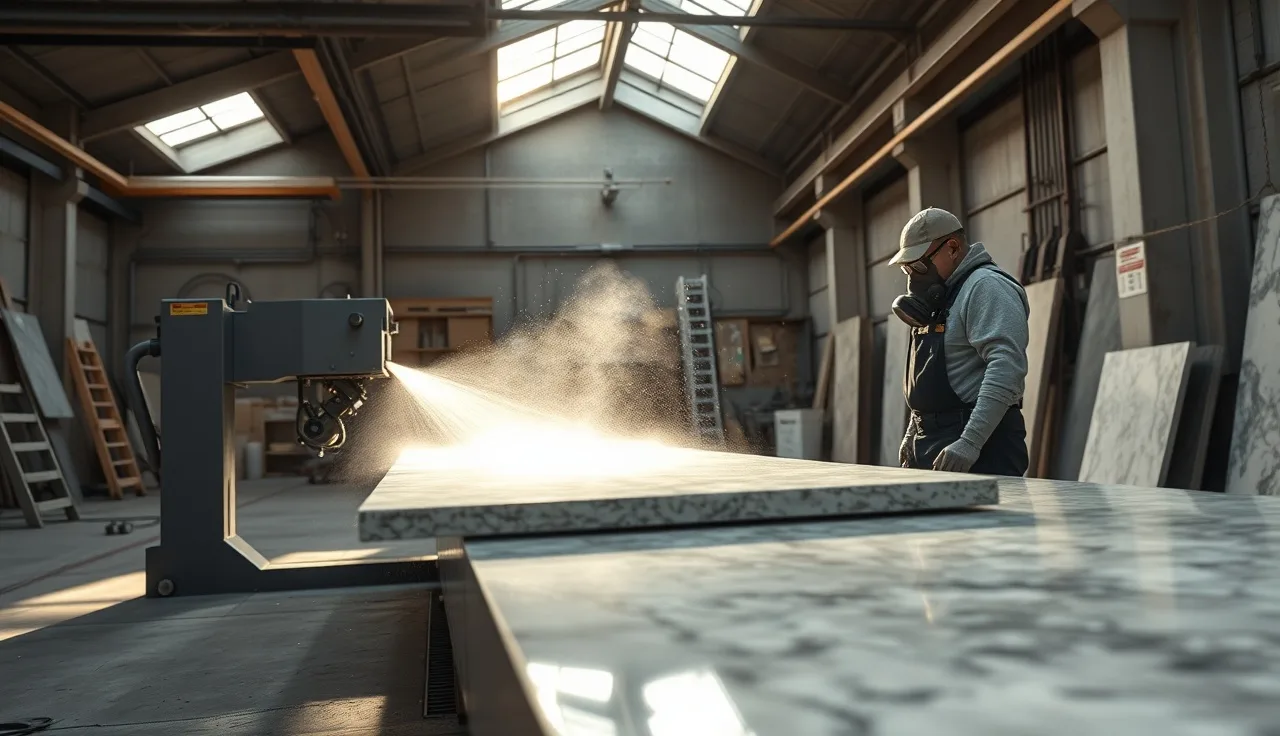
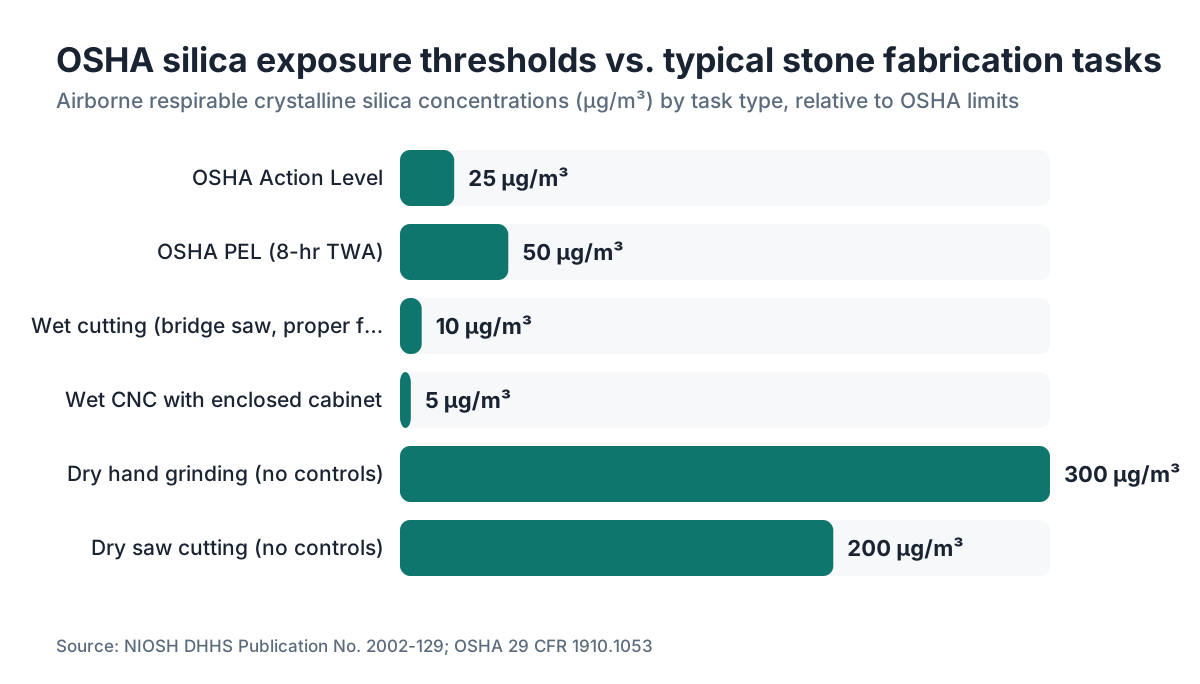
Silica dust is the finding inspectors write up most. The OSHA permissible exposure limit (PEL) for respirable crystalline silica is 50 micrograms per cubic meter of air (µg/m³) as an 8-hour time-weighted average. The action level that triggers mandatory medical surveillance is 25 µg/m³. Those two numbers drive most of the compliance work you owe [1].
What are the OSHA silica rules for stone fabricators specifically?
OSHA's silica standard 29 CFR 1910.1053 took full effect for general industry, which covers most countertop shops, on June 23, 2018. It requires a written Exposure Control Plan, air monitoring or reliance on the engineering controls in Table 1 of the construction standard, medical surveillance for any worker exposed at or above 25 µg/m³ for 30 or more days a year, and training [1].
The engineering controls are specific. Wet methods (a water-fed blade or water suppression at the cutting tool) come first. Local exhaust ventilation (LEV) at grinders, routers, and CNC heads runs a close second. Run wet cutting with the water flowing properly and you may qualify for Table 1 compliance on those tasks, which means you document the controls instead of sampling the air for them.
Air monitoring still applies to dry-cut work and any task Table 1 doesn't list. Monitoring uses NIOSH analytical method 7500 or 7602 for quartz, or 7603 for cristobalite [3]. Keep the results at least 30 years.
Medical surveillance starts when a worker hits the action level (25 µg/m³) for 30 or more days a year. It covers a medical exam, chest X-ray (or CT), and spirometry every three years, or more often if the physician says so [1]. The employer pays.
Engineered quartz products can run 90 percent crystalline silica or more by weight. Granite countertops run 25 to 60 percent [4]. Inspectors know those numbers cold, and they assume silica is a hazard in your shop until your monitoring data proves otherwise.
How do you manage process wastewater and stone slurry legally?
Every CNC machine, saw, and polisher running wet makes slurry: water, stone dust, and cutting debris mixed together. That slurry is regulated. You cannot pour it down a floor drain tied to the municipal sewer without knowing your local pretreatment rules. You cannot put it in a storm drain at all [2][5].
Under the Clean Water Act, sending process wastewater to a publicly owned treatment works (POTW, meaning the city sewer) means meeting local pretreatment standards. Stone slurry runs high in total suspended solids (TSS) and can sit outside the pH range of 6.0 to 9.0 that most industrial pretreatment ordinances allow. Before you discharge, call your POTW's pretreatment coordinator and get a determination [5].
Most shops handle it one of three ways:
- A settling tank that drops the stone fines out, discharges the cleared water to sewer, and sends the settled solids off as solid waste.
- A closed-loop or recirculating system that reuses process water, tops off with makeup water now and then, and barely discharges at all.
- A licensed vacuum hauler that picks up the slurry on a schedule.
The settled solids usually count as non-hazardous solid waste. But if you cut engineered composites with resins or colorants, pay for a waste characterization analysis before you assume non-hazardous status.
Stormwater is a separate problem. Any slurry or stone dust that can reach a parking-lot drain, a loading-dock drain, or bare ground might trigger an NPDES stormwater permit, depending on your state and facility size [2]. Keep wash-down water and slurry contained inside the shop.
What permits does a stone shop typically need before an inspection?
It varies by state, county, and shop size. Here is the common set.
| Permit type | Governing body | When required |
|---|---|---|
| Air quality permit (dust) | State environmental agency | Usually if you have CNC equipment or spray finishing |
| Industrial pretreatment permit | Local POTW | If you discharge process water to city sewer |
| NPDES stormwater permit | EPA or state | Construction sites and some industrial categories |
| Hazardous waste generator ID | EPA/state (RCRA) | If any waste meets hazardous criteria |
| Business operating permit | City/county | General requirement |
Plenty of stone shops fall below the threshold for a formal air permit because wet cutting suppresses airborne dust that far. That is no reason to skip the question. Call your state environmental agency, ask them to classify your operations, and get the classification in writing. An inspector who finds you running without a required permit writes a notice of violation whether your real emissions are low or not [6].
On the RCRA side, stone shops use lubricants, coolant additives, and sometimes adhesives that can turn into listed or characteristic hazardous waste. Generate under 100 kilograms a month and you are a conditionally exempt small quantity generator (CESQG), with lighter requirements. Between 100 and 1,000 kg/month puts you in the small quantity generator (SQG) class. Know which one you are [7].
How do you set up a written Exposure Control Plan that passes inspection?
OSHA's silica rule wants a written Exposure Control Plan built for your shop. A template you pulled off the internet does not count unless you've edited it to match your real machines, real tasks, and real controls. An inspector spots a generic plan in about 30 seconds.
Your plan has to identify each task that makes silica dust, describe the engineering controls for each one (wet cutting, LEV, enclosed cab), list any respirators used as backup, name the person running the plan, spell out the housekeeping rules that keep dust down (no dry sweeping, no compressed air), and set a schedule for reviewing the plan at least once a year [1].
Housekeeping is where shops get caught. Dry sweeping stone dust off the floor violates the silica standard. Blowing dust off surfaces with compressed air is banned. You need wet methods (damp mop, wet vacuum) or HEPA-filtered vacuums. Post a sign if you have to: no dry sweeping, no compressed air for cleanup.
Respiratory protection under OSHA 29 CFR 1910.134 kicks in when engineering controls alone can't hold exposures below the PEL, or as extra protection. Require respirators and you need a written respiratory protection program, fit testing, medical clearance, and training. Half-facepiece respirators with N95 or P100 filters are the usual floor for silica. Powered air-purifying respirators (PAPRs) do better on high-exposure tasks [8].
What records does an inspector ask to see on the day of an inspection?
Keep these in a physical binder and somewhere you can pull them up electronically. Inspectors don't care how thick the binder is. They care whether you can produce the specific document they ask for in about two minutes.
Records they typically request:
- Exposure monitoring results (silica air sampling), including the lab chain of custody
- Written Exposure Control Plan, dated and signed
- Respiratory protection program and fit test records for each worker
- Medical surveillance records (kept confidential, but you show they exist and are current)
- Safety Data Sheets (SDS) for every chemical in the shop: adhesives, sealers, lubricants, blade coolants
- Hazard communication training records showing date, content, and employee signatures
- Waste manifests or disposal receipts for slurry hauling and any hazardous waste
- Stormwater or wastewater discharge permits and any self-monitoring logs
- Equipment maintenance logs for wet-cutting systems and LEV, to prove the controls work
OSHA silica monitoring records stay for 30 years. SDS for a chemical you've stopped using stay 30 years after last use [1]. Medical records stay for the length of employment plus 30 years [8].
If you run software to manage job documentation, link your maintenance logs and equipment records to job records. SlabWise's shop tools, for one, let you attach equipment notes to job files so the records don't live only in a paper binder somebody can misplace.
Here's a trap: training records with no substance. A line reading 'silica training, 3/14/2025' with four signatures beats nothing, but barely. The record should show what was covered, who taught it, and how long it ran.
How do wet cutting systems reduce inspection risk, and what can go wrong?
Wet cutting is the strongest engineering control for silica in stone fabrication, full stop. Water applied at the blade or tool suppresses respirable dust right at the source. NIOSH found that properly applied wet cutting cuts airborne silica by 90 percent or more against dry cutting [3].
But 'wet cutting' only counts when the water is actually flowing, in enough volume, at the right spot. Inspectors check this directly. A clogged feed, a low-flow line, or a nozzle aimed wrong leaves you with a dust problem even though you think you're running wet. Check flow rates against the equipment maker's specs on a schedule and write down the checks.
CNC machines with enclosed water cabinets give you the best control. Bridge saws with top-spray bars come next. Handheld angle grinders with continuous water feed take the most watching, because a worker can bypass the water in a second.
Wet-system failures inspectors flag:
- Water supply line clogged or kinked
- Flow rate below the manufacturer's minimum
- Water not reaching the tool-to-material contact point
- Operators dry-cutting a short section 'just to finish' a cut
- Equipment left unmaintained, so the water system runs unreliable
Keep a maintenance log. Date it. Note the flow-rate check and who did it. That log turns a possible citation into a non-event.
What are the most common violations found in stone shop inspections?
OSHA inspection data and guidance from the Natural Stone Institute and NIOSH point to the same repeat findings [1][3][9]:
- No written Exposure Control Plan, or a generic one that doesn't match operations.
- No air monitoring data, and operations not fully covered by Table 1 controls.
- Dry sweeping or compressed air used for cleanup.
- Respirators worn with no written program or fit testing.
- Missing or outdated SDS for chemicals on-site.
- Hazard communication training not documented.
- Slurry sent to a storm drain or sewer with no permit or pretreatment.
- Wet-cutting equipment not maintained, documented, or running at adequate flow.
- Medical surveillance never started for workers at or above the action level.
- Workers not trained on silica hazards in a language they understand.
Language counts on that last one. OSHA requires hazard communication and training delivered so workers understand it. If your crew speaks Spanish, Portuguese, or another language, your training materials and SDS have to reach them. OSHA publishes silica hazard information in Spanish [1].
Fines land hard. Willful OSHA violations can reach $161,323 per violation as of 2024, adjusted annually for inflation. Serious violations top out at $16,131 per violation [10]. One inspection with several findings adds up fast.
How should you prepare in the 30 days before a scheduled or anticipated inspection?
Most inspections come unannounced. You often sense one is coming anyway: you're in a targeted industry (stone fabrication sits on OSHA's National Emphasis Program for silica), a worker filed a complaint, or you logged a recordable injury. Run the shop as if an inspector walks in Monday.
When you do get notice (some state environmental agencies schedule visits), work this 30-day sequence.
Weeks 1-2: Pull every record and find the gaps. Is the Exposure Control Plan current? Are monitoring results within the past 12 months? Are fit tests current (annual)? Are medical exams current? Fix the paperwork first, because paperwork gaps are the fastest citations to write.
Weeks 2-3: Walk the floor as the inspector would. Check every wet-cutting station. Is water flowing? Check the LEV hoods and look for dust piling up, a sign of weak suction. Check the slurry collection system. Look at chemical storage: containers labeled, incompatibles separated, secondary containment under liquids.
Week 3: Verify waste disposal paperwork. Do you have manifests for the last 12 months of slurry hauling? Do you know your RCRA generator category?
Week 4: Brief the crew. Every worker should know four things: where the SDS binder or system lives, how to report a new chemical brought on-site, what to do when the water system on their machine fails (stop, report, do not dry cut), and where respirators are stored and how to don them.
An inspector talks to workers alone, no management in the room. Workers who can answer basic questions about their own controls signal a shop that runs right.
What happens during the actual inspection, and what are your rights?
An OSHA inspector (compliance safety and health officer, or CSHO) shows credentials and explains why they're there. You get an opening conference, a walk-through with a management representative, and a closing conference where the inspector sums up the findings.
You have the right to walk with the inspector. Use it. Take your own notes. Photograph whatever the inspector photographs. If they take a reading, log the time, location, and number. Your own record can matter later if you contest a citation.
Employees can have a representative on the walk-through too, and workers can talk to inspectors in private. You cannot tell workers to stay quiet.
Asked for a document you don't have on hand? Request time to produce it. Don't guess. 'I need to check that and get back to you' beats a wrong answer that lands in the record.
State environmental inspections (air, water, waste) run much the same. The inspector wants permits, watches operations, collects samples if warranted, and reviews records. Many state agencies send a written report 30 to 60 days out. Answer any findings in writing and keep copies of everything.
Get a Notice of Violation or a citation and you can contest it. For OSHA citations, the contest window is 15 working days from receipt [10]. Miss it and the citation becomes final.
How does shop size or specialty affect what inspectors focus on?
A two-person granite shop faces the same silica hazard as a 40-person shop, but the requirements scale somewhat by size.
Small shops (under 10 workers) get no pass on OSHA's silica standard. They can, though, use OSHA's free on-site consultation program, which runs separately from enforcement. A safety professional visits, points out hazards, and gives you time to fix them before an enforcement officer ever shows. Consultations are confidential, and no citations come out of a consultation visit. The program operates in every state [11].
Shops cutting high-silica engineered stone (quartz composite countertops) carry a higher baseline exposure, because engineered stone can run 90 to 95 percent crystalline silica. Australia, the U.K., and several other countries have banned or heavily restricted dry fabrication of engineered stone over silicosis cases in workers [4]. The U.S. has no outright ban as of mid-2025, but NIOSH and OSHA have put out joint hazard alerts on engineered stone. Inspectors in a quartz shop dig deeper into your controls.
Shops that do sink cutouts with angle grinders run the highest peak exposures. Your saw can run wet all day, but a worker dry-grinding a sink reveal throws off enormous silica in a short burst. Table 1 of the construction standard covers grinders only when they have integrated water delivery or HEPA local exhaust. Check your grinder setup against that list.
How can ongoing recordkeeping prevent future inspection problems?
Shops that pass inspections year after year treat compliance as a routine, not an event. Dated records happen on a schedule, whether or not anyone expects an inspector.
Three things worth building into weekly or monthly operations:
First, a monthly equipment check log. Walk each wet-cutting machine, check water flow, check LEV suction (a manometer, or even a tissue held to the hood, tells you if there's pull), and note repairs. Date it, sign it.
Second, a training calendar. Schedule a silica refresher at least once a year. Track attendance. New hires get trained before they start work, not sometime during week one.
Third, a chemical inventory review. Every time a new product lands in the shop (a new blade coolant, sealer, adhesive), get the SDS and log it before the container opens. Inspectors check whether an SDS exists for every chemical in current use.
For job tracking and operational records, fabrication software like SlabWise can tie job files to maintenance and materials records, closing the gap between production and compliance paperwork. A well-organized paper binder still beats a messy digital system, so pick the one you'll actually keep up.
The silica rule keeps air monitoring records on file for 30 years. Build that retention in on day one instead of reconstructing records when a worker files a claim a decade later.
Frequently asked questions
Does OSHA's silica rule apply to a small countertop shop with just a few employees?
Yes. OSHA 29 CFR 1910.1053 applies to every general industry employer with workers exposed to respirable crystalline silica, no matter the company size. There is no small-business exemption. Small shops can use OSHA's free on-site consultation program to find and fix hazards before an enforcement inspection ever happens.
What is the OSHA permissible exposure limit for silica in a stone shop?
The OSHA PEL for respirable crystalline silica is 50 micrograms per cubic meter of air (µg/m³) as an 8-hour time-weighted average. The action level is 25 µg/m³. Exposures at or above the action level for 30 or more days a year trigger mandatory medical surveillance and air monitoring under 29 CFR 1910.1053.
Can I dispose of stone slurry in the sanitary sewer?
Not without checking with your local publicly owned treatment works (POTW) first. Stone slurry is high in suspended solids and can fall outside the pH limits in local pretreatment ordinances. Many jurisdictions require a pretreatment permit or a determination letter before you discharge. Discharging to a storm drain is prohibited under the Clean Water Act.
How often does a stone shop need to do silica air monitoring?
OSHA requires periodic monitoring whenever exposure may reasonably be expected to exceed the action level. Use Table 1 engineering controls for all covered tasks and you can rely on objective data instead of personal sampling. Any dry cutting or task not on Table 1 requires personal air sampling. Results above the action level require more frequent monitoring.
What respirator is required for cutting stone with high silica content?
OSHA requires at minimum an N95 filtering facepiece respirator when engineering controls alone can't hold exposures below the PEL. For higher-exposure work like dry grinding, a half-facepiece with P100 cartridges or a powered air-purifying respirator (PAPR) protects better. Any required respirator use needs a written respiratory protection program and annual fit testing behind it.
What records does OSHA require a stone shop to keep for silica compliance, and for how long?
Air monitoring records stay for 30 years. Medical surveillance records stay for the length of employment plus 30 years. Written Exposure Control Plans, training records, and respirator fit test records should stay for the length of employment plus at least three years. Safety Data Sheets for discontinued chemicals stay 30 years after last use.
Is engineered quartz more dangerous from a regulatory standpoint than natural granite?
Yes, in practice. Engineered quartz can run 90 to 95 percent crystalline silica by weight, against roughly 25 to 60 percent for granite. NIOSH and OSHA have issued joint hazard alerts specifically about engineered stone silicosis risk. Inspectors apply closer scrutiny to quartz shops, and Australia has banned dry fabrication of engineered stone entirely.
What is OSHA's National Emphasis Program for silica, and does it affect stone shops?
OSHA's National Emphasis Program (NEP) for silica directs compliance officers to proactively inspect high-exposure industries, including stone product manufacturing and countertop fabrication. Being in a targeted industry means your shop is more likely to draw an unannounced inspection than a business in a lower-risk sector. Current records and controls are the only reliable protection.
What is the penalty for an OSHA violation found during a stone shop inspection?
As of 2024, serious OSHA violations carry a maximum penalty of $16,131 per violation. Willful or repeat violations can reach $161,323 per violation. Penalties adjust annually for inflation under the Federal Civil Penalties Inflation Adjustment Act. An inspection with multiple violations can push total fines into six figures, plus the cost of abatement.
Do I need a stormwater permit for my stone fabrication shop?
Possibly. Under EPA's NPDES stormwater program, industrial facilities in certain Standard Industrial Classification (SIC) codes must get a permit if stormwater that touches industrial materials can discharge to surface waters. Stone product manufacturing may fall under this. Contact your state environmental agency to learn whether your operations need an industrial stormwater permit.
What is the RCRA generator category for a typical stone shop, and what does it mean?
Most stone shops that generate small amounts of hazardous waste from lubricants or adhesives fall into the conditionally exempt small quantity generator (CESQG) category, which covers facilities generating under 100 kg of hazardous waste per month. CESQG status carries lighter storage and disposal rules than SQG or LQG status, but you must characterize your waste accurately to confirm it.
Can workers refuse to talk to an OSHA inspector?
Workers have the legal right to speak with an OSHA compliance officer in private, and employers cannot prohibit or discourage those conversations. Workers can also decline an interview, though OSHA may issue a subpoena in formal investigations. Coaching workers to say specific things, or telling them to refuse to speak, can itself become a violation.
How do I contest an OSHA citation after a stone shop inspection?
You have 15 working days from receipt of the citation to file a Notice of Contest with OSHA. Miss the deadline and the citation becomes final with penalties due. File the contest in writing to the OSHA area director. Cases go to the Occupational Safety and Health Review Commission (OSHRC). Many citations settle in an informal conference before any formal hearing.
Does dry sweeping stone dust violate OSHA rules?
Yes. OSHA's silica standard prohibits dry sweeping or dry brushing of surfaces where it would add to silica exposure, unless wet sweeping or HEPA vacuum methods are not feasible. Blowing dust with compressed air is also prohibited. You need wet-method sweeping, wet mopping, or HEPA-filtered vacuums for all shop floor cleanup.
Sources
- OSHA, Respirable Crystalline Silica Standard for General Industry (29 CFR 1910.1053): OSHA PEL of 50 µg/m³ TWA, action level of 25 µg/m³, written Exposure Control Plan requirement, housekeeping prohibitions, and 30-year record retention for silica monitoring data
- EPA, Summary of the Clean Water Act: Federal prohibition on discharge of pollutants to waters of the United States without an NPDES permit; industrial pretreatment requirements for discharges to POTWs
- NIOSH, Hazard Review: Health Effects of Occupational Exposure to Respirable Crystalline Silica (DHHS Publication No. 2002-129): Wet cutting can reduce airborne silica concentrations by 90 percent or more compared to dry cutting; NIOSH analytical methods 7500 and 7602 specified for silica sampling
- NIOSH/OSHA Joint Hazard Alert: Worker Exposure to Silica during Engineered Stone Countertop Fabrication: Engineered stone products can be 90 to 95 percent crystalline silica by weight; Australia has restricted dry fabrication of engineered stone due to silicosis cases among workers
- EPA, National Pretreatment Program: Discharges of industrial process wastewater to a POTW must meet local pretreatment standards, including pH and total suspended solids limits set by the local authority
- EPA, Air Quality Management Process: State environmental agencies issue air quality permits for dust-generating industrial operations; requirements vary by state and facility emission thresholds
- EPA, Hazardous Waste Generators (RCRA): Generator categories: CESQG under 100 kg/month, SQG 100-1000 kg/month, LQG above 1000 kg/month; each category has distinct storage, labeling, and disposal requirements
- OSHA, Respiratory Protection Standard (29 CFR 1910.134): Written respiratory protection program, annual fit testing, and medical clearance required when respirators are used; medical records kept for duration of employment plus 30 years
- Natural Stone Institute (formerly Marble Institute of America), Safety Resources: Industry guidance identifies written Exposure Control Plans, air monitoring gaps, and housekeeping practices as the most common inspection findings in stone fabrication shops
- OSHA, Penalties: As of 2024, serious OSHA violations carry a maximum penalty of $16,131; willful or repeat violations up to $161,323 per violation, adjusted annually for inflation; 15 working days to contest a citation
- OSHA, On-Site Consultation Program: Free, confidential on-site consultation available to small businesses in all states; no citations issued during consultation visits
- EPA, NPDES Stormwater Program: Industrial facilities in regulated SIC codes must obtain a permit if stormwater contacts industrial materials and discharges to surface waters; stone product manufacturing may be covered
Last updated 2026-07-11