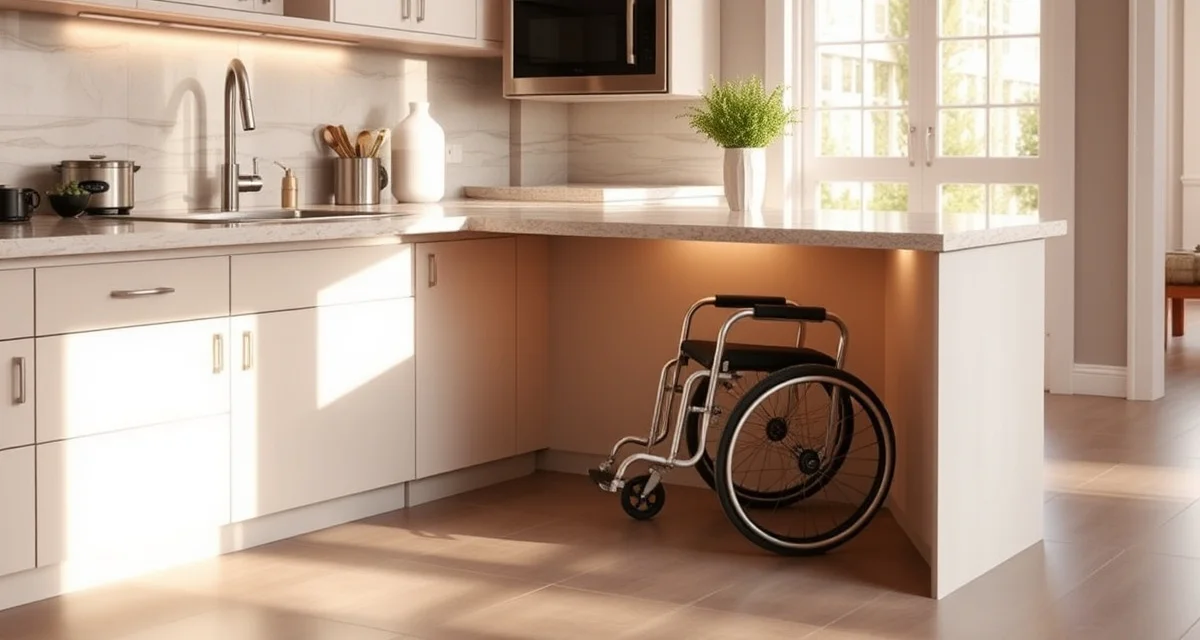
ADA Compliant Countertop Requirements
What Are ADA Compliant Countertops?
An "ADA countertop" is not one universal 34-inch counter rule. The applicable requirement depends on the facility, element, and scoping section. Kitchen work surfaces, sinks, dining surfaces, sales counters, and employee-only counters can fall under different provisions.
This guide summarizes the federal 2010 ADA Standards for fabrication planning. It is not a code determination. The architect or accessibility professional should identify the governing standard, scoped elements, dimensions, and local amendments on the project documents.
TL;DR
- In residential dwelling units required to comply with Section 809, at least one kitchen work-surface section must be 30 inches wide minimum and 34 inches high maximum
- The centered forward approach must include clear floor space plus knee and toe clearance that follows Section 306's profile
- Lavatories and sinks covered by Section 606 are 34 inches maximum to the higher of the rim or counter surface, subject to listed exceptions
- Dining and non-employee work surfaces covered by Section 902 are 28 to 34 inches high
- Sales and service counters use Section 904, not the kitchen work-surface rule
- Fabricators need different template specs for ADA units, which affects cabinet and countertop coordination
- Federal ADA, ABA, Fair Housing Act, Section 504, state code, and local rules have different scopes
Who Needs ADA Compliant Countertops?
Determine the Governing Standard First
- Title II facilities: State and local government projects use the ADA requirements that apply to the scoped facility and alteration
- Title III facilities: Public accommodations and commercial facilities use the applicable ADA scoping and technical sections
- Federally funded or federal facilities: Section 504 or Architectural Barriers Act requirements may also apply
- Multifamily housing: Fair Housing Act design requirements are separate from ADA technical provisions and should not be treated as interchangeable
- State and local codes: These may be more restrictive or use a different adopted accessibility standard
Often Voluntary But Smart
- Aging-in-place renovations: Homeowners planning for future mobility changes
- Universal design projects: Homes designed for usability across all ages and abilities
- Resale value: Accessible features appeal to a broader buyer pool
ADA Countertop Specifications: The Numbers
Kitchen Countertop Requirements
| Specification | ADA Requirement | Standard (Non-ADA) |
|---|---|---|
| Maximum height | 34 inches | 36 inches |
| Work-surface width | 30 inches minimum | Project-specific |
| Approach | Centered forward approach | Project-specific |
| Knee and toe clearance | Comply with Section 306 profile | Not generally required |
| Clear floor space | Comply with Section 305 | Project-specific |
| Exposed underside | No sharp or abrasive surfaces | General safety still applies |
Key point: Section 804.3 requires at least one 30-inch-wide minimum kitchen work surface in residential dwelling units required to comply with Section 809. That is different from saying every kitchen in every covered building needs a five- or six-foot lowered counter.
Calculate your material waste savings
See exactly how much slab material and money you could save with optimized cutting layouts.
Try the free Waste CalculatorBathroom Vanity Requirements
| Specification | ADA Requirement | Standard (Non-ADA) |
|---|---|---|
| Maximum height | 34 inches | 31-36 inches (varies) |
| Clear floor space | Comply with Sections 305 and 606 | Project-specific |
| Knee and toe clearance | Comply with Section 306 where required | Not generally required |
| Plumbing protection | Water supply and drain pipes protected against contact | Project-specific |
Approach Clearances
The accessible element must have the approach required by its governing section:
- Kitchen work surface under 804.3: Centered forward approach with knee and toe clearance
- Dining or work surface under 902: Forward approach with knee and toe clearance
- Sink under 606: Forward approach is generally required, with exceptions for certain breakrooms, kitchenettes, and residential kitchen sinks
- Clear floor space: 30 by 48 inches minimum under Section 305, with additional maneuvering and turning rules where scoped
Design Strategies for ADA Countertops
Strategy 1: Lowered Counter Section
One approach is to provide the required 30-inch-wide minimum work surface at 34 inches maximum while other counters remain at a different project height.
Fabrication notes:
- The lowered section needs its own support system (lower cabinets or wall-mounted brackets)
- The transition between heights requires careful templating
- Consider a waterfall end panel where heights change for a clean visual transition
Strategy 2: Full-Kitchen Accessible Height
For dedicated accessible units or aging-in-place homes, the entire kitchen counter can be set at 34 inches. This simplifies fabrication but requires:
- Lower base cabinets (typically 32.5-inch cabinet height vs. standard 34.5 inches)
- Adjusted appliance heights
- Modified backsplash dimensions
- Consideration that able-bodied users may find the lower height less comfortable for extended food prep
Strategy 3: Adjustable-Height Counters
In residential dwelling-unit kitchens, Section 804.3 permits an adjustable work surface that provides variable heights from 29 to 36 inches. Confirm the mechanism, cabinetry, utilities, controls, and pinch-point protection with the design team. Common applications include:
- Rehabilitation facilities
- Assisted living kitchens
- Custom homes designed for progressive conditions
Strategy 4: Open Knee Space Design
For bathroom vanities and some kitchen sections, wall-mounted countertops with completely open space underneath provide the required knee clearance. This works well with:
- Wall-mounted vanity cabinets (mounted higher to leave knee space)
- Floating countertop brackets rated for the material weight
- Exposed (insulated) plumbing underneath sinks
Material Considerations for ADA Countertops
Weight and Support
Countertops spanning open knee spaces need adequate support since there's no cabinet beneath them. Material weight matters:
| Material | Weight per SF (3cm) | Support Method |
|---|---|---|
| Granite | 18-20 lbs | Steel brackets, corbels |
| Quartz | 15-18 lbs | Steel brackets, corbels |
| Solid Surface | 8-12 lbs | Wood or steel brackets |
| Laminate | 4-6 lbs | Wood brackets, panel supports |
Heavier materials over open knee spaces require:
- Steel support brackets rated for the load (include a safety factor of 2x)
- Lag bolts into wall studs (not just drywall anchors)
- Consideration of dynamic loads (someone leaning on the edge)
Edge Profile Safety
The 2010 ADA kitchen work-surface provision prohibits sharp or abrasive exposed surfaces under the counter. It does not prescribe a universal decorative edge profile for every countertop. The design team may still choose a softened edge for safety and usability:
- Recommended: Bullnose, half-bullnose, or eased with generous radius
- Avoid: Sharp square edges, ogee profiles with pointed details
- Consideration: Users in wheelchairs interact with counter edges at torso and arm height, making smooth profiles especially important
Sink and Faucet Integration
For sinks covered by Section 606, coordinate:
- The 34-inch maximum rim or counter height
- The required approach and Section 306 knee and toe profile
- Water-supply and drain-pipe protection against contact
- Faucet controls that comply with the operable-parts requirements
- Basin, disposal, trap, and insulation geometry shown in the approved details
Common ADA Countertop Mistakes
1. Forgetting Knee Clearance Under Sinks
Knee and toe clearance is a shaped volume, not simply a 27-by-30-by-19-inch rectangular box. Standard traps, disposals, aprons, and supports can intrude into the required profile. Coordinate the approved section detail before fabrication.
2. Wrong Countertop Overhang
Do not convert the knee-clearance depth into a universal countertop-overhang rule. Section 306 measures clearances from the leading edge and permits a defined sloped profile. Use the architect's section detail and verify that brackets, aprons, and cabinetry stay outside the required volume.
3. Ignoring Reach Ranges
A 34-inch height by itself does not make an element accessible. Approach, knee and toe space, operable parts, reach ranges, and adjacent fixtures can all affect compliance.
4. Unsupported Spans
Removing base cabinets for knee clearance also removes support. Have the responsible designer or engineer size concealed brackets, aprons, and anchors for the actual material, span, substrate, and expected loads.
5. Non-Compliant Transitions
Where counter heights change, confirm that the accessible approach and required clearances remain unobstructed. Document the seam, support, edge, and backsplash transition instead of improvising it in the shop.
Cost Drivers for Accessible Countertops
| Cost driver | Why it can change |
|---|---|
| Cabinet or support redesign | Open knee space and removable cabinetry can alter structure |
| Plumbing and fixture geometry | Offset drains, protection, and clearances may require coordination |
| Adjustable mechanisms | Hardware, controls, and utility connections add scope |
| Split-height seams and transitions | Extra templating, finishing, and support may be required |
| Review and documentation | Accessibility details may require additional design coordination |
There is no defensible universal "ADA premium." Price the approved drawings, supports, fixtures, site conditions, and local labor.
Fabricator Checklist for ADA Projects
Before quoting an ADA countertop project, confirm:
- Required counter height (34" max for ADA, verify with architect)
- Section 306 knee and toe clearance profile
- Support method for open spans
- Sink and plumbing geometry
- Edge profile and exposed-underside requirements
- Transition details between ADA and standard heights
- Overhang depth at accessible sections
- Clear floor space requirements met
- Material weight compatible with support plan
- Local code additions beyond federal ADA minimums
FAQ
What is the ADA compliant height for a kitchen countertop?
The maximum height for an accessible kitchen work surface is 34 inches above the finished floor. This is 2 inches lower than the standard 36-inch kitchen counter height. At least one section of counter must meet this requirement in accessible dwelling units.
Do all countertops in a kitchen need to be ADA height?
No universal rule requires every kitchen counter to be 34 inches. In residential dwelling units required to comply with Section 809, Section 804.3 requires at least one kitchen work surface that is 30 inches wide minimum. Other facilities and counter types have different scoping rules.
What materials work best for ADA countertops?
Lighter materials like solid surface and laminate are easier to support over open knee spaces. Quartz and granite work well too but require stronger support brackets. The material choice should account for the unsupported span, load requirements, and edge safety.
How much knee clearance is required under an ADA countertop?
Section 306 defines a contoured knee and toe space with width, height, and depth requirements at different elevations. Do not use a single rectangular dimension as a substitute for the official profile.
Does the Fair Housing Act require ADA countertops in apartments?
The Fair Housing Act has its own coverage and design requirements for covered multifamily dwellings. It is not accurate to substitute ADA Section 804 dimensions without confirming which federal, state, and local standards govern the unit.
Can I retrofit existing countertops for ADA compliance?
Yes, but it often requires replacing both countertops and base cabinets. In some cases, removing cabinets and wall-mounting the existing countertop with added supports can work. The feasibility depends on material condition, wall structure, and plumbing configuration.
What edge profile is required for ADA countertops?
The 2010 ADA Standards do not prescribe one decorative countertop edge profile. Section 804.3.3 says there can be no sharp or abrasive exposed surfaces under the required kitchen work surface. Follow the approved design details for other edges.
Do bathroom vanity countertops have different ADA requirements than kitchens?
The height requirement is the same (34 inches max), but bathroom vanities must also accommodate specific sink depth, faucet reach, and mirror height requirements. The knee clearance standards are identical. Bathroom vanities more frequently use the open-underneath design since storage can be mounted elsewhere.
Get Accurate ADA Templates the First Time
Accessible countertop projects require exact measurements, coordinated clearances, and approved transition details. A fabrication error can delay occupancy and force a remake. SlabWise helps teams compare template dimensions against the approved project information before cutting.
Try SlabWise free for 14 days →
Try These Free Tools
- Photo to Template -- Snap a photo of an existing countertop and get an AI-generated DXF template.
- Template Compare -- Upload two templates and see every dimension change highlighted instantly.
- AI Template Verification -- Cross-check your template against manufacturer specs before cutting.
Sources & Further Reading
- U.S. Department of Justice: 2010 ADA Standards for Accessible Design
- U.S. Access Board: ADA Accessibility Standards
- U.S. Access Board guide to lavatories and sinks
- HUD and DOJ Fair Housing Act design-and-construction guidance overview