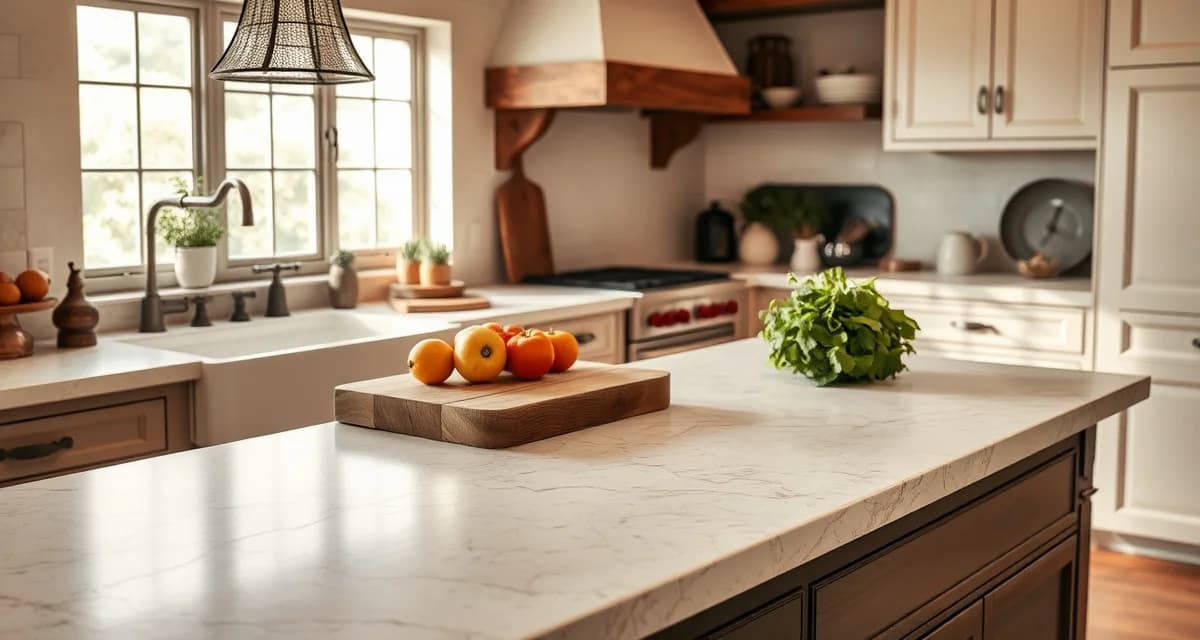
Farmhouse Kitchen Countertop Options
What You Need to Know in 60 Seconds
Farmhouse kitchens blend rustic charm with modern function, and the countertop is where these two worlds meet. The right countertop material grounds your farmhouse kitchen with warmth and texture while handling daily cooking demands. This guide covers the best materials for farmhouse style, how to pair them with classic farmhouse elements, and what to budget for each option.
TL;DR
- Butcher block is the quintessential farmhouse countertop but requires regular maintenance
- White marble or marble-look quartz pairs perfectly with farmhouse sinks and shaker cabinets
- Soapstone offers authentic period-appropriate style with excellent durability
- Honed finishes read more farmhouse than polished across almost every material
- Mixing materials works naturally in farmhouse kitchens - wood island with stone perimeter is a classic combination
- Budget $2,500-$8,000 for a typical farmhouse kitchen depending on material mix
- Farmhouse apron sinks require specific countertop fabrication to accommodate the front panel
The Farmhouse Aesthetic and Countertop Selection
The farmhouse style draws from working kitchens where surfaces were chosen for durability and function first, beauty second. That practical philosophy should guide your countertop selection.
Calculate your material waste savings
See exactly how much slab material and money you could save with optimized cutting layouts.
Try the free Waste CalculatorAuthentic farmhouse materials - wood, natural stone, concrete - show their age gracefully. They develop patina, darken or lighten with use, and carry the marks of daily life. If you want a countertop that looks identical in 10 years to the day it was installed, engineered materials are better suited. If you want a surface that tells a story, natural materials are your path.
Modern Farmhouse vs. Traditional Farmhouse
These two substyles have different countertop preferences.
| Element | Traditional Farmhouse | Modern Farmhouse |
|---|---|---|
| Countertop material | Butcher block, soapstone, natural honed stone | White quartz, marble-look quartz, honed granite |
| Finish | Honed, oiled, matte | Honed or lightly polished |
| Color palette | Warm wood tones, dark grays, cream | White, light gray, light wood accents |
| Edge profile | Eased or slightly rounded | Clean eased, thin beveled |
| Typical pairing | Open shelving, vintage hardware | Shaker cabinets, matte black hardware |
Best Countertop Materials for Farmhouse Kitchens
Butcher Block
No material says farmhouse more clearly than butcher block. Thick wood surfaces provide warmth, texture, and a working-kitchen authenticity that stone and engineered surfaces cannot replicate.
Best wood species for farmhouse kitchens:
- Maple: Tight grain, light color, hardest of the common options. Most stain-resistant.
- Walnut: Rich dark brown tones, softer than maple. Creates dramatic contrast with white cabinets.
- White oak: Warm honey tones, visible grain pattern, good durability. Very period-appropriate.
- Cherry: Deepens in color over time, warm reddish-brown. Develops beautiful patina.
Pros: Warm aesthetics, repairable (sand and refinish), gentle on dropped dishes, excellent cutting surface Cons: Requires regular oiling (monthly), susceptible to water damage, can harbor bacteria if not properly maintained, not heat resistant
Cost: $40-$100/sq ft installed depending on species and thickness
Farmhouse tip: End-grain butcher block (where the wood grain faces up) is the most durable and traditional style. Edge-grain is more affordable and still looks authentic.
Soapstone
Soapstone is a historic countertop material used in American farmhouses for over 200 years. It is naturally nonporous, does not need sealing, and develops a dark gray-green patina over time that looks perfectly at home in a farmhouse kitchen.
Pros: Nonporous (no sealing needed), heat resistant, antibacterial, develops beautiful patina, historically accurate Cons: Softer than granite (scratches more easily, though scratches can be oiled away), limited color range (grays and greens), fewer fabricators work with it regularly
Cost: $70-$120/sq ft installed
Farmhouse tip: Soapstone scratches lighten with time and can be blended away with mineral oil. This self-healing quality makes it forgiving for heavy kitchen use.
Honed Marble
White marble with a honed (matte) finish captures the modern farmhouse look perfectly. The soft, chalky texture pairs beautifully with farmhouse sinks, subway tile backsplashes, and painted wood cabinets.
Pros: Timeless beauty, honed finish hides minor etching better than polished, gets more beautiful with age Cons: Etches from acids (lemon, vinegar, wine), stains if not sealed, requires maintenance commitment
Cost: $75-$150/sq ft installed
Farmhouse tip: Carrara marble (more gray veining, lower cost) reads as more farmhouse than Calacatta (bold veining, higher cost), which leans more luxury.
Marble-Look Quartz
For homeowners who want the white marble farmhouse aesthetic without the maintenance, marble-look quartz is the practical choice. Modern quartz products have become remarkably convincing, with soft veining patterns that approximate Carrara marble.
Pros: No sealing, stain resistant, consistent appearance, wide availability Cons: Does not develop patina or character over time, can look manufactured up close, not heat resistant
Cost: $55-$100/sq ft installed
Honed Granite
Granite with a honed (matte) finish rather than a polished finish takes on a farmhouse-appropriate softness. Light granite with minimal pattern works for modern farmhouse, while darker varieties with visible mineral crystals suit traditional farmhouse kitchens.
Pros: Extremely durable, heat resistant, available in matte finish, natural material Cons: Requires sealing, honed surfaces show oil stains more readily than polished
Cost: $50-$100/sq ft installed
Concrete
Poured concrete countertops have a handmade quality that fits the farmhouse ethos. They can be cast in custom shapes, tinted to match your color scheme, and finished with various textures from smooth to slightly rough.
Pros: Customizable, unique handmade character, can be cast with integrated sinks and drainboards Cons: Prone to cracking if not properly reinforced, requires sealing, heavy (needs strong cabinet support), inconsistent coloring between batches
Cost: $65-$135/sq ft installed
Pairing Countertops with Farmhouse Elements
The Farmhouse Sink Connection
Apron-front (farmhouse) sinks require specific countertop fabrication. The front panel of the sink extends forward past the cabinet face, and the countertop must be cut to accommodate this profile.
Fabrication notes:
- The countertop cutout for a farmhouse sink is larger and more complex than a standard undermount
- The exposed front edge of the countertop cutout is visible from the side and must be finished
- Template accuracy is critical - the countertop must fit tightly around the sink's curved or flat front panel
- SlabWise's Template Verification is particularly valuable here since farmhouse sink cutouts have less tolerance for error than standard undermount configurations
Cabinet Pairing Guide
| Cabinet Style | Best Countertop Match | Why |
|---|---|---|
| White shaker | Butcher block, honed marble, soapstone | Classic contrast with warmth |
| Sage/olive green | White marble, light butcher block | Warm, earthy coordination |
| Navy blue | White quartz, light granite, walnut butcher block | Crisp contrast, dramatic impact |
| Natural wood | Soapstone, dark granite, concrete | Tone-on-tone warmth |
| Cream/antique white | Carrara marble, light gray quartz | Soft, cohesive palette |
Backsplash Pairings
- Subway tile + butcher block: The definitive modern farmhouse combination
- Beadboard + soapstone: Traditional farmhouse with working-kitchen roots
- Handmade tile + marble: Elevated farmhouse with artisan character
- Brick or stone veneer + concrete: Rustic farmhouse with industrial touches
- Shiplap + quartz: Modern farmhouse on a practical budget
Mixing Materials in Farmhouse Kitchens
Farmhouse kitchens are one of the few styles where mixing countertop materials looks entirely natural. In working farmhouses, different surfaces served different purposes - wood for chopping, stone near the stove, cool marble for pastry. Carrying this tradition forward gives your kitchen authentic variety.
Popular Farmhouse Material Combinations
- Butcher block island + soapstone perimeter: The heritage choice. Wood for prep, stone for everything else.
- Butcher block island + quartz perimeter: The practical choice. Wood for warmth, quartz for durability.
- Marble island + wood perimeter: The modern farmhouse choice. Stone statement piece with warm surround.
- Honed granite perimeter + butcher block accent section: Functional zoning with visual variety.
The key is limiting the mix to two materials maximum and ensuring they share a complementary color temperature (both warm, or one warm and one neutral). Three or more materials in a farmhouse kitchen creates visual chaos rather than charming variety.
Edge Profiles for Farmhouse Style
Edge profiles in farmhouse kitchens should look unfussy and natural.
Best choices:
- Eased: The clean, slightly rounded square edge is the most versatile farmhouse option
- Slightly rounded/soft square: A touch more radius than eased, comfortable and practical
- Chamfered: A small 45-degree cut at the edge adds a subtle detail without ornamentation
Avoid:
- Ogee, dupont, or any ornate profile: Too formal for farmhouse style
- Full bullnose: Reads as dated 1990s rather than classic farmhouse
- Waterfall edges: These belong to modern/contemporary design, not farmhouse
Budgeting for Farmhouse Kitchen Countertops
For a typical farmhouse kitchen with 30-45 sq ft of counter area (including island):
| Material Scenario | Estimated Total (Installed) |
|---|---|
| All butcher block (maple) | $1,500-$3,500 |
| All marble-look quartz | $2,000-$4,000 |
| All soapstone | $2,500-$5,000 |
| All honed marble | $2,500-$6,000 |
| Butcher block island + quartz perimeter | $2,000-$4,500 |
| Butcher block island + soapstone perimeter | $2,500-$5,500 |
Farmhouse kitchen countertops generally cost less than luxury contemporary kitchens because the aesthetic favors straightforward edge profiles and standard installation details rather than waterfall edges and mitered profiles.
What is the most authentic farmhouse countertop material?
Butcher block and soapstone are the most historically accurate farmhouse countertop materials. Both were commonly used in American farmhouse kitchens from the 1700s through the early 1900s. Soapstone was especially popular because it does not absorb liquids and handles heat from wood-burning stoves.
Can I use butcher block near a farmhouse sink?
You can, but water exposure around sinks is the biggest threat to butcher block longevity. Keep the wood well-sealed with food-safe mineral oil, wipe up standing water immediately, and consider using a stone or quartz surface directly adjacent to the sink with butcher block elsewhere.
Is soapstone hard to maintain?
Soapstone is one of the easiest natural stones to maintain. It does not need sealing because it is naturally nonporous. The main maintenance task is applying mineral oil every few weeks to even out the patina development. Left unoiled, soapstone darkens unevenly but still performs perfectly.
What color countertop looks best with white farmhouse cabinets?
Warm-toned butcher block (walnut or white oak) creates the most classic farmhouse contrast with white cabinets. For stone, warm gray soapstone or Carrara marble complement white cabinets without feeling cold. Avoid bright white countertops with white cabinets - the monochrome look lacks the warmth that defines farmhouse style.
How do I get the farmhouse look on a tight budget?
Butcher block is the most affordable authentic farmhouse countertop at $40-$65/sq ft installed. For a 30 sq ft kitchen, that is $1,200-$1,950 total. Marble-look quartz in the $55-$70 range is the next most affordable option that still reads as genuine farmhouse style.
Do farmhouse kitchens use polished or matte countertops?
Matte and honed finishes are more appropriate for farmhouse kitchens. Polished surfaces read as formal and contemporary, which conflicts with the farmhouse emphasis on practicality and warmth. Even granite and marble should be specified with a honed finish for a farmhouse installation.
Can concrete countertops work in a farmhouse kitchen?
Yes, particularly in rustic or industrial-farmhouse variations. Concrete brings a handmade quality that aligns with farmhouse values. The main consideration is weight - concrete countertops are heavy and your cabinets must be built to support them. Concrete also requires sealing to prevent staining.
What thickness works best for farmhouse countertops?
Standard 3cm (1.25 inch) thickness works for most stone farmhouse countertops. Butcher block looks best at 1.5-2 inches thick - thinner looks insubstantial and loses the working-kitchen character. Avoid mitered edges that fake extra thickness; farmhouse style values honesty over appearance.
How do I handle the cutout for a farmhouse apron sink?
This is a fabrication-specific question that your countertop fabricator handles during templating. The key detail is that the countertop must be cut precisely to fit around the sink's front panel, with the exposed edges finished to match the top surface. Make sure your fabricator has experience with apron-front sink installations.
Should the island match the perimeter countertops in a farmhouse kitchen?
Matching is fine, but mixing is more traditional and more interesting. A butcher block island with stone perimeter counters is the classic farmhouse approach. If you match everything, add variety through other elements - different cabinet color on the island, open shelving, or distinct hardware.
Build Your Farmhouse Kitchen
Farmhouse kitchens are built on honest materials, practical design, and surfaces that get better with use. Whether you go all-in on butcher block or pair natural stone with wood accents, the right countertop grounds your entire kitchen design.
Use SlabWise's project calculator to compare material costs for your farmhouse kitchen layout and find the right balance of style and budget. Start your 14-day free trial today.
Try These Free Tools
- Kitchen Visualizer -- Upload a kitchen photo and preview different countertop materials in place.
- AR Overlay -- See the actual stone pattern on your customer's cabinets using AR.
- Sink Finder -- Search compatible sink models by countertop dimensions and cutout specs.
Sources & Further Reading
- Natural Stone Institute - Bathroom Design Guidelines
- National Kitchen & Bath Association - Countertop Selection Guide
- Marble Institute of America - Bathroom Stone Applications
- International Surface Fabricators Association - Residential Bathroom Standards