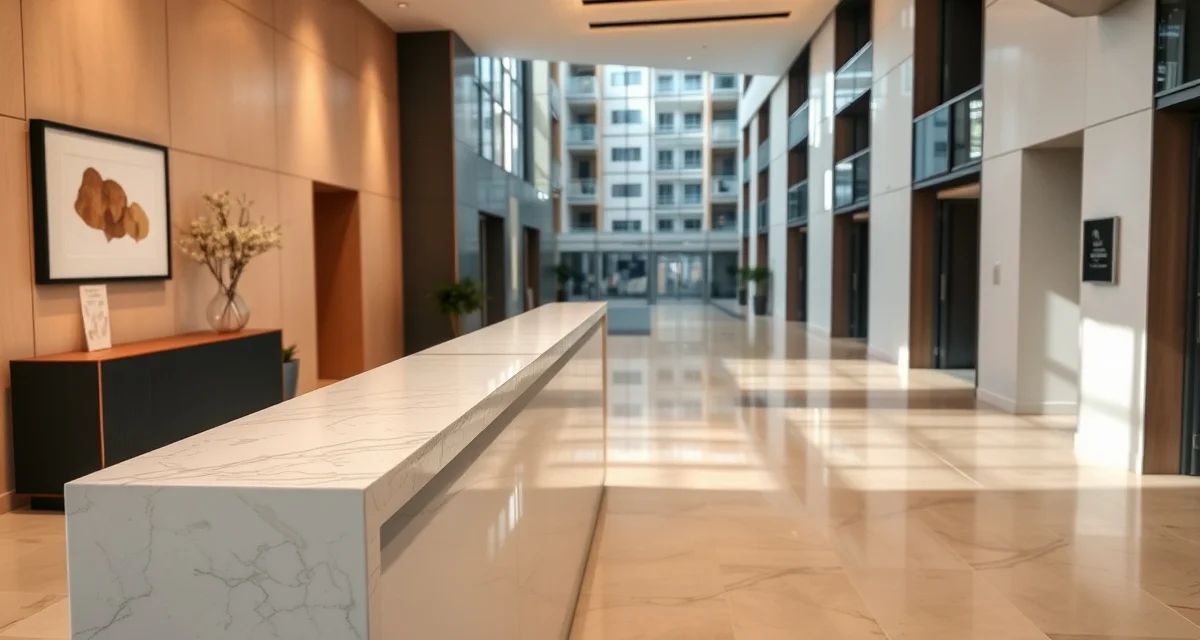
Countertops for Multi-Family Housing
What Are Multi-Family Countertops?
Multi-family countertops are surface installations designed for apartment complexes, condominiums, townhomes, and other shared residential buildings. These projects differ sharply from single-family work because they demand uniform specs, bulk pricing, fast turnaround, and materials that survive years of tenant turnover with minimal upkeep.
TL;DR
- Multi-family countertop projects require materials that balance durability, cost, and appearance across dozens or hundreds of units
- Quartz and solid surface dominate the multi-family segment due to low maintenance and consistent color lots
- Bulk ordering from a single slab source saves 15-25% compared to piecemeal purchasing
- Template standardization across identical floor plans cuts fabrication time by 30-40%
- Property managers should budget $25-$45 per square foot installed for mid-range options
- Coordinating installation schedules with tenant move-in dates prevents costly delays
- Digital fabrication tools reduce waste and errors significantly on repetitive unit layouts
Why Multi-Family Countertop Projects Are Different
Volume Changes Everything
A 200-unit apartment complex might need 600+ countertop pieces fabricated and installed within a tight construction window. That's a fundamentally different challenge than a single kitchen renovation. Fabricators dealing with multi-family work need systems that handle:
Calculate your material waste savings
See exactly how much slab material and money you could save with optimized cutting layouts.
Try the free Waste Calculator- Repetitive templating across 4-8 standard floor plans
- Material procurement in bulk quantities with consistent lot matching
- Installation scheduling coordinated with general contractors, plumbers, and electricians
- Quality control that stays consistent from unit #1 to unit #200
The Stakes Are Higher
A mistake on a single-family job might cost $1,500-$4,000 for a remake. On a multi-family project, one template error replicated across 50 identical units could mean $75,000+ in rework. That math changes your entire approach to verification.
Best Countertop Materials for Multi-Family Housing
| Material | Cost/SF Installed | Durability Rating | Maintenance | Best For |
|---|---|---|---|---|
| Quartz | $35-$65 | 9/10 | Very Low | Class A apartments |
| Solid Surface | $25-$50 | 7/10 | Low | Mid-range rentals |
| Laminate | $10-$25 | 5/10 | Low | Budget/student housing |
| Granite | $35-$75 | 8/10 | Medium | Luxury condos |
| Porcelain | $30-$55 | 8/10 | Very Low | Modern developments |
| Butcher Block | $25-$50 | 4/10 | High | Boutique properties |
Quartz: The Multi-Family Standard
Quartz owns roughly 60% of the new multi-family countertop market for good reasons:
- Consistent color and pattern across large orders. No natural variation surprises.
- Zero sealing required. Property managers don't want to schedule annual sealing for 200 units.
- Stain and scratch resistant. Tenants aren't always gentle.
- 15-year warranty from most major manufacturers.
Popular multi-family quartz lines include Caesarstone's commercial program, Cambria's builder series, and Silestone's multi-unit pricing tiers.
Solid Surface: The Budget-Friendly Performer
For properties targeting the $1,200-$1,800/month rent range, solid surface (Corian, Staron, Hi-Macs) offers a smart middle ground:
- Repairable scratches and minor burns without full replacement
- Integrated sink options that eliminate undermount seal failures
- Lighter weight means easier handling during multi-floor installations
- Price point roughly 20-30% below comparable quartz
Laminate: Still Relevant for Specific Markets
Student housing, workforce housing, and properties with 3-5 year renovation cycles still use laminate extensively. Modern laminate from Formica and Wilsonart has improved dramatically in appearance, and the price point ($10-$25/SF installed) makes financial sense when you're covering 40,000+ square feet across a complex.
How to Spec Multi-Family Countertops
Step 1: Establish Unit Groupings
Categorize your floor plans by countertop requirements:
- Kitchen countertops (L-shapes, U-shapes, galley)
- Bathroom vanities (single, double, ADA-compliant)
- Laundry surfaces (if applicable)
- Common area counters (lobbies, mail rooms, fitness centers)
Step 2: Select Material and Edge Profile
Pick one material and one edge profile for each tier of unit. Consistency speeds fabrication and simplifies future replacement orders. Most multi-family projects use:
- Eased edge for kitchens (simple, safe, economical)
- Half-bullnose for bathrooms (slightly softer look)
- Square edge for utility and common areas
Step 3: Create Master Templates
For buildings with repeated floor plans, create one verified master template per layout. This template gets replicated digitally rather than re-measured for every unit. The time savings are enormous - a fabricator using standardized digital templates can process 15-20 identical kitchens per day versus 4-5 with individual field measurements.
Step 4: Set Installation Sequence
Work backwards from the certificate of occupancy date:
| Phase | Timeline | Activity |
|---|---|---|
| Pre-construction | 8-12 weeks out | Material selection, bulk ordering |
| Templating | 6-8 weeks out | Master template creation, verification |
| Fabrication | 4-6 weeks out | Cutting, polishing, QC |
| Installation | 1-3 weeks out | Install by floor/wing, final inspection |
Cost Analysis: Multi-Family vs. Single-Family
Per-Unit Pricing Breakdown
A typical multi-family kitchen with 35 SF of countertop:
| Cost Component | Single-Family | Multi-Family (50+ units) | Savings |
|---|---|---|---|
| Material | $1,575 | $1,225 | 22% |
| Fabrication | $525 | $350 | 33% |
| Installation | $350 | $245 | 30% |
| Template | $150 | $35 | 77% |
| Total | $2,600 | $1,855 | 29% |
The template cost drops most dramatically because you're amortizing one measurement across dozens of identical units. Fabrication costs drop because batch processing identical pieces is far more efficient than custom work.
Hidden Costs to Budget For
- Elevator protection and staging - $500-$2,000 per building
- Floor protection during carries - $200-$500 per floor
- Overnight material storage on-site - $100-$300/week
- Punch list rework - Budget 2-3% of total contract value
- Extended warranty coverage for property managers - Often 1-2% premium
Common Mistakes on Multi-Family Projects
1. Not Verifying the First Unit Before Full Production
Always fabricate and install one complete unit first. Walk it with the property manager, GC, and designer before authorizing full production. Finding a template error after cutting 50 pieces is financially devastating.
2. Ignoring ADA Requirements
Multi-family buildings must include ADA-compliant units (typically 5-10% of total units). These require different countertop heights, knee clearances, and sometimes different materials. Spec these separately from standard units.
3. Ordering Too Tight on Material
Bulk slab orders should include a 5-8% overage for breakage, defects, and field adjustments. Running short mid-project and ordering from a different lot creates visible color mismatches.
4. Skipping the Mockup Unit
For Class A and luxury developments, build out one complete mockup kitchen 3-4 months before production begins. This gives designers, investors, and property managers a physical space to evaluate before committing to 200+ identical installations.
5. Poor Coordination with Other Trades
Countertops can't go in until cabinets are level and plumbing rough-ins are confirmed. A single plumber running behind schedule can cascade delays across your entire installation timeline.
Technology That Speeds Multi-Family Fabrication
Digital Templating
Laser and LiDAR templating systems capture measurements digitally and transfer them directly to CNC machines. For multi-family, this means:
- One site visit to capture the master template
- Digital replication for identical units
- Direct-to-machine file transfer eliminates manual programming errors
Slab Nesting Software
When you're cutting 200 identical L-shaped kitchen tops, nesting software optimizes how pieces are arranged on each slab. Good nesting algorithms reduce material waste from the industry average of 30-35% down to 20-25% or better. On a 200-unit project using quartz at $45/SF, that waste reduction saves $15,000-$25,000.
SlabWise's nesting engine is built specifically for this kind of repetitive, high-volume work - where even a 2% improvement in yield compounds across thousands of square feet.
Customer Communication Portals
Multi-family projects involve constant coordination between fabricators, GCs, property managers, and building owners. Digital portals that provide real-time production status, installation scheduling, and change order tracking replace the 8-15 phone calls per day that typically bog down these projects.
Working with Property Managers: What Fabricators Need to Know
Property managers care about three things in this order:
- Timeline adherence. Missing a move-in date costs them $150-$300/day per vacant unit in lost rent.
- Budget control. Change orders are their nightmare. Get the specs locked early.
- Warranty and support. They want one phone number to call when a tenant damages a countertop in year 3.
Build your proposal around these priorities. Lead with your on-time completion record, provide a fixed-price quote (not an estimate), and include a clear warranty document with your response times for service calls.
Renovation vs. New Construction: Key Differences
New Construction Multi-Family
- Cabinet and countertop specs established during design phase
- Templates taken from architectural drawings (verified with field measurements)
- Installation happens in a clean, controlled environment
- Typical timeline: 2-4 months from order to completion
Multi-Family Renovation
- Existing conditions vary unit-to-unit despite "identical" floor plans
- Individual templating often required (settlement, previous modifications)
- Work happens around occupied units in some cases
- Requires dust containment, noise restrictions, and tenant communication
- Typical timeline: 3-6 months depending on phasing
FAQ
How many countertop units can a fabricator install per day in a multi-family project?
An experienced crew can install 6-10 kitchen countertop sets per day in a new construction multi-family building, assuming units are ready and accessible. Renovation projects typically see 3-5 per day due to access constraints.
What's the minimum order size for multi-family countertop pricing?
Most fabricators offer volume pricing starting at 20-25 units. Significant tier breaks typically happen at 50, 100, and 200+ units. The biggest savings come from material procurement, where distributors offer 15-25% discounts on full-lot purchases.
How do you handle color matching across a large multi-family order?
For quartz and solid surface, order all material from a single production lot. For natural stone, inspect slabs in person and tag specific bundles for your project. Always order the full material quantity plus overage at once - supplemental orders months later will come from different lots.
Can you mix countertop materials within a multi-family project?
Yes. Many developments use quartz in kitchens and solid surface in bathrooms. Some use granite in penthouses and quartz in standard units. Just be clear in your specs about which material goes where to avoid costly mix-ups during installation.
What warranty should property managers expect on multi-family countertops?
Manufacturer warranties typically cover 10-15 years for quartz and granite. Fabricator installation warranties usually cover 1-2 years. For multi-family, negotiate an extended fabricator warranty (3-5 years) that covers seam separation, adhesive failure, and installation defects.
How do you schedule installations around tenant occupancy?
For renovation projects, work with property management to create an installation schedule that groups vacant units together. Typically, you'll process all vacant units first, then schedule occupied-unit work in 4-hour windows with 48-hour tenant notice requirements.
What's the lead time for a 100-unit multi-family countertop order?
Plan for 6-10 weeks from order confirmation to first installation. This includes 2-3 weeks for material procurement, 1-2 weeks for template finalization, and 2-4 weeks for fabrication. Installation then rolls for 2-4 weeks depending on crew size.
Do multi-family countertop projects require different insurance?
Yes. Most multi-family GCs require $2M-$5M in general liability coverage from countertop subcontractors, compared to the $1M typical for residential work. You may also need builder's risk coverage and an umbrella policy.
How do you handle punch list items efficiently across many units?
Create a digital punch list system where GCs and property managers can log issues with photos and unit numbers. Batch your punch list visits by floor or building wing rather than addressing individual units one at a time.
What happens if a material gets discontinued mid-project?
This is why ordering all material upfront with overage is critical. If a color is discontinued, you'll need to work with the property manager to select an alternative for remaining units. For consistency, some developers choose to replace already-installed units with the new selection - an expensive but sometimes necessary choice.
Get More From Every Slab
Multi-family projects live or die on efficiency. When you're fabricating hundreds of identical pieces, even small improvements in nesting yield, template accuracy, and production scheduling compound into major savings.
SlabWise helps fabricators handle high-volume multi-family work with digital template verification, optimized slab nesting that reduces waste by 10-15%, and a customer portal that cuts coordination calls by 70%.
Try SlabWise free for 14 days →
Try These Free Tools
- Nesting Optimizer -- AI-powered slab layout that maximizes yield considering vein direction and defects.
- Defect Mapping -- Upload a slab photo and AI maps every fissure, pit, and color issue.
- Value Engineering -- Find dollar-quantified suggestions to save material without cutting margin.
Sources & Further Reading
-
International Surface Fabricators Association - Digital Fabrication and CAD/CAM Best Practices
-
Natural Stone Institute - Stone Fabrication Technology and Optimization
-
Marble Institute of America - Template and Layout Efficiency Guidelines
-
National Kitchen & Bath Association - Countertop Installation and Fabrication Standards