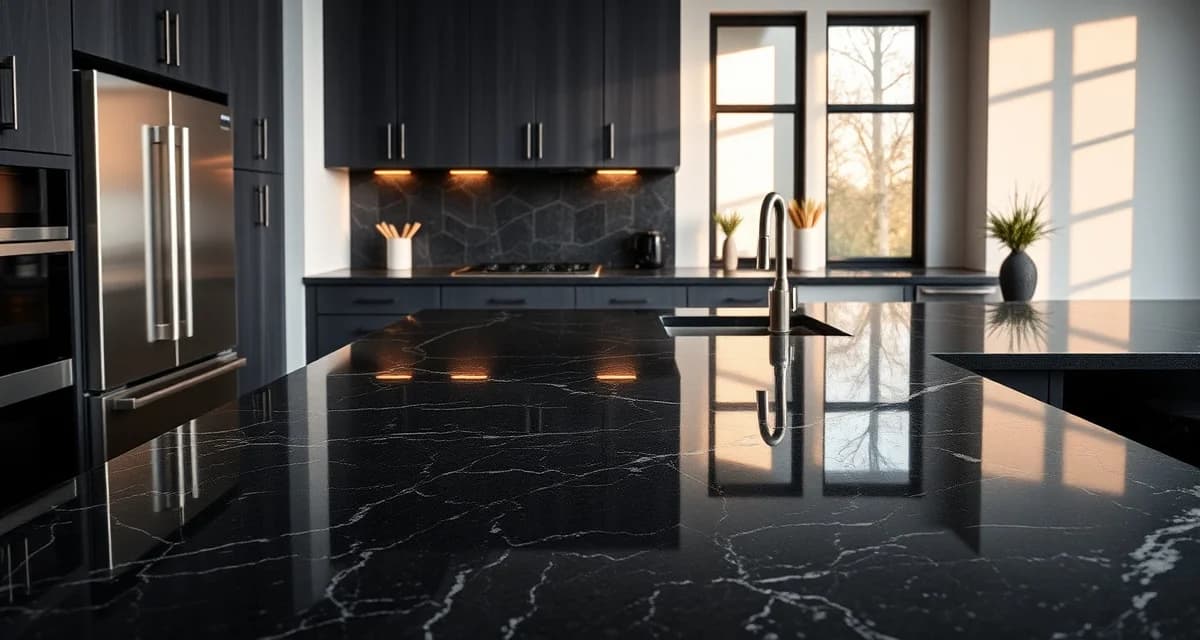
Dark Countertops: Materials and Design
Dark countertops - spanning deep blacks, rich browns, charcoal greys, and midnight blues - account for approximately 25% of all residential countertop installations in the United States. They add weight, contrast, and a sense of luxury to kitchens and bathrooms, and they're making a strong comeback as homeowners move away from the all-white kitchen trend that dominated the last decade.
TL;DR
- Dark countertops come in granite, quartz, soapstone, porcelain, and concrete - prices range from $40/sqft to $150+/sqft installed
- Black granite (Absolute Black, Black Galaxy) remains the most popular dark natural stone, costing $50-$90/sqft installed
- Dark quartz hides stains and crumbs better than white but shows dust, water spots, and fingerprints more
- Soapstone is a top pick for dark countertops due to its natural patina and heat resistance
- Matte and leathered finishes are easier to maintain than polished finishes on dark surfaces
- Pair dark countertops with lighter cabinetry for contrast, or go dark-on-dark with careful lighting
- Expect to budget $2,500-$6,000 for a 40-sqft dark countertop installation
Why Dark Countertops Are Trending Again
After nearly a decade of white and grey kitchens dominating Pinterest boards and HGTV episodes, dark countertops are reclaiming attention. Designers are calling it the "moody kitchen" movement - a shift toward rich, grounded surfaces that create warmth and depth.
Calculate your material waste savings
See exactly how much slab material and money you could save with optimized cutting layouts.
Try the free Waste CalculatorSeveral factors are driving this trend:
Contrast kitchens. The two-tone kitchen (light uppers, dark lowers, or vice versa) has become one of the most requested designs in 2025-2026. Dark countertops anchor these designs with visual weight.
Maintenance perception. Homeowners who installed white marble or light quartz 5-7 years ago are dealing with visible staining, etching, and constant wiping. Dark surfaces hide everyday wear much better.
Material innovation. New finishes like leathered granite and matte porcelain give dark countertops texture and personality that polished black granite couldn't deliver 10 years ago.
Dark Countertop Materials Compared
Black and Dark Granite
Granite remains the go-to for dark natural stone countertops. It's hard (6-7 Mohs), heat-resistant, and available in hundreds of dark varieties.
Price range: $50-$110/sqft installed
| Granite Variety | Color Description | Price Tier | Origin |
|---|---|---|---|
| Absolute Black | Solid, uniform black | Mid ($55-$80/sqft) | India, Zimbabwe |
| Black Galaxy | Black with gold flecks | Mid-Premium ($60-$90/sqft) | India |
| Ubatuba | Dark green-black | Budget-Mid ($45-$65/sqft) | Brazil |
| Steel Grey | Dark charcoal with silver | Mid ($50-$75/sqft) | India |
| Black Pearl | Black with silver/green shimmer | Mid ($50-$80/sqft) | India |
| Titanium | Dark brown-black with movement | Premium ($70-$110/sqft) | Brazil |
Finish options matter more with dark granite. A polished finish shows every fingerprint, water ring, and dust particle. Honed (matte) and leathered (textured) finishes on dark granite are far more forgiving for daily use.
Dark Quartz
Engineered quartz in dark colors offers the consistency that natural stone can't - every slab looks the same, which simplifies multi-slab kitchens.
Price range: $55-$120/sqft installed
Popular dark quartz options include Caesarstone's Empira Black, Cambria's Blackpool Matte, and Silestone's Charcoal Soapstone. Many manufacturers now offer concrete-look and soapstone-look patterns in dark quartz, giving homeowners the appearance of specialty materials without the maintenance.
One caution: very dark quartz in polished finishes is extremely hard to keep looking clean. Fabricators report that customer callbacks about "haze" and "marks" on dark polished quartz are 3x higher than on mid-tone surfaces.
Soapstone
Soapstone deserves special attention in the dark countertop category. This natural stone ranges from medium grey to near-black and develops a rich patina over time as it absorbs oils and use.
Price range: $70-$120/sqft installed
What makes soapstone unique:
- Heat-proof: You can set hot pots directly on soapstone without damage - it's used in wood stove surrounds and laboratory benches
- Non-porous: Unlike granite or marble, soapstone doesn't need sealing
- Self-healing: Minor scratches can be sanded out with fine-grit sandpaper and mineral oil
- Darkens with age: Fresh soapstone is medium grey; it darkens over months of use. Mineral oil accelerates this process
The trade-off is softness. Soapstone scores only 1-2 on the Mohs scale, making it susceptible to dents and gouges from heavy impact.
Dark Porcelain Slabs
Porcelain slabs in dark colors offer the thinnest profile (some as thin as 6mm) and the broadest range of finishes. Brands like Dekton and Neolith produce dark porcelain that mimics everything from oxidized metal to charcoal concrete.
Price range: $60-$120/sqft installed
Porcelain's biggest advantage in dark colors is maintenance. The non-porous surface doesn't show fingerprints or water spots the way polished granite does. It's also UV-stable, so dark porcelain won't fade near windows.
Concrete
Poured or precast concrete countertops in dark charcoal and black tones suit industrial, modern, and loft-style kitchens. Each installation is custom, and the final color depends on the pigment mix, aggregate, and sealing process.
Price range: $75-$150/sqft installed
Concrete is heavy (roughly 18 lbs/sqft at 1.5" thickness), requires professional sealing every 1-3 years, and can develop hairline cracks over time. These characteristics are considered part of concrete's character by fans of the material, but they're dealbreakers for homeowners who want a perfect-looking surface.
Design Strategies for Dark Countertops
Contrast Pairing (Dark Countertop + Light Cabinets)
This is the safest and most popular approach. White, cream, or light grey cabinets paired with a dark countertop creates clear visual separation and prevents the kitchen from feeling like a cave.
Works best with: Kitchens of any size, especially smaller kitchens where dark countertops could otherwise feel heavy.
Dark-on-Dark (Tonal Kitchen)
Dark countertops with dark cabinets create a dramatic, high-end look. This approach requires thoughtful lighting - undercabinet LEDs, pendant lights over the island, and natural light are essential to prevent the space from feeling closed-in.
Works best with: Large kitchens (200+ sqft) with ample natural light, loft spaces, and open-concept layouts.
Two-Tone Countertop Layout
Use a dark surface on the island or lower cabinets and a lighter material on perimeter counters. This breaks up visual monotony and defines different work zones.
Works best with: Kitchens with islands or peninsulas, transitional and contemporary styles.
Material and Finish Mixing
Pair leathered dark granite on the main countertop with a polished lighter stone on the island (or vice versa). Mixing finishes adds visual complexity without introducing competing colors.
Maintaining Dark Countertops
The Fingerprint and Dust Problem
The number one complaint about dark countertops isn't staining - it's that they show dust, water marks, and fingerprints. Here's how each finish performs:
| Finish | Dust Visibility | Fingerprints | Water Spots | Overall Maintenance |
|---|---|---|---|---|
| Polished | Very high | Very high | Very high | Most demanding |
| Honed (matte) | Moderate | Low | Moderate | Moderate |
| Leathered | Low | Low | Low | Easiest |
| Brushed | Low | Very low | Low | Easiest |
If you're choosing a dark countertop specifically for lower maintenance, avoid polished finishes. Leathered and brushed options hide daily wear significantly better.
Daily Cleaning Routine
- Wipe down with a damp microfiber cloth after each use
- Use a spray made of water with a few drops of dish soap for deeper cleaning
- Dry the surface completely to avoid water spots (especially on polished finishes)
- Apply stone-specific cleaner once a week for natural stone surfaces
Sealing Schedule
- Dark granite: Every 12-18 months (darker granites are typically denser and less porous than light granites)
- Soapstone: No sealing needed; apply mineral oil monthly for even darkening
- Dark quartz: Never needs sealing
- Dark porcelain: Never needs sealing
- Concrete: Every 1-3 years depending on sealer type
Cost Comparison for a 40-sqft Kitchen
| Material | Material + Fab | Installation | Total | Maintenance Cost/Year |
|---|---|---|---|---|
| Dark Granite | $2,000-$3,600 | $500-$800 | $2,500-$4,400 | $50-$100 |
| Dark Quartz | $2,200-$4,000 | $500-$800 | $2,700-$4,800 | $0-$25 |
| Soapstone | $2,800-$4,400 | $600-$900 | $3,400-$5,300 | $20-$40 |
| Dark Porcelain | $2,400-$4,000 | $600-$900 | $3,000-$4,900 | $0-$25 |
| Concrete | $3,000-$5,000 | $800-$1,200 | $3,800-$6,200 | $75-$150 |
Fabrication note: Dark materials are less forgiving of cutting errors than light ones. Chips and patches are more visible on dark surfaces. Fabricators using software like SlabWise for AI-powered template verification reduce remake risk by catching measurement errors before the slab reaches the CNC - a big deal when a single dark granite slab can cost $1,500-$3,000.
Common Mistakes with Dark Countertops
-
Choosing polished black for a busy family kitchen. You'll spend more time wiping fingerprints than cooking. Go with honed or leathered instead.
-
Ignoring lighting. Dark countertops absorb light. Without adequate undercabinet lighting and ambient fixtures, the workspace becomes dim and the countertop color looks flat.
-
Forgetting about the edge. Dark countertops with a chipped or rough edge are far more noticeable than light ones. Choose a durable edge profile (eased or beveled) and ask your fabricator about edge polishing quality.
-
Selecting based on a small sample. A 4"x4" sample of dark granite looks nothing like a 120"x26" installed slab. Always visit the slab yard and inspect the full piece - color variation, pitting, and fissures are common in dark granites.
-
Mixing too many dark elements. Dark countertop + dark backsplash + dark flooring + dark cabinets = oppressive. Pick one or two dark elements and let the rest breathe.
FAQ
Are dark countertops hard to maintain?
Dark countertops hide stains and food debris better than white surfaces, but polished dark finishes show dust, fingerprints, and water spots more prominently. The solution is choosing a honed, leathered, or brushed finish, which dramatically reduces visible marks. The actual maintenance (sealing, cleaning) is no different from light-colored stone.
What is the best dark countertop material?
For durability and low maintenance, dark quartz or porcelain slabs are the top choices. For natural stone character and heat resistance, soapstone is hard to beat. For pure drama and consistency, Absolute Black granite in a leathered finish is a proven winner. The best choice depends on your priorities: budget, maintenance tolerance, and aesthetic preference.
Do dark countertops make a kitchen look smaller?
They can, but proper design prevents this. Pairing dark countertops with light cabinetry, adding undercabinet lighting, and keeping the backsplash light-colored all counterbalance the visual weight. In large, well-lit kitchens, dark countertops don't shrink the space at all - they often make it feel more grounded.
What color cabinets go with dark countertops?
White and light grey cabinets are the most popular pairing with dark countertops, creating strong contrast. Natural wood tones (light oak, maple, birch) offer a warmer alternative. Dark-on-dark works in large, well-lit kitchens. Two-tone cabinetry (light uppers, dark lowers) with dark countertops is a top design trend in 2026.
Is Absolute Black granite good for kitchens?
Absolute Black granite is one of the most popular kitchen countertop stones worldwide. It's extremely dense, resists staining well, and takes a beautiful polish or leathered finish. The main downside is that polished Absolute Black shows every speck of dust and every fingerprint. Most designers now recommend it in a honed or leathered finish for kitchens.
How do you remove water spots from dark granite?
Wipe the surface with a clean, damp microfiber cloth, then immediately dry with a separate dry cloth. For persistent hard water spots, apply a paste of baking soda and water, let it sit for 5 minutes, then wipe clean. For severe buildup, a granite-specific hard water remover (available at most home improvement stores for $8-$15) is effective.
Does soapstone scratch easily?
Yes, soapstone is relatively soft (1-2 Mohs) and does scratch with regular use. However, most scratches can be minimized by applying mineral oil, which darkens the stone and blends the scratch into the surface. Deeper scratches can be sanded with 120-grit sandpaper followed by mineral oil application. Many soapstone owners consider the patina of use marks to be part of the material's character.
Are dark quartz countertops better than dark granite?
Dark quartz offers more consistent color, zero porosity, and never needs sealing. Dark granite offers natural uniqueness, better heat resistance, and more finish options (leathered, brushed). Dark quartz is typically easier to maintain; dark granite is more heat-tolerant. Both are excellent choices - the decision usually comes down to whether you prefer engineered consistency or natural character.
What is the cheapest dark countertop option?
Dark laminate countertops start at $25-$40/sqft installed, making them the most affordable option. For natural stone, Ubatuba granite (a dark green-black Brazilian granite) is one of the most affordable dark granites at $45-$65/sqft installed. Dark quartz from budget brands like MSI starts around $50-$60/sqft installed.
Do dark countertops fade in sunlight?
Dark natural stone (granite, soapstone) doesn't fade noticeably in sunlight. Dark quartz can fade with prolonged, direct UV exposure - particularly very dark colors. Dark porcelain slabs are fully UV-stable. If your kitchen gets heavy sun exposure, granite or porcelain are safer choices than quartz for maintaining color over time.
Get a Quick Countertop Estimate
Considering dark countertops for your kitchen? Use the SlabWise countertop calculator to compare material costs, estimate your total project budget, and get a ballpark figure in about 3 minutes - no phone call needed.
Try These Free Tools
- Kitchen Visualizer -- Upload a kitchen photo and preview different countertop materials in place.
- AR Overlay -- See the actual stone pattern on your customer's cabinets using AR.
- Sink Finder -- Search compatible sink models by countertop dimensions and cutout specs.