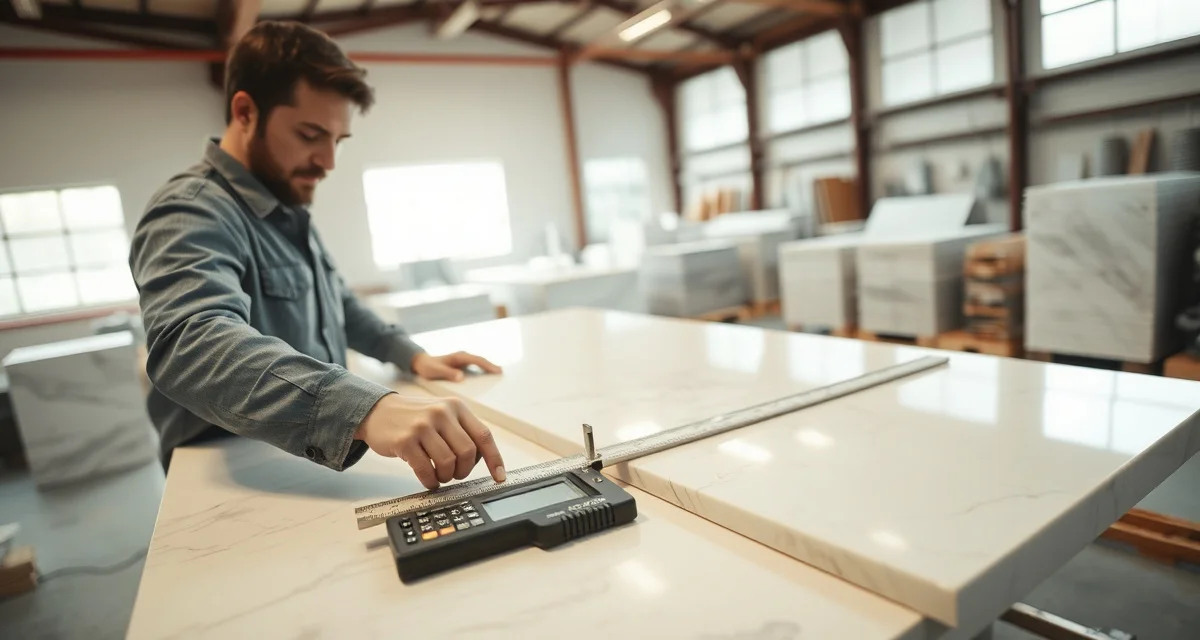
Countertop Material Calculator: Estimate Slab Needs by Project
Knowing how much countertop material a project requires before walking into a stone yard saves time, prevents over-ordering, and gives you real numbers for budgeting. This calculator takes your kitchen or bathroom dimensions, backsplash specifications, and edge details, then estimates the total square footage of slab material needed - including waste factor.
TL;DR
- The average U.S. kitchen requires 30-50 square feet of countertop material (not including backsplash)
- A standard slab is approximately 55 square feet (120" x 66"), but usable area after waste is typically 45-50 sq ft
- Backsplash adds 8-15 sq ft for standard 4-inch height; full-height backsplash can add 25-40 sq ft
- Most kitchen projects need 1-2 slabs; L-shaped or large kitchens with islands may need 3
- Always add 10-15% to your calculated area for waste, edge cuts, and pattern matching
- For natural stone with veining, you may need an additional 5-10% beyond standard waste for grain matching
How to Use the Material Calculator
Step 1: Measure Your Countertop Areas
Measure each section of countertop separately. For L-shaped or U-shaped kitchens, break the layout into straight sections.
Calculate your material waste savings
See exactly how much slab material and money you could save with optimized cutting layouts.
Try the free Waste CalculatorWhat to measure:
- Length of each section (in inches or feet)
- Depth of each section (standard cabinet depth is 25.5 inches, producing a 26-inch deep counter with overhang)
- Island dimensions (length x width)
- Peninsula dimensions if applicable
Measurement tips:
- Measure along the wall, not the front edge (the overhang doesn't add to your needed material beyond the depth measurement)
- Round up to the nearest inch on all measurements
- If cabinets aren't installed yet, use the cabinet layout plan dimensions
Step 2: Add Backsplash
Backsplash requires additional material from the same slab (or matching slab) if you're using stone rather than tile.
| Backsplash Type | Height | Material Needed (per linear foot) |
|---|---|---|
| No backsplash | 0" | 0 sq ft |
| Standard | 4" | 0.33 sq ft |
| Extended | 6" | 0.50 sq ft |
| Full height (to uppers) | 16-18" | 1.33-1.50 sq ft |
| Full wall (no uppers) | 36-48" | 3.00-4.00 sq ft |
Example: A kitchen with 15 linear feet of backsplash at 4-inch height needs approximately 5 sq ft of additional material.
Step 3: Account for Waste Factor
No fabrication process uses 100% of a slab. Cutoffs, edge trims, sink cutouts, and nesting inefficiencies all consume material.
| Scenario | Recommended Waste Factor |
|---|---|
| Simple rectangular layouts (vanities, bars) | 10% |
| Standard L-shaped kitchen | 12-15% |
| Complex layout with island | 15-18% |
| Pattern-matched natural stone | 15-25% |
| Waterfall edges | Add 5-8% beyond standard |
Step 4: Calculate Slabs Needed
Divide your total material need (countertop + backsplash + waste) by the usable area of a standard slab.
Standard slab sizes:
| Material | Typical Slab Dimensions | Gross Area | Usable Area (after edge trim) |
|---|---|---|---|
| Quartz | 120" x 55-63" | 46-52 sq ft | 42-48 sq ft |
| Granite | 108-126" x 54-72" | 40-63 sq ft | 36-58 sq ft |
| Marble | 108-120" x 54-66" | 40-55 sq ft | 36-50 sq ft |
| Quartzite | 108-126" x 54-72" | 40-63 sq ft | 36-58 sq ft |
| Porcelain | 126" x 63" | 55 sq ft | 50-52 sq ft |
Common Kitchen Material Estimates
If you want a quick reference before running the calculator, here are typical material requirements by kitchen type.
Small Kitchen (Galley or One-Wall)
- Counter area: 15-25 sq ft
- Backsplash (standard): 3-6 sq ft
- Waste (12%): 2-4 sq ft
- Total: 20-35 sq ft
- Slabs needed: 1
Average Kitchen (L-Shaped)
- Counter area: 30-45 sq ft
- Backsplash (standard): 5-8 sq ft
- Waste (15%): 5-8 sq ft
- Total: 40-61 sq ft
- Slabs needed: 1-2
Large Kitchen (U-Shaped with Island)
- Counter area: 50-75 sq ft
- Island: 15-25 sq ft
- Backsplash (standard): 8-12 sq ft
- Waste (15%): 11-17 sq ft
- Total: 84-129 sq ft
- Slabs needed: 2-3
Bathroom Vanity
- Counter area: 4-12 sq ft (single) or 12-20 sq ft (double)
- Backsplash (standard): 1-3 sq ft
- Waste (10%): 0.5-2.3 sq ft
- Total: 5.5-25.3 sq ft
- Slabs needed: Portion of 1 slab (often a remnant)
Special Considerations That Affect Material Quantity
Waterfall Edges
A waterfall edge extends the countertop material down the side of the cabinet to the floor. Each waterfall panel adds approximately 4-6 sq ft per side (depending on counter height and depth).
A kitchen island with waterfall edges on both ends adds 8-12 sq ft to your material requirement.
Mitered Edges
A mitered edge doubles the material thickness at the edge by laminating two pieces. This uses significantly more material - typically 15-20% of the slab's edge length becomes waste from the miter cutting process.
Pattern Matching
Bookmatch patterns (where adjacent slabs are opened like a book to create a mirrored pattern) require two slabs from the same block and significantly increase waste because pieces must be positioned for visual continuity, not just efficiency.
Vein-matching across seams also constrains nesting and can add 5-10% to waste.
Jumbo Slabs
Some manufacturers offer oversized slabs (up to 130" x 65"). These can eliminate seams in larger kitchens, but they're more expensive per square foot and may have transportation limitations.
Material Calculator Tips for Homeowners
Tip 1: Always Round Up
If your calculation says 48 sq ft and a slab provides 47 sq ft of usable area, you need two slabs. There's no "stretching" stone to make it fit.
Tip 2: Buy From the Same Lot
Natural stone slabs - even the "same" color - vary from block to block. If your project requires two slabs, buying from the same lot ensures the best color match.
Tip 3: Consider Remnant Availability
For vanities and small projects under 20 sq ft, ask your fabricator about remnant inventory. Remnant pieces are leftover from larger projects and cost 30-50% less than a full slab.
Tip 4: Factor in Oversize for Approval
Some homeowners visit the stone yard, select a slab, and then find that their kitchen requires just a few square feet more than the slab provides. Having accurate measurements before the yard visit prevents this frustrating situation.
Material Calculator Tips for Fabricators
Tip 1: Build Waste into Your Quotes
Quote the customer based on the material you'll actually consume, not just the installed square footage. If a job installs 40 sq ft but consumes 46 sq ft of slab, your material cost should reflect 46 sq ft.
Tip 2: Nest Before Quoting
Running a quick nesting layout before quoting tells you whether a job fits on one slab or two. The difference between 1 slab and 2 slabs can change your material cost by 40-100%.
SlabWise's Slab Nesting lets you run nesting optimization during the quoting phase - before the customer says yes - so your quotes reflect actual material consumption.
Tip 3: Track Actual vs. Estimated Material
Comparing your pre-job material estimate to actual material consumed builds a dataset that improves future estimating accuracy. Over time, you'll develop material factors specific to your shop's processes and material mix.
How many square feet is a typical kitchen countertop?
The average U.S. kitchen countertop is 30-50 square feet, not including backsplash. Small galley kitchens may be 15-25 sq ft; large kitchens with islands can exceed 75 sq ft.
How many slabs do I need for a kitchen?
Most standard kitchens require 1-2 slabs. Large kitchens with islands or extensive backsplash may need 3. Your fabricator can confirm after measuring.
Why do I need to add a waste factor?
No slab is 100% usable. Edge trimming, cutouts (sinks, cooktops), and nesting layout inefficiencies mean 10-15% of the slab becomes scrap. On patterned stone, it can be higher.
Can I use the cutoff pieces for anything?
Larger cutoffs can be used for backsplash, small vanity tops, or accent pieces. Your fabricator can advise on what's usable from the waste.
Is it cheaper to use one large slab or two smaller ones?
If a project fits on one slab, it's almost always cheaper - you avoid the cost of a second slab and the labor for additional seam work. However, some large kitchens physically require two slabs.
How do I estimate material for an irregularly shaped countertop?
Break the shape into rectangles. Measure each rectangle separately, then add the areas together. The calculator handles standard and irregular layouts.
Does countertop thickness affect material needed?
Thickness affects cost per square foot but not square footage. Whether you choose 2cm or 3cm stone, you need the same slab area to cover your counters.
How much extra should I buy for pattern matching?
For natural stone with prominent veining, add 15-25% beyond standard waste to allow for grain alignment and pattern continuity at seams.
What if my countertop has a curved section?
Curved sections require more material than their straight equivalent because the slab must accommodate the full curve footprint as a rectangle. Add 20-30% for curved sections.
Can remnant pieces be used for backsplash?
Yes. Remnant pieces from the primary countertop cut are commonly used for backsplash, saving material and ensuring a perfect color match.
How does an island affect the number of slabs needed?
An island adds 15-25 sq ft typically. If your perimeter counters already use most of a slab, the island will push you to a second slab.
Should I bring my measurements to the stone yard?
Absolutely. Knowing your total material requirement lets you and the fabricator evaluate whether a specific slab is large enough for your project before you commit.
Get Precise Material Estimates
For fabricators: accurate material estimation during the quoting phase means better margins and fewer surprise costs. SlabWise's nesting optimization runs material layouts during the quote stage, so you know the exact slab count before the customer signs.
Start your 14-day free trial and quote with confidence.
Try These Free Tools
- Cost Calculator -- Get instant countertop cost estimates by material, edge profile, and square footage.
- Compare Materials -- Side-by-side material comparison with pricing, durability, and maintenance ratings.
- Edge Profile Selector -- Browse edge profiles with cost impact and visual previews.