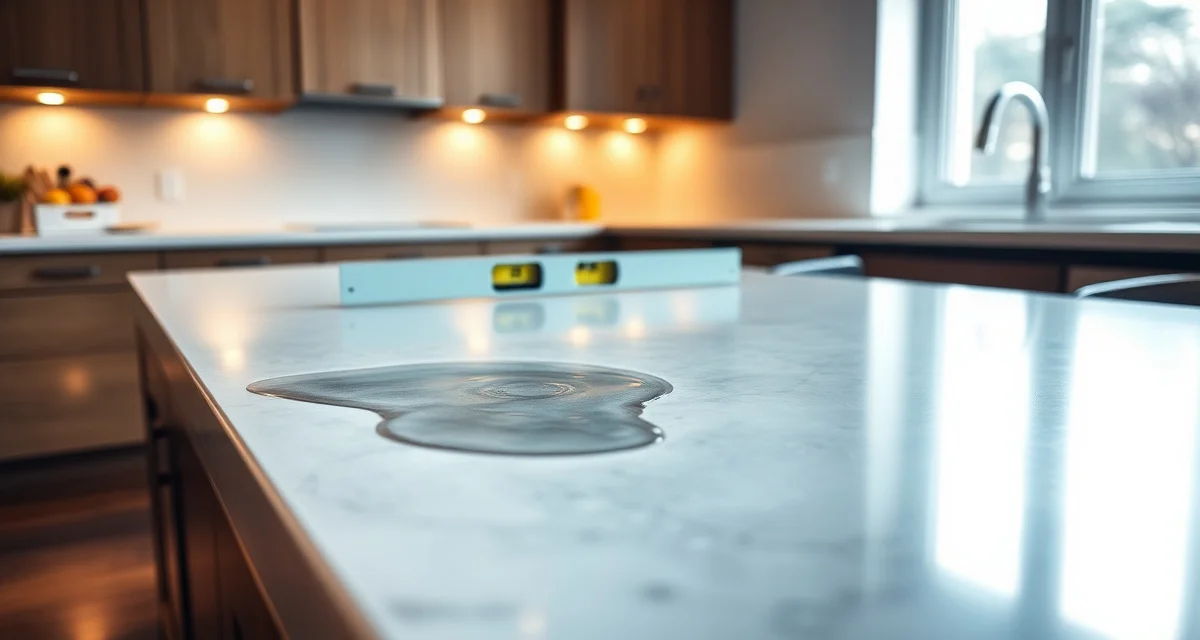
Countertop Uneven After Installation: Causes, Fixes, and Prevention
An uneven countertop after installation is one of the most frustrating post-install problems homeowners face, and it's more common than you'd expect. Whether you're seeing a visible slope, feeling a wobble near the sink, or watching water pool on the surface, uneven counters usually trace back to one of a handful of fixable causes. The good news: most cases don't require a full replacement.
TL;DR
- Uneven countertops are typically caused by unlevel cabinets, improper shimming, settling, or template measurement errors
- A level check takes 60 seconds and tells you whether the problem is the countertop or the cabinets underneath
- Minor unevenness (under 1/8 inch) can often be fixed with shims or leveling compounds without removing the countertop
- Moderate issues (1/8 to 1/4 inch) usually require a professional to lift, shim, and reset the slab
- Severe unevenness (over 1/4 inch) may need cabinet work or slab replacement, costing $500-$2,000+
- Template verification technology catches measurement errors before the slab is ever cut, preventing most installation-day surprises
- Always document the issue with photos and contact your fabricator within the warranty period
How to Tell If Your Countertop Is Actually Uneven
Before calling anyone, confirm the problem. Your eyes can play tricks, especially in kitchens with patterned stone or busy grain movement.
Calculate your material waste savings
See exactly how much slab material and money you could save with optimized cutting layouts.
Try the free Waste CalculatorThe 60-Second Level Test
Grab a 4-foot level (a 2-foot works but is less accurate) and place it across your countertop in multiple directions:
| Test Location | What to Look For |
|---|---|
| Front to back | Gap under level indicates slope toward or away from wall |
| Left to right along runs | Dips or high spots along the counter length |
| Across seams | One side higher than the other at seam joints |
| Around sink cutout | Sagging or lifting near the heaviest point |
| Corner sections | L-shaped counters often show issues at the miter |
What counts as "uneven"?
- Under 1/16 inch over 4 feet: Normal. Most surfaces have this much variation and it won't affect function.
- 1/16 to 1/8 inch: Borderline. You might notice water pooling but it's within acceptable tolerance for most fabricators.
- 1/8 to 1/4 inch: Noticeable. Water pools visibly, objects roll, and the issue should be addressed.
- Over 1/4 inch: Significant. This affects both function and can stress the stone over time, potentially leading to cracks.
The Water Test
Pour a small amount of water on the countertop surface. On a level surface, water should spread evenly or stay roughly where you pour it. If it immediately runs in one direction, you have a slope worth investigating.
6 Reasons Your Countertop Is Uneven
1. Cabinets Weren't Level Before Installation
This is the number-one cause. Countertop fabricators template off the existing cabinet tops. If those cabinets weren't leveled during the kitchen build - or if they've settled since - the countertop follows every imperfection.
Standard cabinet installation calls for leveling to within 1/16 inch. In practice, especially in older homes or flipped houses, cabinets can be off by 1/4 inch or more. A slab of granite or quartz laid on top simply mirrors whatever surface sits underneath.
2. Improper or Missing Shims
Shims are thin wedge-shaped pieces (usually plastic or composite) placed between the cabinet and the countertop to correct minor elevation differences. When an installer skips shimming - or places shims in the wrong locations - the slab sits unevenly.
Proper shimming requires shims at every 12-18 inches along the cabinet run, with additional shims at sink cutouts, seams, and corners. Rushing this step is the second most common cause of uneven installations.
3. Settling After Installation
Houses move. Wood cabinets expand and contract with humidity changes. The subfloor can settle, especially in newer construction. Even if the countertop was perfectly level on install day, these shifts can introduce unevenness over the following weeks or months.
Post-settling unevenness typically shows up:
- 2-6 weeks after installation in new construction
- After seasonal temperature swings in homes with significant humidity changes
- Following plumbing work that disturbed the cabinet structure
4. Template or Measurement Errors
If the original template contained measurement inaccuracies, the fabricated slab may not match the actual cabinet layout. Even a 1/8-inch error in the template can translate to a noticeable fit issue at installation.
This is where precision during the templating phase matters most. Digital templating systems are more accurate than manual methods, but they're only as good as the operator and the verification process that follows.
5. Adhesive or Support Failure
Most countertops are secured with a combination of silicone adhesive and mechanical support (clips, brackets, or plywood subtops). If the adhesive fails or a support bracket loosens, sections of the countertop can shift or sag.
Signs of adhesive failure:
- Countertop moves slightly when you push on an edge
- A clicking or rocking motion when pressing down
- Visible gaps between the countertop and cabinet top that weren't there at installation
6. Warped or Damaged Slab
Less common but possible - the slab itself may have an imperfection. Natural stone can have subtle warping that becomes visible only after installation. Engineered quartz can occasionally develop slight bows during transport or storage.
How to Fix an Uneven Countertop
DIY Fixes for Minor Unevenness
For gaps under 1/8 inch:
-
Shimming from below: Slide plastic shims between the cabinet top and the countertop underside. Use a level to check as you go. This works when you can access the underside through cabinet doors.
-
Leveling compound on cabinets: For minor cabinet height differences, a thin layer of self-leveling compound on the cabinet tops before countertop placement works. This is really only an option during new installation, not after.
-
Adjustable cabinet legs: If your cabinets have adjustable legs (common in modern Euro-style cabinets), you can sometimes correct the issue by adjusting the cabinet height itself.
Cost: $10-$50 in materials
Professional Repairs for Moderate Issues
For gaps between 1/8 and 1/4 inch:
A professional installer will need to:
- Disconnect the sink plumbing
- Cut the caulk line along the backsplash
- Carefully lift the countertop (this usually requires 2-3 people for stone)
- Re-level the cabinets or add proper shimming
- Reset the countertop with fresh adhesive
- Reconnect plumbing and re-caulk
Cost: $300-$800 depending on countertop material and kitchen size
When You Need a Replacement
For gaps over 1/4 inch or if the slab is damaged:
If the unevenness has caused the stone to crack, or if the underlying cabinet structure needs major work, you may be looking at a partial or full replacement.
| Scenario | Typical Cost |
|---|---|
| Cabinet leveling + countertop reset | $500-$1,200 |
| Partial slab replacement (one section) | $800-$2,500 |
| Full countertop replacement | $2,000-$6,000+ |
| Cabinet rebuild + new countertop | $4,000-$12,000+ |
Who's Responsible? Warranty and Liability
This is where it gets tricky, and it depends on the root cause.
Fabricator is responsible if:
- Template measurements were inaccurate
- The slab was fabricated with incorrect dimensions
- Installation team didn't shim properly
- The issue appears within the warranty period (typically 1-2 years for labor)
Homeowner/GC is responsible if:
- Cabinets weren't level before templating and this wasn't flagged
- Settling occurred after installation due to structural issues
- Modifications were made to cabinets after countertop installation
Document everything. Take photos showing the level on the counter, measure the gap, and note the date. Contact your fabricator in writing (email, not just a phone call) so there's a record.
How Fabricators Prevent Uneven Installations
The best fix is prevention. Professional fabrication shops use several methods to catch problems before install day.
Pre-Template Cabinet Inspection
Experienced fabricators check cabinet levelness during the template visit, not after. If cabinets are more than 1/8 inch out of level, the fabricator should flag the issue and ask the homeowner or GC to correct it before templating proceeds.
Digital Templating with Verification
Modern digital templating creates precise measurements, but errors still happen - wrong reference points, bumped laser units, transposed numbers. AI-powered template verification adds a second and third check layer, comparing measurements against sink specs, standard tolerances, and physical constraints.
SlabWise's Template Verification runs a 3-layer check on every template file, catching inconsistencies that lead to fit problems and uneven installations before the slab ever reaches the CNC.
Pre-Install Dry Fitting
Some shops do a dry fit in the fabrication facility, assembling all pieces on a level surface to verify fit and alignment before loading onto the truck. This adds 30-60 minutes of shop time but eliminates surprises at the jobsite.
When to Call a Professional vs. DIY
| Situation | Recommended Action |
|---|---|
| Slight wobble, no visible gap | Try shimming yourself |
| Water pools in one area | Check level, contact fabricator |
| Visible gap between slab and cabinet | Call fabricator for warranty claim |
| Counter rocks or moves | Professional repair needed |
| Crack developing from stress point | Professional repair urgently needed |
| Seam separating due to unevenness | Professional repair needed |
Is it normal for a countertop to be slightly uneven?
Most fabricators work within a tolerance of 1/16 inch over a 4-foot span. Minor variations within this range are considered acceptable and won't cause functional issues.
Can an uneven countertop cause cracks?
Yes. Stone countertops that are unevenly supported develop stress points, particularly around sink cutouts and seams. Over time, these stress points can lead to cracks.
How long after installation should I report unevenness?
Report it as soon as you notice it. Most fabricators offer a 1-2 year warranty on installation labor. Waiting too long can make it harder to prove the issue was present from install.
Will my fabricator fix an uneven countertop for free?
If the unevenness was caused by a fabrication or installation error and you're within the warranty period, most reputable fabricators will correct it at no charge. If it's caused by cabinet settling or other structural issues, you may be responsible for the cost.
Can you fix uneven granite without removing it?
For minor issues, yes. Shimming from below or adjusting cabinet legs can sometimes correct the problem without lifting the slab. For anything over 1/8 inch, the slab usually needs to come up.
Does uneven countertop affect resale value?
A noticeably uneven countertop will come up during a home inspection and can affect buyer perception. Most inspectors flag unevenness over 1/4 inch.
How much does it cost to level a countertop?
Minor shimming runs $10-$50 in materials if you DIY. Professional re-leveling costs $300-$800. Full replacement of a damaged section can reach $2,500 or more.
Can I use self-leveling compound under a countertop?
Self-leveling compound can be applied to cabinet tops before countertop installation to correct minor height differences. It's not practical to use after the countertop is already installed.
Why did my countertop become uneven months after installation?
Post-installation settling is common, especially in new construction. As the house settles and wood cabinets respond to humidity changes, minor shifts can introduce unevenness that wasn't present on install day.
Should I level cabinets before countertop installation?
Absolutely. Cabinet leveling should happen before the template visit. It's much cheaper to level cabinets ($100-$300) than to fix an uneven countertop after the fact.
Stop Uneven Installations Before They Start
For fabricators: template errors and missed cabinet issues are the top causes of post-install callbacks. SlabWise's Template Verification catches measurement inconsistencies across three independent check layers, flagging problems before they become expensive jobsite surprises.
Try SlabWise free for 14 days and see how automated verification reduces callbacks and remakes.
Try These Free Tools
- Photo to Template -- Snap a photo of an existing countertop and get an AI-generated DXF template.
- Template Compare -- Upload two templates and see every dimension change highlighted instantly.
- AI Template Verification -- Cross-check your template against manufacturer specs before cutting.
Sources & Further Reading
-
Natural Stone Institute - Sealant and Adhesive Applications for Natural Stone
-
National Kitchen & Bath Association - Countertop Installation Best Practices
-
ASTM International - Standard Practice for Installation of Caulking Compounds
-
International Surface Fabricators Association - Fabrication Standards and Troubleshooting