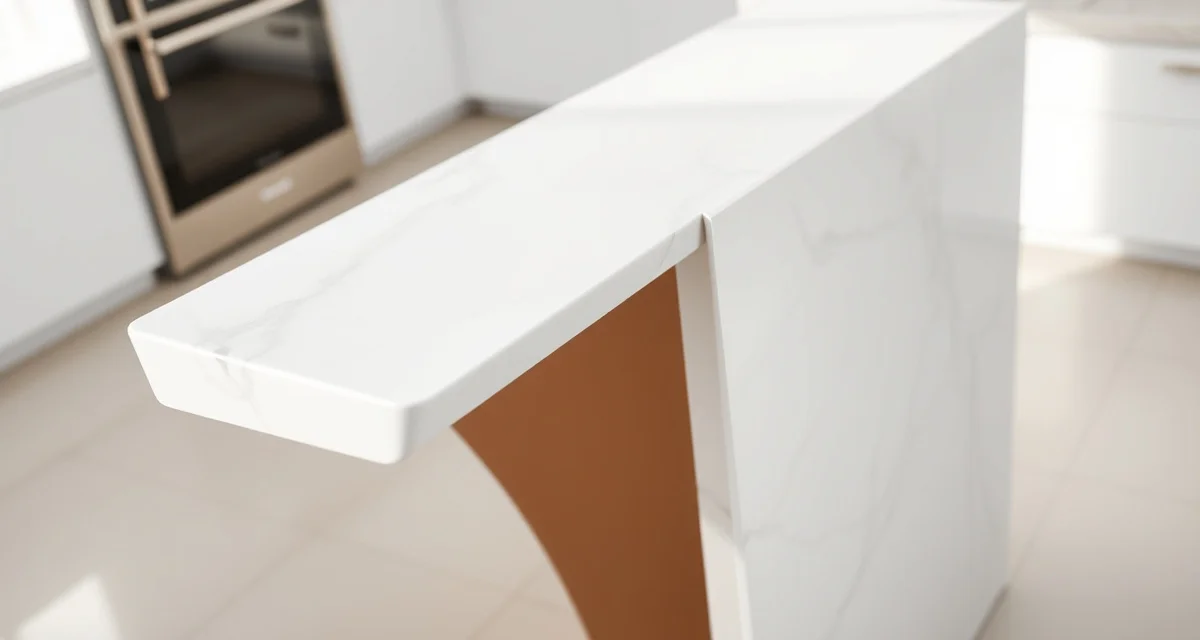
What Is Waterfall Edge? Definition & Guide
Quick Definition
A waterfall edge is a countertop design where the stone continues vertically down one or both sides of a cabinet or island, "falling" from the horizontal surface to the floor like a waterfall. Unlike standard edge profiles that finish the slab's front edge, waterfall designs use additional slab material joined at a mitered 45-degree seam to create a continuous stone surface from top to side.
TL;DR
- Waterfall edge extends the countertop material vertically down the side of a cabinet to the floor
- Requires a mitered 45-degree joint where the horizontal and vertical pieces meet
- Uses significantly more slab material than a standard finished edge
- Vein matching at the miter joint is critical for a quality result
- Typical upcharge is $50-$150+ per linear foot of waterfall face
- Most common on kitchen islands and end panels
- Precise template verification prevents costly misalignment at the miter seam
How Waterfall Edges Work
A waterfall countertop is not just an edge treatment - it's a structural design element. Here's what's actually happening:
Calculate your material waste savings
See exactly how much slab material and money you could save with optimized cutting layouts.
Try the free Waste Calculator- The horizontal countertop slab runs to the edge of the cabinet as normal
- Instead of applying an edge profile (bullnose, ogee, etc.), the slab edge is cut at a precise 45-degree miter
- A second piece of slab material is also cut at 45 degrees on its top edge
- The two mitered edges are joined with epoxy and alignment hardware, creating what looks like a single piece of stone bending 90 degrees from horizontal to vertical
- The vertical panel extends down to the floor (or to a desired height)
When executed well, the miter joint is nearly invisible, and the stone appears to flow from the countertop surface down to the ground in one continuous sheet.
Types of Waterfall Installations
Single Waterfall
Stone falls down one side of the island or cabinet - typically the most visible end. The opposite end is finished with a standard edge profile or butts against a wall.
Double Waterfall
Stone falls down both ends of the island. This is the most dramatic look and uses the most material. Both miter joints must be executed with equal precision.
Waterfall with Return
The vertical panel wraps partially under the cabinet's bottom edge, creating an L-shape on the side. This hides the cabinet base and adds visual weight.
Full Wrap Waterfall
Stone covers the top and cascades down all exposed sides of an island. This is rare due to extreme material cost and complexity but delivers a monolithic stone block appearance.
Material and Fabrication Requirements
Slab Consumption
Waterfall edges consume far more material than any standard edge profile. A typical kitchen island with a single waterfall end uses an additional 10-20 square feet of slab material for the vertical panel alone.
| Installation Type | Additional Slab Material | Material Cost Impact |
|---|---|---|
| Single waterfall (36" cabinet height) | 10-15 sqft | $400-$1,500 |
| Double waterfall | 20-30 sqft | $800-$3,000 |
| Waterfall with return | 12-18 sqft | $500-$1,800 |
| Full wrap | 30-50+ sqft | $1,200-$5,000+ |
Material costs depend heavily on the stone type. A single waterfall in level-1 granite is a much different line item than one in Calacatta marble at $80/sqft.
Miter Joint Fabrication
The miter joint is where waterfall quality is made or broken:
- Cutting - Both pieces must be cut at exactly 45 degrees. Even 0.5 degrees of error creates a visible gap at the joint.
- Vein matching - If the stone has visible veining (marble, quartzite, many quartzes), the veins must align across the miter. This requires careful slab layout planning before any cuts are made.
- Bonding - The mitered edges are joined with color-matched epoxy and drawn together with miter bolts or vacuum clamps.
- Finishing - The outside corner of the joint is polished to create a clean, continuous line.
Where Mistakes Happen
Waterfall installations are where fabrication errors get expensive:
- Vein mismatch at the miter - veins that don't line up across the joint are visible and cannot be fixed without replacing the piece
- Angle errors - a miter that's off by even 1 degree creates a gap that's impossible to hide
- Length errors - if the vertical panel is cut too short, there's a gap at the floor; too long, and it needs to be trimmed on-site
- Template inaccuracy - if the template doesn't capture the exact cabinet dimensions and floor level, the vertical panel won't fit
These mistakes typically cost $1,500-$4,000 in remakes per occurrence. Template verification before cutting is the most effective way to prevent them.
Slab Layout and Nesting Considerations
Waterfall edges demand more thought during slab layout than standard countertops:
Vein Continuity Planning
For veined stones, the horizontal and vertical pieces must come from the same area of the slab, oriented so veins continue across the miter. This constrains the nesting layout and can reduce overall slab yield.
Material Orientation
The vertical waterfall panel must be cut with the correct grain/vein direction. Rotating the piece 90 degrees to fit it into a tighter nesting layout would break the vein continuity.
Waste Impact
Because waterfall pieces are large and must come from specific slab areas, they generate more waste than freely nestable pieces. Typical yield on a waterfall job is 5-10% lower than a standard countertop job.
SlabWise's nesting algorithm accounts for waterfall constraints by maintaining vein orientation requirements and matching relationships between miter pairs. Shops report getting 10-15% better yield on standard jobs, which helps offset the lower yield on waterfall projects.
Pricing Waterfall Edges
Waterfall pricing must account for:
- Additional material - the full square footage of the vertical panel(s)
- Miter cutting - CNC or bridge saw time for precision 45-degree cuts
- Vein matching labor - time spent planning and verifying vein alignment
- Bonding and assembly - epoxy, miter hardware, clamping, curing
- Corner polishing - finishing the outside edge of the miter joint
- Installation complexity - waterfall panels are heavy and fragile during transport and installation
Typical Upcharge Ranges
| Component | Cost Range |
|---|---|
| Material (vertical panel) | $400-$3,000+ |
| Miter fabrication | $150-$400 |
| Vein matching/planning | $100-$300 |
| Bonding and finishing | $100-$250 |
| Additional installation labor | $200-$500 |
| Total upcharge per waterfall end | $950-$4,450+ |
Quoting waterfall projects accurately is critical because the margin for error is high. An underquoted waterfall job can easily lose money. SlabWise's Quick Quote tool includes waterfall configurations so pricing reflects the true cost of materials and fabrication from the first customer interaction.
Design Trends and Popularity
Waterfall edges have grown from a niche luxury feature to a mainstream kitchen design element. They appear frequently on home renovation shows and in design publications, which means more customers are requesting them.
For fabrication shops, this trend is a double-edged sword: waterfall jobs carry higher dollar values and margins, but they also demand more precision and carry higher remake risk. Shops that invest in accurate templating, CNC miter cutting, and reliable quoting systems profit from waterfall work. Shops that wing it often lose money.
FAQ
What is a waterfall edge countertop?
A waterfall edge countertop extends the stone material vertically down one or both sides of a cabinet or island, creating a continuous flow of stone from the horizontal surface to the floor.
How much does a waterfall edge cost?
A single waterfall end typically adds $950-$4,450+ to the countertop cost, depending on the stone material, cabinet height, and vein-matching requirements.
Is a waterfall edge worth it?
For homeowners seeking a high-end, modern aesthetic, waterfall edges add significant visual impact and can increase home value. For fabricators, they're higher-margin jobs when quoted and executed correctly.
How are waterfall edges joined?
The horizontal and vertical pieces are cut at 45-degree miters and bonded with color-matched epoxy. Miter bolts or vacuum clamps hold the pieces tight while the epoxy cures.
Can you do a waterfall edge with granite?
Yes, but vein matching is less of a concern with uniform granites. Heavily patterned or veined granites require the same careful planning as marble or quartzite.
Does the vein need to match on a waterfall?
For veined stones, vein matching at the miter joint is expected. A visible vein mismatch is considered a fabrication defect by most customers and designers.
How thick should stone be for a waterfall edge?
Standard 3cm (1.25") slabs are most common for waterfall installations. The 45-degree miter on 3cm material creates a clean outside corner. 2cm can be used but produces a thinner, more fragile miter joint.
Can waterfall edges be done on both sides of an island?
Yes. Double waterfall installations are common on kitchen islands. Both ends require mitered joints, which roughly doubles the fabrication cost and material usage.
What's the hardest part of fabricating a waterfall edge?
Vein matching and miter accuracy. The two pieces must align visually and physically at the joint. Template accuracy for the vertical panel dimensions is also critical.
How long does a waterfall countertop take to install?
Installation of a waterfall countertop typically takes 30-60 minutes longer than a standard countertop due to positioning the vertical panel, clamping the miter joint, and allowing epoxy curing time.
Quote Waterfall Jobs with Confidence
Waterfall countertops are high-value projects that demand accurate quoting and precise fabrication. SlabWise helps you price waterfall jobs correctly and verify templates before you cut.
Start Your 14-Day Free Trial →
Try These Free Tools
- Nesting Optimizer -- AI-powered slab layout that maximizes yield considering vein direction and defects.
- Defect Mapping -- Upload a slab photo and AI maps every fissure, pit, and color issue.
- Value Engineering -- Find dollar-quantified suggestions to save material without cutting margin.
Sources & Further Reading
- Natural Stone Institute - Fabrication Guidelines and Best Practices
- International Surface Fabricators Association - Waterjet Cutting Technology Standards
- ASTM International - Standard Guide for Abrasive Waterjet Machining
- OSHA - Safety Guidelines for Waterjet Operations