What Is Bullnose Edge? Definition & Guide
Quick Definition
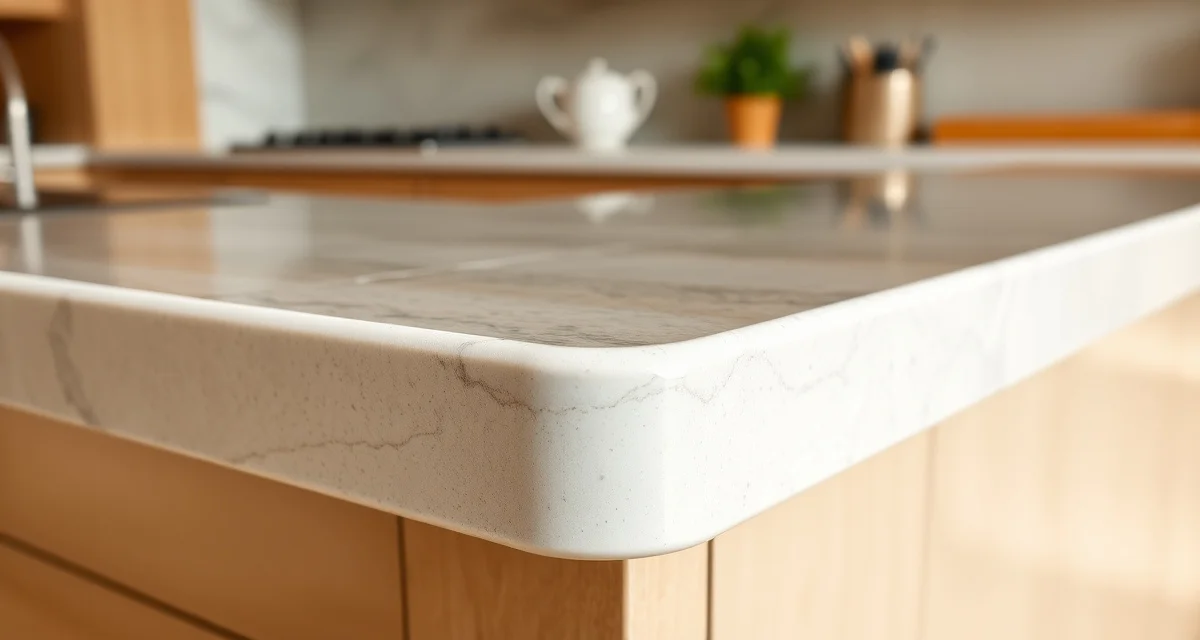
A bullnose edge is a fully rounded countertop edge profile where the top edge curves smoothly over to meet the bottom, creating a half-circle or full-circle cross-section. It's one of the most popular edge profiles in residential countertop fabrication, valued for its soft look and absence of sharp corners that could chip or cause injury.
TL;DR
- Bullnose edge features a fully rounded profile - either half-round or full-round
- It's one of the most commonly requested edge profiles for kitchen and bath countertops
- Half bullnose rounds the top edge only; full bullnose rounds both top and bottom
- Bullnose is relatively simple to fabricate, keeping labor costs moderate
- It works well with granite, quartz, marble, and most engineered stones
- Pricing typically adds $8-$20 per linear foot depending on material and complexity
- Accurate edge profile specs in your quoting system prevent miscommunication and remakes
Understanding the Bullnose Edge Profile
The bullnose edge gets its name from exactly what it looks like - a rounded, nose-like curve along the front edge of a countertop. Unlike square or eased edges that leave a flat top surface meeting a flat side, the bullnose profile eliminates that hard 90-degree angle entirely.
Calculate your material waste savings
See exactly how much slab material and money you could save with optimized cutting layouts.
Try the free Waste CalculatorThere are two primary variations:
Half Bullnose (Demi-Bullnose)
The top edge is rounded into a smooth curve, but the bottom of the slab remains flat or slightly eased. When you run your hand along the countertop edge, your fingers roll over a smooth curve on top but hit a flat surface underneath. This is the more common of the two in residential work.
Full Bullnose
Both the top and bottom edges are rounded, creating a symmetrical half-circle profile when viewed from the end. The entire edge is curved, with no flat surface remaining on the slab edge. Full bullnose is heavier on material removal and takes more fabrication time.
How Bullnose Edges Are Fabricated
Creating a bullnose profile involves multiple steps, whether done by hand or on a CNC machine:
Manual Fabrication Process
- Rough shaping with a hand-held router or angle grinder using a bullnose profiling bit
- Progressive polishing through 4-7 grit stages (typically 50, 100, 200, 400, 800, 1500, 3000)
- Final buffing to match the surface finish of the countertop face
CNC Fabrication Process
- Profile programming - the bullnose radius is set in the CNC software
- Automated profiling using a diamond wheel matched to the desired radius
- Automated polishing through progressive grits on the same machine
- Quality check for consistent radius and finish
CNC machines produce more consistent bullnose edges because the radius stays uniform along the entire length. Hand profiling depends on the operator's skill, and variations of 0.5-1mm in radius are common on long runs.
Bullnose vs. Other Common Edge Profiles
| Edge Profile | Shape | Fabrication Complexity | Typical Cost/LF | Best For |
|---|---|---|---|---|
| Bullnose (half) | Rounded top | Low-Medium | $8-$15 | Kitchens, baths, family homes |
| Bullnose (full) | Fully rounded | Medium | $12-$20 | Islands, peninsulas, bar tops |
| Eased | Slightly softened square | Low | $0-$8 | Modern/contemporary, tight budgets |
| Ogee | S-curve with decorative profile | High | $15-$30 | Traditional, formal kitchens |
| Mitered | 45-degree joined for thick look | High | $25-$50 | Modern waterfall, thick-slab look |
| Beveled | Angled flat cut on top | Low | $5-$12 | Transitional, commercial |
Bullnose sits in a sweet spot between the simplicity of an eased edge and the intricacy of an ogee. It's visually appealing without demanding the fabrication time of more ornate profiles.
Material Considerations for Bullnose Edges
Not every stone behaves the same way when you round its edge:
Granite
Granite holds a bullnose profile well because of its hardness. The polished curve stays crisp and wears slowly. Darker granites show the profile particularly well because the polished edge catches light.
Quartz (Engineered Stone)
Quartz takes a smooth bullnose beautifully. The resin binders in engineered stone produce a uniform finish without the natural pitting that can show up in granite. Most quartz manufacturers specify recommended edge profiles, and bullnose is always on the list.
Marble
Marble is softer and more porous, which means the bullnose edge on marble can dull faster in heavy-use areas. The polished edge may also show etching from acidic spills sooner than the flat surface. Fabricators typically recommend sealing the bullnose edge on marble just as carefully as the face.
Quartzite
Natural quartzite is extremely hard - harder than granite in many cases. This means bullnose fabrication takes longer and wears tooling faster, but the finished edge is exceptionally durable.
Quoting and Pricing Bullnose Edges
Edge profiles are a common source of quoting errors in fabrication shops. The difference between half bullnose and full bullnose is significant in both labor and material cost, yet customers often just say "bullnose" without specifying.
Cost Factors
- Material type - harder stones take longer to profile and polish
- Half vs. full - full bullnose removes more material and requires polishing on both top and bottom curves
- Length of edge - measured in linear feet; longer runs = more time
- Slab thickness - 3cm slabs have more edge to profile than 2cm
- Finish match - the edge must match the surface finish (polished, honed, or leathered)
Common Quoting Mistakes
- Not clarifying half vs. full bullnose with the customer
- Quoting the same price for all materials (quartzite takes 2x the time of quartz)
- Forgetting to include edge polishing time in the estimate
- Missing edge length on islands that are finished on all four sides
A fast, accurate quoting system prevents these errors. SlabWise's Quick Quote tool includes edge profile selection with per-material pricing built in, generating accurate quotes in 3 minutes instead of 20. That eliminates the back-and-forth that eats up your office staff's time.
Bullnose Edge in Customer Communication
One of the biggest challenges with edge profiles is that customers don't speak fabricator language. They see a bullnose on Pinterest and call it "the rounded one." They confuse half bullnose with a pencil round or a waterfall edge.
How to Prevent Miscommunication
- Show physical samples - keep edge profile samples in your showroom
- Include profile images in quotes - a cross-section diagram removes all ambiguity
- Use a customer portal - let customers view and confirm their edge selection online before fabrication begins
Shops using SlabWise's Customer Portal report 70% fewer phone calls, largely because customers can see and confirm details like edge profiles, material selections, and layout approvals without calling the shop.
Installation Considerations
Bullnose edges require a few extra considerations during installation:
- Support requirements - full bullnose on 2cm material can look thin; consider laminating the edge to 4cm for a more substantial look
- Undermount sinks - the bullnose profile curves around the sink cutout edge, requiring careful profiling at the corners
- Backsplash meeting point - where the countertop meets the backsplash at the rear, the bullnose is typically not applied (the back edge is usually left flat against the wall)
- Seam locations - bullnose edges at seams need careful alignment so the profile curves match on both pieces
FAQ
What is a bullnose edge on a countertop?
A bullnose edge is a rounded profile applied to the front edge of a countertop. The top edge curves smoothly downward in a half-circle shape, eliminating sharp corners.
What's the difference between half bullnose and full bullnose?
Half bullnose rounds only the top edge of the slab, leaving the bottom flat. Full bullnose rounds both the top and bottom edges, creating a symmetrical curved profile.
How much does a bullnose edge cost?
Bullnose edge pricing typically ranges from $8 to $20 per linear foot, depending on whether it's half or full bullnose, the stone material, and the slab thickness.
Is bullnose a good choice for kitchen countertops?
Yes. Bullnose is one of the most popular kitchen edge profiles because it's durable, comfortable to lean against, and has no sharp corners that could chip or cause injury.
Does bullnose edge work with all stone types?
Bullnose works with granite, quartz, marble, quartzite, and most engineered stones. Harder materials take longer to fabricate but produce a more durable finished edge.
Is bullnose considered modern or traditional?
Bullnose is versatile and works in both settings, though it leans slightly traditional. Contemporary designs tend to favor eased or mitered edges, while bullnose pairs well with transitional and classic kitchen styles.
How long does it take to fabricate a bullnose edge?
On a CNC machine, bullnose profiling and polishing for a typical kitchen (25-35 linear feet of edge) takes 30-60 minutes. Hand profiling the same length can take 2-4 hours.
Can you put a bullnose edge on a thin slab?
Yes, but a bullnose on 2cm material looks quite thin. Many fabricators recommend laminating the edge to 4cm before applying the bullnose profile for a more substantial appearance.
Does a bullnose edge chip easily?
Bullnose edges are actually more chip-resistant than square or eased edges because there's no sharp corner to catch and break. The rounded profile distributes impact forces more evenly.
How do I choose between bullnose and ogee?
Bullnose is simpler, less expensive, and works in more design styles. Ogee is more decorative with an S-curve profile, better suited for formal or traditional kitchens, and costs more to fabricate.
Get Edge Profiles Right on Every Quote
Misquoted edge profiles lead to pricing errors and customer disputes. SlabWise includes edge profile pricing for every material in your catalog, so your quotes are accurate from the first conversation.
Start Your 14-Day Free Trial →
Try These Free Tools
- Cost Calculator -- Get instant countertop cost estimates by material, edge profile, and square footage.
- Compare Materials -- Side-by-side material comparison with pricing, durability, and maintenance ratings.
- Edge Profile Selector -- Browse edge profiles with cost impact and visual previews.
Sources & Further Reading
- National Kitchen & Bath Association - Cabinet Frame Construction Standards
- International Surface Fabricators Association - Support Frame Requirements for Stone Installation
- Natural Stone Institute - Structural Framing Guidelines for Natural Stone Applications
- ASTM International - ASTM C1242 Standard Guide for Selection, Design, and Installation of Dimension Stone Attachment Systems