What Is Bookmatching? Definition & Guide
Quick Definition
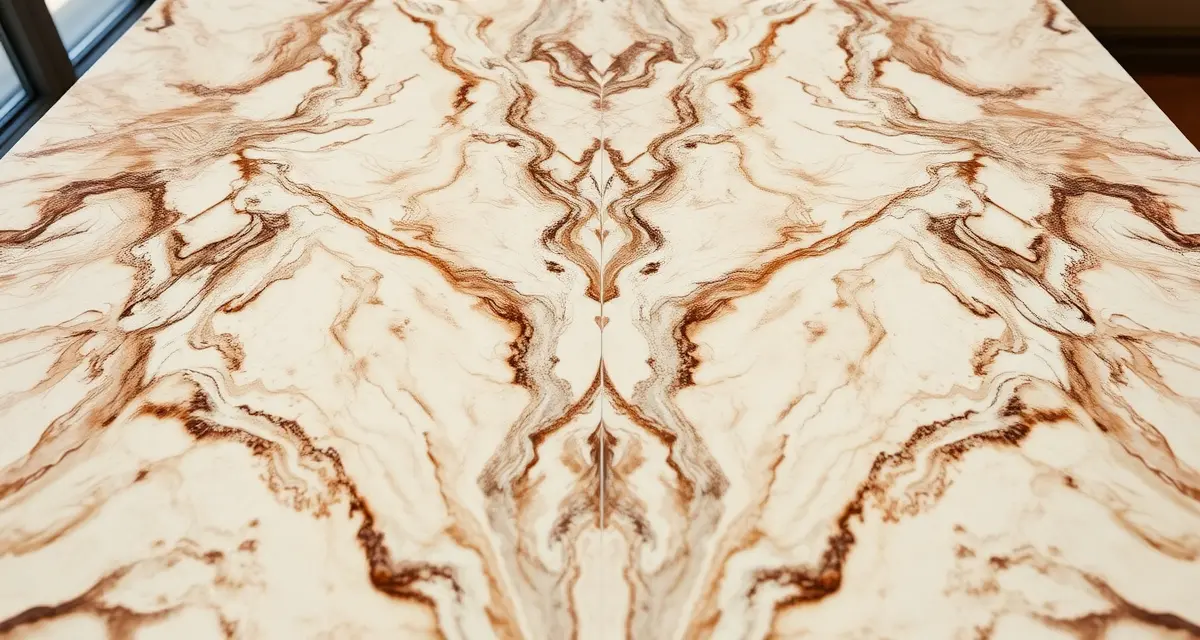
Bookmatching is a fabrication technique where two adjacent slabs from the same stone block are opened like the pages of a book, creating a mirror-image pattern across the seam. The result is a symmetrical, visually striking surface that turns natural veining into a design feature. Bookmatching is most commonly used with marble, granite, and quartzite for countertops, feature walls, and waterfall edges.
TL;DR
- Bookmatching opens two sequential slabs to create a mirror-image pattern at the seam
- Slabs must come from the same block and be cut in consecutive order (sequential slabs)
- Most popular with heavily veined materials like marble, quartzite, and exotic granite
- Adds 15-30% to material costs because you need two specific slabs from one block
- Requires precise slab nesting and seam placement to maintain the mirrored effect
- Commonly used for kitchen islands, waterfall edges, feature walls, and bathroom vanities
- Digital layout tools help fabricators plan bookmatch layouts before cutting
How Bookmatching Works
Think of a book lying flat, open to a two-page spread. The left and right pages are mirrors of each other along the spine. Bookmatching stone works the same way.
Calculate your material waste savings
See exactly how much slab material and money you could save with optimized cutting layouts.
Try the free Waste CalculatorWhen a stone block is cut into slabs at the quarry, each slab is essentially a thin cross-section of the same geological formation. Two consecutive slabs - called sequential slabs - share nearly identical veining patterns because they were right next to each other in the original block.
To bookmatch:
- Select two sequential slabs from the same block
- Flip one slab 180 degrees along its long edge (like turning a page)
- Align them at the seam so the veining mirrors across the joint
- Fabricate and install with the mirrored pattern centered on the finished surface
The result is a symmetrical design that looks intentional and dramatic rather than like two random pieces of stone pushed together.
Where Bookmatching Is Used
Kitchen Islands
Large kitchen islands are the most popular application for bookmatching. The broad, flat surface gives the mirrored pattern room to breathe, and the island often serves as the visual centerpiece of the kitchen.
Waterfall Edges
A waterfall edge - where the countertop material wraps down the side of a cabinet to the floor - creates an additional seam that bookmatching can enhance. Matching the veining from the horizontal surface to the vertical face requires careful planning but produces a dramatic result.
Feature Walls
In commercial spaces and luxury homes, bookmatched slabs are installed as wall cladding. Entire bathroom walls, fireplace surrounds, or lobby features can showcase the mirrored pattern at full slab scale.
Bathroom Vanities
Double vanities with bookmatched tops create a natural sense of symmetry that complements the two-sink layout.
Bookmatching: Cost and Material Considerations
| Factor | Impact |
|---|---|
| Slab cost | 15-30% premium for sequential slab pairs |
| Material waste | Higher - both slabs must be allocated to one project |
| Fabrication time | 20-40% longer due to precise alignment requirements |
| Seam visibility | Lower - the mirrored pattern disguises the joint |
| Customer satisfaction | Higher - bookmatching is perceived as premium work |
Why It Costs More
Bookmatching requires two specific slabs from the same block. This means:
- Slab selection is restricted - you can't mix and match from different bundles
- Inventory planning changes - both slabs must be reserved for one job
- Waste potential increases - if one slab has a defect, both may be unusable for the bookmatch
- Suppliers charge a premium for guaranteed sequential pairs
For fabricators, the higher material cost is typically offset by the ability to charge premium pricing for the finished product.
Best Materials for Bookmatching
Not every stone looks good bookmatched. The technique works best with materials that have strong, directional veining or dramatic color movement.
Excellent for Bookmatching
- Calacatta marble - Bold, sweeping veins create striking mirror patterns
- Quartzite (e.g., Taj Mahal, Mont Blanc) - Dramatic movement with excellent durability
- Exotic granite (e.g., Patagonia, Blue Bahia) - Unique patterns that become art when mirrored
- Onyx - Translucent materials with vivid color banding
Poor Candidates for Bookmatching
- Solid-color quartz - No veining to mirror, so the technique adds nothing
- Uniform granite (e.g., Absolute Black, Uba Tuba) - Minimal pattern variation
- Subtle quartz patterns - The mirror effect isn't visible enough to justify the cost
Bookmatching Challenges for Fabricators
Slab Sourcing
Finding sequential slabs requires strong supplier relationships. Many distributors don't guarantee slab order within a bundle, so fabricators need to inspect slabs in person or request sequential numbering from the quarry.
Layout Precision
A bookmatched layout must be planned precisely before any cutting happens. If the seam alignment is off by even a fraction of an inch, the mirror effect breaks and the result looks like a mismatch rather than a match.
Pattern Continuation at Edges
For waterfall applications, the veining needs to flow from the top surface down the edge. This requires 3D layout planning - something that's extremely difficult with paper drawings but manageable with digital slab layout tools.
Digital Layout Tools
Modern fabrication software can simulate bookmatch layouts digitally using slab photographs. Fabricators upload high-resolution images of both slabs, then arrange them on screen to preview the mirrored effect before committing to cuts. This eliminates guesswork and reduces the risk of expensive mistakes.
SlabWise's slab nesting engine supports bookmatch layout visualization, helping shops plan these premium projects with confidence and minimize material waste.
Bookmatching vs. Vein Matching
These two terms are related but distinct:
| Feature | Bookmatching | Vein Matching |
|---|---|---|
| Slab requirement | Must be sequential from same block | Can use any slabs with similar patterns |
| Pattern result | Perfect mirror image | Continuous, flowing veining |
| Difficulty | Higher | Moderate |
| Cost premium | 15-30% | 5-15% |
| Visual impact | Dramatic symmetry | Natural flow |
Vein matching aims for continuity - making veining flow across a seam as if it were one piece. Bookmatching aims for symmetry - creating a deliberate mirror effect. Both require skill, but bookmatching demands more precise sourcing and planning.
What does bookmatching mean in countertops?
Bookmatching is a technique where two sequential stone slabs from the same block are opened like a book, creating a mirror-image pattern across the seam where they meet.
How much more does bookmatching cost?
Expect a 15-30% premium on material costs because you need two specific sequential slabs reserved for one project. Fabrication time also increases by 20-40%.
What materials look best bookmatched?
Heavily veined materials like Calacatta marble, quartzite, exotic granite, and onyx produce the most dramatic bookmatch effects. Solid-color or uniform materials aren't good candidates.
Is bookmatching the same as vein matching?
No. Bookmatching creates a mirror-image pattern using sequential slabs. Vein matching creates a continuous flowing pattern that can use non-sequential slabs with similar veining.
Can quartz countertops be bookmatched?
Engineered quartz with bold veining patterns (like those mimicking Calacatta marble) can be bookmatched, but the manufactured pattern may not align as naturally as real stone.
How do fabricators plan a bookmatch layout?
Using digital layout tools that overlay high-resolution slab photos, allowing the shop to preview the mirror effect before cutting. This replaces the older method of dry-fitting slabs physically.
Does bookmatching work for waterfall edges?
Yes, and it's one of the most popular applications. The veining mirrors from the horizontal surface down the vertical edge, creating a continuous design that wraps around corners.
What can go wrong with bookmatching?
Misaligned seams, poor slab selection, veining that doesn't mirror well, and inadequate planning are the main risks. A failed bookmatch attempt wastes two premium slabs instead of one.
Do I need sequential slabs for bookmatching?
Yes. The slabs must be consecutive cuts from the same block to ensure the veining pattern mirrors correctly. Random slabs from different blocks won't produce a true bookmatch.
How tight does the seam need to be for bookmatching?
Tighter than a standard seam - ideally 1/32" or less. The closer the pieces, the cleaner the mirror effect appears.
Plan Bookmatch Layouts With Confidence
Bookmatching is one of the most profitable techniques a fabrication shop can offer - when it's planned correctly. SlabWise's digital slab layout and nesting tools let you preview bookmatch results before making a single cut, reducing waste and protecting your margins on premium projects.
Start your 14-day free trial →
Try These Free Tools
- Nesting Optimizer -- AI-powered slab layout that maximizes yield considering vein direction and defects.
- Defect Mapping -- Upload a slab photo and AI maps every fissure, pit, and color issue.
- Value Engineering -- Find dollar-quantified suggestions to save material without cutting margin.
Sources & Further Reading
- Natural Stone Institute - Fabrication Guidelines and Best Practices
- International Surface Fabricators Association - Waterjet Cutting Technology Standards
- ASTM International - Standard Guide for Abrasive Waterjet Machining
- OSHA - Safety Guidelines for Waterjet Operations