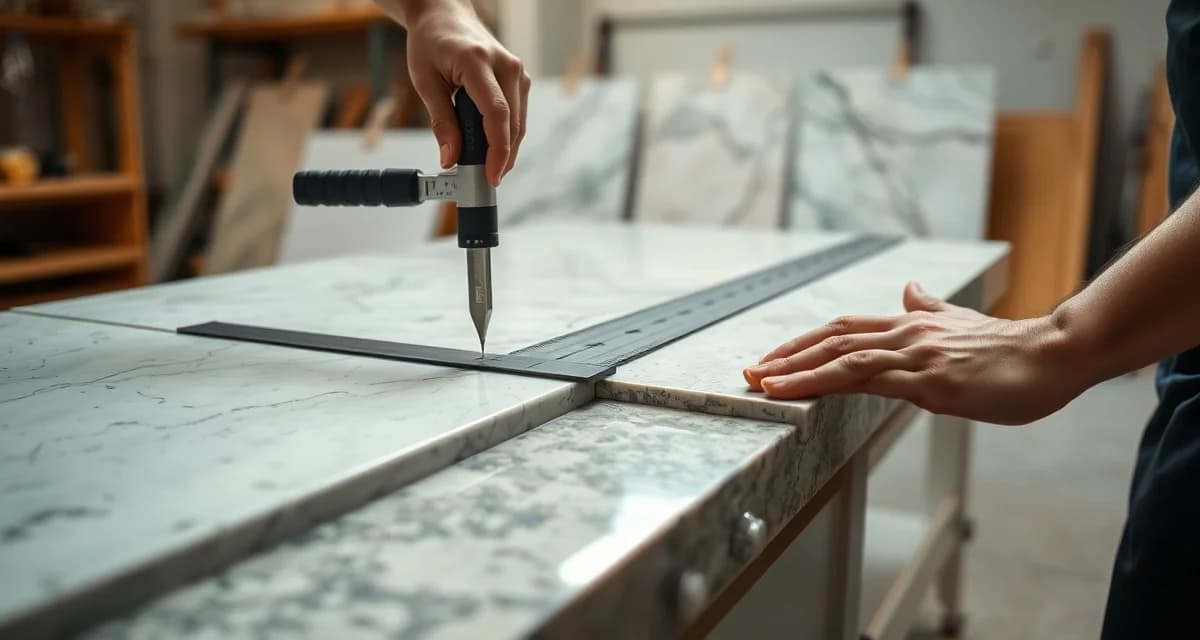
What Is Seam Placement? Definition & Guide
Quick Definition
Seam placement is the process of determining exactly where two pieces of countertop material meet and are joined together during fabrication and installation. It involves choosing locations that minimize visual impact, maintain structural integrity, and account for slab dimensions, cabinet layout, and material characteristics. Proper seam placement is one of the most critical decisions a fabricator makes on every kitchen or bathroom job.
TL;DR
- Seam placement determines where two countertop pieces are joined together
- Ideal seam locations hide joints behind fixtures like sinks, cooktops, or faucets
- Poor seam placement leads to visible lines, structural weakness, and costly remakes ($1,500-$4,000 each)
- Material type matters: granite, quartz, and porcelain each have different seam considerations
- Seams should avoid high-stress areas like unsupported overhangs or cooktop cutouts
- AI-powered layout tools can optimize seam positions automatically during the nesting process
- Customer communication about seam locations before fabrication prevents disputes and callbacks
Why Seam Placement Matters in Countertop Fabrication
Every countertop installation that spans more than a single slab requires at least one seam. While homeowners often expect a perfectly seamless surface, the reality of slab dimensions (typically 55" x 120" for standard slabs) means most L-shaped kitchens, U-shaped layouts, and island configurations need joints.
Calculate your material waste savings
See exactly how much slab material and money you could save with optimized cutting layouts.
Try the free Waste CalculatorThe fabricator's job is to make those joints as invisible and structurally sound as possible. Bad seam placement is one of the top three reasons for customer complaints in the countertop industry, and remaking a botched job can cost between $1,500 and $4,000.
The Three Goals of Good Seam Placement
- Visual minimization - Placing seams where they're least noticeable to the homeowner
- Structural integrity - Ensuring the joint sits on a supported section of cabinetry
- Material efficiency - Positioning seams to maximize slab yield and reduce waste
Where Should Countertop Seams Be Placed?
Best Seam Locations
| Location | Why It Works |
|---|---|
| Behind the sink | Water and fixtures draw the eye away from the seam |
| Near cooktop edges | Appliance creates a natural visual break |
| At inside corners (L-shapes) | The corner itself serves as a transition point |
| Over cabinet walls | Full structural support beneath the joint |
| Along natural color breaks | Some stones have natural veining transitions |
Worst Seam Locations
| Location | Why It Fails |
|---|---|
| Center of a visible run | Maximum visual exposure, hard to hide |
| Over dishwasher gaps | No cabinet support, risk of flexing and cracking |
| Through a sink cutout | Creates a structural weak point |
| Mid-island without support | Overhangs stress the joint over time |
| Across prominent veining | Disrupts the stone's visual pattern |
Seam Placement by Material Type
Different countertop materials behave differently at seam joints, which affects where fabricators should place them.
Granite
Granite seams tend to be more forgiving because the stone's natural variation helps disguise the joint. Fabricators typically use color-matched epoxy to fill the seam. The key challenge with granite is matching the grain direction and color across two separate pieces - which may come from different areas of the same slab or even different slabs entirely.
Quartz (Engineered Stone)
Quartz countertops present a different challenge. Because engineered stone has more uniform patterning, seams can be harder to hide in solid-color selections but easier in heavily veined designs. Quartz seams require tight tolerances - typically 1/16" or less - and color-matched adhesive.
Porcelain Slabs
Porcelain is thinner (typically 12mm or 20mm) and more brittle than granite or quartz. Seam placement in porcelain must avoid high-stress areas entirely. The material's printed pattern can make matching across a seam more difficult since the design is applied rather than natural.
Marble
Marble seams require careful vein matching. Fabricators often spend extra time dry-fitting pieces in the shop to ensure veining flows naturally across the joint. Bookmatching (mirroring adjacent slabs) is a popular technique that turns seams into a design feature rather than a flaw.
How Fabricators Plan Seam Placement
Traditional Method
Historically, fabricators plan seams during templating. The templater measures the space, sketches the layout on paper or a basic CAD program, and marks where seams should go based on experience and slab dimensions. This process relies heavily on individual judgment, and mistakes aren't caught until the stone is already cut.
Digital Layout and AI-Assisted Nesting
Modern fabrication software - including AI-powered nesting tools - can calculate optimal seam placement automatically. These tools consider:
- Slab dimensions and available inventory
- Cabinet layout and support points
- Cutout locations (sinks, cooktops, faucets)
- Material grain direction and pattern matching
- Yield optimization across multiple jobs
SlabWise's slab nesting engine, for example, factors seam placement into its optimization algorithm, helping shops achieve 10-15% better material yield while keeping seams in structurally sound, visually discreet positions.
Seam Placement and Customer Communication
One of the biggest sources of friction between fabricators and homeowners is unexpected seams. Customers who weren't told about seam locations before installation often feel blindsided, even if the seam itself is well-executed.
Best Practices for Communicating Seam Placement
- Mark seams on the template drawing and review them with the customer before cutting
- Show physical seam samples in the showroom so customers know what to expect
- Use a customer portal to share layout drawings and get digital sign-off (this alone can reduce callbacks by up to 70%)
- Document the agreed-upon seam location in writing before fabrication begins
- Photograph the completed seam during installation for your records
Common Seam Placement Mistakes
Mistake 1: Ignoring Cabinet Layout
A seam placed over an open space (like above a dishwasher or trash pull-out) has no support beneath it. Over time, this leads to cracking, separation, or visible gaps. Always verify that the seam sits directly over a cabinet wall or support panel.
Mistake 2: Prioritizing Yield Over Aesthetics
It's tempting to position seams purely to maximize material usage, but a visible seam in a bad location costs far more in remakes and customer dissatisfaction than the stone you saved. Balance material efficiency with visual impact.
Mistake 3: Not Accounting for Overhang
Seams placed near the front edge of an overhang (like a breakfast bar) are subject to downward force every time someone leans on the counter. Move seams away from unsupported edges by at least 6 inches.
Mistake 4: Skipping the Dry Fit
For premium materials like marble or heavily veined quartz, skipping the dry-fit step in the shop means you won't see how the seam looks until it's installed in the customer's home. By then, it's too late.
What is seam placement in countertop fabrication?
Seam placement is the process of deciding where two pieces of countertop material will be joined together. It involves selecting a location that minimizes visual impact, ensures structural support, and accounts for slab size and kitchen layout.
Can you have a countertop with no seams?
Only if the entire countertop fits within a single slab - typically possible for straight runs under 110 inches. L-shaped, U-shaped, and most island configurations require at least one seam.
Where is the best place to put a countertop seam?
Behind the sink, near cooktops, or at inside corners where cabinetry meets. These locations offer structural support and visual distraction that helps hide the joint.
How visible are countertop seams?
A well-executed seam in a good location is typically 1/16" wide or less and very difficult to spot, especially in patterned materials. Solid-color materials show seams more readily.
Does material type affect seam placement?
Yes. Granite's natural variation hides seams well, quartz requires tight tolerances, porcelain is brittle and needs extra support, and marble demands careful vein matching.
How does AI help with seam placement?
AI nesting tools analyze slab dimensions, cabinet layouts, and cutout positions to calculate optimal seam locations that balance material yield with structural and visual requirements.
What happens if a seam is placed poorly?
Poorly placed seams can crack, separate, or become highly visible - leading to customer complaints, remakes costing $1,500-$4,000, and damage to your shop's reputation.
Should customers approve seam placement before fabrication?
Absolutely. Getting written or digital approval on seam locations before cutting prevents disputes and protects both the fabricator and the homeowner.
How wide should a countertop seam be?
Industry standard is 1/16" or less. Tighter seams are better but depend on the material and the fabricator's equipment precision.
Can seams be placed on an island countertop?
Yes, but they must be positioned over a support point. Avoid placing seams in the overhang area of an island where there's no cabinetry beneath.
Does seam placement affect countertop price?
Not directly, but poor seam placement that results in a remake absolutely affects your costs. Planning seams correctly the first time saves thousands.
How do fabricators match color across seams?
By cutting both pieces from the same slab whenever possible, dry-fitting them in the shop, and using color-matched epoxy or adhesive to fill the joint.
Reduce Seam Placement Errors With Better Layout Tools
Seam placement is a decision that affects material yield, structural integrity, and customer satisfaction on every single job. SlabWise's AI-powered nesting engine optimizes seam positions automatically - factoring in cabinet layout, slab inventory, and cutout locations to reduce waste and prevent costly mistakes.
Start your 14-day free trial →
Try These Free Tools
- Nesting Optimizer -- AI-powered slab layout that maximizes yield considering vein direction and defects.
- Defect Mapping -- Upload a slab photo and AI maps every fissure, pit, and color issue.
- Value Engineering -- Find dollar-quantified suggestions to save material without cutting margin.
Sources & Further Reading
- Natural Stone Institute - Fabrication Guidelines and Best Practices
- International Surface Fabricators Association - Waterjet Cutting Technology Standards
- ASTM International - Standard Guide for Abrasive Waterjet Machining
- OSHA - Safety Guidelines for Waterjet Operations