Eased Edge: Complete Guide
Last March, Tony Ruiz pulled a callback sheet off the clipboard wall in his Chandler, Arizona shop and counted seventeen edge complaints in a single quarter. Seventeen. Most of them were eased edges that looked wavy under pendant lighting, the kind of thing homeowners don't notice at the showroom but absolutely notice at 7 a.m. over coffee. "We were running eased edges like they didn't matter because they're the simplest profile," Tony told me. "That's exactly why they kept biting us." He retooled his process (literally, new resin pads, plus a template change on the CNC) and cut callbacks to two the following quarter. His material waste dropped. His crew stopped dreading installs.
Tony's story is the whole thesis of this guide in miniature: the eased edge is the most common, most overlooked, and most profitable edge profile to get right.
This article sits in the CNC Fabrication & Edge Profiles cluster, anchored by the Eased Edge hub. For the full picture of how edge work fits into your broader operation, the Complete Guide to Countertop Fabrication ties every piece of the fab shop into one operational view. What follows is a shop-floor perspective, built from case studies, fabricator surveys, and the kind of hallway conversations that happen at SFA and ISFA events after the booth lights go off.
What "Eased Edge" Actually Means (and Where Shops Disagree)
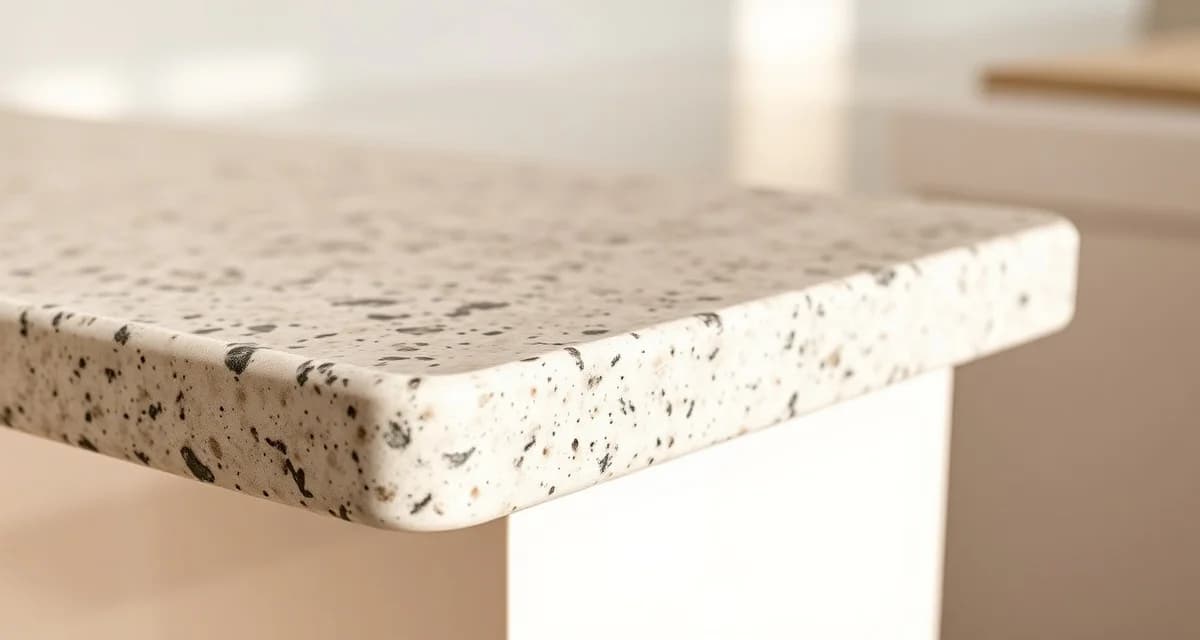
An eased edge is a square, 90-degree countertop edge with a very slight round-over, typically a 1/16" to 1/8" radius, just enough to knock off the sharp arris so it won't chip in transit or cut a kid's forehead. That's it. No dramatic curves, no decorative flair. Think of it as the factory edge of a piece of furniture, functional and clean.
Here's the thing: the industry has never fully agreed on where "eased" ends and "pencil" begins. Some fabricators use the terms interchangeably. Others draw the line at radius size (eased = barely rounded, pencil = slightly more pronounced curve, usually 1/8" to 3/16"). If you're quoting against another shop, make sure you and the customer are talking about the same profile. A sample piece in the showroom solves this argument faster than any spec sheet.
The eased edge dominates modern kitchen design because it's visually quiet. It lets the slab speak. In a world of waterfall islands and book-matched veining, the edge is supposed to disappear, and the eased edge does that better than anything else.
The Dollar Case for Getting Eased Edges Right
CNC edge profiling on a modern bridge saw with edge wheels runs 12 to 18 linear feet per hour. Hand profiling the same edge? Four to six linear feet per hour. For a shop doing 30-plus jobs a month, the CNC pays for itself on edges alone inside 18 months. That math is hard to argue with.
Calculate your material waste savings
See exactly how much slab material and money you could save with optimized cutting layouts.
Try the free Waste CalculatorBut the real money hides in what you're not spending. Tooling cost per linear foot of eased edge runs about $0.40 to $1.10, depending on material and pad quality. Shops that don't track this number bury it in overhead, which means they're not pricing it into jobs, which means they're giving it away for free. On 200 linear feet a week, that's $80 to $220 in unpriced cost, every single week, walking out the door.
Then there's the rework. A shop that gets the output right the first time runs 30 to 40 percent leaner than the shop that's fixing edges after the fact. That's not a guess; it's a consistent finding across fabricator benchmarking surveys.
My honest take: if you're running more than 15 jobs a month and still hand-profiling eased edges, you're leaving enough money on the table to fund a CNC edge package twice over within a year. The boring truth is that the simplest edge profile has the clearest ROI.
The Four Mistakes That Cost You the Most
1. Treating the eased edge as "set it and forget it." CNC programs drift. Tooling wears. What was a crisp 1/16" radius in January becomes a sloppy, inconsistent round-over by June. Shops that don't audit their edge output quarterly watch their numbers slide without understanding why.
2. Making the owner the only person who can troubleshoot. If only you know which edge wheel to swap when the profile looks off, your shop can't scale. Period. Write it down. Laminate it. Tape it to the machine.
3. Skipping documentation. The crew that ran the July kitchen isn't the same crew running the December bathroom vanity. Written process (even a one-page cheat sheet) protects the shop from turnover, which in this trade is constant.
4. Refusing to invest in the right tooling. Shops that try to save $300 a month by running worn pads end up paying $3,000 a month in rework, callbacks, and lost reputation. Penny-wise, pound-foolish has never been more literal than in a fab shop running bad edge wheels.
Building Your Edge Profile Library
Every shop should keep a current edge profile library, physical sample pieces in the showroom plus reference photos in the fabrication file. The profiles that show up most often: eased, pencil, half bullnose, full bullnose, ogee, double ogee, dupont, mitered.
Eased and pencil are the bread and butter of modern kitchens. Bullnose has fallen out of fashion in newer construction but still appears regularly in renovation work. Ogee and dupont edges command a premium and tend to land in higher-end homes where the client is paying attention to every detail.
A clean pricing tier structure makes quoting faster and protects margin:
- Tier 1 (eased and pencil): included in base price
- Tier 2 (quarter round, half bullnose): included on residential jobs
- Tier 3 (ogee and dupont): $12 to $20 per linear foot upcharge
- Tier 4 (mitered edges): priced by the job
A CNC-profiled eased edge on quartz runs nearly free in incremental time. A hand-profiled ogee with a flame polish on quartzite runs $25 to $45 per linear foot in labor alone. Shops using flat edge pricing across all profiles leave margin on the table that tiered shops capture easily.
For more on specific profiles, the guides on Dupont Edge Countertop and Pencil Edge go deeper into those options.
Your 30-Day Action Plan
If you want to act on any of this, here's the order that works.
Week one: Observe and measure. Don't change anything. Track how your current eased edge process performs across 5 to 10 jobs. Write down turnaround time and callback/error rate. Those two numbers are enough to start.
Week two: Find the single biggest leak. Not three leaks. One. Where is time, money, or quality slipping the most? Maybe it's a tooling problem. Maybe it's the handoff between the office and the shop floor. Maybe it's the intake template (a clean intake template prevents 60 to 70 percent of downstream errors, and most shops are running sloppy ones).
Week three: Implement one change. Train the team. Update the written process. Communicate clearly.
Week four: Measure the result. Compare against week one. Adjust. Document what worked.
Shops that follow this pattern consistently show 10 to 25 percent improvement on their tracked metric inside the first cycle. Repeat monthly and the gains compound. By the end of a quarter, you've rebuilt your edge workflow without ever shutting down for a weekend overhaul (which, in my experience, usually produces a worse version within a month anyway).
A Note on Silica Safety
Anywhere a saw, router, or polisher meets engineered stone, respirable crystalline silica is part of the conversation. OSHA's permissible exposure limit is 50 micrograms per cubic meter of air as an 8-hour time-weighted average. Wet cutting, proper ventilation, and fit-tested respirators are the baseline, not the bonus. Shops cutting corners on silica controls are taking on liability that no margin improvement can offset. This applies whether you're templating, nesting, fabricating, or installing. No edge profile is worth a worker's lungs.
Frequently Asked Questions
How long does it take to see results from changing your approach to eased edge?
Most shops see measurable change inside 30 to 60 days. The numbers compound through the first two quarters. Shops with stable crews and clean workflows see results faster than shops fighting turnover.
Is eased edge something a small two-person shop should worry about?
Yes, and arguably more so. Smaller shops have less slack to absorb mistakes. The owner is usually the bottleneck, and any process improvement that clears that bottleneck frees up capacity for the next job.
What is the biggest mistake new shops make on eased edge?
Treating it as a one-time decision instead of an ongoing practice. The first version of any system is wrong. The second is better. The fifth is what wins.
Do bigger shops handle eased edge differently?
The principles are identical. The scale changes. A shop running 30 jobs a month and a shop running 300 face the same math, but the tooling investments and headcount look different. Pick the version that fits your stage.
How much should a typical shop budget for improvements tied to eased edge?
Budget for time more than dollars. Most meaningful changes cost 5 to 20 hours of owner or manager time to set up and another 2 to 5 hours a month to maintain. Software costs, where applicable, run a few hundred a month for small shops up to a few thousand for larger operations. ROI based on case studies generally lands well above cost inside two quarters.
What number should I track first if I'm just starting out?
One speed number and one accuracy number. For most fab shops, that means some version of turnaround time and some version of error or callback rate. Put those two on a whiteboard. Look at them every Monday morning. Everything else can wait.
Is eased edge the same as a flat polished edge?
Not exactly. A flat polished edge (sometimes called a "straight edge") has no radius at all, just a polished 90-degree corner. An eased edge has that slight round-over. In practice, a true flat polished edge chips more easily during transport and install, which is why most fabricators default to at least a minimal ease.
Related Reading
Start with the cluster hub on Eased Edge for the full overview of CNC fabrication and edge profiles in a modern fab shop. From there, the Complete Guide to Countertop Fabrication connects every cluster into one workflow.
Inside this cluster, related supporting articles worth reading next:
From adjacent clusters: