What Is Mitered Edge? Definition & Guide
Quick Definition
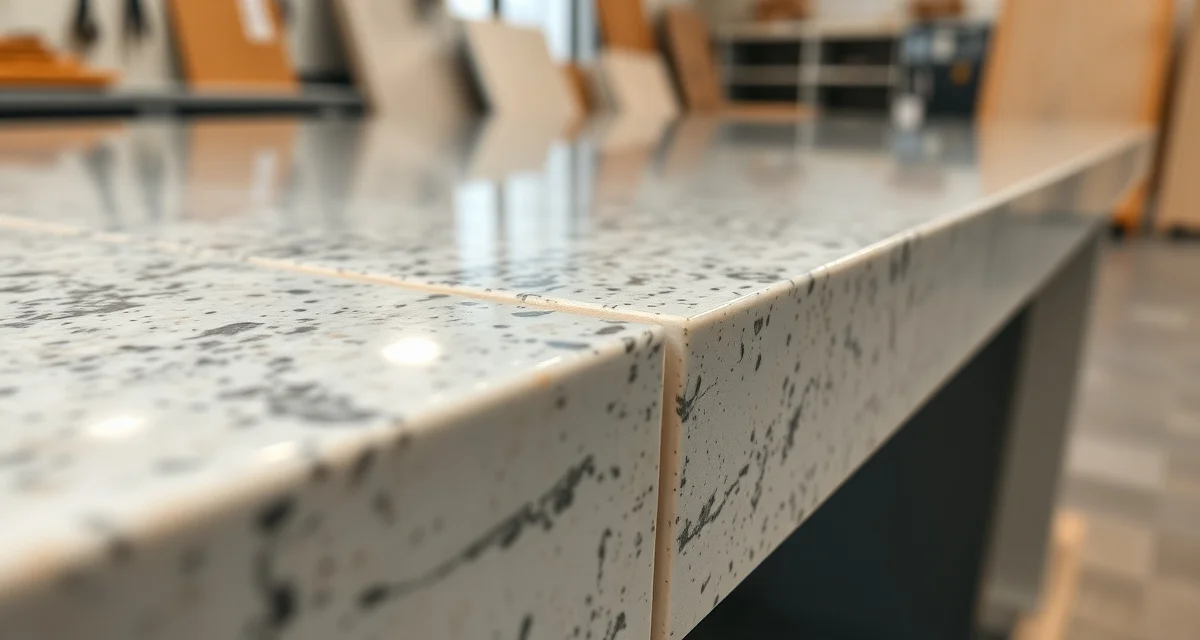
A mitered edge in countertop fabrication is a joint created by cutting two pieces of stone at matching 45-degree angles and bonding them together. The most common application is edge lamination - joining a strip to the front edge of a countertop to create the appearance of a thicker slab. Mitered edges are also essential for waterfall countertop installations and inside/outside corner joints.
TL;DR
- Mitered edge joins two stone pieces at 45-degree angles for a clean, seamless joint
- Primarily used to double apparent slab thickness (2cm looks like 4cm, 3cm looks like 6cm)
- Critical technique for waterfall countertops where horizontal meets vertical
- Requires CNC or precision bridge saw cuts - tolerance of less than 0.5 degrees
- Typical upcharge of $25-$50 per linear foot for mitered edge lamination
- Vein matching at the miter is expected on patterned stones
- Template and cut accuracy directly determine joint quality
What a Mitered Edge Does
At its core, a miter is a 45-degree angle cut. When two pieces are cut at 45 degrees and placed together, they form a 90-degree corner. In countertop work, this serves several purposes:
Calculate your material waste savings
See exactly how much slab material and money you could save with optimized cutting layouts.
Try the free Waste CalculatorEdge Lamination (Thickness Doubling)
The most common use. A strip of matching stone is mitered and bonded to the countertop's front edge, making a 3cm slab look like a 6cm slab. From the front, you see only stone - no substrate, no seam line at the buildup.
Waterfall Joints
Where a countertop transitions from horizontal to vertical (flowing down the side of an island), a mitered joint creates the bend. The two pieces appear to be one continuous slab turning a corner.
Corner Joints
Inside corners (where two countertop sections meet at a wall) and outside corners (where a countertop wraps around a peninsula) can use mitered joints instead of butt joints for a cleaner appearance.
How Mitered Edges Are Cut
CNC Miter Cutting
Modern CNC saws and routers can cut precise 45-degree angles with tolerances under 0.25 degrees. The process:
- The slab is positioned on the CNC table
- The saw blade tilts to exactly 45 degrees
- The cut is made along the programmed path
- The mitered surface is checked with a precision square or digital angle gauge
Bridge Saw Miter Cutting
Many shops use a bridge saw with a tilting blade:
- The blade is tilted to 45 degrees using the saw's angle adjustment
- The operator runs the cut along a guide fence
- Accuracy depends on the saw's calibration and the operator's setup
Bridge saws can produce good miters, but CNC delivers more consistent results over long runs and multiple pieces.
Accuracy Requirements
| Tolerance Level | Angular Accuracy | Result |
|---|---|---|
| Excellent | ±0.25° | Nearly invisible joint |
| Acceptable | ±0.5° | Slight gap, fillable with epoxy |
| Poor | ±1.0° | Visible gap, noticeable joint |
| Unacceptable | >1.0° | Remake required |
A 1-degree error on a 3cm slab creates a gap of approximately 0.5mm at the outside corner. On a visible edge at eye level, that gap is noticeable, especially on dark or polished stones.
Mitered Edge Lamination: Step by Step
Here's the full process for mitered edge lamination on a kitchen countertop:
1. Cut the Edge Strip
A strip of matching stone is cut from the same slab (or same lot) as the countertop. Strip width equals the desired added thickness - typically 3cm for a 3cm-to-6cm buildup.
2. Miter Both Pieces
The countertop's front edge and the strip's top edge are both cut at 45 degrees. The two mitered surfaces must be flat and at exactly matching angles.
3. Dry Fit
The strip is placed against the countertop edge to verify alignment. Veining, color, and angle are all checked before any adhesive is applied.
4. Bond
Color-matched epoxy is applied to both mitered surfaces. The strip is clamped to the countertop using miter bolts, spring clamps, or vacuum fixtures.
5. Cure
Epoxy cures for the manufacturer's recommended time (usually 12-24 hours for full strength). Premature handling risks joint failure.
6. Finish
The outside corner is ground and polished to remove any slight misalignment or excess epoxy. The final result should be a sharp, clean corner line.
Cost Breakdown
Mitered edge lamination is one of the pricier edge treatments because of the material and labor involved:
| Cost Component | Typical Range |
|---|---|
| Edge strip material (per linear foot) | $8-$25 |
| Miter cutting (both pieces) | $5-$10/LF |
| Vein matching and dry fit | $3-$8/LF |
| Epoxy, clamping, and curing | $4-$8/LF |
| Corner polishing and finishing | $5-$10/LF |
| Total upcharge per linear foot | $25-$61 |
For a 30-linear-foot kitchen perimeter, mitered edge lamination adds $750-$1,830 to the job. That's a significant upcharge that needs to be quoted accurately from the start.
When to Use Mitered Edges
Best Applications
- Waterfall countertops - miters are the only way to create the 90-degree stone-to-stone transition
- Thick-slab look - when the client wants a 4cm or 6cm edge appearance without buying full-thickness slabs (which are rare and expensive)
- Modern and contemporary designs - clean, sharp lines suit minimalist aesthetics
- High-end residential and commercial - the monolithic stone look signals quality
When to Avoid
- Budget-constrained projects - simpler lamination methods (stacked, L-shaped) cost less
- High-traffic commercial - mitered corners can chip more easily than rounded profiles
- Heavily veined stone with no match - a vein mismatch at the miter is highly visible and can look worse than a simple edge profile
Common Fabrication Problems
Problem 1: Angle Inconsistency
If the miter angle varies along the cut length (common with poorly calibrated bridge saws), the joint will be tight at one end and open at the other. Solution: calibrate equipment regularly and verify with test cuts.
Problem 2: Epoxy Lines
If the two mitered surfaces don't mate perfectly, the epoxy fill line becomes visible. On polished white stones, even a hairline of tinted epoxy stands out. Solution: tighter tolerances and careful surface preparation.
Problem 3: Joint Failure
Mitered joints that aren't properly bonded can separate under stress - especially during transport and installation. Thermal expansion and contraction over time can also stress weak joints. Solution: proper surface prep, quality epoxy, adequate clamping pressure, and full cure time.
Problem 4: Chip-Outs at the Corner
The acute corner where two mitered surfaces meet is fragile before bonding. Rough handling during dry fit or assembly can chip this corner, requiring repair or replacement. Solution: careful handling and edge protection during fabrication.
Template Accuracy and Mitered Edges
Mitered edges demand exact templates because:
- The edge strip length must match the countertop edge exactly
- Any curve or irregularity in the countertop edge must be replicated in the strip
- For waterfall miters, the vertical panel dimensions depend on exact cabinet measurements
SlabWise's Template Verification system runs a 3-layer check on every template before it reaches the fabrication floor. For mitered edge jobs, this catches dimension errors that would result in mismatched joints - saving the typical $1,500-$4,000 remake cost.
FAQ
What is a mitered edge on a countertop?
A mitered edge is a joint where two pieces of stone are cut at 45-degree angles and bonded together. It's most commonly used to make a countertop edge appear thicker or to create waterfall countertop joints.
How much does a mitered edge cost?
Mitered edge lamination typically costs $25-$50+ per linear foot, depending on the stone material, vein matching requirements, and edge length.
Is a mitered edge the same as a waterfall edge?
Not exactly. A mitered edge is the cutting and joining technique. A waterfall edge is the design result - stone flowing vertically down a cabinet side. Waterfall edges are created using mitered joints.
How thick does a mitered edge make a countertop look?
Mitered edge lamination typically doubles the apparent thickness. A 3cm slab with a mitered edge strip looks like 6cm. A 2cm slab looks like 4cm.
Can you miter quartz countertops?
Yes. Quartz takes mitered cuts well on CNC machines and bridge saws. The bonding process works effectively with quartz because the resin content provides a consistent surface for epoxy adhesion.
Do mitered edges chip easily?
The sharp outside corner of a mitered edge is more prone to chipping than a rounded bullnose profile. This is a trade-off for the clean, modern look. Some fabricators apply a very slight easing to the corner tip to reduce chip risk.
How do you match veins on a mitered edge?
Vein matching requires cutting the edge strip from the same area of the slab as the countertop edge it will be bonded to. The strip is oriented so veins continue from the horizontal surface down the vertical face.
What's the difference between mitered and laminated edges?
Mitered lamination joins pieces at 45 degrees for a seamless corner. Standard lamination stacks a strip behind the edge, which is simpler but leaves a visible seam line on the underside.
How long does a mitered joint take to cure?
Most fabrication epoxies require 12-24 hours for full cure strength. Some fast-set epoxies allow handling after 2-4 hours, but full load-bearing strength takes longer.
Can mitered edges be repaired if they crack?
Minor separations can sometimes be re-epoxied and clamped. Significant cracks or chips at the miter corner usually require replacing the affected piece rather than attempting a repair.
Get Mitered Edge Jobs Right the First Time
Mitered edges leave no room for error. SlabWise's template verification and accurate quoting tools help your shop deliver clean mitered joints and profitable waterfall projects.
Start Your 14-Day Free Trial →
Try These Free Tools
- Photo to Template -- Snap a photo of an existing countertop and get an AI-generated DXF template.
- Template Compare -- Upload two templates and see every dimension change highlighted instantly.
- AI Template Verification -- Cross-check your template against manufacturer specs before cutting.
Sources & Further Reading
- National Kitchen & Bath Association - Kitchen Sink Selection Guide
- International Surface Fabricators Association - Sink Cutout and Installation Standards
- Natural Stone Institute - Countertop Sink Integration Best Practices
- Remodeling Magazine - Apron Front Sinks: Design and Installation Considerations