What Is Laminated Edge? Definition & Guide
Quick Definition
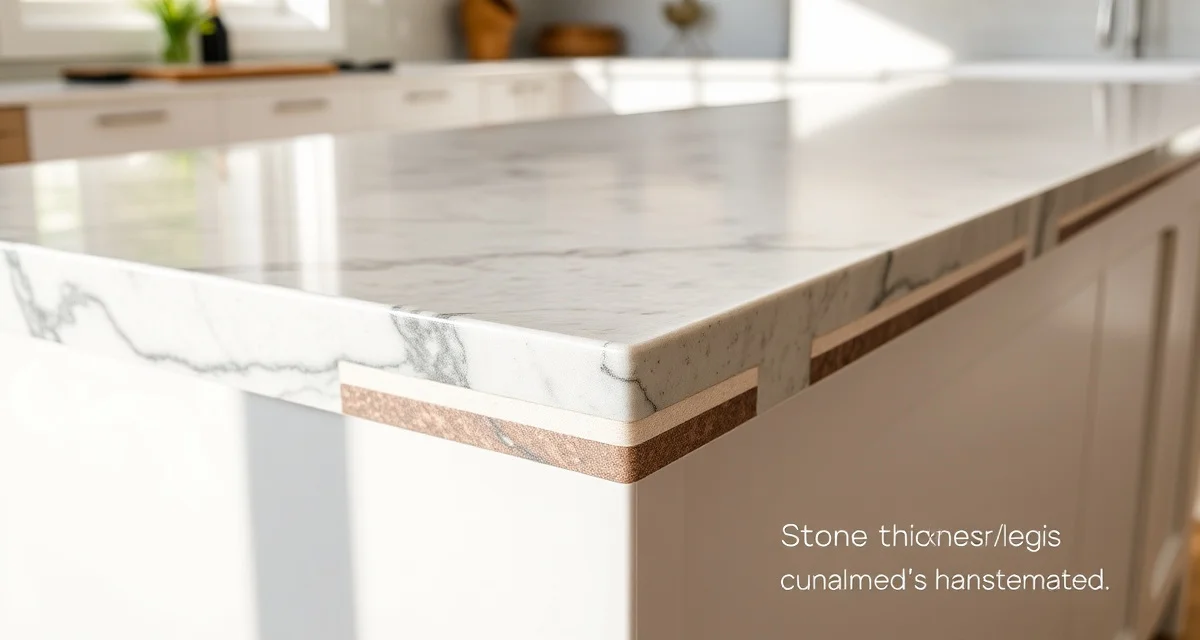
A laminated edge in countertop fabrication is a technique where a strip of stone is bonded to the front edge of a countertop to increase its apparent thickness. A 3cm slab with a laminated edge looks like a 6cm slab when viewed from the front. This is more cost-effective than purchasing full-thickness material and allows decorative edge profiles to be applied to the built-up edge.
TL;DR
- Laminated edge bonds a stone strip to the countertop edge for a thicker appearance
- Costs significantly less than buying full-thickness slab material
- Multiple lamination styles exist: flat (stacked), L-shaped, and mitered
- Adds 3-5 lbs per linear foot of weight to the countertop
- Typical upcharge ranges from $12-$50 per linear foot depending on style
- Edge profiles (bullnose, ogee, etc.) are applied after lamination
- Proper bonding prevents joint separation during transport and installation
Why Fabricators Laminate Edges
Full-thickness stone slabs (4cm, 6cm, or thicker) exist, but they're expensive, heavy, and hard to source. Most countertop slabs come in standard 2cm or 3cm thicknesses. Laminating the edge gives customers the substantial look of thick stone at a fraction of the cost and weight.
Calculate your material waste savings
See exactly how much slab material and money you could save with optimized cutting layouts.
Try the free Waste CalculatorConsider the math:
- A 3cm Calacatta quartz slab at $65/sqft for a 40-sqft kitchen: $2,600 in material
- A 6cm slab of the same material (if available): roughly $5,200+ in material, plus additional weight requiring stronger cabinets
- A 3cm slab with laminated edge strip: $2,600 + $300-$600 for the strip and labor
The laminated approach delivers the same visual impact at the edge for a fraction of the cost.
Types of Edge Lamination
Flat Lamination (Stacked)
The simplest method. A strip of stone is bonded directly to the underside of the countertop's front edge, creating a squared-off thick appearance.
- Pros: Quick to fabricate, least expensive, strong bond
- Cons: A visible seam line between the top slab and the strip is visible from below
- Best for: Kitchens where the underside of the countertop isn't visible
L-Shaped Lamination
The strip wraps both the front face and part of the underside of the slab edge, creating a thicker appearance from both the front and below.
- Pros: Hides the seam from most viewing angles, looks more natural
- Cons: More material and labor, slightly more complex
- Best for: Islands and peninsulas where the edge is viewed from multiple angles
Mitered Lamination
Both the countertop edge and the strip are cut at 45-degree angles and bonded. The outside corner is a clean line with no visible seam.
- Pros: Cleanest appearance, veins can continue from top to edge
- Cons: Most expensive, requires precision cutting, fragile corner point
- Best for: High-end projects, modern designs, veined stones
Full-Thickness Buildup
Multiple strips create the appearance of a very thick slab (6cm, 8cm, or more). Used for commercial applications, reception desks, and statement pieces.
| Lamination Type | Cost/LF | Visual Quality | Complexity |
|---|---|---|---|
| Flat (stacked) | $12-$20 | Good (front view) | Low |
| L-shaped | $18-$30 | Very good | Medium |
| Mitered | $25-$50 | Excellent | High |
| Full-thickness buildup | $35-$60+ | Excellent | High |
The Lamination Process
Step 1: Strip Cutting
A strip of stone is cut from the same slab (or same lot) as the countertop. Strip width matches the desired added thickness. Vein direction and color must match the slab edge.
Step 2: Surface Preparation
Both bonding surfaces are cleaned, dried, and roughened slightly to improve adhesion. Any polished surfaces at the bond line are ground to a matte finish.
Step 3: Dry Fit
The strip is clamped to the countertop edge without adhesive to verify fit, alignment, and color/vein matching. Adjustments are made before any epoxy is mixed.
Step 4: Bonding
Color-matched epoxy (polyester or epoxy resin) is applied to both surfaces. The strip is clamped in position with even pressure along its full length.
Step 5: Curing
The assembly cures for 12-24 hours at room temperature. Heat lamps can accelerate cure time in cold shop environments but must be used carefully to avoid thermal stress.
Step 6: Edge Profiling
After the lamination is fully cured, the desired edge profile (bullnose, ogee, eased, etc.) is cut into the built-up edge. The profile spans both the original slab and the laminated strip.
Step 7: Polishing
The profiled edge is polished through progressive grits to match the countertop surface finish.
Material Matching Challenges
The biggest quality issue in edge lamination is visible color or pattern differences between the countertop and the strip:
Natural Stone
Every natural stone slab varies. Even strips cut from the same slab can look different if they come from opposite ends. Best practice: cut the edge strip from directly adjacent to the countertop piece on the slab layout.
Engineered Quartz
Quartz is more consistent, but batch variation exists. Strips should always come from the same slab, not just the same color/style. Different production runs can have noticeable shade differences.
Veined Materials
For marble, quartzite, and heavily veined quartz, the strip's vein direction must match the slab edge. A horizontal vein pattern on the countertop surface meeting a vertical vein pattern on the laminated edge is immediately noticeable.
Weight and Structural Considerations
Laminated edges add weight:
| Slab Thickness | Strip Addition | Added Weight per LF |
|---|---|---|
| 2cm + 2cm strip | 4cm total | ~3 lbs/LF |
| 3cm + 3cm strip | 6cm total | ~5 lbs/LF |
| 3cm + 6cm buildup | 9cm total | ~10 lbs/LF |
For standard kitchen installations, this added weight is negligible - cabinets easily support it. For large islands with full-perimeter lamination, verify that the cabinet structure can handle the additional load.
Quoting Laminated Edges Accurately
Laminated edge pricing is where many shops make errors:
Common Mistakes
- Quoting flat lamination prices for mitered lamination - the processes are very different in cost
- Not accounting for strip material - the strip comes from the customer's slab, reducing available material for other pieces
- Forgetting profile costs - the edge profile is applied after lamination; both costs must be included
- Ignoring vein matching time - on patterned stones, matching adds 15-30 minutes per job
SlabWise's Quick Quote tool includes lamination options with per-material pricing, so quotes are accurate in 3 minutes. The nesting algorithm also accounts for the strip material in slab layout, ensuring you don't run short.
Quality Control Checkpoints
Before the laminated countertop leaves the shop:
- Bond line is tight with no visible gaps
- Color match between strip and slab is acceptable
- Vein direction matches (on patterned stones)
- Edge profile is consistent along the full length
- Polish level on the edge matches the countertop face
- No chips or rough spots at the profile transition
- Underside seam (on flat lamination) is clean and even
FAQ
What is a laminated edge on a countertop?
A laminated edge is a strip of matching stone bonded to the front edge of a countertop to make it appear thicker. A 3cm slab with a laminated strip looks like a 6cm slab from the front.
How much does a laminated edge cost?
Laminated edge pricing ranges from $12 to $50+ per linear foot depending on the lamination style (flat, L-shaped, or mitered) and the stone material.
Is a laminated edge as strong as a full-thickness slab?
When properly bonded with quality epoxy and allowed to fully cure, laminated edges are structurally sound for countertop use. They won't bear the same impact load as solid stone, but in normal kitchen use, they perform identically.
Can you see the seam on a laminated edge?
On flat (stacked) lamination, a thin seam line is visible when looking at the underside. Mitered lamination hides the seam entirely. L-shaped lamination hides it from most angles.
Does the edge strip come from my slab?
Yes. The strip should be cut from the same slab as your countertop to ensure color and pattern matching. This reduces the usable area of the slab, which your fabricator should account for in the layout.
What edge profiles work with laminated edges?
All standard profiles - bullnose, ogee, eased, bevel, and others - can be applied to a laminated edge. The profile is cut after the lamination is complete and cured.
How thick can you make a countertop with lamination?
Practical laminated edge thickness ranges from 4cm to 12cm. Beyond 12cm, weight becomes significant and the buildup process gets complex. Most residential projects laminate to 4cm or 6cm.
Does lamination affect countertop durability?
The laminated area is slightly more vulnerable to impact than solid stone because the bond line is a potential failure point. In normal use, this is not a concern. Heavy impacts directly on the laminated edge could potentially cause separation.
Can you laminate a kitchen island on all sides?
Yes. Full-perimeter lamination on an island is common. Account for the additional strip material in your slab layout and the extra weight in cabinet load calculations.
How long does lamination add to fabrication time?
Lamination adds 1-3 hours of fabrication time per job (cutting strips, bonding, curing, profiling). Curing time is the longest component - typically 12-24 hours before the edge can be profiled.
Build Laminated Edge Costs into Every Quote
Don't let lamination costs slip through your quoting process. SlabWise includes edge lamination pricing and accounts for strip material in your slab layout automatically.
Start Your 14-Day Free Trial →
Try These Free Tools
- Nesting Optimizer -- AI-powered slab layout that maximizes yield considering vein direction and defects.
- Defect Mapping -- Upload a slab photo and AI maps every fissure, pit, and color issue.
- Value Engineering -- Find dollar-quantified suggestions to save material without cutting margin.
Sources & Further Reading
- Natural Stone Institute - Fabrication Guidelines and Best Practices
- International Surface Fabricators Association - Waterjet Cutting Technology Standards
- ASTM International - Standard Guide for Abrasive Waterjet Machining
- OSHA - Safety Guidelines for Waterjet Operations