What Is Tool Changer? Definition & Guide
Quick Definition
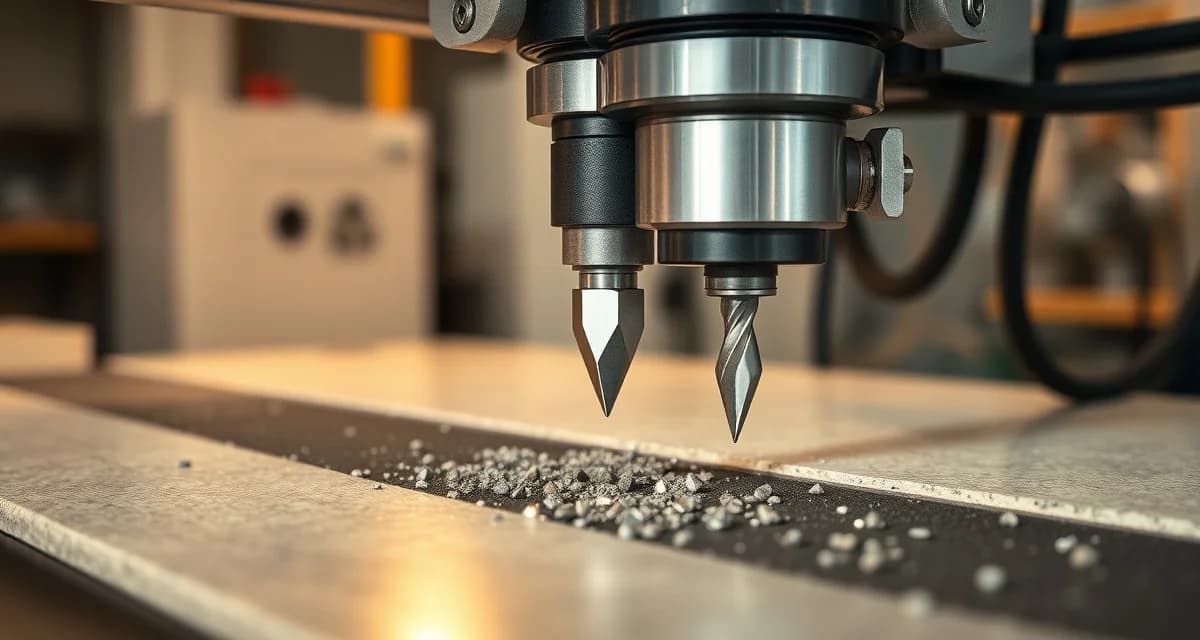
A tool changer (also called an automatic tool changer or ATC) is a mechanism on a CNC router or machining center that automatically swaps cutting tools during a programmed operation - without stopping the machine or requiring manual intervention. In countertop fabrication, tool changers allow a CNC machine to switch between different diamond bits, router bits, profiling wheels, and core drills mid-job, enabling the machine to cut, shape, profile, drill, and polish in a single automated sequence.
TL;DR
- A tool changer (ATC) automatically swaps CNC tools mid-operation without manual intervention
- Enables multiple operations (cutting, profiling, drilling, polishing) in one automated sequence
- Tool magazine capacities range from 4 to 20+ positions
- Reduces job cycle time by 30-50% compared to manual tool changes
- Eliminates operator downtime between operations
- Standard on mid-to-high-end CNC routers for stone fabrication
- Requires proper tool setup, magazine organization, and maintenance
- Tool change time: 5-15 seconds per swap (vs. 2-5 minutes manual)
How an Automatic Tool Changer Works
The Basic Mechanism
- The CNC program signals that a tool change is needed
- The spindle moves to the tool magazine (carousel, rack, or arm)
- The current tool is returned to its designated position
- The new tool is picked up from the magazine
- The spindle clamps the new tool and verifies it's seated correctly
- The CNC program resumes with the new tool
The entire swap takes 5-15 seconds, depending on the machine design and the distance between the spindle and the magazine.
Calculate your material waste savings
See exactly how much slab material and money you could save with optimized cutting layouts.
Try the free Waste CalculatorMagazine Types
| Type | Capacity | Speed | Common On |
|---|---|---|---|
| Carousel (rotary) | 8-20+ tools | Moderate | Mid-to-high-end CNC routers |
| Rack (linear) | 4-12 tools | Fast | Compact and mid-range machines |
| Arm (robotic) | 10-40+ tools | Fastest | High-production industrial machines |
Most countertop fabrication CNCs use carousel or rack-style magazines with 8-12 tool positions - enough for a complete countertop job sequence.
Why Tool Changers Matter in Fabrication
A Typical Countertop CNC Sequence
Without a tool changer, each step below requires the operator to stop the machine, manually remove one tool, install another, and restart:
- Roughing cut - Large router bit removes bulk material around the template shape
- Finishing cut - Smaller bit traces the final profile with tighter tolerance
- Edge profiling - Profiling wheel cuts the selected edge shape (ogee, bullnose, bevel, etc.)
- Sink cutout - Core drill starts the cutout; router bit completes the shape
- Polishing - Sequential polishing pads (50, 100, 200, 400+ grit) smooth the edge
With manual changes, each swap takes 2-5 minutes of machine downtime plus the risk of incorrect tool seating. On a job requiring 8-10 tool changes, that's 20-50 minutes of lost production time.
With an automatic tool changer, the same sequence runs continuously. Total tool change time: under 2 minutes for the entire job.
Production Impact
Time Savings
| Metric | Without ATC | With ATC | Improvement |
|---|---|---|---|
| Tool change time | 2-5 min each | 5-15 sec each | 90%+ faster |
| Total downtime per job | 20-50 min | 1-2 min | 90%+ reduction |
| Operator attention needed | Full-time during changes | Minimal (load and monitor) | Frees operator for other tasks |
| Jobs per shift | 3-5 typical | 5-8 typical | 40-60% more throughput |
Quality Consistency
Manual tool changes introduce variability. Each time an operator removes and reinstalls a tool, there's potential for:
- Slight misalignment affecting cut accuracy
- Incorrect tool selection
- Inconsistent clamping torque
- Tool runout (wobble) from poor seating
Automatic tool changers seat tools with the same precision every time, producing more consistent results across all jobs.
Operator Efficiency
With an ATC, the operator's role shifts from active machine intervention to setup and monitoring. The operator:
- Loads the slab onto the CNC table
- Verifies the tool magazine is loaded correctly
- Starts the program
- Monitors the operation (without intervening)
- Unloads the finished pieces
This frees the operator to prepare the next job, inspect completed pieces, or manage other tasks while the machine runs.
Tool Magazine Setup
Organizing Your Magazine
A well-organized tool magazine improves efficiency and reduces errors:
| Position | Tool Type | Purpose |
|---|---|---|
| T1 | Roughing router bit (large) | Initial cutting |
| T2 | Finishing router bit (small) | Final profile cut |
| T3 | Edge profiling wheel #1 | Primary edge shape |
| T4 | Edge profiling wheel #2 | Secondary edge shape |
| T5 | Core drill | Sink cutout start holes |
| T6 | Cutout router bit | Sink/cooktop cutout completion |
| T7-T10 | Polishing pads (progressive grits) | Edge and cutout polishing |
Tool Presetting
Each tool in the magazine must be measured and its dimensions entered into the CNC controller. This tells the machine exactly how long each tool is and where the advanced sits, ensuring accurate depth and position during cutting.
Maintenance
- Clean tool holders regularly to prevent chips and debris from affecting seating
- Inspect collets and clamping mechanisms for wear
- Verify tool magazine alignment periodically
- Replace worn retention knobs or pull studs before they cause dropped tools
Choosing a CNC With a Tool Changer
Key Specifications
- Magazine capacity: 8-12 positions covers most countertop work; 16+ for shops with many edge profiles
- Tool change speed: 5-15 seconds is typical; faster is better for high-volume production
- Tool holder type: ISO 30 or HSK-63 are the most common standards in stone fabrication
- Maximum tool weight: Ensure the magazine handles heavy profiling wheels (some weigh 5+ lbs)
- Spindle power: ATC machines typically need 12-20+ HP spindles to handle the variety of operations
Cost Considerations
Adding an ATC to a CNC router typically adds $15,000-$40,000 to the machine cost. Given the 30-50% production improvement, most shops recover this investment within 6-12 months.
What is a tool changer on a CNC machine?
An automatic tool changer (ATC) is a mechanism that swaps cutting tools during a CNC program without stopping the machine or requiring manual intervention.
How fast is an automatic tool change?
5-15 seconds per swap, compared to 2-5 minutes for manual tool changes.
How many tools can a magazine hold?
Typical fabrication CNC magazines hold 8-12 tools. Some machines offer 16-20+ positions for shops with diverse edge profile needs.
Does a tool changer improve cut quality?
Yes. Consistent, automated tool seating eliminates the variability of manual changes, producing more precise and repeatable results.
Is a tool changer worth the extra cost?
For most production shops, yes. The 30-50% increase in jobs per shift typically pays back the $15,000-$40,000 ATC cost within 6-12 months.
What happens if a tool breaks during operation?
Most CNC controllers detect anomalies (increased spindle load, position errors) and can pause the program. The operator replaces the tool and the program can usually resume.
Do all CNC routers have tool changers?
No. Entry-level and some mid-range CNC routers require manual tool changes. ATC is a feature of mid-to-high-end machines.
What maintenance does a tool changer need?
Regular cleaning of tool holders, inspection of clamping mechanisms, alignment verification, and replacement of worn retention components.
Can I retrofit a tool changer to an existing CNC?
Some CNC manufacturers offer ATC retrofit kits, but it's often more cost-effective to purchase a new machine with an integrated ATC than to retrofit an older one.
What tool holder standard is used in stone fabrication?
ISO 30 and HSK-63 are the most common. HSK tooling offers better rigidity and repeatability at higher spindle speeds.
How does the CNC know which tool to use?
The CNC program specifies tool numbers (T1, T2, etc.) at each operation step. The controller matches these to the physical positions in the magazine.
Can a tool changer handle polishing pads?
Yes. Polishing pads are mounted on standard tool holders and loaded into the magazine like any other tool, allowing automated multi-step polishing sequences.
Maximize Your CNC Investment
A tool changer multiplies your CNC's productivity. SlabWise helps you maximize the rest of your workflow - from faster quoting and template verification to optimized nesting that keeps your CNC running on accurate, waste-minimized cutting plans.
Start your 14-day free trial →
Try These Free Tools
- Nesting Optimizer -- AI-powered slab layout that maximizes yield considering vein direction and defects.
- Defect Mapping -- Upload a slab photo and AI maps every fissure, pit, and color issue.
- Value Engineering -- Find dollar-quantified suggestions to save material without cutting margin.
Sources & Further Reading
- Natural Stone Institute - Fabrication Guidelines and Best Practices
- International Surface Fabricators Association - Waterjet Cutting Technology Standards
- ASTM International - Standard Guide for Abrasive Waterjet Machining
- OSHA - Safety Guidelines for Waterjet Operations