What Is Laser Templater? Definition & Guide
Quick Definition
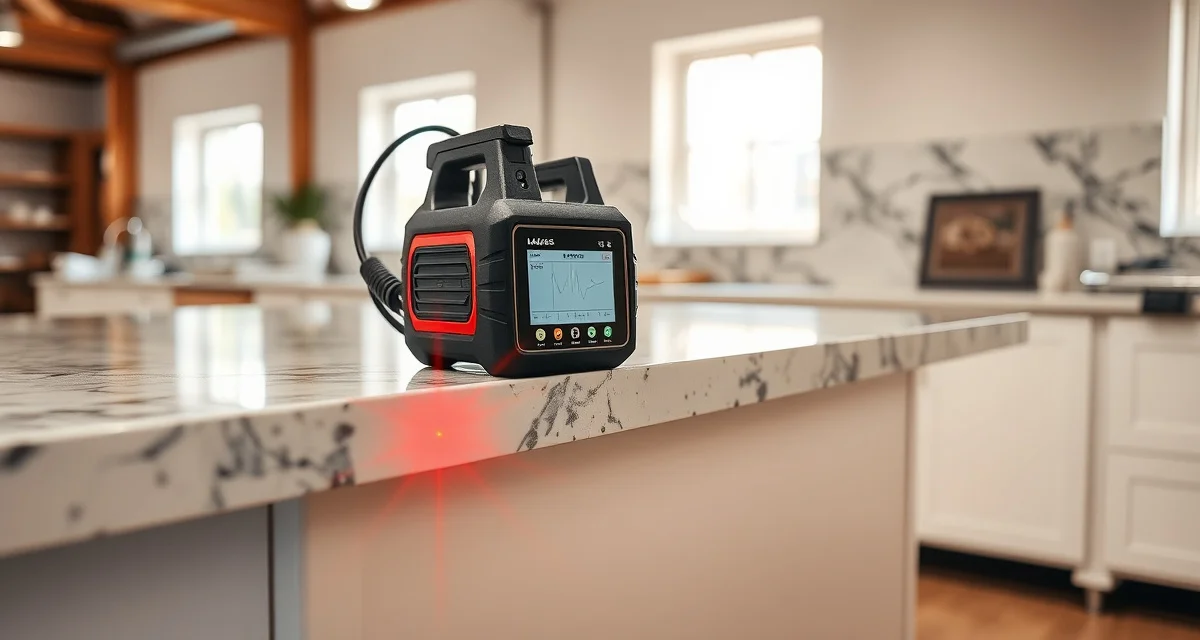
A laser templater is a portable digital measurement device that uses laser distance measurement to capture the exact dimensions and geometry of a countertop installation space. The device projects a laser dot onto surfaces (walls, cabinets, edges) and records the precise coordinates of each point, creating a digital template that can be sent directly to CNC machines and fabrication software. Laser templaters have largely replaced physical stick templates in modern fabrication shops, offering faster measurement, higher accuracy, and direct digital file output.
TL;DR
- A laser templater uses laser distance measurement to digitally capture countertop dimensions
- Replaces physical stick/strip templates with digital files
- Accuracy: ±1/16" or better (vs. ±1/8" for manual templates)
- Creates files compatible with CNC machines and CAD software
- Template time: 30-60 minutes for a typical kitchen (vs. 60-120 minutes manual)
- Major brand: Laser Products Industries (LPI) - the Proliner and LT-2D3D
- Cost: $15,000-$35,000 for the device
- Eliminates physical template storage and transport
- Reduces template errors - a leading cause of costly remakes
How a Laser Templater Works
The Measurement Process
- Setup: The templater is placed on a tripod in the center of the kitchen (or room being measured)
- Calibration: The device self-levels and calibrates to its position
- Point capture: The operator touches the laser probe to key points - wall corners, cabinet edges, sink locations, appliance positions - and captures each coordinate
- Line and curve tracing: The operator traces along edges, recording continuous measurements that define the countertop shape
- Feature marking: Specific features (sink cutout center, faucet hole location, backsplash height) are marked as reference points
- File generation: The device compiles all measurements into a digital file (typically DXF format) ready for CAD software and CNC machines
Measurement Technology
Most laser templaters use one or a combination of:
Calculate your material waste savings
See exactly how much slab material and money you could save with optimized cutting layouts.
Try the free Waste Calculator- Time-of-flight laser - measures the time it takes for a laser pulse to bounce back from a surface
- Phase-shift laser - measures the phase difference of the returned laser signal for higher precision
- Touch probe - a physical stylus that records position when it contacts a surface
Some devices combine laser measurement with touch-probe capability for maximum versatility.
Laser Templater vs. Physical (Stick) Templates
| Factor | Laser Templater | Physical Stick Template |
|---|---|---|
| Accuracy | ±1/16" or better | ±1/8" typical |
| Template time | 30-60 min | 60-120 min |
| File format | Digital (DXF, CAD-ready) | Physical strips/boards |
| Transport to shop | Email or USB drive | Physical transport (truck) |
| Storage | Digital file on computer | Physical storage in shop |
| CNC compatibility | Direct file import | Must be digitized manually |
| Learning curve | Moderate (training needed) | Low (traditional skill) |
| Equipment cost | $15,000-$35,000 | $200-$500 in materials |
| Error rate | Low | Moderate (human measurement) |
The Accuracy Advantage
The difference between ±1/16" and ±1/8" accuracy might sound small, but it compounds across a complex kitchen layout. On an L-shaped kitchen with 20+ measurement points, ±1/8" errors at multiple points can create a cumulative discrepancy of 1/4" or more - enough to make a countertop not fit.
Laser templaters maintain ±1/16" accuracy across the entire layout, keeping cumulative error within acceptable tolerances.
The Digital Workflow Advantage
Laser templaters don't just measure faster - they create a fully digital workflow that eliminates several error-prone steps.
Traditional Physical Template Workflow
- Templater creates physical template on-site → 2. Transports template to shop → 3. Shop worker traces template onto stone → 4. Fabricator cuts stone to traced lines
Each step introduces potential error: the template can shift in transport, tracing is inherently imprecise, and cutting to a traced line depends on the operator's eye.
Digital Laser Template Workflow
- Templater captures digital measurements → 2. File is sent to shop (email/cloud) → 3. File is verified in software → 4. File goes directly to CNC for cutting
The digital file is the same from measurement to machine. No transport damage, no tracing step, no operator interpretation. The CNC cuts exactly what was measured.
This digital workflow integrates directly with fabrication software like SlabWise, where the template file feeds into the verification, nesting, and cutting stages without manual re-entry.
Features of Modern Laser Templaters
3D Measurement
Advanced laser templaters capture three-dimensional data - not just the flat layout but also wall angles, cabinet heights, and surface levels. This is critical for:
- Detecting out-of-level cabinets
- Measuring backsplash heights accurately
- Planning installations where walls aren't plumb
On-Screen Visualization
The device shows the template drawing in real-time on an attached tablet or screen. The templater can verify the layout looks correct before leaving the jobsite.
Automatic Calculations
The software calculates:
- Total square footage for quoting
- Seam locations based on slab constraints
- Overhang dimensions
- Cutout positions relative to cabinet edges
File Export
Templates export in standard CAD formats (DXF, DWG) compatible with all major fabrication software and CNC control systems.
Cost and ROI
Initial Investment
A professional-grade laser templater costs $15,000-$35,000. This includes the measurement device, software, and training.
Return on Investment
| Savings Source | Monthly Value |
|---|---|
| Reduced template time (30 min saved per job × 50 jobs) | $1,250-$2,500 in labor |
| Fewer remakes from template errors (1-2 prevented per month) | $1,500-$8,000 |
| Eliminated physical template materials | $100-$300 |
| Faster quoting from digital measurements | Indirect revenue gain |
Most shops report ROI within 3-6 months of adopting a laser templater.
What is a laser templater?
A portable digital measurement device that uses laser technology to capture the exact dimensions and geometry of a countertop installation space, creating a digital file for CNC machines and fabrication software.
How accurate is a laser templater?
±1/16 inch or better, significantly more accurate than physical stick templates (±1/8 inch).
How long does laser templating take?
30-60 minutes for a typical kitchen, compared to 60-120 minutes for physical templates.
What file formats do laser templaters produce?
Most produce DXF or DWG files compatible with standard CAD software and CNC control systems.
How much does a laser templater cost?
$15,000-$35,000 for a professional-grade device including software and training.
What brands make laser templaters for stone fabrication?
Laser Products Industries (LPI) is the dominant manufacturer, producing the Proliner and LT-2D3D series. Other options include various industrial laser measurement systems.
Do laser templaters work for all countertop materials?
Yes. The laser measures the space, not the material. The same template works whether you're fabricating granite, quartz, marble, or porcelain.
Can laser template files go directly to a CNC machine?
Yes. The digital file can be imported into CAD/CAM software, verified, nested, and sent to the CNC - eliminating manual tracing and interpretation steps.
Does a laser templater replace the need for template verification?
No. The digital file still should be verified for completeness (all pieces captured, cutout specifications correct, edge profiles noted). Laser templaters reduce measurement errors but don't eliminate specification errors.
How long does it take to learn to use a laser templater?
Most operators become proficient within 1-2 weeks of training and practice. The learning curve is moderate - understanding the software and measurement workflow takes more time than the physical operation.
Can laser templaters measure in 3D?
Advanced models capture 3D data, measuring heights, wall angles, and surface levels in addition to the flat countertop layout.
Is laser templating required for modern fabrication?
Not required, but strongly recommended. Shops using laser templaters report significantly fewer remakes and faster turnaround times compared to physical templating.
From Template to Finished Countertop, Faster
Laser templating creates the accurate digital foundation your shop needs. SlabWise builds on that foundation with template verification, optimized nesting, and customer communication tools that keep every job on track from measurement to installation.
Start your 14-day free trial →
Try These Free Tools
- Photo to Template -- Snap a photo of an existing countertop and get an AI-generated DXF template.
- Template Compare -- Upload two templates and see every dimension change highlighted instantly.
- AI Template Verification -- Cross-check your template against manufacturer specs before cutting.
Sources & Further Reading
- National Kitchen & Bath Association - Kitchen Sink Selection Guide
- International Surface Fabricators Association - Sink Cutout and Installation Standards
- Natural Stone Institute - Countertop Sink Integration Best Practices
- Remodeling Magazine - Apron Front Sinks: Design and Installation Considerations