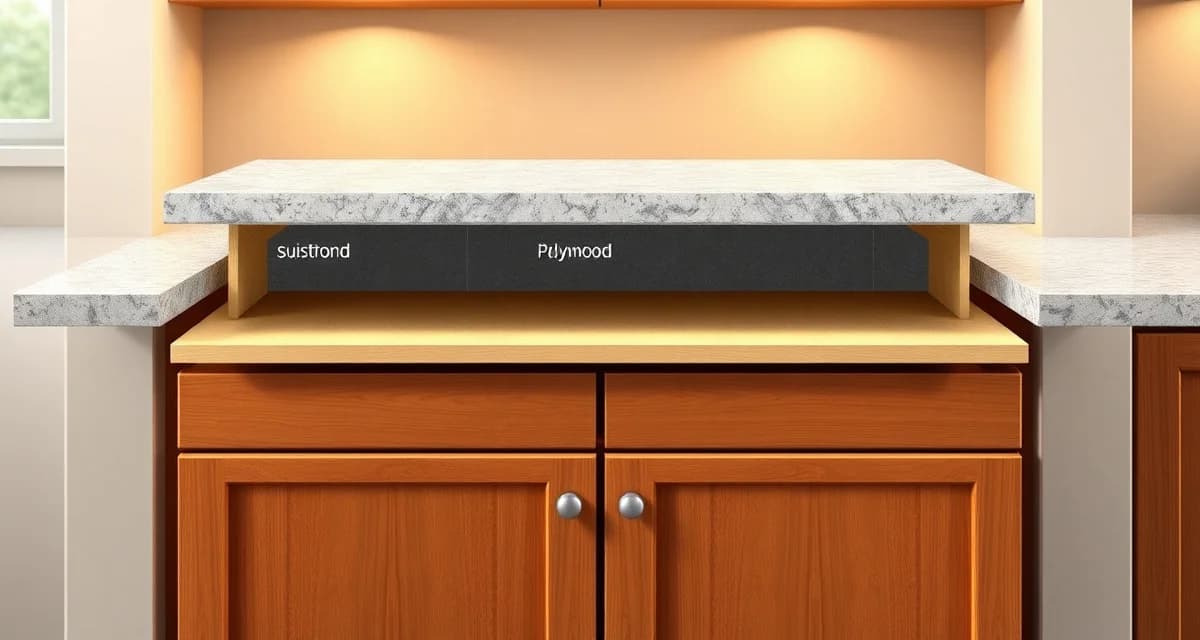
What Is Substrate? Definition & Guide
Quick Definition
A substrate in countertop fabrication is the underlying support material - typically plywood, MDF, or a composite panel - installed on top of cabinets to provide a flat, stable surface for the stone to rest on. Substrates are essential for thin materials like porcelain (12mm) and 2cm stone, and they're used with thicker materials when cabinets are uneven or when extended overhangs need additional support. The substrate bridges gaps, distributes weight, and prevents cracking.
TL;DR
- A substrate is the support panel placed between cabinets and the stone countertop
- Most commonly made from 3/4" plywood or moisture-resistant MDF
- Required for all 2cm (thin) stone and porcelain slab installations
- Optional but recommended for 3cm stone over uneven cabinets
- Provides structural support, distributes weight, and prevents cracking at weak points
- Adds $3-$8 per square foot to the installation cost
- Must be accounted for in templating, as it changes the finished counter height
When Is a Substrate Required?
Always Required
| Material | Thickness | Why |
|---|---|---|
| Porcelain slabs | 12mm (1/2") | Too thin to span between cabinets without support |
| 2cm stone (granite, marble, quartz) | 20mm (3/4") | Insufficient thickness for unsupported spans |
| Ultra-compact surfaces | 12-13mm | Brittle without continuous support |
Recommended
| Situation | Why |
|---|---|
| Uneven cabinets | Substrate creates a flat, level surface |
| Frameless (European) cabinets | Less support surface for stone to rest on |
| Extended overhangs | Substrate extends support past the cabinet edge |
| Heavy undermount sinks | Distributes the sink weight across a larger area |
| Dishwasher gaps | Bridges the open span where there's no cabinet beneath |
Optional
| Material | Thickness | Notes |
|---|---|---|
| 3cm granite | 30mm (1-1/4") | Thick enough to span between cabinets in most configurations |
| 3cm quartz | 30mm (1-1/4") | Self-supporting in standard configurations |
| 3cm quartzite | 30mm (1-1/4") | May benefit from substrate at wide unsupported spans |
Substrate Materials
Plywood (3/4" Exterior Grade)
The most common substrate material. Exterior-grade (or marine-grade) plywood resists moisture better than interior grades. It provides strong, consistent support and is easy to cut and install.
Calculate your material waste savings
See exactly how much slab material and money you could save with optimized cutting layouts.
Try the free Waste CalculatorPros: Strong, dimensionally stable, moisture-resistant (exterior grade), widely available Cons: Heavier than alternatives, can swell if exposed to prolonged moisture
MDF (Moisture-Resistant)
Medium-density fiberboard provides a perfectly flat surface. Moisture-resistant (MR) MDF is treated to withstand humidity in kitchen and bathroom environments.
Pros: Perfectly flat surface, uniform density, lower cost than plywood Cons: Heavier than plywood, can swell if water penetrates the surface, weaker at edges
Composite/Honeycomb Panels
Lightweight engineered panels used in specialty applications. These are more expensive but significantly lighter, which matters for large commercial installations.
Pros: Very lightweight, strong, won't absorb moisture Cons: More expensive, not widely stocked, requires special fasteners
How Substrate Affects Countertop Height
Adding a substrate changes the finished height of the countertop. This is a critical detail that must be captured during templating.
Standard Kitchen Counter Height
| Component | Without Substrate | With 3/4" Substrate |
|---|---|---|
| Cabinet height | 34.5" | 34.5" |
| Countertop (3cm) | 1.25" | 1.25" |
| Substrate | - | 0.75" |
| Finished height | 35.75" | 36.5" |
The standard finished counter height is 36 inches. If the kitchen has a mix of substrate and non-substrate sections, the height difference between them is visible and must be planned for.
Adjusting for Substrate
Some cabinet manufacturers offer adjustable legs or reduced-height cabinets specifically for installations that include a substrate. If the cabinets aren't adjustable, the substrate thickness must be factored into the overall design.
Substrate Installation
Preparation
- Level the cabinets before installing the substrate. Shimming individual cabinets to level is easier than trying to fix an uneven surface after the substrate is down.
- Cut the substrate to match the cabinet layout, including cutouts for plumbing and any access panels.
- Dry-fit the substrate on the cabinets to verify fit before attaching.
Attachment
The substrate is screwed to the cabinet frames from above, using screws that penetrate the cabinet rail but don't protrude below it (which would interfere with drawers). Screws are placed every 12-16 inches along the cabinet rails.
Sealing
For kitchens and bathrooms, the top surface of the substrate should be sealed with a waterproofing membrane or paint to prevent moisture from swelling the wood. Particular attention is needed around sink cutouts where water exposure is highest.
Substrate and Fabrication Workflow
Template Impact
The templater must note whether a substrate will be used so that:
- Finished countertop height is calculated correctly
- Sink and cooktop cutout positions account for the added thickness
- Overhang dimensions are measured from the correct reference point
Nesting Impact
Substrate doesn't directly affect slab nesting, since the stone dimensions remain the same. However, if substrate changes the overhang specification (e.g., substrate extends the support area, allowing a smaller stone overhang), this can affect piece dimensions.
Installation Impact
The substrate must be installed and leveled before the countertop template is finalized. Templating before the substrate is in place means the template measurements won't account for the added height and may not reflect the actual surface conditions.
Substrate Costs
| Material | Cost per sq ft | Labor per sq ft | Total Installed |
|---|---|---|---|
| Exterior plywood (3/4") | $2-$4 | $2-$3 | $4-$7 |
| MR MDF (3/4") | $1.50-$3 | $2-$3 | $3.50-$6 |
| Composite panels | $5-$10 | $3-$5 | $8-$15 |
For a 40 sq ft kitchen countertop, substrate adds $140-$280 in material and labor - a modest cost relative to the stone but essential for thin materials and problem cabinet situations.
What is a substrate in countertop fabrication?
A substrate is a support panel (usually plywood or MDF) installed on top of cabinets to provide a flat, stable base for the stone countertop.
When is a substrate required for countertops?
Always for thin materials (12mm porcelain, 2cm stone). Recommended for uneven cabinets, frameless cabinet systems, extended overhangs, and heavy undermount sink installations.
What material is best for a countertop substrate?
3/4-inch exterior-grade plywood is the most popular choice. It balances strength, moisture resistance, flatness, and cost.
Does a substrate change the counter height?
Yes. A 3/4-inch substrate adds 3/4 inch to the finished countertop height. This must be planned for during the design and templating stages.
Do 3cm (thick) countertops need a substrate?
Not in most standard installations. 3cm stone is thick enough to span between cabinets without support. Substrates are still recommended over uneven cabinets or wide unsupported spans.
How is the substrate attached to the cabinets?
With screws driven from above into the cabinet frame rails, spaced every 12-16 inches. Screws must not protrude below the rail.
Should the substrate be sealed?
Yes, especially around sink and dishwasher areas. A waterproofing membrane or sealant prevents moisture from swelling the wood.
Does the substrate affect templating?
Yes. The template must be created after the substrate is installed so measurements reflect the actual surface height and conditions.
How much does a substrate add to the project cost?
Typically $3-$8 per square foot installed, depending on the substrate material. For a 40 sq ft kitchen, that's $120-$320.
Can you use regular plywood as a substrate?
Interior-grade plywood works in low-moisture areas but isn't recommended for kitchens or bathrooms. Exterior-grade or marine-grade plywood provides better moisture resistance.
Does porcelain always need a substrate?
Yes. Porcelain slabs at 12mm or 20mm thickness require full continuous support to prevent cracking.
Who installs the substrate - the cabinet installer or the countertop fabricator?
Practices vary. Some fabrication shops include substrate installation; others require the cabinet installer or general contractor to handle it. Clarify responsibility early in the project.
Account for Every Layer in Your Fabrication Plan
Substrate changes counter height, affects template accuracy, and determines structural performance. SlabWise's template verification system flags substrate-related issues before fabrication, ensuring the finished countertop fits perfectly - at the right height, with the right support.
Start your 14-day free trial →
Try These Free Tools
- Nesting Optimizer -- AI-powered slab layout that maximizes yield considering vein direction and defects.
- Defect Mapping -- Upload a slab photo and AI maps every fissure, pit, and color issue.
- Value Engineering -- Find dollar-quantified suggestions to save material without cutting margin.
Sources & Further Reading
- Natural Stone Institute - Fabrication Guidelines and Best Practices
- International Surface Fabricators Association - Waterjet Cutting Technology Standards
- ASTM International - Standard Guide for Abrasive Waterjet Machining
- OSHA - Safety Guidelines for Waterjet Operations