What Is Ogee Edge? Definition & Guide
Quick Definition
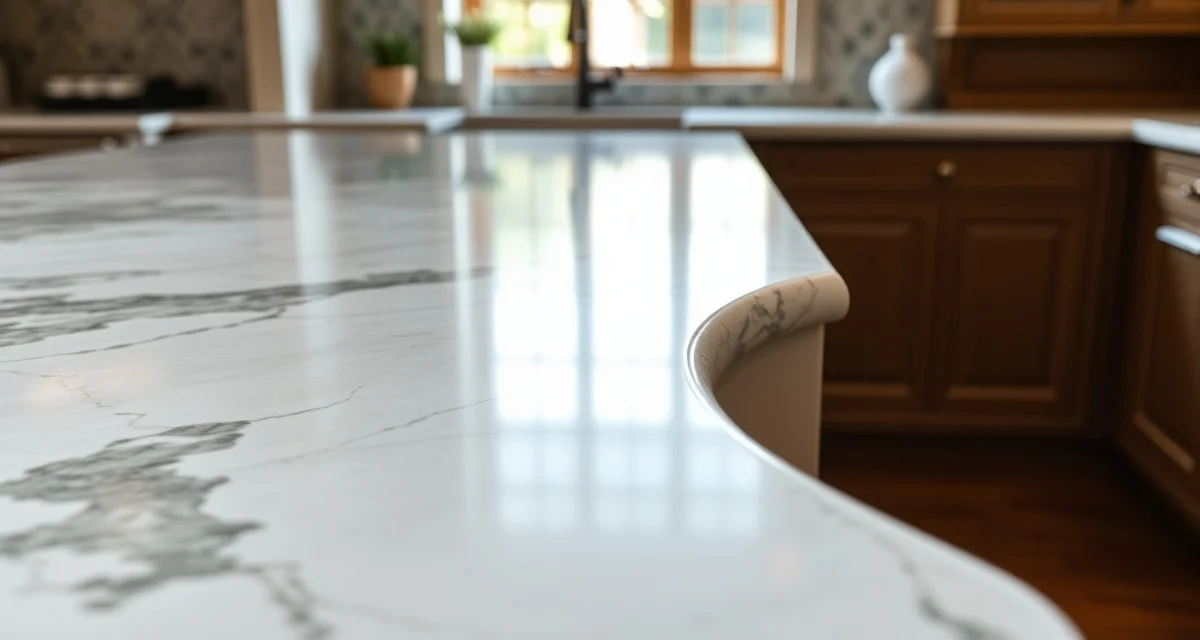
An ogee edge is a decorative countertop edge profile featuring an S-shaped curve - a concave arc flowing into a convex arc. It's one of the most ornate standard edge profiles in stone fabrication, commonly found in traditional and formal kitchen designs. Ogee requires more fabrication time and tooling than simpler profiles like eased or bullnose.
TL;DR
- Ogee is an S-curve edge profile with a concave-to-convex shape
- It's the go-to edge for traditional, formal, and high-end kitchen designs
- Fabrication is more complex and time-consuming than bullnose or eased edges
- Pricing typically runs $15-$30+ per linear foot depending on material
- Available in standard ogee, double ogee, and ogee with fillet variations
- CNC machines produce more consistent ogee profiles than hand shaping
- Accurate edge profile specs in your quoting system prevent costly remakes
The Ogee Profile Explained
The ogee edge takes its name from architectural molding, where the ogee shape has been used for centuries in crown molding, door frames, and column capitals. In countertop fabrication, it translates to an S-curve carved into the front edge of the slab.
Calculate your material waste savings
See exactly how much slab material and money you could save with optimized cutting layouts.
Try the free Waste CalculatorLooking at the edge from the side, you'll see:
- The top surface of the countertop
- A concave (inward-curving) arc
- Transitioning into a convex (outward-curving) arc
- Meeting the flat underside of the slab
This double curve creates shadow lines that give the edge a sculpted, furniture-like quality. It's the kind of profile that says "formal dining" rather than "casual kitchen."
Ogee Variations
Fabrication shops typically offer several ogee variants:
Standard Ogee
The classic single S-curve. One concave arc flowing into one convex arc. This is what most customers mean when they say "ogee."
Double Ogee
Two stacked S-curves on the edge, creating a more elaborate, deeper profile. This requires thicker material - typically 3cm minimum, though many shops laminate to 4cm or 6cm for double ogee.
Ogee with Fillet
The ogee curve is separated from the countertop surface by a small flat step (the fillet). This adds another visual element and a slight ledge below the surface.
Reverse Ogee
The S-curve is flipped, with the convex curve on top and the concave curve below. Less common but occasionally requested for specific design applications.
Fabrication Process
Ogee is one of the more demanding edge profiles for fabricators:
CNC Machine Process
- Profile bit selection - ogee requires a specific diamond profiling wheel matched to the curve dimensions
- Rough profiling - the CNC router carves the initial S-curve at a controlled feed rate
- Progressive polishing - 5-8 grit stages to bring the curved surfaces to a match with the slab face
- Inside curve polishing - the concave section is harder to polish evenly than a flat or convex surface
- Quality inspection - checking profile consistency along the full length
Hand Fabrication
Hand-shaping an ogee edge demands significant skill. The operator must:
- Maintain consistent depth and curve radius across the full length
- Polish the concave section without flattening it
- Match the finish in the concave area to the rest of the edge
Hand-fabricated ogee profiles frequently show inconsistencies that CNC eliminates. For shops doing high-volume work, CNC is the only practical way to deliver consistent ogee quality.
Cost and Pricing Factors
Ogee is one of the most expensive standard edge profiles. Here's why:
| Cost Factor | Impact |
|---|---|
| Specialized tooling | Ogee profiling wheels cost more than bullnose or flat-edge tools |
| Fabrication time | 2-3x longer than eased edge, 1.5-2x longer than bullnose |
| Polishing complexity | Concave surfaces need extra attention and slower feed rates |
| Material thickness | Double ogee often requires lamination, adding material cost |
| Skill requirement | Higher operator skill needed for quality control |
Typical Pricing Ranges
| Material | Standard Ogee/LF | Double Ogee/LF |
|---|---|---|
| Granite | $15-$22 | $25-$35 |
| Quartz | $15-$20 | $22-$30 |
| Marble | $18-$25 | $28-$40 |
| Quartzite | $20-$30 | $30-$45 |
These prices represent the edge fabrication upcharge only, on top of the base countertop cost.
Ogee vs. Other Decorative Edges
| Profile | Visual Complexity | Cost Range/LF | Design Style |
|---|---|---|---|
| Ogee | High | $15-$30 | Traditional, formal |
| Bullnose | Low | $8-$20 | Transitional, versatile |
| Eased | Minimal | $0-$8 | Modern, contemporary |
| Dupont | Medium-High | $12-$25 | Traditional |
| Cove | Medium | $10-$18 | Transitional |
| Mitered | Medium (structural) | $25-$50 | Modern, architectural |
When to Recommend Ogee to Customers
Ogee works best when:
- The kitchen design follows a traditional, French country, or formal aesthetic
- Cabinet doors have raised panels or decorative molding (the ogee echoes these details)
- The stone is a lighter color where the shadow lines will be visible
- Budget allows for the premium edge fabrication cost
Ogee is usually the wrong choice when:
- The design is contemporary or minimalist
- The countertop is a busy, heavily veined pattern (the edge detail gets lost)
- Budget is tight - simpler edges deliver similar durability at lower cost
- The countertop has many outside corners (ogee at corners requires skilled hand-finishing)
Common Quoting and Fabrication Pitfalls
1. Underquoting Ogee Labor Time
Shops that price ogee the same as bullnose are leaving money on the table. Ogee takes significantly more machine time, polishing time, and quality checking. Price it based on actual production time, not as a simple edge upcharge.
2. Corner Transitions
Where two ogee edges meet at an outside corner, the profiles must blend together smoothly. This transition point is almost always done by hand, even on CNC-cut edges. Failing to account for corner finishing time in your quote creates margin erosion.
3. Customer Expectation Mismatches
Customers who see ogee on Pinterest don't always understand that the profile changes how the countertop looks in their specific lighting. Dark stones can hide the ogee curves. Providing edge profile samples or detailed photos during the quoting process prevents disappointment.
4. Material Thickness Issues
Standard ogee on 2cm material looks compressed and loses its visual impact. Most fabricators recommend 3cm minimum for standard ogee. For double ogee, laminating to 4cm or 6cm is practically required. These material considerations must be communicated clearly in the quote.
SlabWise's Quick Quote system includes edge profile selection with per-material pricing rules, so your quotes account for these variables automatically. Quotes go out in 3 minutes with accurate pricing, not 20 minutes with guesswork.
Maintenance and Durability
Ogee edges require slightly more maintenance than flat edges:
- Cleaning - the concave section collects crumbs and water; customers should know this upfront
- Chipping - the thin edges of the S-curve are more prone to chipping than a bullnose or eased edge, especially in hard stones like quartzite
- Repolishing - if an ogee edge dulls or chips, repair is more involved than on a flat edge profile
FAQ
What is an ogee edge on a countertop?
An ogee edge is a decorative S-curve profile carved into the front edge of a countertop. It features a concave arc flowing into a convex arc, creating a formal, sculpted appearance.
How much does an ogee edge cost?
Ogee edge pricing typically ranges from $15 to $30+ per linear foot as an upcharge on top of the base countertop price. Double ogee profiles cost more.
Is ogee edge outdated?
Ogee remains popular in traditional and formal kitchen designs. While modern and contemporary kitchens have shifted toward simpler profiles, ogee is a classic choice that suits certain styles well.
What's the difference between ogee and bullnose?
Bullnose is a simple rounded curve. Ogee is an S-shaped curve with both concave and convex arcs, giving it a more decorative, sculpted appearance. Ogee costs more and takes longer to fabricate.
Can you put an ogee edge on quartz countertops?
Yes. Quartz takes ogee profiles well, and most major quartz manufacturers include ogee as a recommended edge profile. The resin content in engineered quartz produces a smooth, consistent finish.
Does ogee edge chip easily?
The thin transitions in the ogee curve are more susceptible to chipping than rounded or flat edges. This is most noticeable with harder, more brittle stones like quartzite.
What countertop thickness works best for ogee?
A minimum of 3cm is recommended for standard ogee. Double ogee typically requires 4cm or thicker, often achieved through edge lamination.
Is ogee good for kitchen islands?
Ogee works on islands, especially in traditional designs. Keep in mind that islands typically have finished edges on all four sides, which increases the linear footage and total edge fabrication cost.
How long does it take to fabricate ogee edges?
For a standard kitchen (25-35 linear feet), CNC ogee profiling and polishing takes 1-2 hours. Hand fabrication can take 4-8 hours. Corner transitions add additional time.
Can I mix ogee with other edge profiles?
Some homeowners use ogee on the main countertop edge and a simpler profile on the island or bar. This is uncommon but acceptable. Discuss it with the fabricator during the quoting phase.
Quote Ogee Edges Accurately Every Time
Complex edge profiles like ogee are exactly where quoting errors hide. SlabWise builds per-material, per-profile pricing into every quote so your team doesn't have to guess.
Start Your 14-Day Free Trial →
Try These Free Tools
- Cost Calculator -- Get instant countertop cost estimates by material, edge profile, and square footage.
- Compare Materials -- Side-by-side material comparison with pricing, durability, and maintenance ratings.
- Edge Profile Selector -- Browse edge profiles with cost impact and visual previews.
Sources & Further Reading
- National Kitchen & Bath Association - Cabinet Frame Construction Standards
- International Surface Fabricators Association - Support Frame Requirements for Stone Installation
- Natural Stone Institute - Structural Framing Guidelines for Natural Stone Applications
- ASTM International - ASTM C1242 Standard Guide for Selection, Design, and Installation of Dimension Stone Attachment Systems