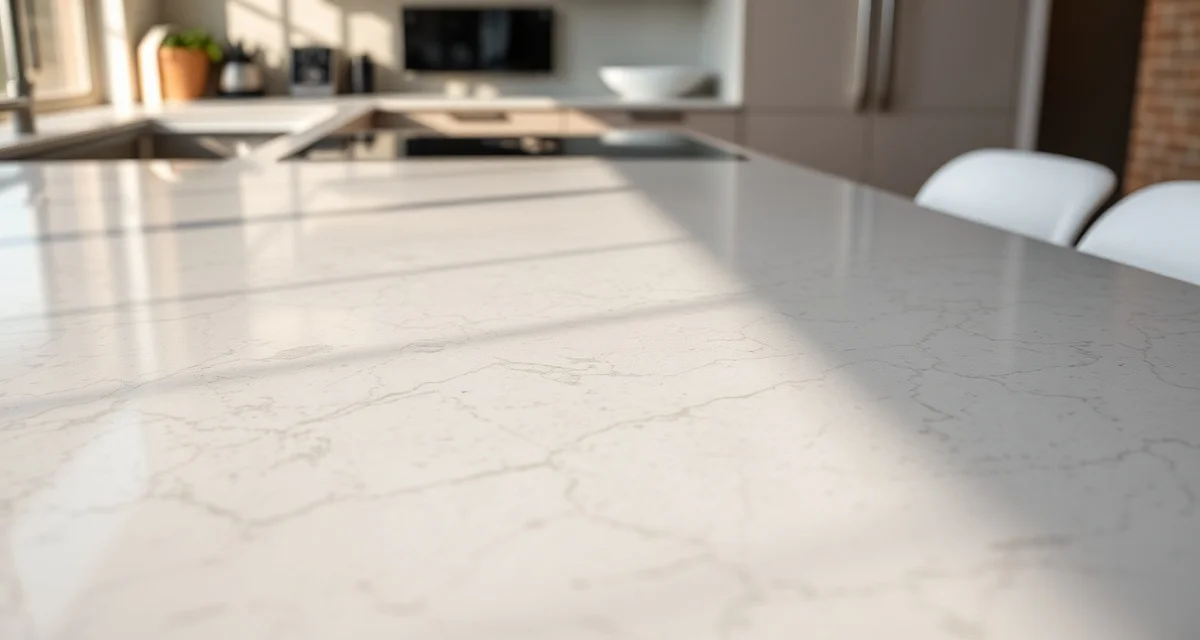
What Is Quartz Countertop? Definition & Guide
Quick Definition
A quartz countertop is an engineered stone surface made from approximately 90-94% ground natural quartz crystals combined with 6-10% polymer resins and pigments. Unlike natural stone (granite, marble), quartz countertops are manufactured in a factory, giving them consistent color, pattern, and performance characteristics. Quartz is the most popular countertop material in the US residential market, valued for its durability, low maintenance, and wide range of designs - including patterns that mimic marble and other natural stones.
TL;DR
- Quartz countertops are engineered stone: ~90% ground quartz + ~10% resin and pigments
- Most popular countertop material in the US residential market
- Non-porous - doesn't need sealing (unlike granite or marble)
- Consistent color and pattern within a production lot
- Not heat-resistant - resin can scorch at temperatures above 300°F
- Available in 2cm and 3cm thicknesses; 3cm is standard for kitchens
- Fabricated with the same tools as natural stone (CNC, waterjet, diamond blades)
- Major manufacturers: Caesarstone, Cambria, Silestone, MSI, LG Viatera
How Quartz Countertops Are Made
Raw Materials
- Ground quartz crystals (90-94% by weight) - sourced from quartz mines, then crushed and sorted by grain size
- Polymer resins (6-10%) - typically polyester or acrylic-based, acting as the binding agent
- Pigments - added to create specific colors and patterns
- Recycled materials - some manufacturers include recycled glass or mirror fragments
Manufacturing Process
- Mixing: Ground quartz, resin, and pigments are blended in precise proportions
- Molding: The mixture is poured into slab-sized molds
- Compaction: Vibro-compression under vacuum removes air pockets and compresses the material
- Curing: The slab is heated in a kiln to harden the resin
- Polishing: The cured slab surface is ground and polished to the desired finish
- Inspection: Quality control checks for color consistency, defects, and dimensional accuracy
The result is a dense, non-porous slab that's ready for fabrication.
Calculate your material waste savings
See exactly how much slab material and money you could save with optimized cutting layouts.
Try the free Waste CalculatorQuartz Countertop Properties
| Property | Specification |
|---|---|
| Composition | 90-94% quartz, 6-10% resin and pigments |
| Hardness (Mohs scale) | 7 (quartz mineral) |
| Density | 2.3-2.5 g/cm³ |
| Water absorption | Near zero (non-porous) |
| Flexural strength | 40-60 MPa (stronger than most granite) |
| Max temperature tolerance | ~300°F (resin limits heat resistance) |
| Standard thicknesses | 2cm (3/4") and 3cm (1-1/4") |
| Standard slab size | ~55" × 120" (varies by manufacturer) |
Fabrication Considerations for Quartz
Cutting
Quartz is cut with the same diamond blades and CNC machines used for natural stone. It produces a fine dust during cutting that contains crystalline silica - making wet cutting and proper dust suppression equipment mandatory for worker safety.
Seaming
Quartz seams require tight tolerances (1/16" or less). Because the material's pattern is manufactured, seam alignment matters - especially with designs that mimic marble veining. Color-matched adhesive is used to fill the seam joint.
Edge Profiling
All standard edge profiles (eased, beveled, bullnose, ogee, etc.) can be cut on quartz. The resin content makes the material slightly more forgiving than natural stone during edge profiling, with less risk of chipping.
Polishing
Most quartz arrives pre-polished from the factory. Fabricators polish seam joints and any CNC-machined edges to match the factory finish. Some quartz finishes (honed, leathered, concrete) require specific polishing techniques to maintain the intended texture.
Heat Sensitivity
The resin in quartz can scorch or discolor at temperatures above 300°F. Fabricators should inform customers to use trivets for hot pots and pans. Discoloration from heat is not repairable and may require section replacement.
Quartz vs. Granite vs. Marble
| Factor | Quartz | Granite | Marble |
|---|---|---|---|
| Origin | Manufactured | Natural quarried stone | Natural quarried stone |
| Porosity | Non-porous | Porous (needs sealing) | Very porous (needs sealing) |
| Pattern consistency | Highly consistent | Unique per slab | Unique per slab |
| Heat resistance | Low (~300°F max) | High | Moderate |
| Scratch resistance | High | High | Low |
| Stain resistance | High (no sealing needed) | Moderate (requires sealing) | Low (stains easily) |
| Price range (installed) | $50-$150/sq ft | $40-$200/sq ft | $75-$250/sq ft |
| Maintenance | Minimal | Annual sealing | Regular sealing |
Market Position and Trends
Quartz is the dominant countertop material in the US market, accounting for an estimated 35-40% of all countertop installations. Its popularity is driven by:
- Low maintenance - no sealing required, easy to clean
- Design variety - manufacturers produce hundreds of colors and patterns, including convincing marble look-alikes
- Consistency - homeowners can see a sample and know exactly what they'll get
- Durability - resists scratches, stains, and bacteria
Challenges for Fabricators
- Silica dust regulations are tightening, requiring shops to invest in wet-cutting equipment and dust collection systems
- Manufacturer warranty requirements often mandate specific fabrication practices
- Heat damage claims from customers who don't understand the material's limitations
- Pattern matching at seams is more difficult with veined quartz designs than with solid colors
Health and Safety: Silica Dust
Cutting, grinding, and polishing quartz generates dust containing crystalline silica. Prolonged inhalation of silica dust causes silicosis - a serious, irreversible lung disease. OSHA regulations require:
- Wet cutting methods to suppress dust
- Proper ventilation and dust collection systems
- Personal protective equipment (respirators) when dry conditions exist
- Exposure monitoring for workers
This is not optional. Shops that cut quartz must comply with silica exposure limits (OSHA PEL: 50 μg/m³ over an 8-hour TWA).
What is a quartz countertop made of?
Approximately 90-94% ground natural quartz crystals mixed with 6-10% polymer resins and pigments. It's an engineered (manufactured) product, not a natural stone cut from a quarry.
Is quartz the same as quartzite?
No. Quartz is an engineered product made in a factory. Quartzite is a natural stone quarried from the earth. They have very different properties and price points.
Do quartz countertops need to be sealed?
No. Quartz is non-porous, so it doesn't absorb liquids and doesn't require sealing - unlike granite and marble.
Can quartz countertops handle hot pots?
Not directly. The resin can scorch at temperatures above 300°F. Always use trivets or hot pads. Heat damage on quartz is permanent and not repairable.
How much do quartz countertops cost?
Typically $50-$150 per square foot installed, depending on the brand, pattern, edge profile, and complexity of the installation.
How are quartz countertops fabricated?
With the same CNC machines, diamond blades, and waterjet cutters used for natural stone. Wet cutting is required to control crystalline silica dust.
What are the biggest quartz brands?
Caesarstone, Cambria, Silestone (Cosentino), MSI Q Quartz, LG Viatera, and Hanstone are among the largest manufacturers.
Can quartz be bookmatched?
Veined quartz patterns can be oriented for continuity across seams, though the result isn't a true bookmatch like natural stone since the pattern is printed or manufactured.
Does quartz chip or crack easily?
Quartz is durable but not indestructible. Sharp impacts at edges can cause chips. Improper support or overhangs can lead to cracking over time.
Is quartz safe for kitchen use?
Yes. Quartz is NSF-certified for food contact, non-porous, and resistant to bacteria growth. It's widely used in both residential and commercial kitchen applications.
How long do quartz countertops last?
With proper care, quartz countertops last 15-25+ years. Most manufacturers offer 10-15 year warranties.
What finishes are available for quartz?
Polished (glossy), honed (matte), leathered (textured), and concrete (slightly rough) finishes are the most common options.
Fabricate Quartz Jobs Faster and With Less Waste
Quartz is consistent, reliable, and the market's top seller. SlabWise helps fabrication shops optimize quartz slab layouts, verify templates before cutting, and keep customers informed through every stage - reducing waste, preventing remakes, and speeding up quotes.
Start your 14-day free trial →
Try These Free Tools
- Cost Calculator -- Get instant countertop cost estimates by material and square footage.
- Kitchen Visualizer -- Upload a kitchen photo and preview different materials in place.
- Template Compare -- Upload two templates and see every dimension change highlighted.
Sources & Further Reading
- OSHA - Crystalline Silica Construction Standard
- Natural Stone Institute - Silica Safety Guidelines
- International Surface Fabricators Association - Crystalline Silica Exposure Prevention
- U.S. Geological Survey - Silica Mineral Commodity Summary