Equipment FAQ
Quick Definition
This equipment FAQ answers the most common questions from fabricators and homeowners.
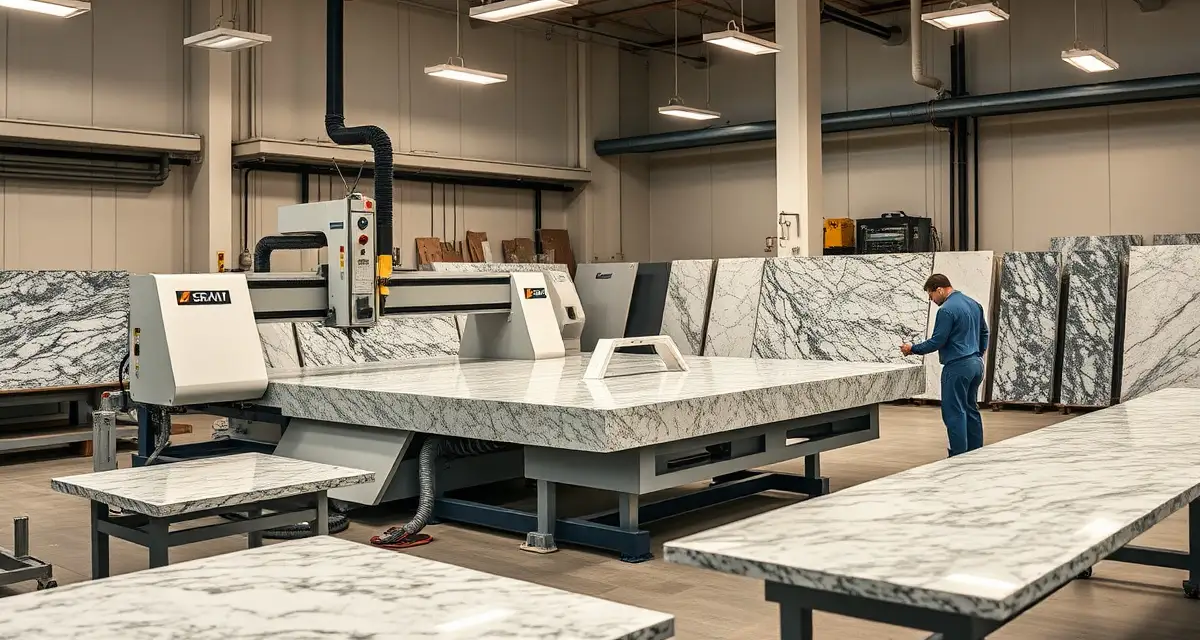
Countertop fabrication equipment includes the machines and tools used to cut, shape, polish, and install natural and engineered stone. The core equipment in a modern fabrication shop includes a CNC bridge saw or router, a laser or digital templating system, edge polishing machines, and material handling equipment like A-frames, gantry cranes, and vacuum lifters. Total equipment investment for a new shop ranges from $150,000 to $1,000,000+ depending on automation level.
TL;DR
- A new fabrication shop needs $150K-$500K minimum in equipment to start operations
- CNC bridge saws ($100K-$500K) are the single largest equipment investment
- Laser templaters ($15K-$35K) have replaced manual wood/cardboard templates in most shops
- Edge polishing machines ($10K-$80K) range from manual hand tools to automated inline systems
- Most equipment has a 7-15 year useful life with proper maintenance
- Used equipment can save 40-60% but comes with higher maintenance risk
- Water recycling systems ($5K-$25K) are now required in most states
- Software integration with CNC equipment is critical for accurate DXF file processing
Core Fabrication Equipment
What equipment does a countertop fabrication shop need?
Here's the complete equipment list for a functional fabrication shop, organized by priority:
Calculate your material waste savings
See exactly how much slab material and money you could save with optimized cutting layouts.
Try the free Waste CalculatorEssential (must-have to operate):
| Equipment | Price Range (New) | Purpose |
|---|---|---|
| CNC bridge saw | $100,000-$500,000 | Primary cutting - straight cuts, sink cutouts, miters |
| Templating system (laser/digital) | $15,000-$35,000 | Field measurements for accurate fabrication |
| Edge polisher (inline or manual) | $10,000-$80,000 | Edge profiling and finishing |
| A-frames/storage racks | $2,000-$10,000 | Slab storage and transport |
| Vacuum lifter | $5,000-$15,000 | Safe slab handling (OSHA compliance) |
| Water management system | $5,000-$25,000 | Wet cutting water supply and recycling |
| Hand tools & consumables | $3,000-$8,000 | Polishing pads, blades, epoxy, adhesives |
Growth equipment (adds capacity and capability):
| Equipment | Price Range (New) | Purpose |
|---|---|---|
| CNC router | $80,000-$350,000 | Complex shapes, sink cutouts, detailed work |
| 5-axis bridge saw | $250,000-$700,000 | Miters, complex angles, waterfall edges |
| Gantry crane | $10,000-$50,000 | Overhead slab movement in shop |
| Waterjet cutter | $80,000-$300,000 | Precision cuts, inlays, complex shapes |
| Automated edge polisher | $40,000-$150,000 | High-volume edge finishing |
| Forklift | $15,000-$40,000 | Loading/unloading slabs from trucks |
What is the difference between a CNC bridge saw and a CNC router?
These are the two main CNC machines in fabrication, and they serve different but overlapping purposes:
CNC Bridge Saw:
- Primary function: straight cuts, crosscuts, and miters
- Moves a circular diamond blade along X, Y, and Z axes
- Best for: slab cutdown, sink cutouts, and production cutting
- 3-axis models handle basic cuts; 5-axis models add tilt and rotation for miters and complex angles
- Faster for straight-line production cutting
CNC Router:
- Primary function: complex shapes, edge profiles, and detailed cutwork
- Uses a spinning tool bit (like a woodworking router, but for stone)
- Best for: curved edges, intricate sink cutouts, decorative details
- Standard 3-axis; some shops add a 4th axis for edge work
- More versatile for detail work but slower on long straight cuts
Most mid-to-large shops have both. The bridge saw handles the heavy cutting, and the router handles detail work. Small shops starting out typically invest in a bridge saw first, then add a router as volume grows.
How much does a CNC bridge saw cost?
Bridge saw pricing breaks into tiers based on capability:
| Tier | Price Range | Axes | Features | Best For |
|---|---|---|---|---|
| Entry-level | $100,000-$180,000 | 3-axis | Basic cuts, manual positioning | Startup shops, low volume |
| Mid-range | $180,000-$350,000 | 3-5 axis | Auto tool change, miter cuts | Growing shops, 20-40 jobs/month |
| Production | $350,000-$500,000+ | 5-axis | Full automation, high speed | High-volume, 50+ jobs/month |
Major bridge saw manufacturers include Park Industries, Intermac (Biesse), Breton, BACA, and Prussiani. Parts and service availability should factor heavily into the purchase decision - a machine with great specs but poor local service support costs more in downtime than a slightly less capable machine with responsive service.
Do I need a 5-axis saw or is 3-axis enough?
This depends on your work mix:
3-axis is sufficient if:
- Most of your work is standard kitchen and bath countertops
- Waterfall edges are rare (less than 5% of jobs)
- You subcontract miter work when needed
- Budget is limited and you need to prioritize other equipment
5-axis is worth the investment if:
- You do regular waterfall edge work
- Miter joints are common in your projects
- You handle commercial or high-end residential with complex geometry
- Volume justifies the higher capital cost
- You want to eliminate subcontracting for specialty cuts
The price difference between 3-axis and 5-axis is typically $100,000-$200,000, so the ROI calculation depends on how many miter/waterfall jobs you're doing (or turning away) per year.
Templating Equipment
What templating systems are fabricators using today?
The templating market has shifted heavily toward digital/laser systems:
| System Type | Market Share (est.) | Accuracy | Speed | Cost |
|---|---|---|---|---|
| Laser templater (LT-2D/3D, Proliner) | ~60% | ±1/16" or better | 15-30 min per kitchen | $15,000-$35,000 |
| Digital measuring (Flexijet) | ~15% | ±1/16" or better | 20-35 min per kitchen | $20,000-$40,000 |
| Manual (stick/cardboard templates) | ~20% | ±1/8"-1/4" | 45-90 min per kitchen | $200-$500 |
| Photo-based / measurement apps | ~5% | Varies widely | 10-15 min per kitchen | $0-$500/month |
Is a laser templater worth the investment?
For most shops doing 15+ jobs per month, yes. Here's the ROI calculation:
Costs:
- Equipment: $20,000-$35,000 (typical Proliner or LT-2D3D)
- Training: 1-2 weeks for proficiency
- Annual maintenance/calibration: $500-$1,500
Savings:
- Time savings: 30-60 minutes saved per template (vs. manual)
- Accuracy improvement: Reduces template-related remakes from 3-5% to under 1%
- Remake prevention: Each prevented remake saves $1,500-$4,000
If a laser templater prevents just 2 remakes per month (conservative estimate), that's $3,000-$8,000 in monthly savings - paying for the equipment in 3-12 months.
How accurate are laser templaters?
Modern laser templating systems (Proliner, LT-2D3D, Flexijet) achieve accuracy of ±1mm (about 1/25 of an inch) under normal field conditions. This is 4-8x more accurate than manual templates, which typically achieve ±3-6mm (1/8"-1/4").
However, accuracy depends on:
- Operator training - Even good equipment gives poor results with poor technique
- Field conditions - Unstable surfaces, unlevel floors, and obstructions affect readings
- Calibration - Regular calibration maintains accuracy over time
- Software processing - How the field data converts to a DXF file matters
This is where template verification adds another layer of quality control. Even with a $30,000 laser templater, human error during field measurement happens. AI-powered verification systems like SlabWise's 3-layer check catch dimensional issues that slip through, reducing remakes further.
Edge and Polishing Equipment
What edge polishing equipment do fabricators need?
Edge polishing equipment ranges from basic hand tools to fully automated inline systems:
Hand polishing tools ($500-$2,000):
- Variable-speed angle grinder with stone-specific polishing pads
- Used for touch-ups, small jobs, and field work
- Skill-dependent - quality varies with operator experience
Radial arm polisher ($10,000-$25,000):
- Semi-automated edge profiling
- Operator guides the stone past the tooling
- Good for small-to-medium shops
Inline/automated edge polisher ($40,000-$150,000):
- Fully or semi-automated edge finishing
- Consistent quality regardless of operator
- Required for high-volume production (40+ jobs/month)
What diamond blades and tooling do I need to stock?
Standard consumable tooling inventory for a mid-size shop:
| Consumable | Purpose | Replacement Frequency | Annual Cost (est.) |
|---|---|---|---|
| Diamond saw blades (14"-20") | Bridge saw cutting | Every 500-2,000 cuts | $3,000-$8,000 |
| Router bits (various profiles) | Edge profiling, cutouts | Every 200-500 operations | $2,000-$6,000 |
| Polishing pads (50-3000 grit set) | Surface and edge polishing | Weekly to monthly | $2,000-$5,000 |
| Core drill bits | Faucet holes, cutouts | Every 50-200 holes | $500-$1,500 |
| Finger bits | Sink cutout detail work | Every 100-300 cutouts | $1,000-$3,000 |
Total annual consumable budget for a shop doing 30 jobs/month: roughly $10,000-$25,000.
Water and Dust Management
Why do fabrication shops need water management systems?
Stone cutting generates two hazards: dust and slurry. Water management addresses both:
-
Wet cutting - Water cools the blade and suppresses dust during cutting. Without water, diamond blades overheat and wear prematurely, and airborne silica dust creates serious health hazards (silicosis).
-
Slurry management - The water-and-stone-dust mixture (slurry) cannot be dumped into municipal sewer systems. Most jurisdictions require settling tanks or filtration systems.
-
Water recycling - Closed-loop water systems recycle cutting water, reducing both water consumption and waste disposal costs.
| System Type | Cost | Water Recovery | Best For |
|---|---|---|---|
| Basic settling tank | $5,000-$10,000 | 70-80% | Small shops, low volume |
| Filtration/clarifier system | $10,000-$25,000 | 85-95% | Mid-size shops |
| Full recycling system | $20,000-$50,000 | 95%+ | High-volume shops, water-scarce areas |
What dust collection is required for a stone shop?
Dust control is both an OSHA requirement and a health necessity:
- Wet cutting is the primary dust control method - reduces airborne silica by 90%+
- Local exhaust ventilation near dry processes (hand polishing, dry grinding)
- Personal protective equipment - N95 or P100 respirators during any dry stone work
- Air monitoring - OSHA permissible exposure limit for respirable crystalline silica is 50 μg/m³ over an 8-hour shift
- Shop ventilation - General dilution ventilation for the overall workspace
OSHA's Silica Rule (29 CFR 1926.1153) applies to all stone fabrication shops and carries significant penalties for non-compliance.
Equipment Maintenance
How often should CNC equipment be maintained?
A general maintenance schedule for CNC fabrication equipment:
| Maintenance Task | Frequency | Estimated Cost |
|---|---|---|
| Daily lubrication/cleaning | Daily | Labor only |
| Blade/tool inspection | Daily | Labor only |
| Water system check | Daily | Labor only |
| Calibration verification | Weekly | Labor only |
| Belt and bearing inspection | Monthly | $0-$500/month |
| Full calibration | Quarterly | $500-$2,000 |
| Annual service (manufacturer) | Annually | $2,000-$8,000 |
| Major component replacement | As needed | $1,000-$20,000 |
Annual maintenance budget: Plan for 3-5% of equipment purchase price annually. A $300,000 bridge saw should have a $9,000-$15,000 annual maintenance budget.
Should I buy new or used equipment?
Used equipment can save 40-60% on purchase price but carries risks:
Buying used works well when:
- You can inspect the machine running before purchase
- Service history is documented
- The manufacturer still supports that model with parts
- You have (or can hire) a qualified technician for setup
- The seller offers a short-term warranty
Buying new makes more sense when:
- You need manufacturer warranty coverage (1-3 years typical)
- You want the latest software and control systems
- Service/parts availability for older models is questionable
- You're financing (lenders prefer new equipment)
- Training and installation support from the manufacturer matters
What is the minimum equipment needed to start a fabrication shop?
At minimum, you need a CNC bridge saw, a templating system (laser recommended), basic hand polishing tools, A-frames for slab storage, a vacuum lifter, and a water management system. This minimum setup runs $150,000-$250,000 for new equipment. Many startup shops begin with quality used equipment to reduce initial capital needs to the $80,000-$150,000 range.
How long does CNC equipment typically last?
With proper maintenance, a quality CNC bridge saw or router has a useful life of 10-20 years. The mechanical components (rails, bearings, spindle) wear over time, but the bigger factor is usually software and control system obsolescence. A 15-year-old machine may still cut accurately but may not communicate with modern templating software or accept current DXF file formats.
Can I finance fabrication equipment?
Yes. Equipment financing is common in the fabrication industry. Typical terms include 10-20% down payment, 5-7 year terms, and 6-10% interest rates. Equipment manufacturers often partner with financing companies and may offer promotional rates. SBA loans are another option for qualifying shops. Leasing is also available, which keeps equipment off your balance sheet but costs more long-term.
How do I choose between equipment brands?
Key factors beyond price: local service availability (critical - a machine down for parts is lost revenue), training and support quality, software compatibility with your other systems, resale value, and the manufacturer's track record in your region. Talk to other fabricators using the same equipment rather than relying only on manufacturer demos.
What software integrates with CNC fabrication equipment?
CNC equipment reads DXF files generated by templating software and fabrication management platforms. Key software integrations include: templating system to DXF export, fabrication management software for job routing and production scheduling, and nesting software for material optimization. SlabWise integrates with major CNC equipment brands, accepting DXF files from all major templating systems and outputting optimized cut files.
Do I need a separate CNC router if I have a 5-axis bridge saw?
Not necessarily. A 5-axis bridge saw handles many operations that previously required a router - miter cuts, some edge profiles, and complex angles. However, a dedicated CNC router still excels at curved cuts, intricate sink cutouts, and detailed edge work. Shops running 40+ jobs per month typically benefit from having both machines to avoid bottlenecking the bridge saw.
How much floor space does a fabrication shop need?
A basic shop needs 3,000-5,000 square feet minimum for one CNC machine, slab storage, finishing area, and workspace. A mid-size shop with bridge saw and router runs 5,000-10,000 sqft. High-volume operations with multiple machines, dedicated edge polishing, and inventory areas need 10,000-25,000+ sqft. Plan for slab storage racks to accommodate 50-200 slabs depending on volume.
What safety equipment is required in a stone shop?
OSHA requires: hearing protection near CNC machines (85+ dB), eye protection during all cutting and grinding operations, steel-toe boots, cut-resistant gloves for handling stone, respirators rated for silica dust (N95/P100 minimum), and wet cutting for dust suppression. Shops must also have emergency eye wash stations, first aid kits, and proper signage. An annual safety audit is strongly recommended.
How do I calculate equipment ROI?
Equipment ROI formula: (Annual revenue enabled or saved by the equipment - Annual operating cost) / Equipment cost. For a $200,000 bridge saw that enables $600,000 in annual fabrication revenue with $100,000 in operating costs, ROI is ($600K - $100K) / $200K = 2.5x in year one. Most fabrication equipment pays for itself within 1-3 years at reasonable volume (20+ jobs per month).
Should I invest in equipment or software first?
You need basic equipment to operate, but software amplifies the value of your equipment. A shop with a $300,000 bridge saw and no nesting software wastes 28-35% of material. Adding $199/month nesting and management software can reduce waste to 15-25%, saving thousands per month in material alone. The equipment-first-then-software approach makes sense - but don't delay software adoption.
Match Your Equipment With Smart Software
Your CNC equipment is only as good as the files it receives. Template errors become cutting errors, and poor nesting wastes expensive material regardless of how accurate your saw is.
SlabWise's AI template verification catches errors in DXF files before they reach your CNC. AI slab nesting optimizes every cut layout for 10-15% better yield. The result: your existing equipment produces more accurate parts with less material waste.
Start your 14-day free trial - connect your templating workflow and see the difference AI verification makes on your next batch of jobs.
Try These Free Tools
- Nesting Optimizer -- AI-powered slab layout that maximizes yield considering vein direction and defects.
- Defect Mapping -- Upload a slab photo and AI maps every fissure, pit, and color issue.
- Value Engineering -- Find dollar-quantified suggestions to save material without cutting margin.
Sources & Further Reading
- Natural Stone Institute - Natural Stone Care and Maintenance Guide
- National Kitchen & Bath Association - Countertop Selection Guidelines
- ASTM International - Standards for Stone and Countertop Materials
- International Surface Fabricators Association - Countertop Material Properties
Internal Links
- CNC Bridge Saw Guide - Full buyer's guide for bridge saws
- Best CNC Bridge Saws - Ranked by price and performance
- Digital Templating FAQ - Everything about laser and digital templating
- Silicosis Safety FAQ - Dust control and worker health
- Shop Layout Guide - Designing an efficient fabrication facility
- CNC Maintenance Guide - Keeping your equipment running
- Best Slab Nesting Software - Software for material optimization