What Is Gantry Crane? Definition & Guide
Quick Definition
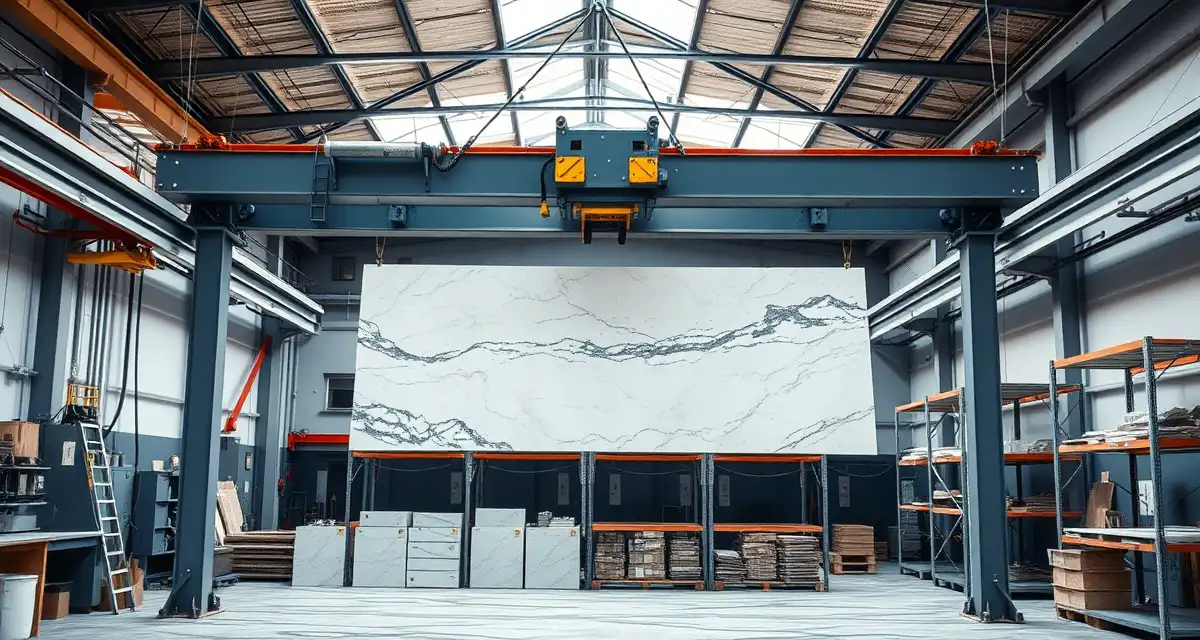
A gantry crane (also called an overhead crane or bridge crane in fabrication contexts) is a lifting device used in countertop fabrication shops to move heavy stone slabs between A-frame storage, CNC machines, fabrication tables, and loading areas. In a typical fab shop, gantry cranes lift slabs weighing 400-1,200 pounds using a hoist attached to a beam that travels along overhead rails or freestanding legs, allowing one or two operators to safely move material that would otherwise require four or more people.
TL;DR
- Gantry cranes move heavy stone slabs around fabrication shops safely
- Typical capacity: 1,000-5,000 lbs for countertop applications
- Two main types: overhead (ceiling-mounted) and freestanding gantry
- Cost: $3,000-$15,000 for freestanding; $10,000-$50,000+ for overhead bridge cranes
- Essential for shops processing more than 5-10 jobs per week
- Used with vacuum lifters or slab clamps for safe slab gripping
- OSHA requires operator training and regular inspections
Gantry Cranes in Countertop Fabrication
Why Every Serious Fab Shop Needs a Crane
A standard 3cm granite slab (120" x 72") weighs approximately 800-1,000 pounds. A comparably sized quartz slab weighs around 700-900 pounds. Moving these slabs manually - even with a team - is dangerous, slow, and leads to injuries and slab breakage.
Calculate your material waste savings
See exactly how much slab material and money you could save with optimized cutting layouts.
Try the free Waste CalculatorConsider a typical day at a mid-size fabrication shop:
- Pull 3-5 slabs from A-frames to the CNC saw
- Move cut pieces from the saw to edge polishing
- Transfer finished pieces to quality check tables
- Load finished countertops onto transport A-frames for delivery
- Unload incoming slabs from the delivery truck to storage A-frames
That's 15-25+ heavy lifts per day. Without a crane, this work requires multiple people per lift, takes longer, and carries substantial injury risk.
Types of Cranes Used in Fabrication Shops
Overhead Bridge Cranes
Ceiling-mounted cranes that run on rails attached to the building's structural columns or walls. A bridge beam travels along the rails, and a hoist moves along the bridge.
| Feature | Details |
|---|---|
| Capacity | 2,000-10,000 lbs (typical for fab shops) |
| Coverage | Entire shop floor (rail-to-rail) |
| Speed | Fast, smooth movement |
| Cost | $10,000-$50,000+ installed |
| Installation | Requires adequate building structure |
| Best For | Permanent shops with high volume |
Overhead bridge cranes are the preferred option for established fabrication shops because they cover the entire floor area without obstructing ground-level space. The main limitation: your building must have adequate structural capacity to support the crane rails and load.
Freestanding Gantry Cranes
Self-supporting cranes that stand on legs (often on wheels) and don't require building attachment. The beam spans between two A-shaped or straight leg assemblies.
| Feature | Details |
|---|---|
| Capacity | 1,000-5,000 lbs (typical) |
| Coverage | Limited to gantry span and travel |
| Speed | Moderate |
| Cost | $3,000-$15,000 |
| Installation | Minimal - set on floor, level, ready |
| Best For | Smaller shops, outdoor areas, or secondary lifting needs |
Freestanding gantry cranes work well for smaller shops, outdoor slab yards, or as secondary cranes in specific work areas (loading dock, saw area, etc.).
Jib Cranes
Wall-mounted or floor-mounted cranes with a rotating arm. Jib cranes serve specific work stations - the area around a CNC machine, a polishing station, or a loading dock.
| Feature | Details |
|---|---|
| Capacity | 500-2,000 lbs |
| Coverage | Circular area around mounting point |
| Cost | $2,000-$8,000 |
| Best For | Single-station lifting needs |
Crane Accessories for Stone Handling
The crane itself provides the lifting force, but you need the right attachment to grip the slab safely:
| Attachment | Use Case | Price Range |
|---|---|---|
| Vacuum lifter | Most common for slab handling; grips flat surfaces | $3,000-$8,000 |
| Slab clamps | Grips slab edges; good for vertical storage | $500-$2,000 |
| Nylon slings | Flexible straps for irregular shapes | $50-$200 |
| Spreader bar | Distributes load across wide slabs | $500-$1,500 |
Vacuum lifters are the most popular choice for countertop fabrication because they grip the slab's flat surface without edge contact, reducing chipping risk.
Sizing a Crane for Your Shop
| Shop Profile | Recommended Crane | Capacity |
|---|---|---|
| Startup (5-10 jobs/month) | Freestanding gantry | 1,000-2,000 lbs |
| Mid-size (15-30 jobs/month) | Overhead bridge crane | 2,000-5,000 lbs |
| Large (30-60+ jobs/month) | Overhead bridge + secondary gantry | 3,000-10,000 lbs |
Always size up. Buy more capacity than you think you need. A 2,000-lb crane handles most individual slabs, but when you need to move a slab bundle, a waterfall edge assembly, or a large commercial piece, extra capacity prevents dangerous overloading.
Safety and Compliance
OSHA regulates crane operation in the workplace. Key requirements for fabrication shops:
- Operator training - All crane operators must be trained and competent. Document training records.
- Regular inspections - Daily visual inspections by operators; annual inspections by qualified personnel.
- Load testing - New cranes and cranes after significant repair must be load-tested before use.
- Posted capacity - Maximum load capacity must be clearly posted on the crane.
- No riding loads - Workers must never ride on the hook, sling, or load.
Planning Your Shop Layout Around the Crane
Your crane coverage determines your shop layout. Think of crane access as the backbone of your material flow:
Ideal flow pattern:
- Receiving area (truck → A-frame storage) - crane access required
- Storage to CNC saw - crane access required
- CNC saw to edge polisher - crane or manual handling for smaller pieces
- Polisher to QC table - manual handling usually sufficient
- QC to transport A-frame - crane access helpful for large pieces
Position your A-frames, CNC equipment, and loading dock within the crane's coverage area. Anything outside crane reach requires manual handling or a secondary crane.
Connecting Crane Efficiency to Workflow Software
A crane's productivity depends on the operator knowing which slab to pull next. When your production schedule is clear - verified template, confirmed slab assignment, scheduled production slot - the crane operator moves with purpose. When the schedule is ambiguous, the operator spends time asking questions, checking work orders, and potentially pulling the wrong slab.
SlabWise connects your slab inventory to your production schedule, so every job that's ready for fabrication has a specific slab assigned and a specific location on a specific A-frame. Your crane operator knows exactly what to pull and where to bring it.
How much does a gantry crane cost for a stone shop?
Freestanding gantry cranes range from $3,000-$15,000. Overhead bridge cranes range from $10,000-$50,000+ including installation.
What capacity crane do I need for stone slabs?
A minimum of 1,000 lbs for individual slabs. A 2,000-3,000 lb capacity provides safe margin for heavier slabs and future needs.
Do I need OSHA certification to operate a crane?
OSHA requires operators to be trained and competent but does not require a specific certification. Document your training program and operator qualifications.
What's the difference between a gantry crane and a bridge crane?
A gantry crane is freestanding (supported by its own legs). A bridge crane mounts to the building structure (walls or columns). Both serve the same function.
Can I install an overhead crane in any building?
Not necessarily. The building must have adequate structural capacity to support the crane rails and dynamic loads. A structural engineer should evaluate your building before installation.
How often should cranes be inspected?
Daily visual inspections by operators, monthly inspections of critical components, and annual comprehensive inspections by qualified inspectors. Keep all inspection records on file.
Should I buy a new or used crane?
Used cranes can save 30-50% on cost. Ensure any used crane is inspected by qualified personnel before installation and meets current safety standards.
What is a vacuum lifter?
A vacuum lifter is an attachment that grips flat surfaces (like stone slabs) using suction cups powered by a vacuum pump. It's the most common crane attachment in countertop fabrication.
Can one person operate a shop crane?
Yes. Cranes are designed for single-operator use, which is one of their primary advantages - one person with a crane can safely move slabs that would otherwise require a team.
How do I maintain a shop crane?
Follow the manufacturer's maintenance schedule, which typically includes lubrication, cable/chain inspection, brake testing, electrical checks, and structural inspections.
Keep Your Crane Moving the Right Slab with SlabWise
Your crane operator is only as fast as the information they have. SlabWise tells them exactly which slab, which A-frame, and which job - no hunting, no guessing, no wasted crane time.
Start your 14-day free trial at SlabWise.com
Try These Free Tools
- Cost Calculator -- Get instant countertop cost estimates by material, edge profile, and square footage.
- Compare Materials -- Side-by-side material comparison with pricing, durability, and maintenance ratings.
- Edge Profile Selector -- Browse edge profiles with cost impact and visual previews.
Sources & Further Reading
- National Kitchen & Bath Association - Cabinet Frame Construction Standards
- International Surface Fabricators Association - Support Frame Requirements for Stone Installation
- Natural Stone Institute - Structural Framing Guidelines for Natural Stone Applications
- ASTM International - ASTM C1242 Standard Guide for Selection, Design, and Installation of Dimension Stone Attachment Systems