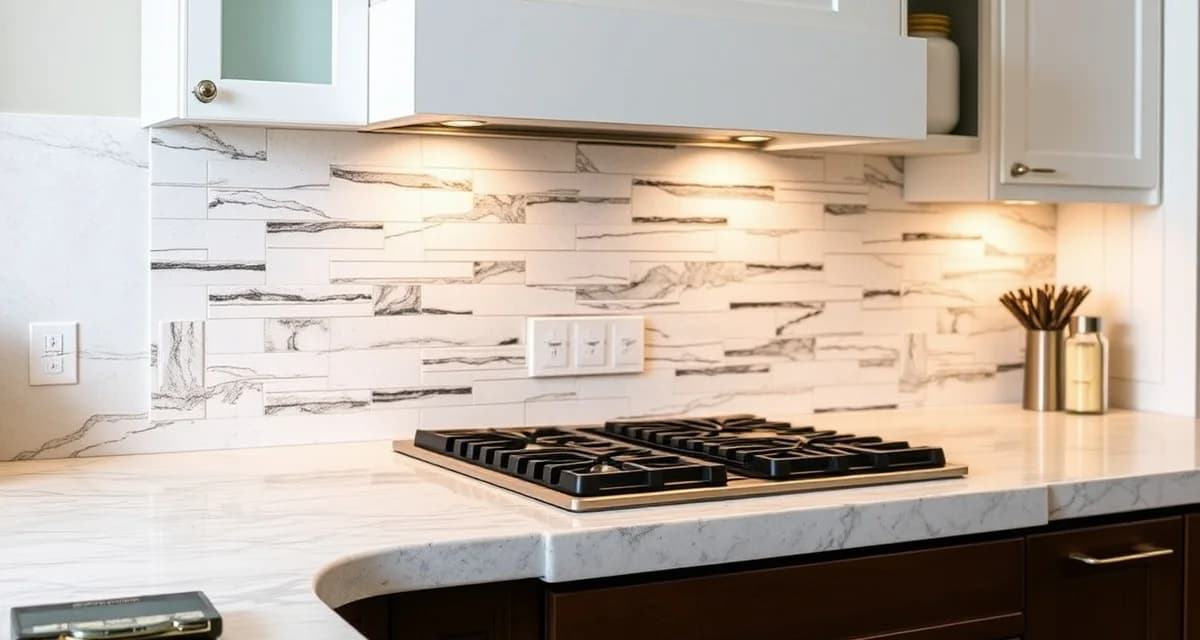
What Is Backsplash? Definition & Guide
Quick Definition
A backsplash is the vertical surface material installed on the wall behind and above a countertop, extending from the countertop surface upward. In countertop fabrication, backsplashes are typically made from the same stone as the counter (granite, quartz, marble) and are cut, finished, and installed as part of the countertop project. Standard backsplash height is 4 inches, though full-height backsplashes that extend to the underside of wall cabinets are increasingly popular.
TL;DR
- A backsplash is the vertical material on the wall directly above a countertop
- Standard height is 4 inches; full-height extends to the bottom of upper cabinets (typically 18")
- Made from the same countertop material or a complementary material (tile, glass, metal)
- Stone backsplashes are cut from the same slab to ensure color and pattern matching
- Adds 10-20% to the material required per job, affecting slab yield calculations
- Must be accounted for during template verification and slab nesting
- Full-height backsplashes require more precise wall measurements due to variations in wall flatness
Types of Backsplash in Countertop Fabrication
Standard (4-Inch) Backsplash
The most common option. A 4-inch tall strip of stone, typically 3/4" (2cm) thick, is installed along the wall behind the countertop. It protects the wall from water and cooking splashes at the most vulnerable area - directly behind the counter surface.
Calculate your material waste savings
See exactly how much slab material and money you could save with optimized cutting layouts.
Try the free Waste CalculatorFull-Height Backsplash
Extends from the countertop surface to the bottom of the upper cabinets, typically 15-18 inches tall. Full-height stone backsplashes create a dramatic visual impact and are increasingly requested in modern kitchen designs.
Waterfall Backsplash
A variation where the stone extends up the wall and may continue over the upper cabinets or to the ceiling. This is a luxury application that requires significant additional material and precise installation.
No Backsplash (Tile Alternative)
Some customers choose tile, glass, or metal backsplash instead of stone. In these cases, the fabricator may install a small (1-2") stone strip as a transition piece, or the countertop terminates flush with the wall.
Backsplash Heights and Material Requirements
| Backsplash Type | Typical Height | Thickness | Additional Material per Linear Foot |
|---|---|---|---|
| Standard | 4" | 2cm (3/4") | 0.33 sq ft |
| Full-height | 15-18" | 2cm or 3cm | 1.25-1.5 sq ft |
| Waterfall wall | 36-48" | 2cm or 3cm | 3-4 sq ft |
| No stone backsplash | 0" | N/A | 0 sq ft |
For a kitchen with 15 linear feet of backsplash:
- Standard 4": requires about 5 additional sq ft of material
- Full-height 18": requires about 22.5 additional sq ft
- Waterfall 48": requires about 60 additional sq ft
This additional material requirement directly impacts slab yield and nesting calculations.
Fabrication Considerations for Stone Backsplashes
Cutting and Thickness
Backsplash pieces are typically cut from the same slab as the countertop to ensure color and pattern matching. Standard backsplashes are usually 2cm (3/4") thick rather than the 3cm (1-1/4") used for countertops. Some shops resaw 3cm offcuts to produce 2cm backsplash pieces, improving material utilization.
Wall Scribe
Walls are rarely perfectly flat or plumb. Backsplash pieces must be scribed (trimmed) to fit tightly against the wall surface. The template should account for wall irregularities, and the finished backsplash edge is typically left unpolished where it meets the wall since caulk fills any small gaps.
Outlet and Switch Cutouts
Full-height backsplashes almost always require cutouts for electrical outlets and light switches. These cutouts must be precisely located during templating, and their positions must be verified before fabrication.
Corner Joints
Where backsplash meets at inside corners (like the junction of two perpendicular wall runs), the joint must be clean and caulked. Some fabricators miter these corners; others butt-join them with a polished edge.
Backsplash and Slab Nesting
Backsplash pieces are often the overlooked element in slab nesting. Because they're thin strips, they can usually be nested into the leftover spaces around the main countertop pieces - but only if they're included in the nesting plan from the start.
Common Mistakes
- Forgetting the backsplash entirely during nesting, then discovering there's not enough material to cut it
- Nesting backsplash pieces far from the countertop area on the slab, resulting in poor color/pattern matching
- Not accounting for outlet cutouts in the backsplash template
- Ignoring grain direction - backsplash veining should flow in the same direction as the countertop
Best Practice
Include backsplash pieces in the digital nesting layout alongside countertop pieces. Position them adjacent to the countertop area on the slab to maintain pattern continuity. AI nesting tools can optimize this automatically by treating backsplash pieces as part of the overall job layout.
Installation Details
Adhesion
Stone backsplashes are typically adhered to the wall using construction adhesive (like silicone or a modified thinset). The backsplash sits on top of the countertop surface - it does not hang from the wall independently.
Caulking
A thin bead of color-matched caulk seals the joint between the backsplash and the countertop surface. This joint is caulked rather than grouted because the countertop and wall expand and contract at different rates. Grout would crack; caulk flexes.
Alignment With Countertop Edge
The backsplash face should be flush with the front edge of the countertop in most installations. Some designs call for the backsplash to be set back slightly from the counter edge.
Stone Backsplash vs. Tile Backsplash
| Factor | Stone Backsplash | Tile Backsplash |
|---|---|---|
| Material cost | Higher (same slab as counter) | Lower (separate material) |
| Pattern matching | Matches countertop exactly | Complementary but different |
| Fabrication complexity | Included in countertop job | Separate trade (tile installer) |
| Maintenance | Minimal - same care as countertop | Grout lines require periodic sealing |
| Visual impact | Clean, continuous look | More design variety (patterns, colors, textures) |
| Lead time | Same as countertop | Separate scheduling required |
For fabricators, stone backsplashes add revenue to each job and keep the entire project under one trade. Full-height stone backsplashes in particular are high-margin add-ons.
What is a backsplash on a countertop?
A backsplash is the vertical surface material installed on the wall directly above the countertop. It protects the wall from water, grease, and food splashes.
How tall is a standard countertop backsplash?
Standard backsplash height is 4 inches. Full-height backsplashes extend 15-18 inches to the bottom of upper cabinets.
Should the backsplash match the countertop?
For stone countertops, matching the backsplash material creates the cleanest look. The backsplash should be cut from the same slab for the best color and pattern match.
How thick is a stone backsplash?
Typically 2cm (3/4 inch), which is thinner than the standard 3cm (1-1/4 inch) countertop thickness.
Does a backsplash affect slab yield?
Yes. Backsplash pieces add 10-20% to the total material needed per job and must be included in the slab nesting plan to maintain yield.
Can you install a stone backsplash on uneven walls?
Yes, but the backsplash pieces need to be scribed (trimmed) to follow the wall's contour. Gaps between the stone and wall are sealed with caulk.
Do full-height backsplashes need outlet cutouts?
Almost always. Kitchens have electrical outlets along the wall between the counter and upper cabinets that must be templated and cut precisely.
Is the joint between backsplash and countertop caulked or grouted?
Caulked. The flexible caulk joint accommodates the different expansion rates of the countertop and the wall structure behind the backsplash.
How are backsplash pieces attached to the wall?
With construction adhesive (silicone or modified thinset). The backsplash sits on the countertop surface and is glued to the wall.
Does a full-height backsplash add significant cost?
Yes. It increases material requirements substantially (an additional 15-25 sq ft for an average kitchen) and adds fabrication and installation time.
Can vein matching extend through the backsplash?
Yes, and it should. The backsplash pieces should be nested adjacent to the countertop pieces on the slab so veining flows naturally from the horizontal surface up the wall.
Should backsplash be included in the original template?
Absolutely. Measuring and including backsplash dimensions during the initial template visit prevents a return trip and ensures accurate nesting.
Include Backsplash in Every Nesting Plan
Backsplash pieces are easy to overlook during layout planning - until you run out of material. SlabWise's AI nesting engine includes backsplash in the optimization process, positioning pieces for pattern continuity while maximizing overall slab yield.
Start your 14-day free trial →
Try These Free Tools
- Nesting Optimizer -- AI-powered slab layout that maximizes yield considering vein direction and defects.
- Defect Mapping -- Upload a slab photo and AI maps every fissure, pit, and color issue.
- Value Engineering -- Find dollar-quantified suggestions to save material without cutting margin.
Sources & Further Reading
- Natural Stone Institute - Fabrication Guidelines and Best Practices
- International Surface Fabricators Association - Waterjet Cutting Technology Standards
- ASTM International - Standard Guide for Abrasive Waterjet Machining
- OSHA - Safety Guidelines for Waterjet Operations