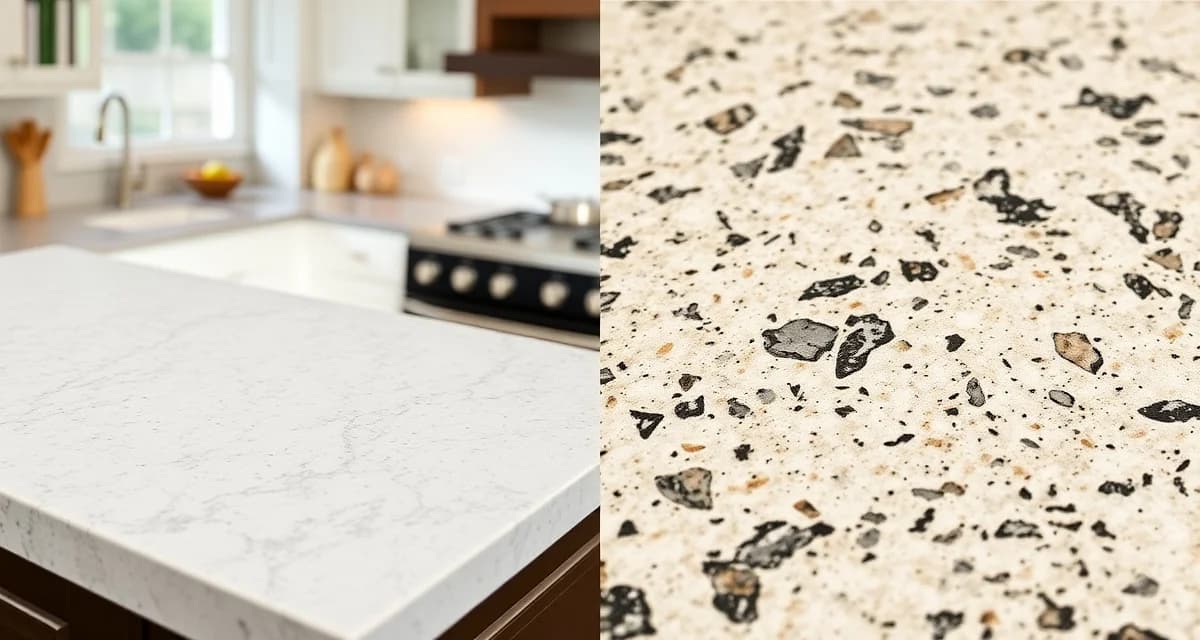
Quartz vs Granite Countertops: 2026 Comparison
Quartz and granite are the two most popular countertop materials in the United States, together accounting for over 75% of all kitchen countertop installations. Quartz is an engineered stone made from 93% crushed quartz mixed with resin binders, while granite is a natural stone quarried from the earth. Both are durable, heat-resistant, and widely available, but they differ significantly in maintenance, appearance consistency, and price range.
TL;DR
- Quartz costs $50-$150/sq ft installed; granite costs $40-$175/sq ft installed
- Quartz requires zero sealing; granite needs resealing every 1-3 years
- Granite handles heat better---up to 1,200F vs quartz at 300-400F before damage
- Quartz has consistent patterns; granite has unique natural variation per slab
- Quartz holds 51% market share vs granite at approximately 24% in 2026
- Both materials last 25-50+ years with proper care
- Granite offers more color variety from nature; quartz offers more design control
Side-by-Side Comparison
| Feature | Quartz | Granite |
|---|---|---|
| Composition | 93% crushed quartz + 7% resin | 100% natural stone |
| Installed Cost | $50-$150/sq ft | $40-$175/sq ft |
| Avg Kitchen Cost (40 sq ft) | $3,200-$6,000 | $2,800-$7,000 |
| Hardness (Mohs) | 7 | 6-6.5 |
| Heat Resistance | Moderate (use trivets) | High (direct hot pans OK briefly) |
| Stain Resistance | Excellent (non-porous) | Good (requires sealing) |
| Scratch Resistance | Very Good | Very Good |
| Maintenance | Soap and water | Seal every 1-3 years |
| Seam Visibility | Moderate (resin can discolor) | Moderate (natural variation helps hide) |
| UV Resistance | Poor (can yellow outdoors) | Excellent |
| Eco Rating | Moderate (manufactured) | Good (natural, but quarried) |
| Lifespan | 25-50+ years | 50-100+ years |
| Resale Value Impact | High | High |
| Best For | Low-maintenance kitchens, bathrooms | Kitchens, outdoor spaces, heat zones |
Cost Comparison in Detail
Material Cost to Fabricators
| Tier | Quartz Slab Cost | Granite Slab Cost |
|---|---|---|
| Budget / Level 1 | $14-$22/sq ft | $8-$18/sq ft |
| Mid-Range / Level 2 | $22-$40/sq ft | $18-$35/sq ft |
| Premium / Level 3 | $40-$60/sq ft | $35-$55/sq ft |
| Ultra-Premium | $55-$80/sq ft | $55-$120/sq ft |
Granite has a lower floor price than quartz at the budget level, making it the more affordable option for cost-conscious homeowners. However, exotic granite varieties can exceed premium quartz pricing by a significant margin.
Calculate your material waste savings
See exactly how much slab material and money you could save with optimized cutting layouts.
Try the free Waste CalculatorTotal Project Cost Example
Standard 40 sq ft L-shaped kitchen, eased edge, 1 undermount sink cutout, standard installation:
| Cost Component | Mid-Grade Quartz | Mid-Grade Granite |
|---|---|---|
| Material (48 sq ft with waste) | $1,680 | $1,440 |
| Fabrication | $480 | $528 |
| Edge Work (22 lin ft) | $220 | $242 |
| Sink Cutout | $250 | $250 |
| Installation | $600 | $600 |
| Sealing | $0 | $120 |
| Total Installed | $3,230 | $3,180 |
At the mid-grade level, the total installed cost difference between quartz and granite is minimal---typically under $200 for a standard kitchen. The pricing gap widens at the budget level (granite is cheaper) and at the premium level (varies by specific stone).
Durability and Performance
Hardness and Scratch Resistance
Quartz rates 7 on the Mohs hardness scale, while granite ranges from 6 to 6.5. In practical terms, both resist scratching from normal kitchen use. Knives will not scratch either surface, though cutting directly on stone will dull your knife blades. The slight hardness advantage of quartz means it is marginally more resistant to surface wear over decades.
Heat Resistance
This is where granite has a clear advantage. Granite can handle direct contact with hot pots and pans without damage. Quartz, because of its resin binders, can be damaged by temperatures above 300-400 degrees Fahrenheit. A hot skillet placed directly on quartz can cause discoloration, cracking, or a permanent white mark where the resin burns.
Practical recommendation: Use trivets with quartz countertops. Granite is more forgiving, but using trivets with both materials is still good practice.
Stain Resistance
Quartz is non-porous, meaning liquids cannot penetrate the surface. Red wine, coffee, oil, and lemon juice sit on top and wipe away easily---even if left for hours.
Granite is naturally porous. Without sealing, liquids can penetrate the surface and leave stains. Properly sealed granite resists most stains, but the sealant wears over time and must be reapplied every 1-3 years depending on usage. Dark granites (like Absolute Black) are naturally denser and less prone to staining than light-colored varieties.
Chip and Crack Resistance
Both materials can chip if struck hard at an edge or corner. Granite is slightly more prone to chipping at unsupported edges because it is a natural stone with internal grain structures that can create weak points. Quartz, being engineered, has more uniform strength throughout.
Minor chips in both materials can be repaired with color-matched epoxy. Major cracks in either material typically require section replacement.
Appearance and Design
Quartz Appearance
Quartz manufacturers can engineer nearly any look: marble veins, concrete textures, solid colors, and terrazzo-inspired patterns. Popular quartz looks in 2026 include:
- Calacatta marble look (white with bold grey veining)
- Concrete-inspired matte finishes
- Warm neutral tones (greige, warm white)
- Dramatic dark veining on white backgrounds
The main limitation: quartz patterns repeat. A quartz slab from a factory run will look very similar to another slab from that same color line. For large kitchens with long runs of countertop, pattern repetition can be noticeable at seams.
Granite Appearance
Every granite slab is one of a kind. The natural variation in color, veining, and crystal structure means no two slabs are identical. This uniqueness is a major selling point for customers who want something truly individual.
Granite comes in virtually every color: black, white, grey, brown, gold, blue, green, red, and multi-colored. Crystal sizes range from fine-grained to large, bold patterns. The variety is enormous---there are hundreds of granite types in regular commercial production.
The trade-off: natural variation means what you see in a small sample may not represent the full slab. Customers should always view and approve the actual slab before fabrication.
Maintenance Comparison
Daily Care
| Task | Quartz | Granite |
|---|---|---|
| Cleaning | Warm water + mild soap | Warm water + mild soap |
| Disinfecting | Isopropyl alcohol spray | Isopropyl alcohol spray |
| Stain removal | Non-abrasive cleaner | Stone-specific cleaner |
| Avoid | Harsh chemicals, bleach | Acidic cleaners, vinegar |
Long-Term Maintenance
| Task | Quartz | Granite |
|---|---|---|
| Sealing | Never | Every 1-3 years ($75-$200 or DIY) |
| Professional polishing | Rarely needed | Every 5-10 years if desired |
| Chip repair | As needed | As needed |
| Replacement timeline | 25-50+ years | 50-100+ years |
Quartz wins on maintenance convenience. There is no sealing schedule to remember, no annual maintenance cost, and no risk of staining from a missed seal application. For busy homeowners who want a set-it-and-forget-it surface, quartz is the easier choice.
Best Uses for Each Material
Choose Quartz When:
- You want a low-maintenance surface with no sealing requirement
- You prefer consistent, predictable patterns
- You want a marble look without marble's fragility
- The countertop is in a bathroom or area with frequent water exposure
- You want a wide range of manufactured color options
- The area is indoor only (quartz is not UV-stable for outdoor use)
Choose Granite When:
- You want a unique, one-of-a-kind stone pattern
- Heat resistance is important (heavy cooking, bakers)
- The countertop will be outdoors or in direct sunlight
- You are working with a tight budget (Level 1 granite is cheaper than Level 1 quartz)
- You prefer the look and feel of natural stone
- Long-term durability is the top priority (granite lasts generations)
Environmental Considerations
Quartz is manufactured in factories using crushed stone, resin binders, and pigments. The manufacturing process consumes energy, and the resin component is petroleum-based. Some quartz manufacturers have introduced recycled content (up to 40% recycled materials in some product lines).
Granite is quarried from natural deposits, which involves significant land disturbance and transportation from quarry sites (often international). However, granite is a natural product with no synthetic binders, and it can be repurposed or recycled at end of life.
Neither material is clearly "greener" than the other. The environmental impact depends heavily on specific brands, quarry practices, and transportation distances.
FAQ
Is quartz or granite more expensive?
At the budget level, granite is cheaper---Level 1 granite starts at $40/sq ft installed versus $50/sq ft for entry-level quartz. At the mid-range, prices are very similar ($65-$100/sq ft for both). At the premium level, exotic granite can exceed premium quartz pricing. For a typical 40 sq ft kitchen, the total cost difference between similar grades is usually under $500.
Which is more durable, quartz or granite?
Both are extremely durable for kitchen use. Quartz is harder (7 vs 6-6.5 Mohs) and more stain-resistant because it is non-porous. Granite is more heat-resistant and will not be damaged by hot cookware. For overall durability in a kitchen, they perform comparably. Granite has a longer theoretical lifespan (100+ years vs 50+ years).
Can I put hot pans on quartz countertops?
You should always use trivets or hot pads on quartz. Temperatures above 300-400F can damage the resin binders in quartz, causing discoloration or permanent marks. Granite is more heat-tolerant and can handle brief contact with hot pans, though thermal shock can cause cracking in any stone.
Does granite really need to be sealed?
Yes. Granite is a porous natural stone that can absorb liquids and stain without a sealant barrier. Most fabricators apply an initial seal at installation. You should reseal every 1-3 years depending on the granite type and usage. The water test (pour a small amount of water on the surface; if it darkens within 5 minutes, it needs sealing) is a simple way to check.
Which has better resale value, quartz or granite?
Both materials add comparable resale value to a home. Real estate agents consistently rank quartz and granite among the top kitchen upgrades for home value. In 2026, quartz has a slight edge in buyer preference due to its modern appearance options and low-maintenance reputation, but granite remains highly valued, especially in luxury and traditional markets.
Can I use quartz outdoors?
No. Quartz is not recommended for outdoor use. UV exposure causes the resin binders and pigments to fade and yellow over time. For outdoor kitchens, barbecue surrounds, and patio bars, granite is the better choice. Other outdoor-rated options include Dekton, certain quartzites, and concrete.
Which is easier to fabricate, quartz or granite?
Quartz is generally easier and faster to fabricate. It has consistent density and hardness throughout the slab, producing predictable cutting and polishing results. Granite varies in hardness, has natural fissures, and may have weak spots that require more careful handling. Quartz fabrication takes roughly 10-15% less time than equivalent granite work.
Do quartz countertops look fake?
Modern quartz manufacturing has improved dramatically. Premium quartz brands produce veining patterns that closely mimic natural marble and stone. However, the look is engineered---patterns repeat, and the surface has a different depth than natural stone. Most visitors to a home cannot distinguish premium quartz from natural stone without being told, but experienced stone professionals can usually tell the difference.
Which is heavier, quartz or granite?
They weigh approximately the same. A 3cm (1.25-inch) slab of either material weighs about 18-20 pounds per square foot. Both require sturdy cabinetry for support, and both require a 2-3 person crew for installation. Neither material needs structural modifications to standard kitchen cabinets.
How long do quartz and granite countertops last?
Quartz countertops last 25-50+ years. Granite countertops last 50-100+ years and can potentially last the lifetime of the home. Both timelines far exceed the average kitchen remodel cycle (15-20 years), so longevity is rarely a deciding factor for homeowners.
Get an Instant Estimate for Your Countertop Project
Use the SlabWise countertop cost calculator to compare quartz and granite pricing for your specific kitchen layout. Enter your dimensions, choose your material, and get an accurate estimate in seconds.
Try the Free Cost Calculator →
Compare materials side by side and find the right surface for your budget and lifestyle.
Try These Free Tools
- Cost Calculator -- Compare material costs instantly across different countertop options.
- Compare Materials -- Side-by-side material comparison with pricing, durability, and maintenance.
- Kitchen Visualizer -- Let customers preview countertop materials in their actual kitchen.
Sources & Further Reading
-
Natural Stone Institute - Technology and Software Solutions for Stone Fabricators
-
International Surface Fabricators Association - Fabrication Software and Digital Tools
-
National Kitchen & Bath Association - Technology Integration in Countertop Design
-
Marble Institute of America - Digital Fabrication and Software Standards