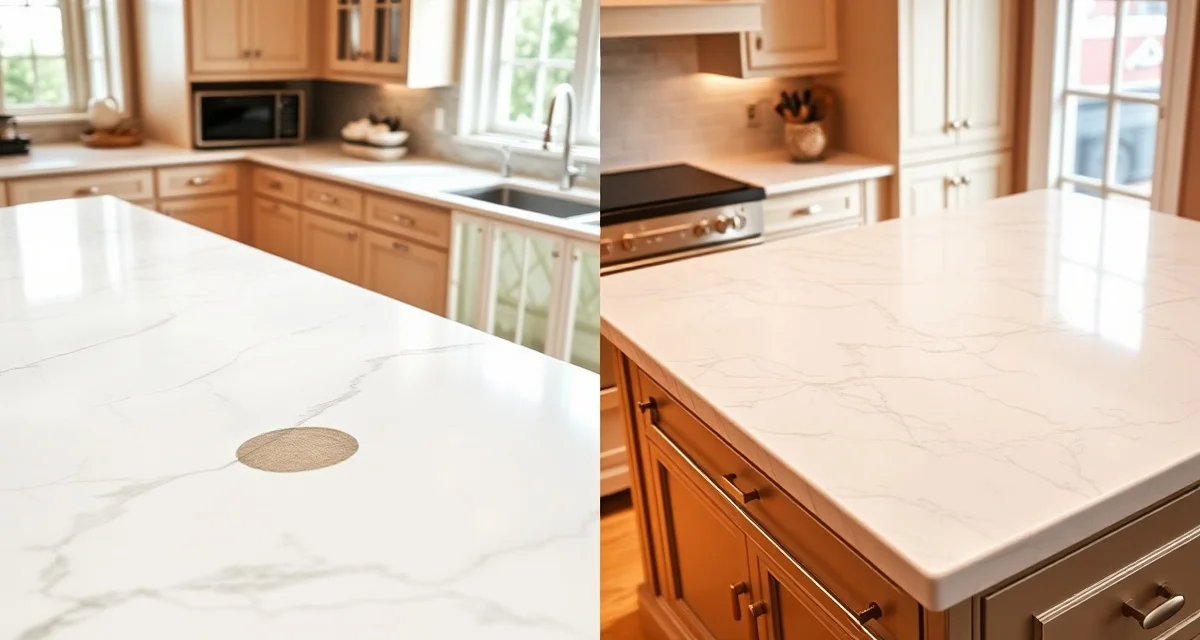
Marble vs Porcelain Countertops: 2026 Comparison
Marble is the original luxury countertop. Porcelain can now mimic marble's look with almost none of its maintenance headaches. This comparison helps you decide between the real thing and its most convincing engineered alternative.
TL;DR
- Marble etches from acids; porcelain is chemically inert and never etches
- Porcelain is non-porous and needs zero sealing; marble needs sealing every 3-6 months
- Marble has an irreplaceable natural beauty --- depth, warmth, and luminosity that porcelain approaches but cannot fully match
- Porcelain handles heat, UV, and outdoor use; marble is more limited in all three
- Marble costs more at the premium end: $75-$250/sq ft vs. $55-$120/sq ft for porcelain
- Porcelain edges can chip more easily than marble, and edge profile options are limited
- For busy kitchens, porcelain is the practical choice; for luxury spaces where beauty outweighs practicality, marble is unmatched
Side-by-Side Comparison
| Feature | Marble | Porcelain Slab |
|---|---|---|
| Type | Natural metamorphic stone | Manufactured (clay fired at 2,200F+) |
| Installed Cost (per sq ft) | $75-$250 | $55-$120 |
| Sealing Required | Every 3-6 months | Never |
| Heat Resistance | Moderate | Excellent (500F+) |
| Scratch Resistance | Low (3-5 Mohs) | High |
| Acid Sensitivity | Very High (etches) | None |
| Stain Resistance | Low (porous) | Very High |
| UV Resistance | Yes | Yes |
| Outdoor Use | Not recommended | Yes |
| Pattern Uniqueness | Every slab is unique | Printed (can repeat) |
| Edge Chip Resistance | Moderate | Moderate (edges are vulnerable) |
| Maintenance Level | High | Very Low |
| Lifespan | 50+ years (with patina) | 25-50+ years |
The Etching Problem
Marble's biggest weakness is acid sensitivity. The calcium carbonate in marble reacts chemically with acids, creating etch marks --- dull, light-colored spots or rings on the surface. This happens in seconds from contact with:
Calculate your material waste savings
See exactly how much slab material and money you could save with optimized cutting layouts.
Try the free Waste Calculator- Lemon or lime juice
- Wine (especially red and white)
- Vinegar
- Tomato sauce
- Coffee
- Many cleaning products
Sealing marble prevents staining (absorption) but does NOT prevent etching (chemical reaction). This is the #1 misunderstanding homeowners have about marble care.
Porcelain does not etch. It does not react with any household acid. You can spill lemon juice on porcelain and leave it for hours without any surface damage. For anyone who cooks with acidic ingredients (which is most people), this is a massive practical advantage.
Maintenance Gap
The maintenance difference between these two materials is enormous:
Marble Maintenance
- Seal every 3-6 months with a penetrating impregnator
- Wipe acidic spills within 30-60 seconds
- Use only pH-neutral cleaners
- Use coasters under all glasses
- Use trivets for hot items
- Professional re-polishing every 3-5 years ($300-$800)
- Constant vigilance against etching and staining
Porcelain Maintenance
- No sealing needed, ever
- Clean with any household cleaner
- No restrictions on acid contact
- Place hot items directly on the surface
- No professional maintenance needed
Appearance: Real vs. Replica
This is where the conversation gets philosophical.
Marble's beauty is genuine. The veining formed over millions of years. Light enters the stone and creates a soft, luminous glow. The surface has warmth and depth that photographs cannot fully capture. Every slab is unique --- a piece of natural art.
Porcelain's beauty is manufactured. Digital printing technology creates marble patterns that are remarkably realistic from a few feet away. Premium porcelain captures the veining, color gradation, and overall feel of marble. But under close inspection, the printed pattern lacks the translucent depth of real stone. And on very large installations, pattern repetition may be visible.
For many homeowners, porcelain's appearance is close enough. For others, nothing but the real thing will do. This is a personal call that no spec sheet can make for you.
Cost
Porcelain is generally less expensive than marble, especially compared to premium varieties:
- Carrara marble: $75-$120/sq ft vs. Carrara-look porcelain: $55-$80/sq ft
- Calacatta marble: $150-$250/sq ft vs. Calacatta-look porcelain: $75-$110/sq ft
When you add marble's ongoing maintenance costs (professional sealing, polishing, eventual repair), the lifetime cost gap widens further in porcelain's favor.
Best Uses
Choose Marble When:
- Authenticity matters and only genuine natural stone satisfies your vision
- The space is a bathroom where acid exposure is minimal
- You accept patina and view etch marks as character, not damage
- The project is a luxury home where marble's prestige adds value
- Light kitchen use --- you will be careful with the surface
Choose Porcelain When:
- Practical durability matters more than natural authenticity
- The kitchen sees heavy, daily use with cooking and entertaining
- Outdoor installation is planned
- Budget-conscious marble look is the goal
- Zero maintenance is a firm requirement
Can porcelain look as good as real marble?
Premium porcelain comes very close to marble's appearance from a normal viewing distance. Side-by-side and up close, marble's translucent depth and natural variation are noticeably different from porcelain's printed surface. Most guests would not notice the difference in a finished kitchen.
Is marble too high-maintenance for a kitchen?
It depends on your tolerance. Active home cooks who use acidic ingredients frequently will find marble maintenance frustrating. Homeowners with light kitchen use or those who embrace patina can enjoy marble for decades. Many designers recommend marble for bathrooms and porcelain or quartzite for kitchens.
Does porcelain countertop chip easily?
Porcelain surfaces are very hard and resist scratching. Edges are the vulnerable point --- a heavy impact on a porcelain edge can cause chipping, especially at thinner profiles (12mm). Edge treatments and reasonable care prevent most issues.
Can you put hot pots on marble?
Marble handles moderate heat, but thermal shock (sudden extreme temperature change) can cause cracking. Using trivets is strongly recommended. Porcelain handles hot cookware without any concern.
How long does marble last?
Marble can last 50+ years structurally. However, it will develop patina, etch marks, and surface changes over time. Many homeowners love this aging process; others find it unacceptable. The stone itself does not degrade, but its appearance changes with use.
Which has better resale value?
Genuine marble in good condition is a strong selling point in luxury homes. Porcelain is well-received by most buyers but does not carry the same prestige. In mid-range homes, porcelain's practicality may appeal more to buyers than marble's maintenance demands.
Can I use marble outdoors?
Marble is not recommended for outdoor use. It is porous, susceptible to weather damage, and will stain and deteriorate faster in outdoor conditions. Porcelain, granite, and sintered stone are better choices for outdoor countertops.
Is Carrara marble cheaper than porcelain?
Carrara is the most affordable premium marble, starting around $75/sq ft installed. Standard porcelain slabs start around $55/sq ft. Carrara marble costs slightly more upfront and significantly more over time when you factor in sealing, maintenance, and potential re-polishing.
Make Your Choice
Marble is for those who value authenticity and accept the trade-offs. Porcelain is for those who want the look without the worry. Both are valid choices that serve different priorities.
Compare costs for your specific project with our countertop cost calculator. Fabricators can try SlabWise free for 14 days to optimize slab usage and speed up quoting.
Try These Free Tools
- Cost Calculator -- Compare material costs instantly across different countertop options.
- Compare Materials -- Side-by-side material comparison with pricing, durability, and maintenance.
- Kitchen Visualizer -- Let customers preview countertop materials in their actual kitchen.
Sources & Further Reading
-
Natural Stone Institute - Technology and Software Solutions for Stone Fabricators
-
International Surface Fabricators Association - Fabrication Software and Digital Tools
-
National Kitchen & Bath Association - Technology Integration in Countertop Design
-
Marble Institute of America - Digital Fabrication and Software Standards