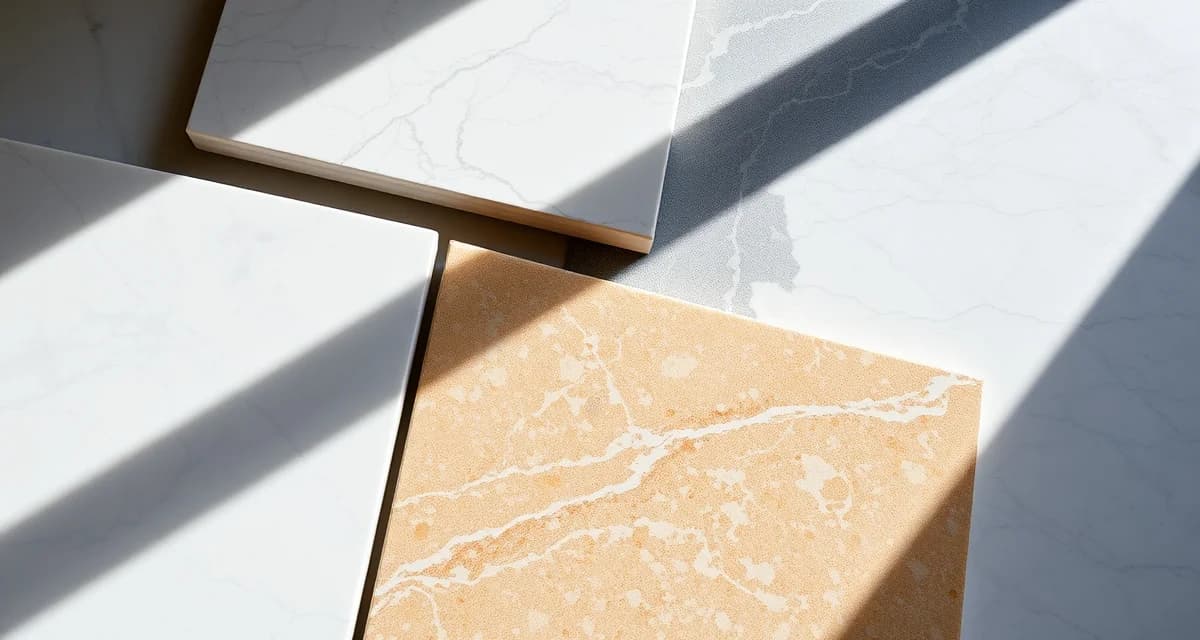
Types of Quartzite for Countertops
Quick Definition
Types of quartzite is a common question in the countertop industry.
Quartzite is a natural metamorphic stone formed when sandstone is exposed to extreme heat and pressure underground. It is significantly harder than marble and granite, ranking 7 on the Mohs hardness scale. Popular countertop varieties include Taj Mahal, Super White, White Macaubas, and Fantasy Brown - each with distinct veining, color, and price characteristics.
TL;DR
- Quartzite is a natural stone - do not confuse it with engineered quartz (like Caesarstone or Cambria)
- Taj Mahal quartzite is the most sought-after variety, with warm gold veining on a white background ($80-$200/sq ft)
- Super White offers a marble-like look with much better durability ($70-$180/sq ft)
- Quartzite rates 7 on the Mohs scale, making it harder than granite and far harder than marble
- It resists etching from acids - unlike marble, lemon juice will not dull the surface
- Prices range from $60-$250/sq ft installed depending on variety and availability
- Sealing is still recommended - quartzite is less porous than marble but not maintenance-free
White and Light Quartzite Varieties
White quartzite gives you the marble look without the marble maintenance headaches. These are the most popular varieties for kitchen countertops.
Calculate your material waste savings
See exactly how much slab material and money you could save with optimized cutting layouts.
Try the free Waste Calculator| Quartzite Type | Origin | Color/Veining | Price Range (Installed) | Hardness |
|---|---|---|---|---|
| Taj Mahal | Brazil | Warm white with gold/tan veins | $80-$200/sq ft | Very hard |
| Super White | Brazil | White/gray with soft gray veins | $70-$180/sq ft | Hard |
| White Macaubas | Brazil | White with gray/blue veins | $70-$160/sq ft | Very hard |
| White Princess | Brazil | White with light gray veins | $70-$150/sq ft | Hard |
| Mont Blanc | Brazil | White with gold/gray veins | $60-$140/sq ft | Hard |
| Cristallo | Brazil | Semi-translucent white, minimal veining | $80-$200/sq ft | Hard |
| Sea Pearl | Brazil | White with green/gray waves | $80-$170/sq ft | Very hard |
Taj Mahal quartzite is the single most requested quartzite variety in the countertop market. Its warm white background with subtle gold veining creates a look that sits somewhere between Calacatta marble and a warm neutral. Unlike Calacatta, it will not etch when your customer squeezes a lemon over it.
Super White is frequently mislabeled. Some slabs sold as "Super White" are actually dolomitic marble, not true quartzite. A simple acid test (a drop of vinegar on an inconspicuous area) will confirm: true quartzite will not react, while marble or dolomite will fizz slightly. Always verify with your supplier.
White Macaubas features cooler tones than Taj Mahal, with gray and sometimes blue veining on a white background. It is one of the harder quartzite varieties and holds up well to daily kitchen use.
Gray and Blue Quartzite Varieties
Gray and blue quartzites have gained popularity as homeowners move toward cooler, more contemporary color palettes.
| Quartzite Type | Origin | Color/Veining | Price Range (Installed) | Hardness |
|---|---|---|---|---|
| Fantasy Brown | India | Gray/brown with flowing waves | $50-$100/sq ft | Moderate-hard |
| Perla Venata | Brazil | Light gray with white veins | $60-$130/sq ft | Hard |
| Azul Macaubas | Brazil | Blue with white/gold veins | $100-$250/sq ft | Very hard |
| Blue Roma | Brazil | Steel blue with white veins | $90-$200/sq ft | Hard |
| Titanium | Brazil | Dark gray with metallic shimmer | $60-$130/sq ft | Very hard |
Fantasy Brown is another stone with an identity problem. Depending on the quarry and block, it may be classified as quartzite, marble, or dolomite. Hardness and acid resistance vary from slab to slab. Test before you commit, and price accordingly.
Azul Macaubas is one of the most striking natural stones available - a true blue quartzite with dramatic movement. Availability is limited and pricing reflects that. It is a statement stone used primarily for islands, feature walls, and high-end bathroom applications.
Warm and Exotic Quartzite Varieties
Beyond white and gray, quartzite comes in a range of warm and exotic colors that compete with the most dramatic natural stones on the market.
| Quartzite Type | Origin | Color/Veining | Price Range (Installed) | Hardness |
|---|---|---|---|---|
| Calacatta Macaubas | Brazil | White with green/gold veins | $80-$180/sq ft | Hard |
| Fusion | Brazil | Multi-colored with bold movement | $80-$200/sq ft | Hard |
| Emerald Green | Brazil | Green with white veins | $100-$250/sq ft | Very hard |
| Patagonia | Brazil | Warm gold/brown with red veins | $90-$200/sq ft | Hard |
| Madre Perla | Brazil | Pearl/beige with soft movement | $60-$120/sq ft | Hard |
Fusion quartzite is as dramatic as natural stone gets - swirls of pink, gold, gray, and white in a single slab. Every slab is radically different, which makes it exciting for homeowners but challenging for fabricators who need to match multiple pieces across a large countertop layout.
Quartzite Hardness Compared to Other Materials
One of quartzite's biggest selling points is its hardness. Here is how it compares to other common countertop materials:
| Material | Mohs Hardness | Scratch Resistance | Etch Resistance |
|---|---|---|---|
| Quartzite | 7 | Excellent | Excellent (true quartzite) |
| Granite | 6-7 | Very good | Good |
| Engineered Quartz | 7 | Excellent | Good |
| Marble | 3-5 | Poor | Poor |
| Soapstone | 1-2 | Poor | Excellent |
This hardness means quartzite resists scratching better than granite and far better than marble. It also resists etching from household acids - the main weakness of marble countertops.
However, hardness comes with a fabrication trade-off. Quartzite is harder to cut and polish than marble or granite, which can affect fabrication time and blade wear. Fabricators working with quartzite regularly factor in higher tooling costs.
Fabrication Considerations for Quartzite
Quartzite is not just another slab on the saw. Fabricators need to account for several material-specific challenges.
Cutting and Tooling
- Quartzite wears through diamond blades faster than granite - expect 20-30% more blade usage
- Slower feed rates are needed to prevent micro-chipping on harder varieties
- CNC programming may need adjustment for quartzite-specific tool paths
- Edge profiles with tight radii (like full bullnose) require more polishing passes
Template Accuracy
With quartzite slabs regularly costing $80-$200/sq ft, template errors are expensive mistakes. A single mismeasured cutout on a Taj Mahal slab could cost $2,000-$4,000 in wasted material. This is exactly where SlabWise's 3-layer template verification pays for itself - catching dimension errors, cutout placement issues, and edge detail mismatches before fabrication begins.
Slab Matching and Nesting
Many quartzite varieties have dramatic directional veining that limits how pieces can be arranged on a slab. Fabricators need to:
- Orient all pieces to maintain vein direction and flow
- Plan seam placement to minimize visual disruption
- Account for vein matching when ordering multiple slabs
- Use nesting software that respects directional constraints
SlabWise's nesting algorithms account for directional material patterns, helping fabricators get 10-15% better yield even on heavily veined quartzite slabs.
How to Verify True Quartzite
The stone industry has a mislabeling problem. Stones marketed as quartzite sometimes turn out to be dolomite, marble, or something in between. Here is how to verify what you are actually buying:
The acid test: Place a small drop of white vinegar or diluted muriatic acid on an inconspicuous area. True quartzite will not react. Marble and dolomite will fizz or bubble.
The scratch test: Try scratching the surface with a steel knife blade. True quartzite (Mohs 7) will not scratch from steel (Mohs 5.5). If it scratches, it is not quartzite.
Request petrographic analysis: For high-value projects, ask your supplier for a petrographic report that confirms the stone's mineral composition.
Common mislabeled stones:
- Fantasy Brown - often dolomite or marble
- Super White - sometimes dolomitic marble
- White Princess - occasionally soft dolomite
- Calacatta Macaubas - verify the specific block
Quartzite vs. Engineered Quartz: Key Differences
This causes constant confusion among homeowners. Quartzite and quartz are completely different materials.
| Factor | Quartzite (Natural) | Engineered Quartz |
|---|---|---|
| Composition | 100% natural stone | 90-93% ground quartz + resin |
| Pattern | Unique per slab | Manufactured, repeatable |
| Heat resistance | Excellent | Moderate (resin can discolor) |
| UV resistance | Excellent | Poor (can yellow outdoors) |
| Sealing needed | Yes, periodically | No |
| Price range | $60-$250/sq ft | $50-$150/sq ft |
| Brands | N/A (natural) | Caesarstone, Cambria, Silestone |
Fabricators should explain this distinction clearly to customers. A homeowner who wants "quartz" may actually want quartzite once they understand the differences - or vice versa.
Choosing the Right Quartzite
For High-Traffic Kitchens
Prioritize harder varieties: White Macaubas, Sea Pearl, or Titanium. These hold up to daily abuse and resist scratching from pots, pans, and utensils.
For a Marble Alternative
Taj Mahal, Super White, or Mont Blanc deliver marble-like aesthetics without the etching and staining concerns. These are the safest recommendation for customers who love the marble look but cook frequently.
For a Statement Piece
Azul Macaubas, Fusion, or Emerald Green create instant visual impact. Best used for islands or accent areas where the dramatic movement can be fully appreciated.
For Budget-Conscious Projects
Fantasy Brown (verify it is true quartzite), Madre Perla, or Mont Blanc offer the quartzite look at more accessible price points.
Frequently Asked Questions
Is quartzite more expensive than granite? Generally yes. Most quartzite varieties cost $60-$250/sq ft installed, while granite ranges from $40-$150/sq ft. The premium reflects quartzite's superior hardness and the higher fabrication costs involved.
Does quartzite stain? True quartzite is very stain-resistant but not stain-proof. It is less porous than marble or granite, but sealing every 1-2 years is still recommended to maintain protection.
Can quartzite crack? While extremely hard, quartzite can crack from impact or structural stress - particularly at weak points near cutouts. Proper support and professional installation reduce this risk significantly.
Is quartzite good for outdoor kitchens? Quartzite is one of the best natural stones for outdoor use. It resists UV fading (unlike engineered quartz), handles temperature extremes well, and its hardness stands up to outdoor conditions.
How do you clean quartzite countertops? Warm water and mild dish soap for daily cleaning. Avoid harsh chemicals. Wipe up spills promptly even though quartzite resists staining better than marble.
What edge profiles work best with quartzite? Eased and beveled edges are the most practical because quartzite's hardness makes intricate profiles like ogee more time-consuming and expensive to fabricate. Mitered edges are possible but require experienced fabricators.
Does quartzite need to be sealed? Yes. While less porous than marble, quartzite should be sealed upon installation and resealed every 1-2 years. Some denser varieties like White Macaubas may need less frequent sealing.
Why does my quartzite look like marble? It might actually be marble. Mislabeling is common in the stone industry. Perform an acid test (vinegar drop) to verify. True quartzite will not react to acid.
How thick should quartzite countertops be? Standard thickness is 3 cm (approximately 1.25 inches). Some varieties are available in 2 cm, but 3 cm provides better structural integrity and allows for more edge profile options.
Can you put hot pans on quartzite? Yes. Quartzite handles heat extremely well - far better than engineered quartz, which can discolor from hot pans. Trivets are still recommended as a precaution.
What is the rarest quartzite color? True blue quartzites like Azul Macaubas and Blue Roma are among the rarest. Emerald Green quartzite and Calacatta Viola quartzite are also extremely limited in supply.
How long do quartzite countertops last? With proper care and sealing, quartzite countertops can last a lifetime - 50+ years easily. The material itself is millions of years old and incredibly durable.
Get Accurate Quartzite Quotes in Minutes
Quartzite pricing varies dramatically by variety, and your customers want answers fast. SlabWise's Quick Quote tool lets you generate detailed, material-specific estimates in 3 minutes instead of 20 - accounting for the real cost differences between a Taj Mahal slab and a Fantasy Brown. Start your 14-day free trial and close more quartzite jobs.
Try These Free Tools
- Nesting Optimizer -- AI-powered slab layout that maximizes yield considering vein direction and defects.
- Defect Mapping -- Upload a slab photo and AI maps every fissure, pit, and color issue.
- Value Engineering -- Find dollar-quantified suggestions to save material without cutting margin.
Sources & Further Reading
-
Natural Stone Institute - Stone Selection and Specification Guide
-
International Surface Fabricators Association - Slab Selection Best Practices
-
National Kitchen & Bath Association - Countertop Material Selection Guidelines
-
Marble Institute of America - Natural Stone Inspection and Grading Standards