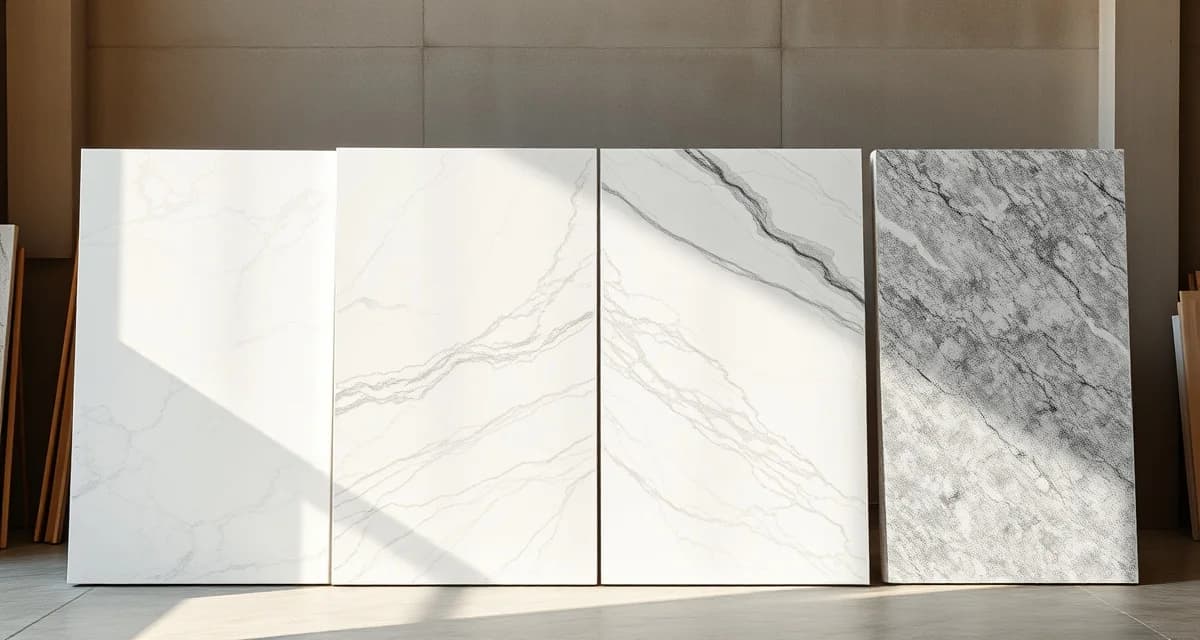
Types of Marble for Countertops
Quick Definition
Marble is a metamorphic natural stone formed from limestone under heat and pressure. It comes in dozens of varieties distinguished by color, veining pattern, hardness, and origin. For countertops, the most popular types include Carrara, Calacatta, Statuario, Emperador, and Crema Marfil - each with different price points, maintenance needs, and visual characteristics.
TL;DR
- Carrara marble is the most affordable and widely available white marble, typically $40-$100/sq ft installed
- Calacatta marble features bolder, more dramatic veining and costs $100-$250/sq ft installed
- Statuario marble is the rarest white Italian marble, often exceeding $200/sq ft
- Emperador marble (dark and light) offers warm brown tones at $50-$150/sq ft
- Crema Marfil provides a creamy beige option at $40-$80/sq ft
- All marble is porous, softer than granite, and requires regular sealing
- Honed finishes hide etching better than polished finishes in kitchen applications
Popular Marble Types Compared
Not all marble is created equal. The variety you choose affects everything from your budget to how much maintenance you will deal with for years to come. Here is a breakdown of the most common types fabricators and homeowners work with.
Calculate your material waste savings
See exactly how much slab material and money you could save with optimized cutting layouts.
Try the free Waste CalculatorWhite and Gray Marble Varieties
White marble dominates the countertop market because of its timeless look and versatility. But the differences between white marble types are significant - especially in price.
| Marble Type | Origin | Color/Veining | Price Range (Installed) | Best For |
|---|---|---|---|---|
| Carrara | Carrara, Italy | White/gray with fine gray veins | $40-$100/sq ft | Bathrooms, budget-friendly kitchens |
| Calacatta | Carrara, Italy | White with bold gold/gray veins | $100-$250/sq ft | Statement kitchens, islands |
| Statuario | Carrara, Italy | Bright white with dramatic gray veins | $150-$300/sq ft | Luxury kitchens, feature walls |
| Thassos | Greece | Pure white, minimal veining | $50-$120/sq ft | Bathrooms, backsplashes |
| Danby | Vermont, USA | White with subtle gray/green veins | $80-$150/sq ft | Kitchens (harder than Italian marble) |
| White Princess (Quartzite*) | Brazil | White with soft gray veins | $70-$150/sq ft | Kitchens needing more durability |
*White Princess is technically quartzite but often sold as marble. Always verify the actual stone type before purchasing.
Carrara marble is the workhorse of the marble world. It makes up a large portion of marble countertop installations because it is widely available and relatively affordable. The veining tends to be softer and more feathery compared to Calacatta.
Calacatta marble is quarried from the same region as Carrara but in much smaller quantities. The veining is thicker, more defined, and often carries gold or warm gray tones. This scarcity drives the higher price.
Statuario marble sits at the top of the Italian white marble hierarchy. It features a brighter white background with bold, sweeping gray veins. Slabs with strong book-matched veining can sell for over $300/sq ft at the slab yard.
Brown and Beige Marble Varieties
Not every kitchen calls for white stone. Brown and beige marbles pair well with warm-toned cabinetry and traditional design styles.
| Marble Type | Origin | Color/Veining | Price Range (Installed) | Best For |
|---|---|---|---|---|
| Emperador Dark | Spain | Deep brown with white/gold veins | $50-$150/sq ft | Traditional kitchens, bathrooms |
| Emperador Light | Spain | Tan/light brown with white veins | $40-$100/sq ft | Warm-toned kitchens |
| Crema Marfil | Spain | Creamy beige with soft veining | $40-$80/sq ft | Bathrooms, large surfaces |
| Breccia Oniciata | Italy | Warm beige with amber veins | $60-$120/sq ft | Accent pieces, islands |
Emperador Dark is one of the most recognized brown marbles. It works especially well in bathrooms and as a contrast island in white kitchens.
Crema Marfil is popular for large-format applications because its consistent coloring makes slab matching easier - a real advantage for fabricators working on multi-slab projects.
Colored and Exotic Marble Varieties
For homeowners wanting something beyond white or brown, these options deliver striking visual impact.
| Marble Type | Origin | Color/Veining | Price Range (Installed) | Best For |
|---|---|---|---|---|
| Nero Marquina | Spain | Black with white veins | $60-$150/sq ft | Modern kitchens, contrast pieces |
| Green Guatemala | India/Guatemala | Deep green with white veins | $50-$120/sq ft | Statement islands, powder rooms |
| Rosa Levanto | Turkey | Burgundy/rose with white veins | $70-$150/sq ft | Luxury bathrooms |
| Blue de Savoie | France | Blue-gray with white veins | $100-$200/sq ft | High-end projects |
| Calacatta Viola | Italy | White with purple veins | $150-$350/sq ft | Ultra-luxury applications |
Nero Marquina has become very popular in modern and transitional kitchen designs. Its black background with crisp white veining creates a dramatic contrast, especially against white cabinetry.
Marble Hardness and Durability by Type
All marble is softer than granite (marble rates 3-5 on the Mohs hardness scale versus 6-7 for granite), but some varieties are harder than others. This matters for kitchen use where scratches and etching are daily risks.
Harder marbles (better for kitchens):
- Danby marble (Vermont) - denser crystalline structure
- Crema Marfil - relatively hard for marble
- Emperador Dark - compact grain structure
Softer marbles (better for bathrooms or low-use areas):
- Carrara - standard marble hardness
- Calacatta - similar to Carrara
- Thassos - crystalline but can be brittle
The Etching Reality
Every marble type will etch when exposed to acids like lemon juice, vinegar, or tomato sauce. Etching appears as dull spots on polished surfaces. This is a chemical reaction, not a stain - and sealer does not prevent it.
Fabricators often recommend honed finishes for kitchen marble because the matte surface disguises etching far better than a polished finish. Discuss this with your fabricator before committing to a finish.
How Fabricators Work with Different Marble Types
From a fabrication standpoint, marble variety affects more than just aesthetics. Different marbles behave differently during cutting, polishing, and installation.
Cutting considerations:
- Softer marbles require slower feed rates to prevent chipping
- Dark marbles like Nero Marquina can show micro-chips more visibly on edges
- Exotic marbles with heavy veining need careful seam placement to maintain pattern continuity
Template and verification: Template accuracy matters even more with marble than with granite or quartz. Marble remakes are expensive - a Calacatta slab remake can easily cost $3,000-$5,000 in material alone. This is where AI-powered template verification tools like SlabWise catch measurement errors before the saw touches stone, protecting both the fabricator's margin and the customer's investment.
Nesting and yield: Marble slabs often have directional veining that limits how pieces can be nested. A fabricator working with Statuario needs to orient every piece to maintain vein flow, which can reduce yield compared to a more uniform stone like Crema Marfil. Smart nesting software helps maximize usable material even with these constraints.
Choosing the Right Marble for Your Project
For Kitchens
If you want marble in the kitchen, consider these factors:
- Budget under $80/sq ft: Carrara or Crema Marfil
- Budget $100-$200/sq ft: Calacatta or Danby
- Maximum durability: Danby (Vermont marble is denser than most Italian varieties)
- Minimum maintenance worry: Go with a honed finish regardless of variety
For Bathrooms
Bathrooms are marble's natural habitat. Less exposure to acids and heavy use means almost any variety works well:
- Vanity tops: Carrara, Calacatta, or Thassos
- Shower surrounds: Crema Marfil or Emperador (avoid pure white in wet areas - water spots show more)
- Floor-to-ceiling installations: Crema Marfil for consistency across multiple slabs
For Commercial Projects
Hotels, restaurants, and office lobbies frequently use marble. Commercial projects need:
- Consistent availability across large orders - Crema Marfil and Carrara excel here
- Repairability - lighter marbles are easier to hone out scratches
- Slab matching - uniform varieties reduce the risk of mismatched pieces across a large installation
What to Ask Your Fabricator
Before selecting a marble type, ask these questions:
- Can I see the actual slab (not just a sample)? Marble varies dramatically slab to slab
- What finish do you recommend for my application? Polished vs. honed changes the look and maintenance
- How will you handle seam placement with this veining? Critical for book-matched or heavily veined marble
- What is your remake policy for marble? Given the cost, this matters
- Do you use template verification technology? Shops using tools like SlabWise's 3-layer verification catch errors before cutting
Frequently Asked Questions
What is the most popular marble for kitchen countertops? Carrara marble is the most widely installed marble for kitchens due to its availability and lower cost compared to Calacatta or Statuario. It works with nearly every design style.
What is the difference between Carrara and Calacatta marble? Both come from the Carrara region of Italy, but Calacatta has bolder, more dramatic veining (often with gold tones) and is much rarer. Carrara features softer, more dispersed gray veining and costs 50-70% less.
Is marble a good choice for kitchen countertops? Marble works in kitchens if you accept that it will develop a patina over time. It will etch from acidic foods and can stain if not sealed. Many homeowners love this lived-in character; others find it frustrating.
Which marble is most durable for countertops? Danby marble from Vermont is considered one of the hardest and most durable marble varieties available. It is denser than most Italian marbles and more resistant to scratching and etching.
How much does marble cost compared to quartz or granite? Entry-level marble (Carrara) is comparable to mid-range granite at $40-$100/sq ft installed. Premium marble (Calacatta, Statuario) costs $150-$300/sq ft, which is higher than most quartz and granite options.
Does marble color affect price? Yes. White marbles with dramatic veining (Calacatta, Statuario) command the highest prices. Brown and beige varieties (Emperador, Crema Marfil) are typically more affordable. Exotic colors (Nero Marquina, Calacatta Viola) vary based on rarity.
How often does marble need to be sealed? Most marble countertops should be sealed every 6-12 months, though usage level and marble type affect this. Lighter, more porous varieties may need more frequent sealing than denser types.
Can you mix marble types in one kitchen? Yes. A common approach is using one marble type for perimeter counters and a different type or material for the island. Discuss slab thickness and edge profile consistency with your fabricator to keep the look cohesive.
What is the best marble for a bathroom vanity? Calacatta and Carrara are the most popular choices for bathroom vanities. Bathrooms are lower-risk for marble since exposure to acids and heavy use is minimal.
How do I tell real marble from marble-look quartz? Real marble is cool to the touch, has natural variation between slabs, and will etch if you place a drop of lemon juice on it. Marble-look quartz is uniform, does not etch, and feels slightly warmer.
Why do marble slabs from the same quarry look different? Marble forms over millions of years with varying mineral deposits. Even slabs cut from the same block can show different veining intensity and color tones. Always select your specific slab rather than ordering from a sample.
Is Calacatta Borghini the same as regular Calacatta? No. Calacatta Borghini is a sub-variety with particularly bold, warm-toned veining. It is rarer and typically more expensive than standard Calacatta marble.
Get Accurate Marble Countertop Quotes Fast
Whether your customer is choosing Carrara or Calacatta, accurate quoting starts with accurate measurements. SlabWise's Quick Quote tool generates detailed marble countertop estimates in 3 minutes instead of 20 - with material-specific pricing that accounts for the real cost differences between marble varieties. Start your 14-day free trial and see how fast quoting should work.
Try These Free Tools
- Nesting Optimizer -- AI-powered slab layout that maximizes yield considering vein direction and defects.
- Defect Mapping -- Upload a slab photo and AI maps every fissure, pit, and color issue.
- Value Engineering -- Find dollar-quantified suggestions to save material without cutting margin.
Sources & Further Reading
-
Natural Stone Institute - Stone Selection and Specification Guide
-
International Surface Fabricators Association - Slab Selection Best Practices
-
National Kitchen & Bath Association - Countertop Material Selection Guidelines
-
Marble Institute of America - Natural Stone Inspection and Grading Standards