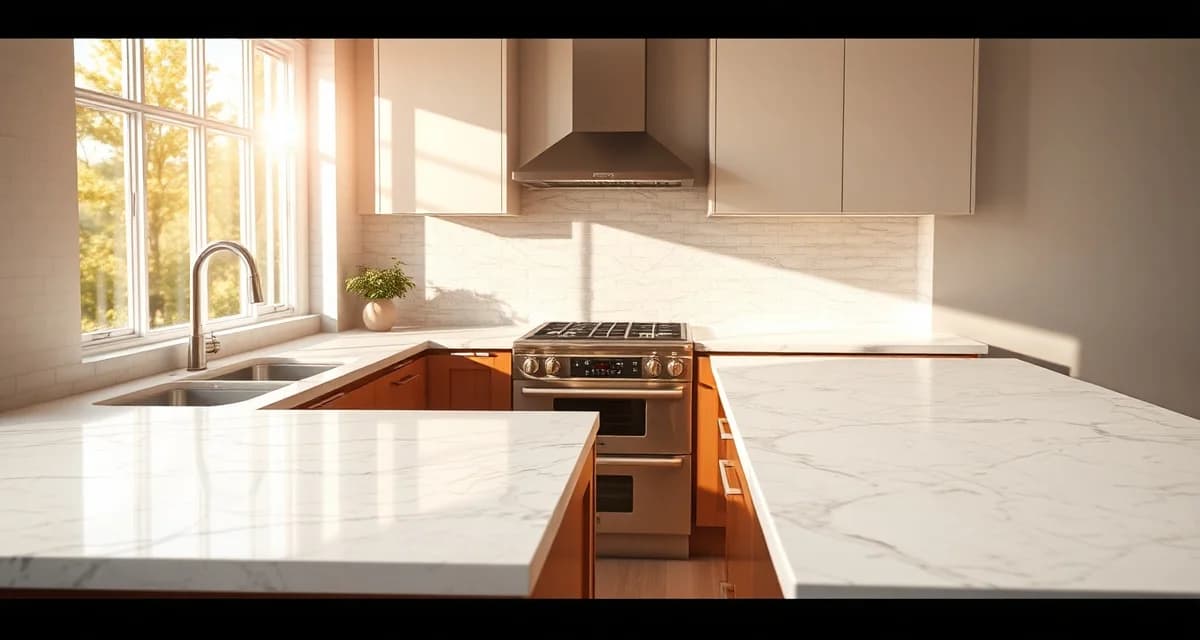
Best Kitchen Countertop Materials in 2026
Quick Definition
Kitchen countertop materials must withstand daily cooking abuse - heat, moisture, stains, knife marks, and heavy pots. The best kitchen countertop materials balance durability against aesthetics and maintenance requirements. Your choice directly impacts how your kitchen functions, looks, and holds value for the next decade.
TL;DR
- Quartz leads for most kitchens - near-zero maintenance with hundreds of design options
- Granite remains king for heat resistance and one-of-a-kind slab patterns
- Porcelain is the fastest-growing kitchen surface in 2026
- Quartzite bridges the gap between marble beauty and granite toughness
- Butcher block works best as a secondary surface or island topper
- Expect to spend $55-$175/sq ft installed for mid-to-high-end materials
- Fabrication quality matters as much as material choice - demand digital templating and CNC cutting
What Makes a Kitchen Countertop Material "Good"?
Kitchens are the hardest working rooms in a house. A material that looks great in a showroom might fail within two years if it cannot handle real cooking conditions.
Calculate your material waste savings
See exactly how much slab material and money you could save with optimized cutting layouts.
Try the free Waste CalculatorHere is what separates good kitchen countertop materials from bad ones:
| Factor | Why It Matters in Kitchens |
|---|---|
| Heat tolerance | Hot pans, baking sheets, and crockpots touch the surface daily |
| Stain resistance | Coffee, red wine, turmeric, tomato sauce, and oil are constant threats |
| Scratch hardness | Knives, ceramic dishes, and cast iron skillets scrape the surface |
| Moisture handling | Sinks, splashes, and spills create standing water |
| Maintenance burden | Busy cooks need surfaces that clean up fast with minimal special care |
| Edge durability | Kitchen countertops get bumped by hips, elbows, and heavy items |
1. Quartz (Engineered Stone) - Best Overall for Kitchens
Price: $55-$175/sq ft installed Durability: 9/10 Maintenance: Wipe with soap and water
Quartz dominates kitchen installations because it solves the two biggest complaints homeowners have about natural stone: inconsistent appearance and ongoing sealing maintenance.
Kitchen-Specific Advantages
- No sealing - ever. This matters when you are cooking three meals a day and do not want to think about annual maintenance rituals.
- Uniform patterns. You can order matching slabs for large kitchens and get consistent veining across 60+ sq ft.
- Stain proof in practice. Coffee, wine, and oils wipe clean. Leave tomato sauce overnight and it still comes off.
- Non-porous surface means no bacterial growth in microcracks.
Kitchen-Specific Drawbacks
- Setting a 400°F baking sheet directly on quartz can leave a permanent white mark. Always use trivets.
- Dark-colored quartz shows water spots and fingerprints more than light colors.
- Large island overhangs (beyond 12 inches) need steel brackets or plywood support underneath.
Best Quartz Brands for Kitchens
| Brand | Price Tier | Standout Feature |
|---|---|---|
| Cambria | Premium | Made in USA, lifetime warranty |
| Caesarstone | Mid-High | Largest color selection |
| Silestone | Mid-High | N-Boost antibacterial technology |
| MSI Q | Budget-Mid | Best value per square foot |
| Viatera (LG) | Mid | Good quality-to-price ratio |
2. Granite - Best for Heat Resistance
Price: $50-$200/sq ft installed Durability: 9/10 Maintenance: Seal every 1-3 years
Granite remains the material of choice for serious home cooks who regularly move hot pans between stovetop and counter. Nothing else at this price handles heat as well.
Kitchen-Specific Advantages
- True heat immunity. Pull a cast iron skillet from a 500°F oven and set it right on the counter.
- Rock-hard surface. Granite rates 6-7 on the Mohs scale - most kitchen items will not scratch it.
- Each slab is unique. If you value natural character over consistency, granite delivers.
- Strong resale appeal. Real estate agents consistently rank granite kitchens higher.
Kitchen-Specific Drawbacks
- Dark granites (Ubatuba, Absolute Black) can hide crumbs and stains that build up
- Sealing is non-negotiable - an unsealed granite counter will absorb oil and moisture
- Heavy - a standard kitchen layout with granite weighs 500-800 lbs
- Matching slabs for large kitchens is nearly impossible; expect slight color variation
Popular Granite Colors for Kitchens
- White/Light: Alaska White, Colonial White, River White
- Gray: Steel Gray, Viscont White, Silver Cloud
- Dark: Absolute Black, Ubatuba, Black Pearl
- Warm: Giallo Ornamental, Santa Cecilia, Venetian Gold
3. Porcelain Slabs - Best for Modern Kitchens
Price: $55-$150/sq ft installed Durability: 9.5/10 Maintenance: Wipe clean, no sealing
Porcelain countertop slabs are the fastest-growing segment in kitchen surfaces. Products like Dekton, Neolith, and SapienStone use sintered technology to create surfaces that resist virtually everything.
Kitchen-Specific Advantages
- Nothing stains it. Turmeric, beet juice, red wine - wipe and gone.
- Heat proof. Place a hot pot directly on porcelain without any damage.
- Scratch resistant. Harder than quartz and granite on the Mohs scale.
- Large-format slabs reduce seam count in big kitchens.
- Thin options (6mm-12mm) work for backsplash-to-counter continuity.
Kitchen-Specific Drawbacks
- Edges can chip during installation - require experienced fabricators
- Fewer edge profile options compared to quartz or granite (especially thin slabs)
- Repair is difficult if the surface chips - matching color for fills is tricky
- Some homeowners find the surface "too perfect" - lacks natural stone warmth
4. Quartzite - Best Natural Stone Alternative
Price: $70-$200/sq ft installed Durability: 9.5/10 Maintenance: Seal annually
Quartzite gives you the soft veining and translucent beauty of marble with durability that matches or exceeds granite.
Kitchen-Specific Advantages
- Harder than granite. Rates 7-8 Mohs - extremely scratch resistant.
- Beautiful veining. Taj Mahal, White Macaubas, and Fantasy Brown are popular choices.
- Heat resistant. Safe for direct hot pan contact.
- Increasing availability as quarries expand production to meet demand.
Kitchen-Specific Drawbacks
- Must be sealed - though less frequently than marble
- Genuine quartzite is sometimes confused with dolomite marble by dishonest sellers
- Premium varieties cost as much as high-end marble
- Heavier than granite per square foot
How to Verify Real Quartzite
- Glass scratch test: Real quartzite scratches glass easily
- Acid test: Dolomite marble fizzes when hydrochloric acid is applied; quartzite does not
- Ask for geological testing from the slab supplier
5. Marble - Best for Baking and Pastry
Price: $75-$250/sq ft installed Durability: 6/10 Maintenance: Seal every 6-12 months
Marble is not the most practical kitchen material, but it remains the top choice for baking stations and statement islands where aesthetics outweigh maintenance concerns.
Kitchen-Specific Advantages
- Naturally cool surface keeps pastry dough and chocolate at optimal working temperature
- Unmatched beauty. Calacatta Gold, Statuario, and Carrara remain aspirational choices
- Premium perception in luxury home markets
- Develops patina that many homeowners grow to appreciate
Kitchen-Specific Drawbacks
- Etches from acid. Lemon juice, vinegar, and tomato sauce leave dull marks instantly
- Stains from oil without regular sealing
- Scratches easily compared to granite or quartz
- Expensive to replace when damage becomes excessive
Making Marble Work in Kitchens
If you are set on marble, consider these strategies:
- Use honed (matte) finish - etching is less visible than on polished
- Apply a high-quality impregnating sealer every 6 months
- Reserve marble for the island and use quartz or granite for prep areas near the stove
- Accept the patina - many marble owners say the "lived-in" look adds character
6. Butcher Block - Best Secondary Surface
Price: $40-$100/sq ft installed Durability: 5/10 Maintenance: Oil monthly
Butcher block works brilliantly as a kitchen island or prep station while pairing with harder materials (quartz, granite) along the perimeter.
Best Wood Species for Kitchen Countertops
| Wood | Hardness (Janka) | Best For |
|---|---|---|
| Hard Maple | 1,450 | Most kitchens - hardest common option |
| Walnut | 1,010 | Rich brown aesthetic |
| White Oak | 1,360 | Water resistance and durability |
| Cherry | 950 | Warm reddish tones |
| Teak | 1,070 | Superior moisture resistance |
Kitchen-Specific Advantages
- Warm aesthetic that balances cold stone elsewhere in the kitchen
- Cutting board built into the counter - no board to wash
- Can be sanded and refinished when scratched or stained
- Easy to cut for custom sizes and shapes
Kitchen-Specific Drawbacks
- Standing water causes warping - keep dry around sinks
- Requires monthly mineral oil application
- Not sanitary for raw meat prep unless regularly maintained
- Burns and deep cuts are permanent without sanding
7. Concrete - Best for Custom Kitchens
Price: $65-$135/sq ft installed Durability: 7/10 Maintenance: Seal every 1-3 years
Concrete countertops allow fully custom shapes, integrated sinks, drainboards, and embedded features. They fit industrial, farmhouse, and modern kitchen designs equally well.
Kitchen-Specific Advantages
- Integrated sinks eliminate seam issues around cutouts
- Custom drainboard grooves channel water directly into the sink
- Color pigments allow any shade imaginable
- Heavy, solid feel that communicates quality
Kitchen-Specific Drawbacks
- Hairline cracks are normal and expected - they are cosmetic, not structural
- Acid etching occurs without sealing (similar to marble)
- Long lead time for custom casting (2-4 weeks)
- Weight requires reinforced cabinetry
8. Solid Surface (Corian) - Best for Invisible Seams
Price: $40-$100/sq ft installed Durability: 6/10 Maintenance: Wipe clean; can sand out scratches
Solid surface materials like Corian, Hi-Macs, and Staron allow thermoformed shapes and invisible seams. They have fallen out of fashion somewhat but still solve specific kitchen problems well.
Kitchen-Specific Advantages
- Seams are chemically bonded and become invisible
- Integrated sinks of the same material create a single-piece look
- Scratches and minor burns can be sanded and buffed out on-site
- Non-porous - no sealing required
Kitchen-Specific Drawbacks
- Scratches more easily than stone
- Cannot handle hot pans directly - melts and scorches at moderate temperatures
- Lacks the visual depth of natural or engineered stone
- Lower resale value than granite or quartz
Kitchen Countertop Cost Comparison
For a typical 40 sq ft kitchen countertop (L-shaped layout with one sink cutout):
| Material | Material Cost | Fabrication & Install | Total Installed |
|---|---|---|---|
| Laminate | $600-$1,000 | $400-$800 | $1,000-$1,800 |
| Butcher Block | $1,200-$2,400 | $400-$1,600 | $1,600-$4,000 |
| Solid Surface | $1,200-$2,400 | $400-$1,600 | $1,600-$4,000 |
| Quartz | $1,600-$4,400 | $600-$2,600 | $2,200-$7,000 |
| Granite | $1,400-$5,200 | $600-$2,800 | $2,000-$8,000 |
| Porcelain | $1,600-$3,600 | $600-$2,400 | $2,200-$6,000 |
| Quartzite | $2,000-$5,200 | $800-$2,800 | $2,800-$8,000 |
| Marble | $2,200-$6,400 | $800-$3,600 | $3,000-$10,000 |
| Concrete | $1,800-$3,400 | $800-$2,000 | $2,600-$5,400 |
How Good Fabrication Protects Your Investment
Even the best material fails if fabrication is sloppy. Kitchen countertops have complex geometries - sink cutouts, cooktop openings, angled corners, and backsplash returns. Every measurement and cut matters.
Digital templating uses laser measurement devices to capture your kitchen dimensions to within 1/16 of an inch. This precision matters because a 1/4-inch error on a sink cutout can mean the countertop does not fit - and a granite remake costs $1,500-$4,000.
CNC cutting produces consistent, accurate cuts that hand tools cannot match. Fabricators using CNC bridge saws and routers produce cleaner edges, tighter sink cutout tolerances, and more efficient slab usage.
Nesting optimization determines how pieces are laid out on the slab before cutting. Smart nesting software reduces waste from the typical 12-18% down to 8-12%, which saves material cost on expensive stones. For a $150/sq ft Calacatta marble job, that waste reduction can save $500-$1,000 per kitchen.
Template verification catches errors before they ruin expensive slabs. A three-layer verification system - checking the field template against the CNC program against the final cut - is the industry gold standard for preventing remakes.
FAQ
What kitchen countertop material is most popular in 2026?
Quartz holds the largest market share for kitchen countertops. Its combination of low maintenance, consistent appearance, and broad price range makes it the default choice for mid-range and upper-mid-range kitchen renovations. Porcelain slabs are the fastest-growing category.
Can I mix countertop materials in my kitchen?
Absolutely. A common approach is granite or quartz on perimeter counters with butcher block on the island. Mixing materials creates visual interest and lets you place the right material where it functions best - stone near the stove, wood for prep, marble for a baking station.
How thick should kitchen countertops be?
Standard thickness is 3 cm (about 1.25 inches) for quartz, granite, and marble. This thickness provides structural strength without excessive weight. Porcelain slabs come in 6mm, 12mm, and 20mm options - thinner profiles need built-up edges for a substantial look.
Do I need to seal my kitchen countertops?
It depends on the material. Quartz, porcelain, laminate, and solid surface never need sealing. Granite needs sealing every 1-3 years. Marble needs sealing every 6-12 months. Concrete needs sealing every 1-3 years. Always follow your fabricator's specific sealing recommendations.
What countertop material is safest for food prep?
Quartz and porcelain are the most hygienic because their non-porous surfaces do not harbor bacteria. Stainless steel (common in commercial kitchens) is the gold standard for sanitation. Granite is safe when properly sealed. Butcher block requires regular sanitizing.
How long does kitchen countertop installation take?
Template measurement takes 30-60 minutes. Fabrication takes 5-10 business days. Installation takes 2-4 hours for a typical kitchen. The total process from template to finished install runs 1-3 weeks depending on material availability and shop workload.
What countertop material holds up best around sinks?
Quartz and porcelain perform best near sinks because they absorb zero moisture. Granite holds up well when sealed. Avoid butcher block next to sinks - standing water warps and degrades wood rapidly. Marble near sinks is fine if sealed properly.
Should I get polished or honed countertops?
Polished surfaces reflect light and show the full depth of stone patterns but reveal scratches, etching, and water spots more. Honed (matte) surfaces hide imperfections better and suit casual, modern kitchens. For marble in kitchens, honed is almost always the better choice.
What questions should I ask my countertop fabricator?
Ask about their templating method (digital vs. manual), CNC capabilities, warranty terms, timeline, and quality control process. Ask to see examples of completed kitchens using your chosen material. And ask how they handle communication during the project - shops with customer portals keep you informed without requiring constant phone calls.
How can I reduce my kitchen countertop costs?
Choose a mid-range material (level 1-2 granite or standard quartz), minimize the number of cutouts, pick a simple edge profile (eased or beveled), and keep the layout straightforward. Avoid premium edge profiles (ogee, waterfall) that add $10-$30/linear foot to fabrication costs.
Estimate Your Kitchen Countertop Cost
Not sure what your kitchen will cost? Our free countertop calculator gives you a material and installation estimate in under 3 minutes. Enter your approximate dimensions, pick your material, and get a price range - no phone calls, no sales pressure.
Try the SlabWise Cost Calculator →
Try These Free Tools
- Kitchen Visualizer -- Upload a kitchen photo and preview different countertop materials in place.
- AR Overlay -- See the actual stone pattern on your customer's cabinets using AR.
- Sink Finder -- Search compatible sink models by countertop dimensions and cutout specs.
Sources & Further Reading
- Natural Stone Institute - Bathroom Stone Applications Guide
- National Kitchen & Bath Association - Vanity Material Selection Guidelines
- International Surface Fabricators Association - Bathroom Countertop Materials Standards
- ASTM International - Standard Specification for Natural Stone Used in Bathroom Applications