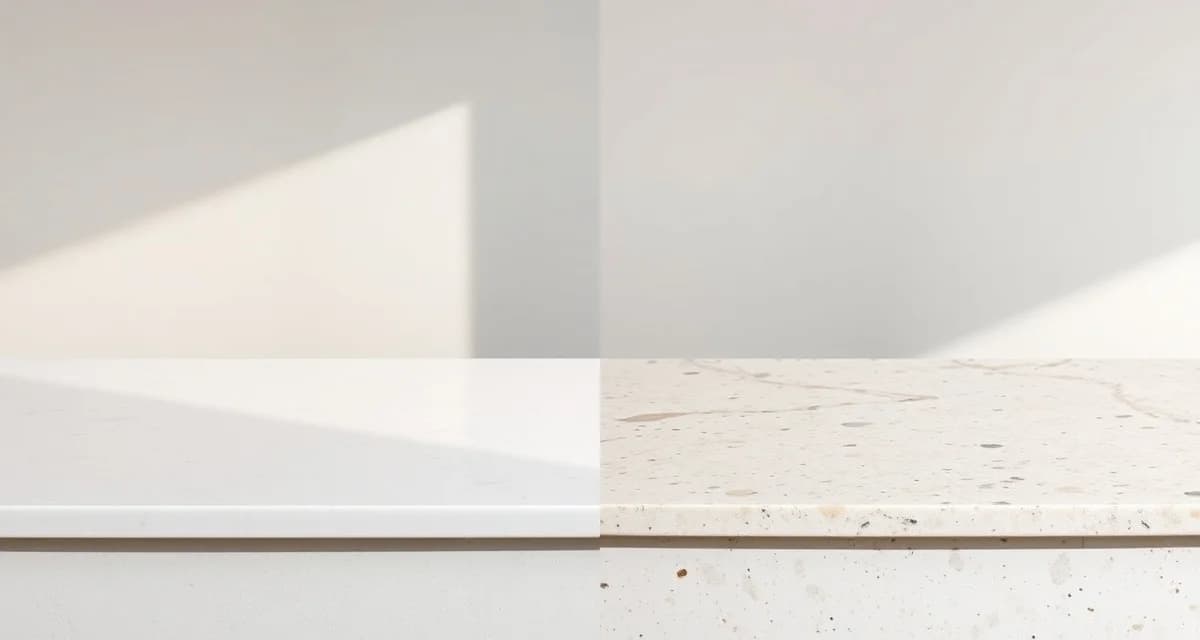
Quartz vs Quartzite: What's the Difference?
Quartz and quartzite are entirely different materials despite their similar names. Quartz is a manufactured (engineered) countertop made from roughly 90-94% ground quartz crystals bound with 6-10% polymer resin. Quartzite is a natural metamorphic rock formed when sandstone is subjected to extreme heat and pressure deep underground. Quartz is non-porous, consistent in color, and available in hundreds of patterns. Quartzite is a natural stone with unique veining, superior heat resistance, and a harder surface, but it requires sealing and has more variation between slabs.
TL;DR
- Quartz is engineered (man-made); quartzite is natural stone (quarried from the earth)
- Quartz is non-porous and never needs sealing; quartzite is porous and needs sealing every 1-2 years
- Quartzite handles heat far better than quartz (1,200degF+ vs. 300degF)
- Quartz offers consistent color and hundreds of pattern options; quartzite patterns vary slab to slab
- Quartzite is harder (7-8 Mohs) than quartz (5-7 Mohs) and more scratch-resistant
- Quartz costs $50-$120/sq ft installed; quartzite costs $80-$200/sq ft installed
- Quartz holds 51% of the U.S. countertop market; quartzite is a growing premium niche
Composition and Origin
Quartz (Engineered Stone)
- Made from: ~90-94% ground natural quartz crystals + 6-10% polyester/acrylic resin + pigments
- Manufactured by: Caesarstone, Cambria, Silestone, MSI, Viatera, and dozens of other brands
- How it's made: Ground quartz is mixed with resin and pigments, compressed under vacuum, and baked at approximately 200degF
- Available patterns: 200+ options from solid whites to marble-look veining
- Consistency: Two slabs of the same color look virtually identical
Quartzite (Natural Stone)
- Made from: Pure sandstone metamorphosed under extreme heat (1,000degF+) and pressure
- Quarried from: Brazil, India, Norway, United States, and other locations worldwide
- How it forms: Over millions of years, sandstone recrystallizes into an interlocking quartz crystal structure
- Available patterns: Dozens of natural varieties, each with unique veining and color
- Consistency: Every slab is unique; slabs from the same block are similar but never identical
Head-to-Head Comparison
| Property | Quartz | Quartzite |
|---|---|---|
| Type | Engineered stone | Natural stone |
| Hardness (Mohs) | 5-7 | 7-8 |
| Heat resistance | Low (~300degF; resin scorches) | High (1,200degF+) |
| Scratch resistance | Good | Excellent |
| Porosity | Non-porous | Porous (requires sealing) |
| Stain resistance | Excellent (without sealing) | Good (with proper sealing) |
| UV resistance | Poor (yellows in sunlight) | Excellent |
| Etching resistance | Good | Excellent (true quartzite) |
| Pattern consistency | Very consistent | Varies by slab |
| Color options | 200+ manufactured patterns | Limited to natural variations |
| Sealing required | No | Yes, every 1-2 years |
| Outdoor use | No (UV damage) | Yes |
| Cost installed | $50-$120/sq ft | $80-$200/sq ft |
| Market share | ~51% of U.S. countertops | Growing niche (estimated 3-5%) |
Durability Differences
Scratch Resistance
Quartzite wins. True quartzite rates 7-8 on the Mohs hardness scale, making it harder than glass, steel, and most kitchen tools. You can cut directly on quartzite without damaging it (though it will dull your knives). Quartz rates 5-7 on the Mohs scale and can be scratched by abrasive materials, though it's still harder than granite.
Calculate your material waste savings
See exactly how much slab material and money you could save with optimized cutting layouts.
Try the free Waste CalculatorHeat Resistance
Quartzite wins decisively. Natural quartzite formed under temperatures exceeding 1,000degF and handles hot pots, pans, and baking dishes without any damage. Quartz's resin binders scorch at 300-400degF, making trivets mandatory. For avid home cooks, this is often the deciding factor.
Stain Resistance
Quartz wins. The resin in quartz makes it completely non-porous. Liquids can't penetrate the surface, period. Quartzite is porous and requires an impregnating sealer to prevent stains. A well-sealed quartzite resists stains effectively, but the sealer must be maintained.
Impact Resistance
Roughly equal. Both materials can chip from dropping heavy objects on edges. Quartz's resin gives it slight flexibility. Quartzite is harder but more brittle.
Appearance and Design
Quartz Aesthetics
Quartz's biggest design advantage is variety and consistency. Manufacturers create patterns that mimic Carrara marble, Calacatta marble, concrete, and other materials with repeatable precision. If you want a specific look (say, white with gray veins), you can find a quartz that matches exactly, and every slab will look the same.
Popular quartz looks:
- White marble-look (Calacatta Botanica, Statuario Maximus)
- Pure white solid (White Attica, Arctic White)
- Gray concrete-look (Rugged Concrete, Raw Concrete)
- Dark dramatic (Charcoal Soapstone, Coastal Gray)
Quartzite Aesthetics
Quartzite offers natural beauty that engineered products can't replicate. Each slab has unique veining formed over millions of years. The patterns range from subtle (White Macaubas) to dramatic (Azul Macaubas, Cristallo).
Popular quartzite varieties:
- Taj Mahal - Warm white with soft gold veining
- Super White - Cool white with flowing gray veining
- White Macaubas - Clean white with light gray movement
- Azul Macaubas - Striking blue-gray with dramatic veining
- Cristallo - Semi-translucent with quartz crystal formations
- Sea Pearl - Complex gray, cream, and burgundy patterns
The "natural vs. manufactured" debate is a personal preference. Some homeowners want the uniqueness of natural stone. Others prefer the predictability of engineered products.
Maintenance Comparison
Quartz Maintenance
- Daily cleaning: Warm water + mild dish soap
- Sealing: Never needed
- Heat protection: Always use trivets
- Stain treatment: Surface-level; wipe with baking soda paste
- Annual cost: $20-$40 (cleaning products only)
Quartzite Maintenance
- Daily cleaning: Warm water + pH-neutral stone cleaner
- Sealing: Every 1-2 years with an impregnating sealer
- Heat protection: Optional but recommended for sealer longevity
- Stain treatment: Poultice method for absorbed stains
- Annual cost: $40-$80 (cleaning products + sealer)
Quartzite maintenance is comparable to granite. If you're comfortable maintaining granite, quartzite won't feel like extra work.
Common Confusion: Mislabeled Stones
A significant issue in the stone industry is mislabeling. Several stones commonly sold as "quartzite" are actually marble, dolomite, or other softer stones:
- Super White - Sometimes quartzite, sometimes dolomite (softer, acid-sensitive)
- White Princess - Often dolomite, not true quartzite
- Fantasy Brown - Usually dolomite or marble, not quartzite
- Calacatta Lux "quartzite" - Frequently marble
How to verify: Scratch the surface with a steel knife blade. True quartzite won't scratch. If it scratches, it's probably dolomite or marble. You can also apply a drop of lemon juice; true quartzite won't react, while marble and dolomite will etch.
Always verify the stone's identity before purchasing, especially for white or light-colored "quartzites" that may actually be much softer stones.
FAQ
Is quartzite more expensive than quartz? Generally yes. Quartzite typically costs $80-$200 per square foot installed, while quartz runs $50-$120. The premium reflects quartzite's rarity, quarrying costs, and more labor-intensive fabrication.
Can I use quartz outdoors? No. Quartz contains resin that degrades under UV light, causing yellowing and discoloration. Quartzite, granite, and porcelain are suitable outdoor materials.
Which is better for a kitchen? Both work well. Choose quartz if you prioritize low maintenance and consistent appearance. Choose quartzite if you prioritize heat resistance, natural beauty, and scratch resistance. Your cooking habits and aesthetic preferences should guide the decision.
Does quartzite etch like marble? True quartzite does not etch from acidic substances. However, many stones sold as "quartzite" are actually dolomite or marble, which do etch. Verify your stone's identity with a scratch or acid test before assuming it's acid-resistant.
Which is harder to fabricate? Quartzite is harder to cut and shape due to its extreme hardness (7-8 Mohs). Fabrication takes longer, uses more diamond tooling, and costs more. Quartz is softer and cuts more easily with standard CNC equipment.
Can I get quartzite that looks like marble? Yes. Varieties like Taj Mahal, Super White, and White Macaubas closely resemble marble's white-with-veining aesthetic but with quartzite's superior durability. This "marble look without marble maintenance" is quartzite's biggest selling point.
Do quartz and quartzite weigh the same? Quartzite is slightly denser, weighing about 18-22 lbs per square foot (3cm), while quartz weighs about 15-20 lbs per square foot. The weight difference is minimal in practice.
Which has better resale value? Both are viewed positively by home buyers. Quartz's broad popularity means wider buyer appeal. Quartzite's premium positioning can attract design-savvy buyers willing to pay more. Neither is a poor choice for resale.
How do I clean quartzite? Daily: warm water + pH-neutral stone cleaner. Weekly: more thorough wipe-down. Annually: reseal with impregnating sealer. Avoid acidic cleaners (even though true quartzite won't etch, the sealer can be affected).
Compare Material Options for Your Kitchen
Use our free cost calculator to see how quartz and quartzite compare in pricing for your specific kitchen layout, including material, fabrication, and installation costs.
[Try the SlabWise Cost Calculator →]
Try These Free Tools
- Cost Calculator -- Compare material costs instantly across different countertop options.
- Compare Materials -- Side-by-side material comparison with pricing, durability, and maintenance.
- Kitchen Visualizer -- Let customers preview countertop materials in their actual kitchen.