What If Your Counter Is Not Level? Causes, Fixes, and Prevention
Quick Definition
A countertop that isn't level means the surface has an uneven plane - water pools in spots, objects slide, and gaps appear between the counter and wall. This happens due to uneven cabinets, settling foundations, improper shimming during installation, or warped substrates. Fixing it ranges from simple shimming to full reinstallation depending on severity.
TL;DR
- Small level issues (under 1/8") can often be fixed with shims or adhesive adjustments without removing the countertop
- Uneven cabinets are the #1 cause - fabricators should check cabinet level before templating
- Granite and quartz won't bend to match uneven surfaces, creating stress fractures over time
- Shimming costs $100-$300 when caught early; a full re-install runs $500-$1,500+
- Digital templating catches level problems before fabrication, saving $1,500-$4,000 in potential remakes
- Backsplash gaps are the most visible symptom - a 1/4" gap screams "bad install" to homeowners
- Prevention starts at template stage - accurate measurements prevent 90% of level-related callbacks
Why Does a Countertop End Up Not Level?
There's no single villain here. Countertops go out of level for several reasons, and most of them trace back to what's underneath.
Calculate your material waste savings
See exactly how much slab material and money you could save with optimized cutting layouts.
Try the free Waste CalculatorCabinet Issues
Cabinets take a beating during kitchen renovations. Floors aren't always flat, walls aren't always plumb, and the cabinet installer may have rushed the job. If your base cabinets are off by even 1/8 inch across a 10-foot run, that translates into visible gaps and pooling water on the finished counter.
Common cabinet problems include:
| Issue | Frequency | Impact on Countertop |
|---|---|---|
| Uneven cabinet tops | Very common | Direct transfer to counter surface |
| Out-of-plumb walls | Common | Backsplash gaps, uneven overhangs |
| Settling over time | Moderate | Gradual level shift, cracking risk |
| Missing or broken shims | Common | Localized low spots |
| Incorrect cabinet height | Occasional | Step between counter sections |
Floor and Foundation Problems
Older homes settle unevenly. A kitchen floor that slopes 1/2 inch from one end to the other will transfer that slope directly through the cabinets to the countertop. This is especially noticeable in homes built before 1970 or those on pier-and-beam foundations.
Installation Errors
Sometimes the fabricator or installer simply doesn't check level during the install. They set the slab, tighten it down, and move to the next job. The homeowner doesn't notice until they set a glass of water down and watch it slide.
How to Check If Your Countertop Is Level
You don't need professional equipment for a basic check.
The Water Test
Pour a small amount of water in the center of your counter. If it migrates consistently toward one edge, you have a slope. This won't tell you exact measurements, but it confirms the problem.
Using a Level
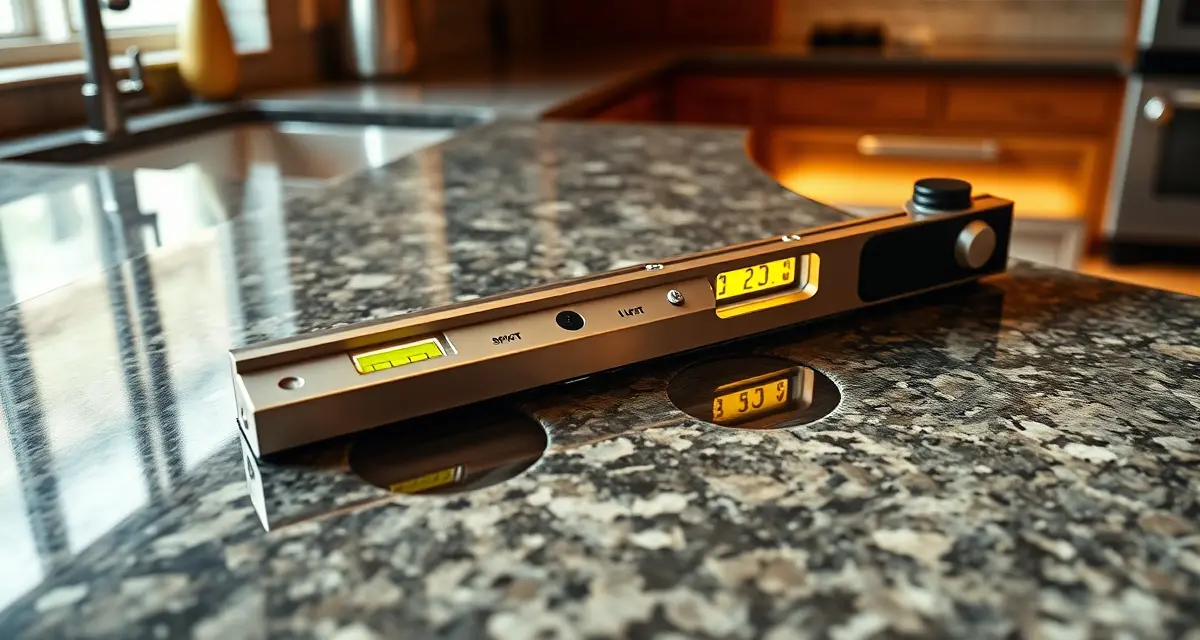
A 4-foot builder's level gives you the most useful reading. Place it in multiple directions:
- Front to back - check at three points along the counter length
- Left to right - check at the front edge and against the wall
- Diagonal - catch twists that front-to-back checks miss
Acceptable Tolerances
Not every countertop needs to be laser-flat. Industry standards from the Marble Institute of America (now the Natural Stone Institute) allow:
- 1/16 inch over 10 feet for a tight tolerance installation
- 1/8 inch over 10 feet for standard residential work
- Anything over 1/4 inch is a defect that needs correction
Fixing a Countertop That's Not Level
Option 1: Shimming (Minor Issues)
For level problems under 1/8 inch, shimming is the most practical fix. The installer places composite or plastic shims between the cabinet top and the countertop underside, then re-applies adhesive.
Cost: $100-$300 Time: 1-2 hours Disruption: Minimal - plumbing usually stays connected
Option 2: Cabinet Adjustment (Moderate Issues)
When cabinets themselves are the problem, they need to be re-leveled before the counter can sit properly. This involves loosening the cabinets from the wall, shimming the bases, and re-securing everything.
Cost: $300-$800 Time: 3-6 hours Disruption: Moderate - counter must be lifted off
Option 3: Counter Re-Installation (Severe Issues)
If the countertop has already been cut to fit an out-of-level condition, or if it's cracked from stress, you're looking at a remake. A new template, new fabrication, and new installation.
Cost: $1,500-$4,000+ depending on material Time: 2-4 weeks Disruption: Major - no countertops during fabrication
Option 4: Scribing and Caulking (Cosmetic Fix)
For small backsplash gaps caused by level issues, a skilled installer can scribe the backsplash piece to match the wall contour and fill remaining gaps with color-matched caulk.
Cost: $150-$400 Time: 1-3 hours Disruption: Minimal
How Level Problems Affect Different Countertop Materials
Not all materials respond the same way to an uneven base.
| Material | Flexibility | Risk if Not Level | Typical Response |
|---|---|---|---|
| Granite (3cm) | None | Stress fractures, especially around cutouts | Cracks near sink or cooktop |
| Quartz (3cm) | Very slight | Voided warranty from some manufacturers | May bow slightly, then crack |
| Marble (2cm) | None | Extremely crack-prone | Breaks at thinnest points |
| Quartzite (3cm) | None | Similar to granite | Fractures under sustained stress |
| Laminate | Moderate | Follows substrate shape | Bubbling at edges |
| Butcher block | Some | Warping, joint separation | Gaps open between boards |
Granite and quartz slabs weighing 15-20 pounds per square foot put enormous downward force on high spots. A 30-square-foot granite countertop weighs roughly 500 pounds. If that weight sits on two high points with a gap in the middle, the stone is essentially a bridge under constant stress.
Prevention: Catching Level Issues Before They Become Expensive
At the Cabinet Stage
The general contractor or cabinet installer should verify level across all cabinet runs before the countertop fabricator arrives. A simple checklist:
- All cabinet tops within 1/8" of level across the full run
- Walls checked for plumb where backsplash will meet
- Corner cabinets checked for twist
- Peninsula and island cabinets verified independently
At the Template Stage
This is where digital templating shines. A laser templating system measures not just the countertop outline but also the cabinet surface elevation at dozens of points. If the cabinets are out of level, the templator flags it immediately - before any stone gets cut.
Traditional stick templating (cardboard and hot glue) captures the outline but tells you nothing about level. A digital template with elevation data prevents the most expensive mistakes.
At the Installation Stage
Even with perfect templates, installers should dry-fit the countertop before applying adhesive. Set the slab down, check level in multiple directions, identify any rocking points, and shim before committing.
What Fabricators Should Know About Level Callbacks
Level-related callbacks are among the most expensive in the countertop business. A typical callback for a level issue costs:
- $200-$500 for a shim-and-adjust visit
- $1,500-$4,000 for a full remake if the slab cracked
- Lost reputation - one bad Google review about a "crooked countertop" costs more than any single job
Fabrication shops processing 20-40 jobs per month can expect 2-4 level-related issues unless they have a systematic checking process. That's $400-$16,000 in monthly exposure.
Digital workflow tools that flag level problems at the template stage - before a $2,000 slab gets cut - pay for themselves within the first prevented remake.
FAQ
How much does it cost to level a countertop?
Simple shimming runs $100-$300. Cabinet re-leveling costs $300-$800. A full countertop remake due to cracking from level stress runs $1,500-$4,000 or more depending on the material.
Will an unlevel countertop crack?
Yes, over time. Stone countertops (granite, quartz, marble, quartzite) don't flex. If they're bridging a gap over an uneven base, sustained stress will eventually cause a fracture - usually at the weakest point near a sink or cooktop cutout.
Can you fix a level problem without removing the countertop?
Minor issues (under 1/8") can sometimes be addressed by injecting adhesive or adding shims at accessible points. Anything more severe typically requires lifting the slab.
Who is responsible for an unlevel countertop - the cabinet installer or the fabricator?
It depends on the contract. Generally, the fabricator is responsible for checking cabinet level before templating and flagging any issues. If they template over uneven cabinets without noting the problem, they share liability.
How do I know if my cabinets are level enough for stone countertops?
Use a 4-foot level across all cabinet runs. Acceptable tolerance is 1/8" over 10 feet for standard residential work. If you find more variance than that, have the cabinet installer correct it before the template appointment.
Does quartz crack more easily than granite on uneven cabinets?
Quartz is slightly more flexible than granite, but this isn't enough to prevent cracking on significantly uneven surfaces. Both materials require level support. Some quartz manufacturers will void the warranty if the cabinets aren't within spec.
Can self-leveling compound fix countertop level issues?
Self-leveling compound is for floors, not countertops. The proper fix for uneven cabinets is shimming, re-leveling, or replacing problem cabinet sections.
How often do fabricators deal with level issues?
In a shop doing 20-40 installs per month, level-related callbacks occur 2-4 times monthly on average. Shops that use digital templating with elevation mapping see significantly fewer issues because problems get caught before fabrication.
Should the countertop be perfectly level or can it have a slight pitch?
Outdoor countertops and bar tops sometimes get a slight pitch for drainage. Indoor kitchen countertops should be level within 1/8" over 10 feet. Perfectly flat isn't realistic, but pooling water is unacceptable.
What tools do installers use to check countertop level?
A 4-foot builder's level is standard. Some installers use digital levels for faster readings. Laser templating systems can map elevation across the entire cabinet surface during the template visit.
Can an unlevel countertop cause plumbing problems?
Yes. If the countertop pitches toward the wall, water can pool behind the faucet and seep into cabinet interiors. If it pitches forward, water runs off the edge onto the floor.
Will caulk fix the gap from an unlevel countertop?
Caulk can fill small backsplash gaps (under 1/8"). Larger gaps look terrible with caulk alone. A scribed backsplash piece plus color-matched caulk handles gaps up to 1/4". Beyond that, the base issue needs correction.
Get Accurate Templates That Catch Level Issues Early
Level problems are preventable when you catch them at the template stage. SlabWise's Template Verification uses a 3-layer checking system that flags elevation inconsistencies before your shop cuts a single slab - saving $1,500-$4,000 per avoided remake.
[Start Your 14-Day Free Trial →]
Try These Free Tools
- Photo to Template -- Snap a photo of an existing countertop and get an AI-generated DXF template.
- Template Compare -- Upload two templates and see every dimension change highlighted instantly.
- AI Template Verification -- Cross-check your template against manufacturer specs before cutting.
Sources & Further Reading
- Natural Stone Institute - Countertop Support Guidelines
- International Surface Fabricators Association - Structural Support Requirements
- National Kitchen & Bath Association - Countertop Installation Standards
- ASTM International - C1526 Standard Specification for Serpentine Dimension Stone